
By now, you might’ve already seen that EV sales in Europe broke records again in 2025. A total of 2 585 187 battery electric vehicles were sold in Europe in 2025, growing by a strong 29,7% in the full year of 2025.
Nearly every 5th car sold in Europe is fully electric today.
Considering this, one would expect that finding the info on fast charging prices, to compare every single operator you could possibly charge with in your country, would certainly be easy nowadays, right? How much does fast charging cost across Europe?
Well, as a charging operator ourselves, we found that finding DC fast charging prices for all charging networks at once in any country is… not that easy after all. It can be kind of a black box, really. There’s a rare comparison site here and there for a single country, but nothing across markets you could fully trust.
So we went out and built one. For all of Europe.
This overview is a tool that should help you quickly find the full picture of all DC fast charging networks present in any European country, and where their €/kWh prices fall compared to the competition.
In this overview, we’ll first take a look at the across-Europe comparison of fast charging prices to see how countries themselves compare, and then we will look closer into each market and see the inner CPO comparison in a leaderboard format. If you want to jump into just your country, then just click through the table of contents.
Public EV charging cost across Europe for fast charging
EV drivers in different parts of Europe can end up seeing very different conditions once they go and try to charge their EVs in the fast charging networks.
When looking at the prices, the median price of every kWh charged can be more than double, depending on which European country you’re in.
Here is how the fast charging prices compare across Europe:
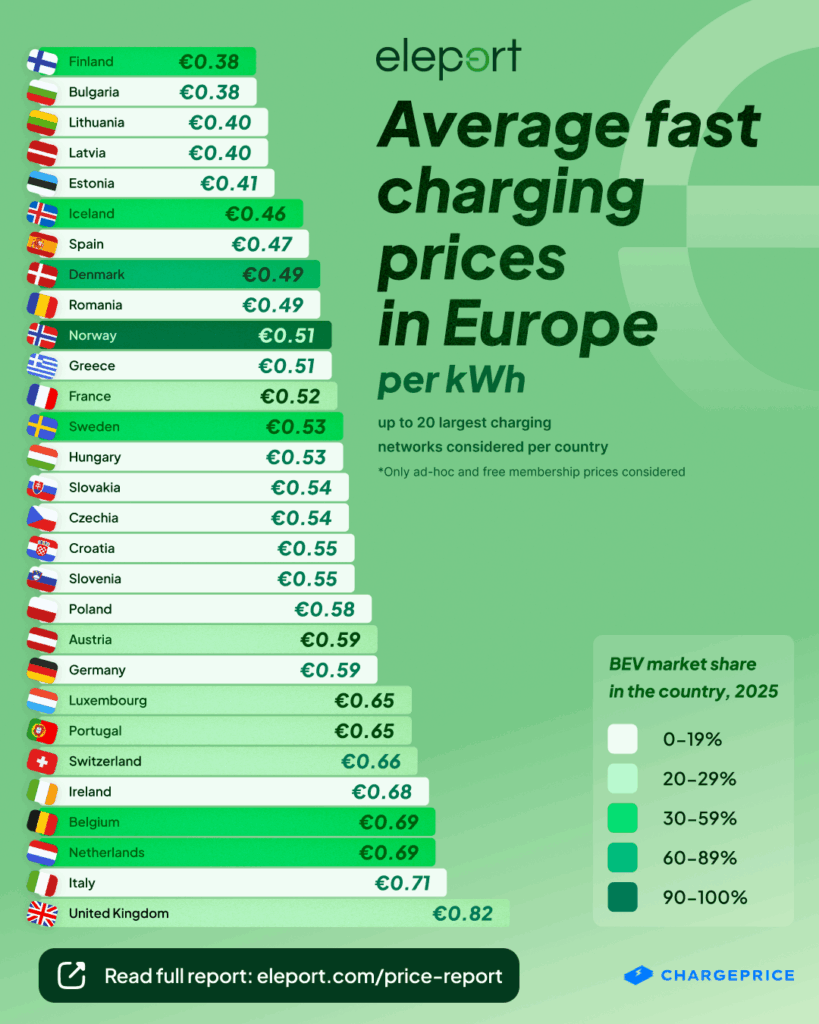
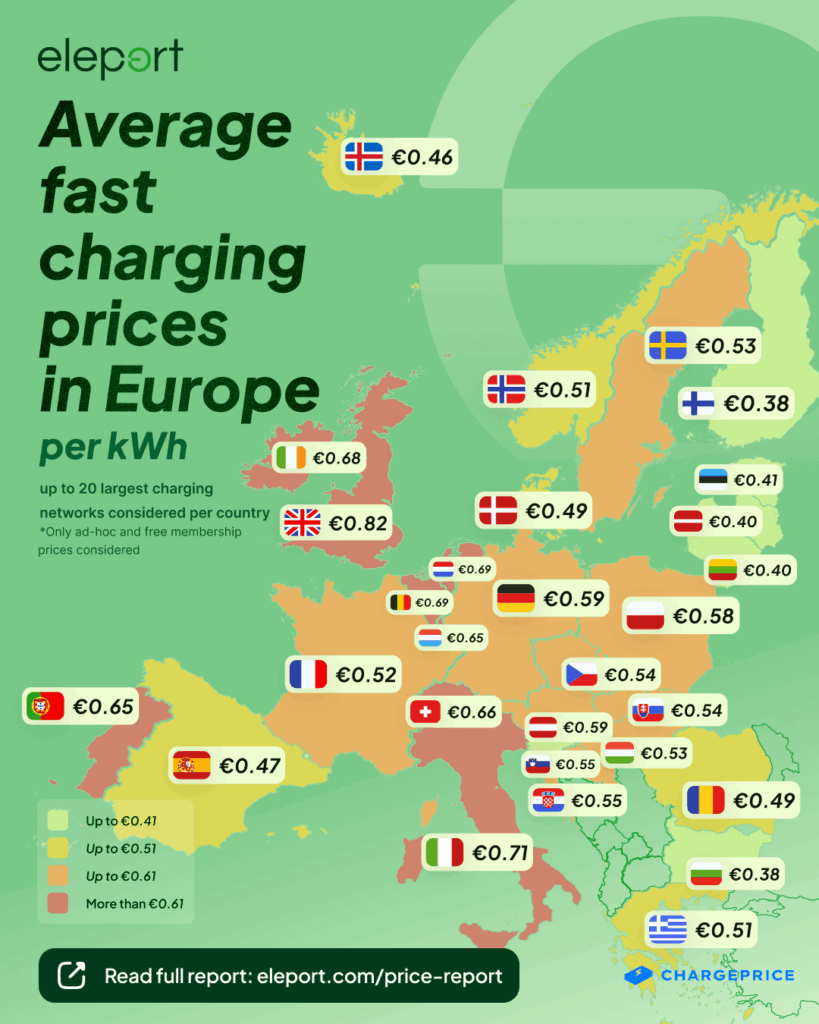
As we can see, Finland, with 0.38 €/kWh, takes the win in Europe for the lowest median price for fast charging. Bulgaria ties for the same price, and the Baltics follow with 0.40 €/kWh to 0.41 €/kWh for the top five.
The median out of those country medians, so the real average price you could expect for a fast charge in Europe, would be at 0.54 €/kWh, which you’ll see Slovakia and Czechia have landed on exactly.
On the other end of the pricing range, we’ll find the UK at the absolute highest, averaging 0.82 €/kWh for the median fast charge, measured across the 24 largest Charge Point Operators (CPOs) in the country. This is 2.15 times higher than what Finland averages, and 1.5x the European average. The second-worst price comes in from Italy at 0.71 €/kWh, then the Netherlands and Belgium at 0.69 €/kWh.
That brings in an interesting point. Are the fast charging prices actually indicative of how well the EV adoption is doing in any of the countries? Let’s observe – we’ve added the market share categories as colors to the infographic above.
The top five countries in EV adoption in Europe – Norway (95.9% BEV market share), Denmark (68.5%), Iceland (41.2%), the Netherlands (40.2%), and Finland (37.2%) are spread across the pricing ranking, but generally in the top half.
Norway is there, slightly below the European average, in 11th place. Denmark is close, in 9th out of 29 countries, Iceland is even better at 6th, and Finland took the lead.
The outlier here is the Netherlands at 27th place, but here the market specifics come into play – the Dutch people have the by far widest network of public AC chargers at their disposal, which likely reduces the pressure on CPO fast charging competition. However, the EV shares of Belgium (34.7%) and the UK (23.4%) are also notable, even though their fast charging prices are significantly high as well.
Looking at the other end of the EV market adoption, interestingly, the cheaper DC fast charging pricing doesn’t seem to automatically suggest that the countries are doing well in EV adoption, with the Eastern European countries in the top five for the cheapest average charging price – Bulgaria, Lithuania, Latvia, and Estonia all have under 10% EV market share.
It seems reasonable to suggest that the lower purchasing power of the people is a strong factor here, and for a complete picture, we should also compare it with the fossil fuel prices in the countries. The conclusion to draw here is likely that cheaper fast charging prices do not necessarily produce fuel for EV adoption, and vice versa – higher than average fast charging prices also don’t seem to hinder EV adoption.
With our analysis of these 29 European countries, we found more trends that otherwise would not be easily visible. Here are 6 patterns we have discovered.
Key Takeaways from our Europe fast charging overview
Grocery retailers are among Europe’s cheapest charging operators. In nearly every market, a supermarket chain is among the top three cheapest: Lidl (active in 15+ countries), ALDI (DE/AT), Kaufland (DE/CZ/HR/PL), Migros (CH), K-Lataus/Kesko (FI), Continente (PT), Tommy (HR). This might be due to these operators subsidizing charging to drive foot traffic, but also the reality of easier charging rollout for them – they have the land within their existing parking lots and likely have enough grid connection to play with, the two constraints all CPOs have to deal with.
IONITY’s pricing logic is clear across the countries: while it ranks in the bottom half in all countries except Norway, its higher tier (Power) subscription (typically €11.99/mo) is significantly lower, making it actually among the cheapest high-powered charging options instead. For anyone charging enough to offset the plan cost, that is. For those who charge less, the Motion tier that sits in the middle for pricing and the membership fee might solve it.
What you’ll see with these large cross-European CPOs is that they price on each of these markets differently, and IONITY has one of the widest spreads in pricing: in Finland, IONITY prices at 0.42€ ad-hoc and 0.24€/kWh for the €11.99 plan, yet in the UK, the prices are 81p (0.93€) and 46p (0.53€) respectively.
More competition doesn’t automatically mean cheaper fast charging prices. Although we brought out the 20 to 30 largest DC fast charging operators per country in this overview, we started it from analysing around 300 CPOs when countries had that many.
For example, while Germany has a lot of CPOs, as it is also the largest country in Europe in terms of EV unit sales as well, these 200+ connector CPOs ended up forming a 0.59€ median fast charging price, which is in 21st place out of 29 in the ranking by the lowest median price across Europe. The UK, also a heavily saturated market in terms of CPOs and the second-largest in EV unit sales in Europe, is the most expensive market.
Only 35% of the top CPOs offer any membership/subscription. And this is dominated by the cross-Europe players like Tesla, IONITY, Fastned, and Electra. Two-thirds of all CPO entries we have gathered have no membership tier at all. For most smaller or regional CPOs, it’s pay-as-you-go through ad-hoc or a free app only.
Tesla Supercharging cost positioning varies, but it starts at the lowest price in more than half of the countries! It is the cheapest CPO, if looking at the off-peak tariff that starts its dynamic pricing range, in 18 countries out of 29 analyzed (Netherlands, Romania, France, Iceland, Finland (matches Lidl), Norway, Greece, Croatia, Czechia, Belgium, UK, Ireland, Luxembourg, Portugal, Slovenia, Switzerland, Germany, and Poland).
However, Tesla varies its prices both per hour and per location within any country (except a few countries with fixed prices). Tesla’s supercharging membership, which costs mostly for €11.99/month, makes these dynamic prices even cheaper. A good example is Finland, the already cheapest average fast charging market – in the free app tier it ties with Lidl for 0.29€ with the off-peak tariff (while Lidl wins in the 24/7), but the subscription takes that off-peak tariff even down to 0.21€/kWh.
Utility cross-selling is the emerging bundling play. “Charge cheaper if you buy our household electricity” appears in certain countries, driven by utility players. This is especially visible in the Baltics (often 10% off or other incentives), in Iceland (“loyalty tariffs” offered), and Sweden.
This vertical integration gives utility-CPOs a moat that pure-play operators can’t easily replicate. Another bundling play from certain energy providers even allows for the “use home electricity price when charging at public chargers” with certain lock-in contracts.
Eleport positions itself as a mid-priced yet premium service, without the drivers needing to watch out for dynamic tariffs. We focus on building DC hubs in convenient locations.
Join our newsletter
No fluff, no spam.
Methodology
Before we kick off the country-level overviews, here’s the important bit about our methodology:
Showing only DC prices, this is our unique overview based on publicly available data and subject to changes.
This research is commissioned by Eleport, put together with the EVwire.com team, with the help of the charging price platform Chargeprice.net. Some country-specific comparison tools used are noted in the relevant country sections.
Notes on the prices shown per CPO:
All ≥50kWh DC power tiers are banded into price ranges in the same cells. Any dynamic pricing is also shown in that price range. The tables are sorted for the best non-commitment price (ad-hoc and free app prices).
For the Tesla Supercharging price, at least three different locations in each country have been observed to ensure a larger sample of the data.
Disclaimer: Eleport is not responsible for any mismatch in data, given the changing nature of market prices, and given only publicly available data has been used. Nearly all of the prices published in this report are sourced and fresh as of February 2026. We are happy to update the details if needed and proven. If you find any mismatch, please reach out at hello@eleport.com
Now let’s take a closer look at the different 2026 EV charging prices compared for Europe, per each country.
Fast Charging Price Comparison in Finland for 2026
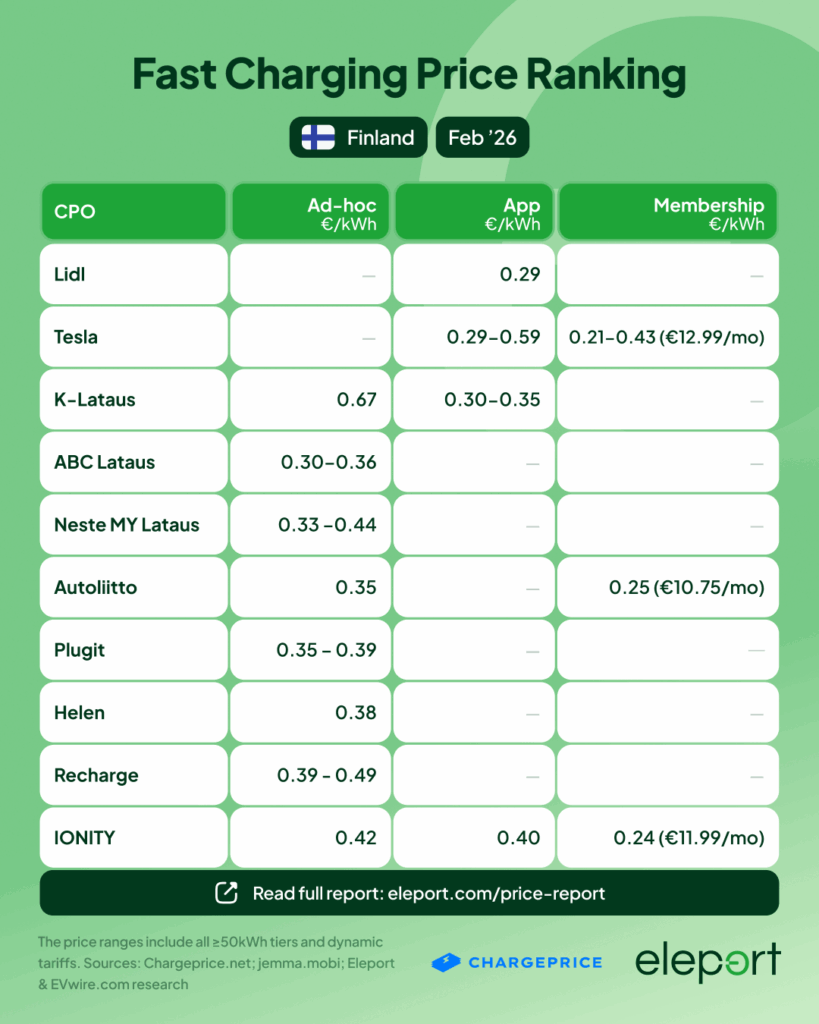
The average (median) fast charging price in Finland is the cheapest in all of Europe, at €0.38 per kWh.
26 745 EVs were sold in Finland in 2025, growing +22,3% year-over-year.
The EV market share rose from 29,5% to 37,2%.
Finland is among Europe’s most dynamic DC markets, with multiple operators linking prices to spot electricity, creating price swings that can double overnight in extreme grid conditions. On the flip side, this brings some very cheap pricing to everyday use as well, with Lidl 0.29€/kWh as the cheapest and Tesla achieving that in the off-peak hours, while going even down to 0.21€/kWh on the membership plan.
To compare, that rate is cheaper than the actual EU average electricity price of €0.2872 per kWh… at home!
In determining fast charging prices in Finland, the local jemma.mobi site provided an useful initial overview.
| CPO | Ad-hoc €/kWh | App €/kWh | Membership €/kWh |
| Lidl | — | €0.29 | — |
| Tesla | €0.29-€0.59 | €0.21-€0.43, €12.99/mo | |
| K-Lataus | €0.67 | €0.30-€0.35 | — |
| ABC Lataus | €0.30–€0.36 | — | — |
| Neste MY Lataus | €0.33–€0.44 | — | — |
| Autoliitto | €0.35 | — | €0.25 (€10.75/mo) |
| Plugit | €0.35–€0.39 | — | — |
| Helen | €0.38 | — | — |
| Recharge | €0.39-€0.49 | — | |
| IONITY | €0.42 | €0.40 | €0.24, €11.99/mo |
Fast Charging Price Comparison in Bulgaria for 2026
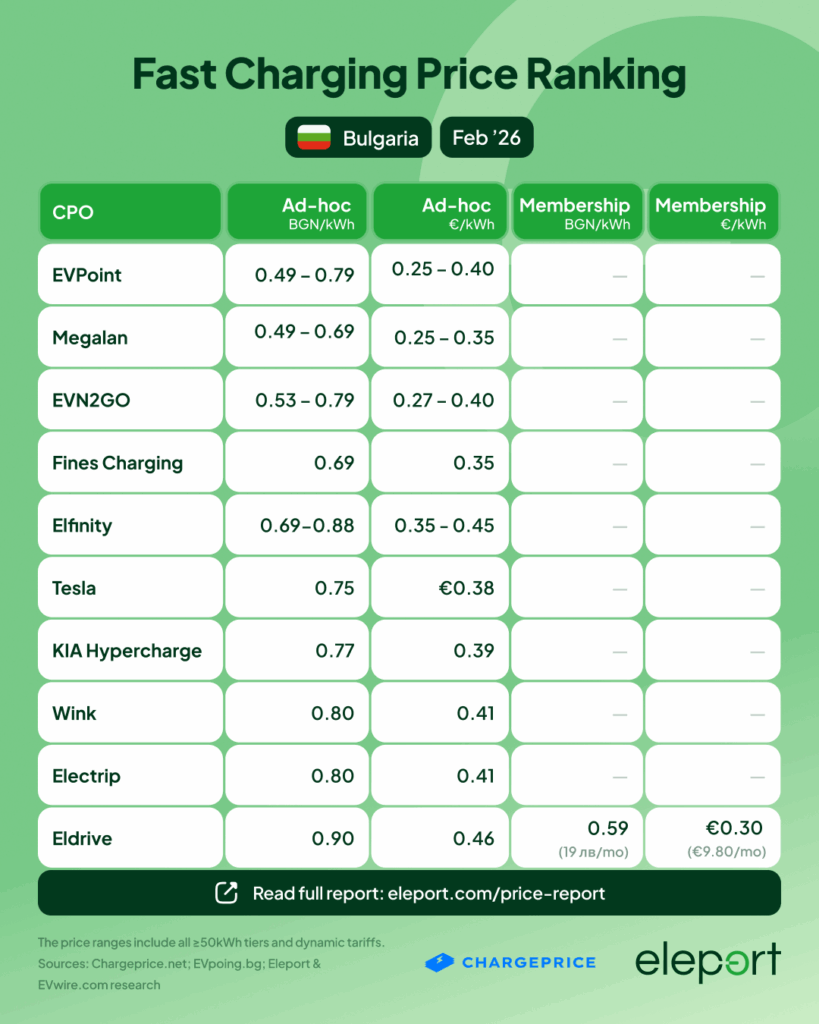
The median fast charging price in Bulgaria is €0.38 per kWh (~0.74 lev).
2 420 EVs were sold in Bulgaria in 2025, growing +62,0% year-over-year.
The EV market share rose from 3,5% to 4,9%.
Note: Since Bulgaria has now adopted the Euro as currency from 1st of January 2026, which is why for the transition period we will also show prices in both lev and euro.
Bulgaria matched Finland in the median public EV charging cost, and may actually offer the cheapest DC fast charging in all of Europe if viewing it this way: EVPoint and Megalan start at just 0.49 lev/kWh (€0.25/kWh) in a country where home electricity costs ~0.28 lev per kWh (~0.14€/kWh). So public DC fast charging is barely 1.75x the home rate, compared to a normal of 2.5 to 3x in Western Europe.
Additional source we’ve used to put Bulgarian fast charging prices together: the EVPoint.bg site.
| CPO | Ad-hoc BGN/kWh | Ad-hoc €/kWh | Membership BGN/kWh, €/kWh |
| EVPoint | 0.49–0.79 | €0.25–€0.40 | — |
| Megalan | 0.49–0.69 | €0.25–€0.35 | — |
| EVN2GO | 0.53–0.79 | €0.27–€0.40 | — |
| Fines Charging | 0.69 | €0.35 | — |
| Elfinity | 0.69-0.88 | €0.35-0.45 | — |
| Tesla Supercharger | 0.75 | €0.38 | — |
| KIA Hypercharge | 0.77 | €0.39 | — |
| Wink | 0.80 | €0.41 | — |
| Electrip | 0.80 | €0.41 | — |
| Eldrive | 0.90 | €0.46 | 0.59 (19 lev/mo), €0.30 (9.8€/mo) |
Fast Charging Price Comparison in Lithuania for 2026

The average (median) fast charging price in Lithuania is €0.40 per kWh.
3 150 EVs were sold in Lithuania in 2025, growing +77,1% year-over-year.
The EV market share rose from 5,9% to 7,5%.
Lithuania is perhaps the most contested Baltic market, even if all three average at nearly the same kWh price. All three major Baltic utilities compete head-to-head here:
- Ignitis ON (home team in Lithuania, 98% coverage),
- Enefit VOLT (Estonian), and
- Elektrum Drive (Latvian, cheapest due to dynamic tariff)
Even though Lidl is often among the cheapest offers in most markets, in Lithuania Lidl chargers charge a 43–79% markup over Elektrum’s own-brand pricing, showing how site partnerships can dramatically inflate prices.
Meanwhile, the independent charging network available across CEE, Eleport, is testing competitive non-dynamic tariffs of €0.29/kWh – €0.36/kWh depending on the location.
| CPO | Ad-hoc €/kWh | App €/kWh | Membership €/kWh |
| Elektrum Drive | — | 0.26–0.33 | −10% for customers |
| Eleport | 0.29-36 | 0.29-36 | — |
| Neste | 0.39 | 0.29–0.39 | — |
| Ignitis ON | — | 0.32–0.42 | — |
| Enefit VOLT | — | 0.35–0.49 | −10% for customers |
| Eldrive | — | 0.45 | 0.31 (€11.90/mo) |
| Lidl (Elektrum) | — | 0.471 | — |
| IONITY | 0.52 | 0.50 | 0.30 (€11.99/mo) |
Fast Charging Price Comparison in Latvia for 2026

The average (median) public EV charging cost at fast chargers in Latvia is €0.40 per kWh.
1 602 EVs were sold in 2025, growing +27,3% year-over-year.
The EV market share fell from 7,3% to 7,1%.
Latvia’s Virši fuel chain offers the most granular power-tiered DC pricing we have found in Europe: six tiers that are incrementally based on the power offered, from €0.28 (40kW) to €0.42 (320–400kW). To compare, most CPOs use two or three tiers, and some just settle with a single one.
Eleport is priced just below the median in Latvia, at 0.39€/kWh for most locations, with few exceptions at 0.44€/kWh.
The legacy e-mobi/CSDD network still charges per minute (€0.23/min) rather than per kWh — a relic where the price is especially dependent on how much your vehicle can pull. Nowadays, the e-mobi stations, as many others in Latvia, can be activated with the Mobilly app.
IONITY seems to have not taken a look at most of the competition pricing in Latvia for a while, since it is currently at nearly double the kWh price from the next spot with its 0.71€/kWh price. Even the 0.42€/kWh membership pricing at €11.99 per month doesn’t bring it a better ranking in the leaderboard this time.
| CPO | Ad-hoc €/kWh | App €/kWh | Membership €/kWh |
| Virši | 0.28–0.42 | 0.28–0.42 | — |
| Elektrum Drive | — | 0.28–0.46 | −10% for customers |
| Neste | 0.39 | 0.29–0.39 | — |
| Ignitis ON | 0.33–0.39 | 0.33-0.39 | — |
| Enefit VOLT | — | 0.36–0.47 | -10% for customers |
| Eleport | 0.39-44 | 0.39-44 | — |
| IONITY | 0.74 | 0.71 | 0.42 (€11.99/mo) |
| e-mobi / CSDD | — | 0.23 €/min | — |
Fast Charging Price Comparison in Estonia for 2026

The average (median) fast charging price in Estonia is €0.41 per kWh.
868 EVs were sold in Estonia in 2025, declining -34,2% year-over-year.
The EV market share rose from 5,2% to 6,6%.
Estonia, once the world’s first country with a nationwide EV charging network (2013, state-built) has evolved into a competitive private market with a distinctive Baltic flavor – the DC charging network is very thoroughly built out, even leading to some small towns seeing as many DC ports as there are actual EVs on its roads.
Neste’s nighttime charging price of 0.29€/kWh, which is valid across all three Baltic states, comes in as cheapest for Estonians, while Eleport offers the next most competitive price without the time of day changes, starting from 0.32 €/kWh for the 50kW chargers, with 0.42€/kWh for most up-to-400 kWh ultra-fast chargers and a few exceptions at 0.46€/kWh.
The other Baltic signature is utility cross-selling: Enefit gives 10% off for its electricity customers, Elektrum Drive 10% does the same. Others that offer electricity contracts for home users are even offering versions of ‘take your home electricity price on the road’ type of deals. Basically, in Estonia and also in Baltics, your choice of home electricity provider can now directly affect your public EV charging cost.
| CPO | Ad-hoc €/kWh | App €/kWh | Membership €/kWh |
| Neste | 0.39 | 0.29–0.39 | — |
| Eleport | 0.32–0.46 | 0.32–0.46 | — |
| Elektrum Drive | — | 0.32–0.47 | -10% for customers |
| Ignitis ON | 0.35–0.39 | 0.35–0.39 | — |
| Enefit VOLT | 0.42–0.54 | 0.33–0.50 | -10% for customers |
| eTerminal | 0.35-0.41 | 0.35-0.41 | 0.32-0.38 (for customers) |
| Alexela | — | 0.37–0.49 | — |
| Circle K | 0.48 | 0.48 | — |
| IONITY | 0.58 | 0.55 | |
| Tesla | — | 0.56 | 0.40 (12.99€/mo) |
Fast Charging Price Comparison in Iceland for 2026
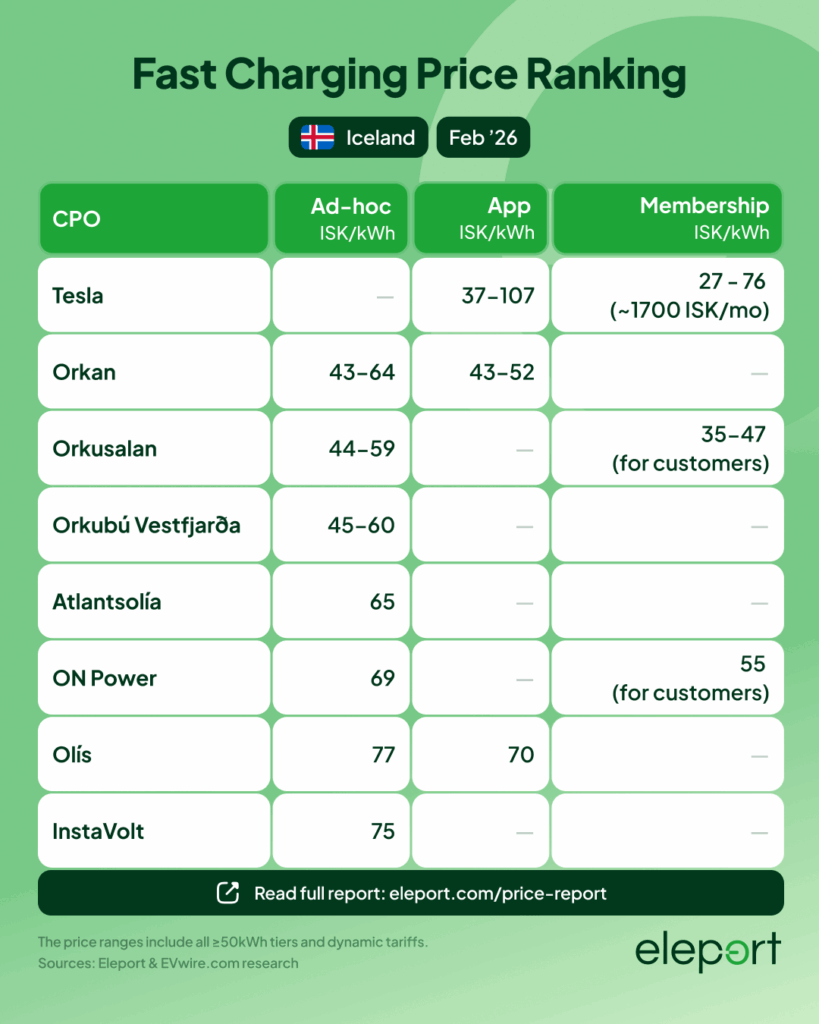
The median public EV charging cost for fast chargers in Iceland is €0.46 per kWh.
5 988 EVs were sold in Iceland 2025, growing +125,0% year-over-year.
The EV market share rose from 26,0% to 41,2%.
Iceland’s DC charging market offers quite a few unique situations, but the market is clearly going fully electric.
Tesla Supercharging cost of off-peak pricing at 37 ISK beats all, as we’ll see in a lot of European countries below, but the high side of the dynamic range in Iceland also goes to 107 ISK, which is significantly more than any player in the market. The next cheapest would perhaps surprise you. Despite 41% of all new cars sold being fully electric, the next cheapest charging comes… from gas station operators. Particularly, it’s Orkan at 43 ISK/kWh (~€0.30), and not the national utility ON Power.
Per-station pricing is the norm: Orkan ranges 43–64 ISK depending on location. The “loyalty discount” model here is that both ON Power and Orkusalan tie discounted DC rates to household electricity contracts, much like we saw in the Baltics, rather than charging subscriptions.
InstaVolt (UK-based) is the only international entrant besides Tesla, with a flat 75 ISK tap-and-go model that’s simple but has the highest fast charging price in the country.
| CPO | Ad-hoc ISK/kWh | App ISK/kWh | Membership ISK/kWh |
| Tesla | 37-107 | 27-76 (~1700 ISK/mo) | |
| Orkan | 43–64 | 43–52 | — |
| Orkusalan | 44-59 | — | 35-47 (for customers) |
| Orkubú Vestfjarða | 45–60 | — | — |
| Atlantsolía | 65 | — | — |
| ON Power | 69 | — | 55 (for customers) |
| Olís (Ísorka) | 77 | 70 | — |
| InstaVolt | 75 | — | — |
Fast Charging Price Comparison in Spain

The average (median) fast charging price in Spain is €0.47 per kWh.
101 627 EVs were sold in Spain in 2025, growing +77,1% year-over-year.
The EV market share rose from 5,6% to 8,8%.
Spain’s DC market is defined by strong subscription competition and time-of-use pricing. Endesa X Way (nearly 3,000 connectors) and Acciona charge just €0.25/kWh at night for sub-100kW, which would be competitive with home charging. Endesa’s e-Smart Plus subscription drops night HPC to €0.125/kWh for a €13.89/month membership — effectively offering the cheapest DC charging in all of Europe.
Fuel companies dominate infrastructure: Repsol, Moeve/CEPSA, and the Iberdrola/bp pulse joint venture. The gap between ad-hoc and subscription pricing (40–60%) is among the widest in Europe, and 11 out of 19 larger CPOs we’ve gathered for this analysis had a paid membership tier. This competition is only set to increase, as Spain was one of the highest EV growth markets in Europe last year.
| CPO | Ad-hoc €/kWh | App €/kWh | Membership €/kWh |
| Acciona | €0.25-€0.43 | — | — |
| Endesa X Way | 0.25-0.35 | — | €0.125-€0.175 (€13.89/mo) |
| Tesla | — | €0.28–€0.57 | €0.20–€0.45 (€11.99/mo) |
| Repsol | €0.29-€0.446 | — | €0.363 (€36.30/mo) |
| EMT Madrid | €0.35–€0.40 | — | — |
| Allego | €0.399-€0.550 | — | — |
| Eranovum | €0.40-€0.49 | — | — |
| Wenea | €0.42-€0.59 | — | — |
| Electra | €0.54 | €0.44 | 0.29 (€9.99/mo) |
| Fastned | €0.59 | €0.531 (-10%) | €0.41 (€11.99/mo) |
| Zunder | €0.45-€0.55 | — | 0.4 (€9.99/mo) |
| EDP | — | €0.45 | — |
| bp pulse | Iberdrola | €0.45-€0.49 | — | €0.37 (€14.95/mo) |
| PowerDot | €0.53 | — | — |
| Atlante | €0.53 | — | €0.29 (€9.99/mo) |
| TotalEnergies | €0.58 | — | — |
| Porsche | €0.59 | — | €0.39 (€16.99/mo) |
| Moeve (ex-CEPSA) | €0.60 | — | 0.45 (€9/mo) |
| IONITY | €0.65 | €0.62 | €0.37 (€11.99/mo) |
Fast Charging Price Comparison in Denmark

The average (median) fast charging price in Denmark is €0.49 per kWh.
126 542 EVs were sold in Denmark in 2025, growing +42,0% year-over-year.
The EV market share rose from 51,5% to 68,5%.
Denmark’s EV revolution is in full swing, with the country on an even faster EV transition curve than what we saw in Norway.
Denmark’s DC fast charging market is uniquely situated too: six of 21 CPOs now use dynamic or spot-linked pricing — more than any other country we’ve observed.
Tesla charging cost is again the lowest possible fast charging price in Denmark with its off-peak 1.80 DKK/kWh (€0.24 /kWh) which is further reduced to 1.2 DKK/kWh (0.16 €/kWh) with its monthly membership. NRGi, Circle K and EV-EL follow in the < 3 DKK range, while the peak pricing we’ve seen can get to 5.49 DKK (0.73€) per kWh.
The other Danish distinction is a rich ecosystem of free loyalty discounts: OK (-10%), Norlys (-20%), Uno-X (-0.10 kr), Shell (-0.15 kr), Circle K (-0.10 kr), EWII (-10%). Denmark also saw the 2026 electricity tax reform (the “elafgiftsrefusion” eliminated Jan 1), simplifying home charging and pressuring public DC prices, leading to several CPOs raising rates in the past few months.
Six operators each have 600+ DC points (Clever, Norlys, Tesla, Circle K, E.ON, OK), making Denmark one of the most competitive markets by infrastructure per capita.
In Denmark, we had a lot of help in pricing data gathering from the FDM.dk & elbiil.dk websites.
| CPO | Ad-hoc DKK/kWh | App DKK/kWh | Membership DKK/kWh |
| Tesla | — | 1.80–5.30 | 1.20-3.80 (85 DKK/mo) |
| NRGi/Zapp | 2.00–4.65 | — | — |
| Circle K | 2.79 | 2.69 | — |
| EV-EL | 2.74–3.54 | — | — |
| Eviny | 3.19 | 3.19 | — |
| OK | 3.69 | 3.23 | — |
| Norlys | 3.29–3.69 | 3.26 | 2.72-3.06 (59 DKK/mo) |
| Uno-X | 3.62 | 3.39 | — |
| Shell/DCC | 3.75 | 3.44 | — |
| PowerGo | 3.45–5.07 | — | — |
| EWII | 3.49–5.39 | 3.49 | — |
| IONITY | 3.86 | 3.67 | 2.20 (90 DKK/mo) |
| EDF | 3.73–5.01 | — | — |
| Recharge | 3.79 | — | — |
| Q8 | 3.79 | — | — |
| Stella | 3.84 | — | — |
| E.ON | 3.95 | — | 3.45 (99 DKK/mo) |
| Clever | 4.49–5.49 | 3.97 | — |
| Allego | 4.30 | — | — |
| TotalEnergies | 4.95 | — | — |
| Fastned | 4.99 | 4.491 (-10%) | 3.49 (89.99 DKK/mo) |
Fast Charging Price Comparison in Romania
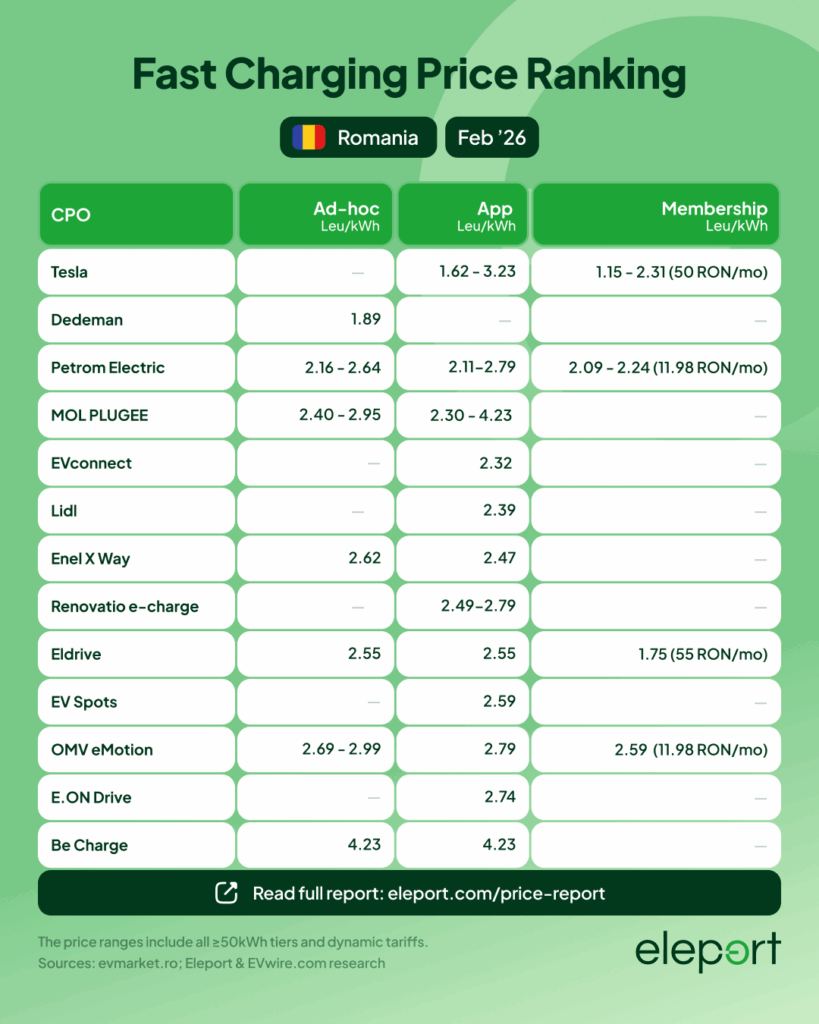
The average (median) fast charging price in Romania is €0.49 per kWh.
8 849 EVs were sold in Romania in 2025, declining by 9,7% year-over-year.
The EV market share fell from 6,5% to 5,6%.
While Tesla charging cost commands Romania’s lowest fast charging price with 1.62 RON / kWh off-peak, and the retail store Dedeman follows at 1.89 RON on the alternative timing – the store hours – the Romanian market is actually overwhelmingly dominated by one group: OMV Petrom.
OMV Petrom controls three separate charging brands — Renovatio e-charge (~1,200+ charging ports and the country’s largest network), Petrom Electric (400+ ports), and OMV eMotion (270+ points at OMV stations). Together, that’s nearly 1,900 charging points from a single corporate group, with each brand running its own app and pricing structure. The second-largest independent player, Eldrive, operates around 1,000 points and sits at the median fast charging price for the whole country, around 2.50 RON.
At the opposite extreme, Be Charge (Enel Group) charges 4.23 RON/kWh, more than double the market average, and the irony is that their chargers often sit at the same Lidl and Kaufland locations where you can charge for 2.39 RON via the Lidl Plus app instead.
Romania also stands out for its DC-heavy infrastructure: about 42% of its public charging points are DC, roughly double the EU average of around 20%, reflecting a market that leapfrogged straight to fast charging rather than building out a dense AC network first.
In Romania, the website evmarket.ro was helpful for us in gathering the pricing data.
| CPO | Ad-hoc Leu/kWh | App Leu/kWh | Membership Leu/kWh |
| Tesla | 1.62-3.23 | 1.15-2.31 (50 RON/mo) | |
| Dedeman | 1.89 | — | — |
| Petrom Electric | 2.16 – 2.64 | 2.11-2.79 | 2.09-2.24 (11.98/mo) |
| MOL PLUGEE | 2.40-2.95 | 2.30-4.23 | — |
| EVconnect | — | 2.32 | — |
| Lidl (Lidl Plus) | — | 2.39 | — |
| Enel X Way | 2.62 | 2.47 | — |
| Renovatio e-charge | — | 2.49 | — |
| Eldrive | 2.55 | 2.55 | 1.75 (55/mo Pro) |
| EV Spots (DC) | — | 2.59 | — |
| OMV eMotion | 2.69-2.99 | 2.79 | 2.29 – 2.59 (11.98/mo) |
| E.ON Drive | — | 2.74 | — |
| Renovatio e-charge | — | 2.79 | — |
| Be Charge | 4.23 | 4.23 | — |
Join our newsletter
No fluff, no spam.
Fast Charging Price Comparison in Norway
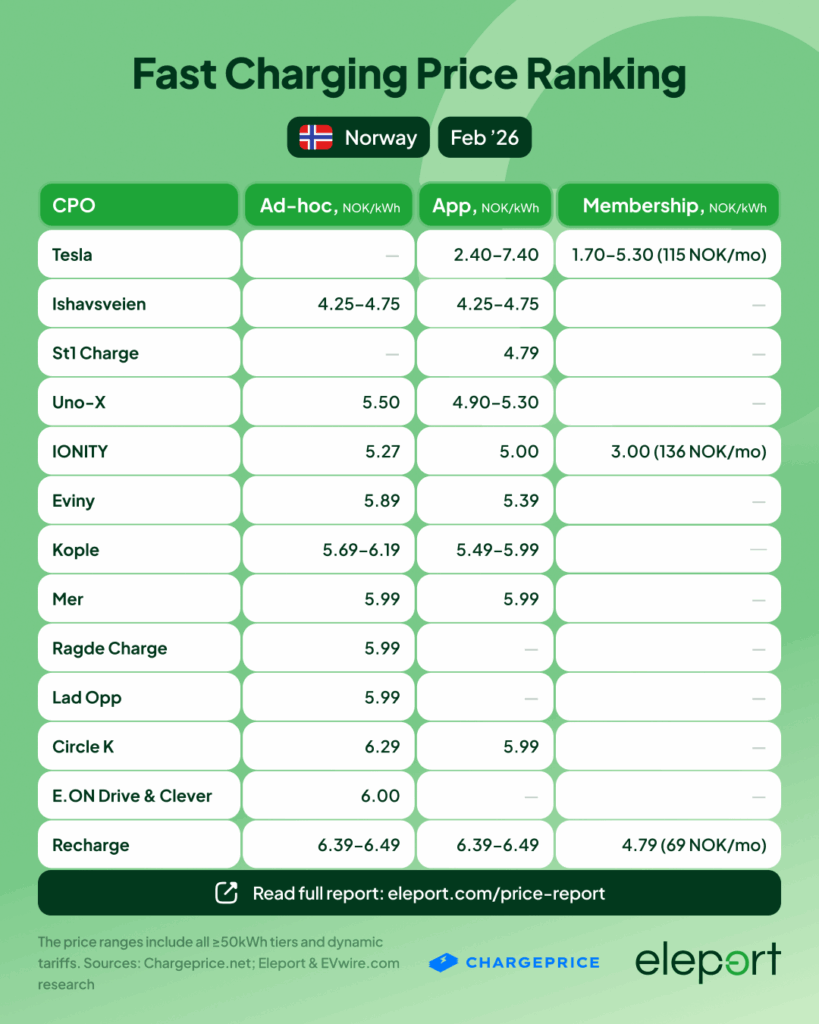
The average (median) fast charging price in Norway: €0.51 per kWh
172 231 EVs were sold in Norway in 2025, growing +50,6% year-over-year.
The EV market share rose from 88,8% to 95,9%.
Now, on to the world’s most mature EV market.
As you can see, the country that has now done it isn’t necessarily with the cheapest fast charging prices out there – it falls just barely below the average €0.54 of European countries we’ve analysed.
In Norway, Tesla charging cost takes the ridiculously cheap side of the fast charging market in the off-peak times with 2.40 NOK/kWh (0.21 €/kWh), with the membership prices dropping further to 1.70 NOK / kWh.
Here, the gap for second place is noticeable with Ishavsveien coming in at nearly double, 4.25 NOK/kWh (0.38 €/kWh), even though it would still be considered cheap. Coincidentally (or not?), Tesla’s dynamic pricing also sets the country’s highest fast charging price, as the 7.40 NOK/kWh (0,66 €/kWh) at peak even trumps the otherwise highest charging price at 6.49 NOK.
Norway’s distinctive feature is the Elbilforeningen “Ladeklubben” — a single RFID chip from the Norwegian EV Association that works across 10+ charging networks, which can even lead to prices below the CPO’s own app. This third-party aggregator undercutting direct pricing is unique in Europe and suggests CPOs value the volume simplicity of a single roaming partner.
| CPO | Ad-hoc NOK/kWh | App NOK/kWh | Membership NOK/kWh |
| Tesla | — | 2.40–7.40 | 1.70–5.30 (115NOK/mo) |
| Ishavsveien | 4.25–4.75 | 4.25–4.75 | — |
| St1 Charge | — | 4.79 | — |
| Uno-X | 5.50 | 4.90–5.30 | — |
| IONITY | 5.27 | 5.00 | 3.00 (136NOK/mo) |
| Eviny | 5.89 | 5.39 | — |
| Kople | 5.69–6.19 | 5.49–5.99 | — |
| Mer | 5.99 | 5.99 | — |
| Ragde Charge | 5.99 | — | — |
| Lad Opp | 5.99 | — | — |
| Circle K | 6.29 | 5.99 | — |
| E.ON Drive & Clever | 6.00 | — | — |
| Recharge | 6.39–6.49 | 6.39–6.49 | 4.79 (69NOK/mo) |
Fast Charging Price Comparison in Greece

The average (median) fast charging price in Greece is €0.51 per kWh.
8 892 EVs were sold in Greece in 2025, growing +2,1% year-over-year.
The EV market share fell from 6,4% to 6,2%.
Greece is an early-stage market and it’s also visible on the count of available DC operators. However, Greece has a significant regulatory tailwind, as the VAT on EV charging was slashed from 24% to 6% in mid-2025, delivering an immediate consumer price drop.
This gives us the Tesla charging cost with dynamic prices starting at 0.32 €/kWh, locals following from 0.43€ and leading up to 0.53€ per kWh for regular and up to 0.67 €/kWh on the higher powered tiers. Tesla tops the locals completing both ends in Greece with 0.83€/kWh for the peak charging rates.
Power-tiered pricing dominates: nearly every Greek operator differentiates sub-150kW from HPC. The regulator RAAEY runs chargingcost.gr, a real-time pricing portal across 693 DC stations — rare government-level price transparency. IONITY has zero operational stations in Greece despite pan-European presence, and the market requires up to 13 different apps with no cross-network roaming — a fragmentation problem that will need solving.
A great resource to compare 2026 EV charging prices in Greece live can be found on the government-built chargingcost.gr.
| CPO | Ad-hoc €/kWh | App €/kWh | Membership €/kWh |
| Tesla | 0.32-0.83 | 0.23-0.59 (€11.99/mo) | |
| Chargespot | 0.47–0.56 | 0.43–0.53 | — |
| EcoCharge | — | 0.45–0.49 | — |
| nrg incharge | 0.57–0.67 | 0.45–0.55 | ~0.45 (€25/year) |
| EVloader | — | 0.45–0.60 | — |
| Electrip | 0.48–0.54 | — | — |
| ElpeFuture | 0.55 | 0.50 | — |
| DEI blue | 0.57–0.64 | 0.52–0.59 | — |
| Joltie | 0.53 | 0.53 | — |
Fast Charging Price Comparison in France
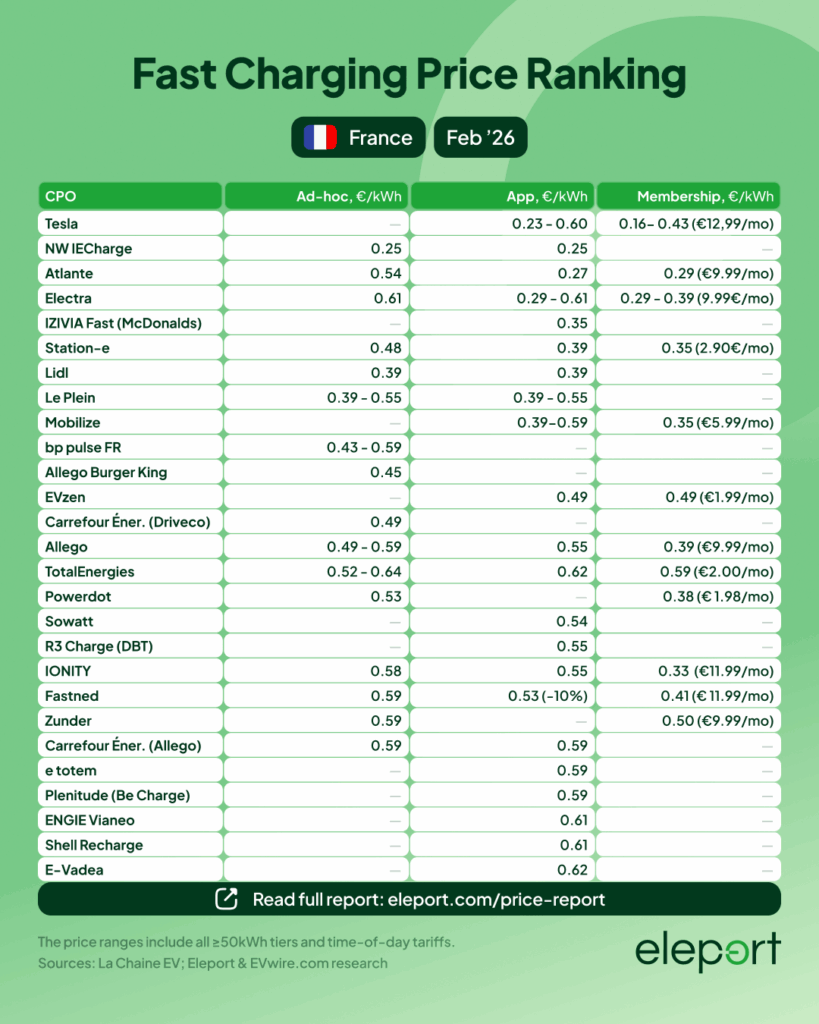
The average (median) fast charging price in France is €0.52 per kWh
326 922 EVs were sold in France in 2025, growing +12,5% year-over-year.
The EV market share rose from 16,9% to 20,0%.
France has a very saturated 2026 EV charging prices and CPO market compared to most countries, and we brought out the 28 larger ones from our vast research.
France, even though it sits on the 13th place in our cheapest public EV charging cost list, actually has the first end of the market as perhaps the best in all of Europe: Tesla off-peak starts at €0.23, notably NW IECharge price is €0.25/kWh, Atlante comes in at €0.27/kWh and Electra’s free app prices also start at 0.29€/kWh.
It is just the large amount of large CPOs with up to €0.62/kWh prices that drag up the median price of 0.52€/kWh shown above. We’ve also identified 12 different monthly charging memberships one could sign up for in France.
In France, the website of La Chaine EV helped us source some of the pricing.
| CPO | Ad-hoc €/kWh | App €/kWh | Membership €/kWh |
| Tesla | €0.23-€0.60 | €0.16-€0.43 (€12,99) | |
| NW IECharge | €0.25 | €0.25 | — |
| Atlante | €0.54 | €0.27 | €0.29 (€9.99/mo) |
| Electra | €0.61 | €0.29-€0.61 | €0.29-€0.39 (9.99€/mo) |
| IZIVIA Fast (McDonalds) | — | €0.35 | — |
| Station-e | €0.48 | €0.39 | €0.35 (2.90€/mo) |
| Lidl | €0.39 | €0.39 | — |
| Le Plein | €0.39-€0.55 | €0.39-€0.55 | — |
| Mobilize (Renault) | — | 0.39-0.59 | 0.35 (€5.99/mo) |
| bp pulse FR | €0.43-€0.59 | — | — |
| Allego Burger King | €0.45 | — | — |
| EVzen | — | €0.49 | €0.49 (€1.99/mo) |
| Carrefour Éner. (Driveco) | €0.49 | — | — |
| Allego | €0.49-€0.59 | €0.55 | €0.39 (€9.99/mo) |
| TotalEnergies | €0.52-€0.64 | €0.62 | €0.59 (€2.00/mo) |
| Powerdot | €0.53 | — | €0.38 (€ 1.98/mo) |
| Sowatt | — | €0.54 | — |
| R3 Charge (DBT) | — | €0.55 | — |
| IONITY | €0.58 | €0.55 | €0.33 (€11.99/mo) |
| Fastned | €0.59 | €0.531 (-10%) | €0.41 (€ 11.99/mo) |
| Zunder | €0.59 | — | €0.50 (€9.99/mo) |
| Carrefour Éner. (Allego) | €0.59 | €0.59 | — |
| e totem | — | €0.59 | — |
| Plenitude (Be Charge) | — | €0.59 | — |
| ENGIE Vianeo | — | €0.61 | — |
| Shell Recharge | — | €0.61 | — |
| E-Vadea | — | €0.62 | — |
Fast Charging Price Comparison in Sweden

The average (median) public EV charging cost at fast chargers in Sweden is €0.53 per kWh.
99 723 EVs were sold in Sweden in 2025, growing +5,7% year-over-year.
The EV market share rose from 35,0% to 36,5%.
Every third car sold in Sweden today is fully electric. And the fast charging price game here is smart – CPO offers range from 2.99 SEK (0.28€) by E.ON all the way to 6.90 SEK/kWh offered by JOLT Energy.
E.ON’s cheapest DC rate (from 2.20 SEK/kWh) however is only available to E.ON household electricity customers, following the same path we saw in the Baltics earlier. Vattenfall InCharge does something similar, with a 3.95 SEK automatic night rate (22:00–06:00) that rewards off-peak charging.
The alltomelbil.se website was helpful in surfacing some of the pricing data in Sweden.
| CPO | Ad-hoc SEK/kWh | App SEK/kWh | Membership SEK/kWh |
| E.ON | 2.99-5.99 | 2.99-5.99 | 2.20-5.99 (utility customers) |
| Tesla | 3.80-6.90 | 1.90-4.90 (129 kr/mo) | |
| Mer | 4.00-8.00 | — | 2.72-5.50 (79 kr/mo) |
| Cheap Charge | — | 4.50 | — |
| St1 | 4.59-5.29 | — | — |
| Lidl | 5.80 | 4.6 | — |
| Nima Energy | 4.79 | 4.79 | — |
| OKQ8 | 5.29 | 5.29 | — |
| Hedin Supercharge | 5.29 | — | — |
| Eviny (Bilkraft) | 5.29 | 5.29 | — |
| Recharge | 5.49 / 5.99 | — | 3.99 (119 kr/mo) |
| Clever | 5.69 | — | — |
| IONITY | 6.00 | 5.70 | 3.42 (136 kr/mo) |
| Vattenfall InCharge | 5.95 | 5.95 | 3.95 (customers) |
| kWatt | 5.95 | — | — |
| E.ON Drive & Clever (JV) | 5.99 | — | — |
| Circle K Charge | 6.27 | 6.27 | — |
| Allego | 6.30 | — | — |
| JOLT Energy | 6.90 | 6.90 | 4.9 (65 SEK/mo) |
Fast Charging Price Comparison in Hungary
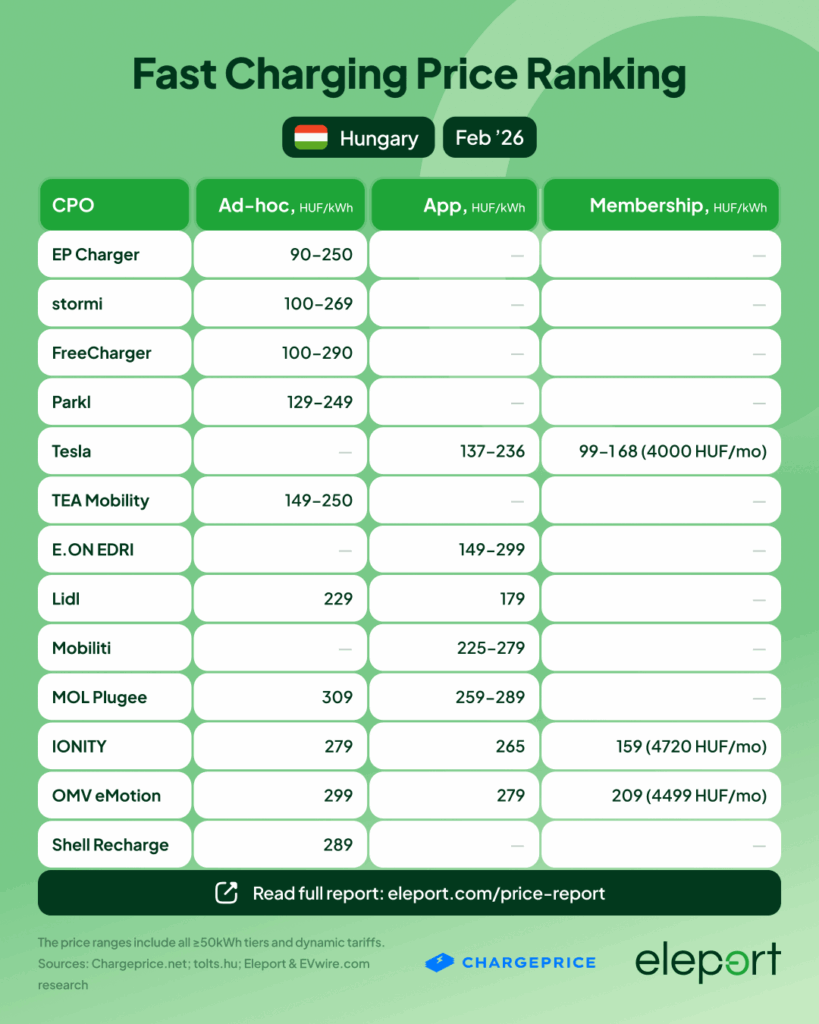
The average (median) public EV charging cost at fast chargers in Hungary is €0.53 per kWh.
11 002 EVs were sold in Hungary in 2025, growing +28,5% year-over-year.
The EV market share rose from 7,0% to 8,5%.
Hungary’s median EV public charging cost is a cent below the European average, but the fast charging prices are spread across a very wide range, spanning from 90 to 309 HUF/kWh (€0.24 – €0.81), perhaps the largest such range we’ve seen in Europe.
The cheapest options like EP Charger from 90 HUF/kWh (0.24€) and stormi from 100 HUF (0.29€ /kWh) actually rival home charging cost, while casual visitors hitting MOL Plugee (309 HUF), Shell Recharge (289 HUF), or OMV (299 HUF) at highway stops pay 3x more.
Most of the country’s local CPOs seem to only want to show their prices in the apps, so the tolts.hu website was of great help to us in navigating these public charging prices.
| CPO | Ad-hoc HUF/kWh | App HUF/kWh | Membership HUF/kWh |
| EP Charger | 90–250 | — | — |
| stormi | 100–269 | — | — |
| FreeCharger | 100–290 | — | — |
| Parkl | 129–249 | — | — |
| Tesla | — | 137–236 | 99–168 (4000 HUF/mo) |
| TEA Mobility (Teapont) | 149–250 | — | |
| E.ON EDRI | 149-299 | — | |
| Lidl | 229 | 179 | — |
| Mobiliti (MVM) | — | 225–279 | — |
| IONITY | 279 | 265 | 159 (4720 HUF/mo) |
| MOL Plugee | 309 | 259-289 | |
| OMV eMotion | 299 | 279 | 209 (4499 HUF/mo) |
| Shell Recharge | 289 | — | — |
Fast Charging Price Comparison in Slovakia

The average (median) public EV charging cost at fast chargers in Slovakia is €0.54 per kWh.
4 377 EVs were sold in Slovakia in 2025, growing +96,5% year-over-year.
The EV market share rose from 2,4% to 4,7%.
Welcome to the exact middle of fast charging prices in Europe! Slovakia and Czechia below claim this 0.54€/kWh median spot with their inner-country medians exactly.
In Slovakia, Lidl, the retail chain, and ejoin Go, the local charging player, tie for the first spot at 0.39€/kWh, while the latter offers higher powered charging for the same amount. The rest of the market carries on smoothly to €0.65/kWh asked by IONITY on its free app. Interestingly, 5 of the 9 CPOs we found offer a membership tier, with Tesla and ZSE Drive taking the member price down to the €0.29/kWh level in their dynamic pricing range.
The government statistical office publishes weekly average charging prices — rare transparency that very few EU countries match.
An instrumental support for putting the Slovakian market info together was the mojelektromobil.sk EV portal.
| CPO | Ad-hoc €/kWh | App €/kWh | Membership €/kWh |
| Lidl | €0.39 | — | — |
| ejoin GO | €0.45 | €0.39 | — |
| Tesla | €0.41-€0.58 | €0.29-€0.41 (€11.99/mo) | |
| OMV eMotion | €0.69 | €0.44-0.59 | €0.39-0.54 (€3.99/mo) |
| ZSE Drive | €0.59-0.69-0.79 | €0.49-0.59-0.69 | €0.29-0.59 (€13.90/mo) |
| MOL Plugee | €0.59 | €0.54 | — |
| GreenWay | — | €0.59-0.69 | €0.40 (up to €59.90/mo for 150kWh included) |
| Shell Recharge | €0.64 | — | — |
| IONITY | €0.68 | €0.65 | €0.39 (€11.99/mo) |
Fast Charging Price Comparison in Czechia
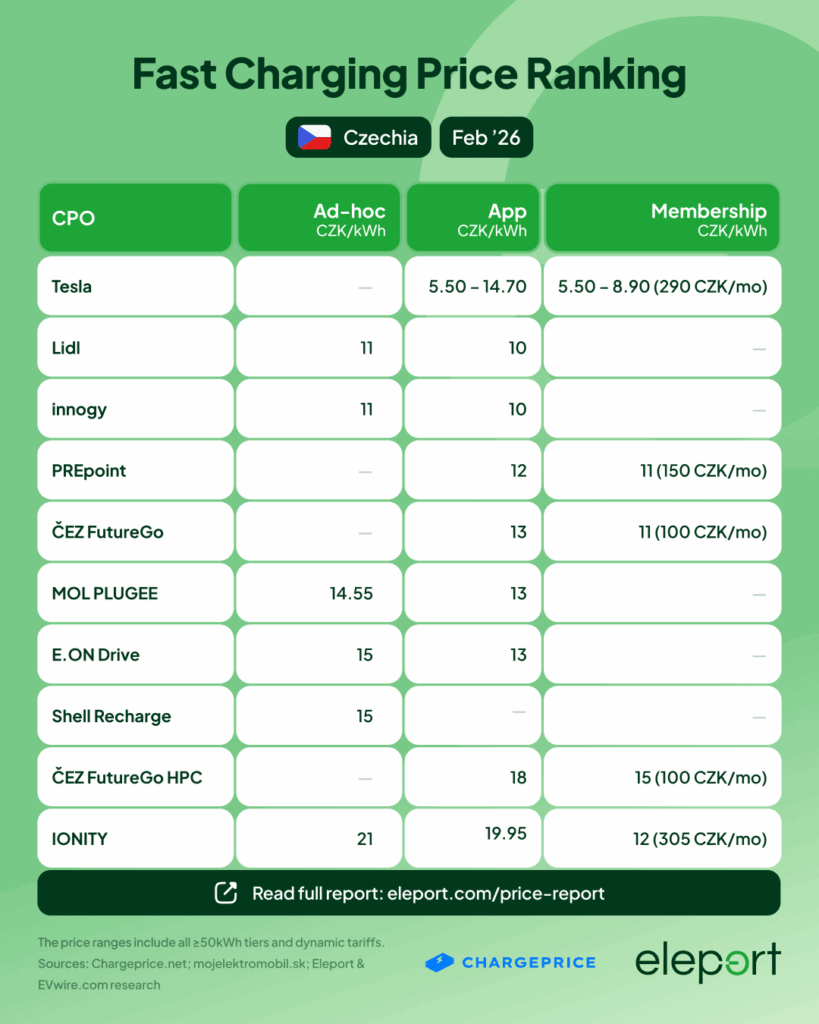
The average (median) public EV charging cost at fast chargers in Czechia is €0.54 per kWh.
13 806 EVs were sold in Czechia in 2025, growing +26,5% year-over-year.
The EV market share rose from 4,7% to 5,6%.
Czechia sits in the absolute middle in our €/kWh pricing data comparison across Europe as well.
The Czech Republic has the widest price spread in our whole report: 3.8x between Tesla’s off-peak membership rate (CZK 5.50/kWh, ~€0.23) and IONITY’s ad-hoc (CZK 21, ~€0.87)!
Lidl and innogy follow Tesla charging cost with 10 and 11 CZK/kWh prices respectively, but it is the three energy incumbents — ČEZ (FutureGo), E.ON Drive, and PRE (PREpoint) that control roughly two-thirds of all DC infrastructure. All three keep their prices flat and at the 12-13 CZK/kWh range (0.50-0.54 €/kWh).
| CPO | Ad-hoc CZK/kWh | App CZK/kWh | Membership CZK/kWh |
| Tesla | — | 5.50–14.70 | 5.50–8.90 (290 CZK/mo) |
| Lidl | 11 | 10 | — |
| innogy | 11 | 10 | — |
| PREpoint | — | 12 | 11 (150 CZK/mo) |
| ČEZ FutureGo | — | 13 | 11 (100 CZK/mo) |
| MOL PLUGEE | 14.55 | 13 | — |
| E.ON Drive | 15 | 13 | — |
| Shell Recharge | 15 | — | — |
| ČEZ FutureGo HPC | — | 18 | 15 (100 CZK/mo) |
| IONITY | 21 | 19.95 | 12 (305 CZK/mo) |
Fast Charging Price Comparison in Croatia
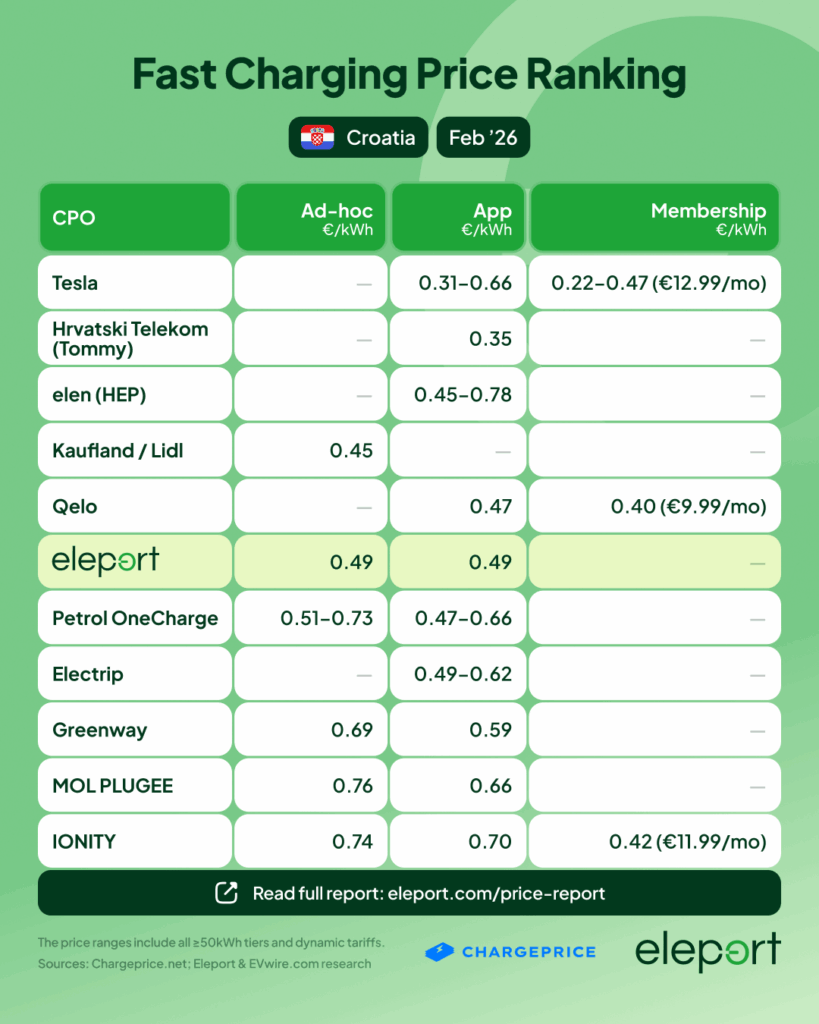
The average (median) public EV charging cost at fast chargers in Croatia is €0.55 per kWh.
1 266 EVs were sold in Croatia in 2025, declining 29,4% year-over-year.
The EV market share fell from 2,8% to 1,8%.
Croatia is Europe’s slowest EV market in terms of adoption, now having fallen to 1.8% EV share of all sales. However, there’s still decent action in the fast charging market, spruced up by the tourist traffic. The prices start with Tesla charging cost at 0.31€/kWh for off-peak and go up to 0.70 €/kWh coming from IONITY.
For tourists on the Adriatic coast, the takeaway is simple: go for the conveniently situated Eleport charger at King Cross in Zagreb, or charge off-motorway at Tommy, Kaufland, or Lidl.
Eleport, which places in the lower-than-average pricing range with a flat 0.49€/kWh rate, has just recently launched the largest EV fast charging hub in Croatia.
| CPO | Ad-hoc €/kWh | App €/kWh | Membership €/kWh |
| Tesla | — | 0.31–0.66 | 0.22–0.47 (€12.99/mo) |
| Tommy | 0.35 | — | — |
| elen (HEP) | — | 0.45–0.78 | — |
| Kaufland / Lidl | 0.45 | — | — |
| Qelo | — | 0.47 | 0.40 (€9.99/mo) |
| Eleport | — | 0.49 | — |
| Petrol OneCharge | 0.51–0.73 | 0.47–0.66 | — |
| Electrip | — | 0.49–0.62 | — |
| Greenway | 0.69 | 0.59 | — |
| MOL PLUGEE | 0.76 | 0.66 | — |
| IONITY | €0.74 | €0.7 | €0.42 (€11.99/mo) |
Fast Charging Price Comparison in Slovenia

The average (median) public EV charging cost at fast chargers in Slovenia is €0.55 per kWh.
6 419 EVs were sold in Slovenia in 2025, growing +103,9% year-over-year.
The EV market share rose from 5,9% to 11,2%.
Slovenia took the third spot overall in EV growth in 2025, effectively doubling the sales compared to the previous year.
Tesla’s off-peak pricing wins the night rounds again with 0.36€/kWh, with MOONcharge perhaps slightly surprisingly coming second with €0.45/kWh starting point. MOONcharge (Porsche Slovenija) runs public DC at VW/Audi/Škoda dealerships — open to all brands.
We’ve got plenty of middle-market pricing there, and one of the entries is Eleport with €0.53/kWh. Having just recently gotten a €35M loan from the EIB, we can expect more chargers to be built across CEE.
A helpful tool that helped us put the Slovenian overview together was elektro-ljubljana.si.
| CPO | Ad-hoc €/kWh | App €/kWh | Membership €/kWh |
| Tesla | €0.36-€0.57 | €0.26-€0.41 (€11.99/mo) | |
| MOONcharge | €0.55-0.75 | €0.45-0.65 | — |
| MOL Plugee | €0.55-0.80 | €0.45-0.70 | — |
| Petrol | €0.51-0.73 | €0.47-0.66 | — |
| Gremo na elektriko | — | €0.49-0.59 | — |
| MegaTel | — | €0.49-0.59 | — |
| Eleport | — | €0.53 | — |
| Allego | €0.61 | — | — |
| IONITY | €0.73 | €0.69 | €0.41 (€9.99/mo) |
Join our newsletter
No fluff, no spam.
Fast Charging Price Comparison in Poland

The average (median) public EV charging cost at fast chargers in Poland is €0.58 per kWh.
43 311 EVs were sold in Poland in 2025, growing +161,5% year-over-year.
The EV market share rose from 3,0% to 7,2%.
Poland was the surprising rising star of 2025, as it took the absolute win in EV growth for the year, also more than doubling its EV market share of all sales.
Poland’s DC market has matured remarkably fast, too: there are 23 CPOs that we decided to list in a market that barely had a strong fast charging presence five years ago. Local operators dominate rather than pan-European networks, but with a few caveats, like the growing Eleport footprint in the county.
In Poland, EkoEN plays the dynamic pricing game slightly better than Tesla, with 1.49 PLN (0.35€/kWh) for off-peak rates against Tesla’s 1.50 PLN – the latter, however, is possible to drop to 1.00 with the membership pricing. These two end up as the cheapest public EV charging costs in Poland. Eleport’s 2.39 PLN/kWh (€0.56/kWh) beats the median of 0.58€, while the highest prices we found on the market went all the way to the surprisingly expensive 3.39 PLN (0.80€/kWh) on the other end.
The two additional sources that helped us sort out Poland’s pricing are EV Klub and elektromobilni.pl
| CPO | Ad-hoc PLN/kWh | App PLN/kWh | Membership PLN/kWh |
| EkoEN | — | 1.49 PLN – 3.36 PLN | — |
| Tesla | — | 1.50-2.70 PLN | 1.00-2.00 PLN (50 PLN/mo) |
| MOYA Energia | — | 1.80 PLN – 2.69 PLN | — |
| Budimex Mobility | — | 1.99 PLN – 2.58 PLN | — |
| ScreenCharge | — | 1.99 PLN | — |
| ChargeIn | 1.99 PLN – 2.39 PLN | — | |
| eTAURON | 2.39 PLN | 1.76 PLN – 2.72 PLN | — |
| Enefit VOLT | 2.70 PLN | 2.25-2.40 PLN | — |
| Powerdot | 2.26-2.85 PLN | — | — |
| Eleport | — | 2.39 PLN | — |
| ChargeEuropa | — | 2.40 PLN | — |
| Lidl | — | 2.40 PLN | — |
| GO+EAuto | — | 2.45 PLN | — |
| Polenergia | 3.10 PLN | 2.48 – 2.68 PLN | — |
| Kaufland | — | 2.52-2.71 PLN | — |
| E.ON Drive (PL) | — | 2.69 PLN | — |
| Horyzont EV | — | 2.69 PLN | — |
| NOXO Energy | 3.39 PLN | 3.09-3.39 PLN | — |
| IONITY | 3.26 | 3.1 | 1.86 (51.5 PLN/mo) |
| Greenway | — | 3.15 PLN | 2.10 PLN (79.99 PLN/mo) |
| Orlen Charge PL | — | 3.19 PLN | — |
| Shell Recharge | 3.19 PLN | 2.99-3.59 PLN | — |
| Circle K Charge | 3.25 PLN | — | — |
Fast Charging Price Comparison in Austria

The average (median) public EV charging cost at fast chargers in Austria is €0.59 per kWh.
60,651 EVs were sold in Austria in 2025, growing +35,9% year-over-year.
The EV market share rose from 17,6% to 21,3%.
Austria packs 21 DC operators that have more than 100 connectors into a country of 9 million, which is quite a strong presence. The market is fragmented across regional Stadtwerke (Wien Energie, Salzburg AG, IKB, Linz AG, EVN, Energie Steiermark, KELAG), meaning a cross-country drive takes you through multiple utility networks, each with its own app and pricing if you’re not using one of the roaming or capable EV route planning apps.
The cheapest public EV charging cost in Austria comes from Lidl and Wien Energie, both hitting €0.39 via their apps, with Wien Energie’s top-tier subscription reaching €0.30, which is also the cheapest EV charging price for fast charging among the majors in the country. At the expensive end, four major CPOs independently set ad-hoc at exactly €0.79 while their free app price is lower, suggesting a tacit market ceiling for unregistered charging.
Austria seems to be one of the few countries where Tesla Supercharging price isn’t covering a wide dynamic range and thus isn’t putting it at the top of the list with a cheap off-peak tariff.
| CPO | Ad-hoc €/kWh | App €/kWh | Membership €/kWh |
| Lidl | — | €0.39 | — |
| Wien Energie | €0.56 | €0.39 | €0.3 (€34.9/mo) |
| Salzburg AG | €0.66 | €0.42 | €0.52 (€4.99/mo) |
| illwerke vkw | €0.75 | €0.48 | — |
| da emobil | €0.49 | €0.59 | — |
| IKB (e-laden Tirol) | €0.51-0.63 | €0.54 | — |
| EVN | €0.75 | €0.54 | €0.47-0.49 ( €4.95/mo) |
| Shell Recharge (SHE) | €0.79 | €0.54 | — |
| ÖAMTC ePower | €0.79 | €0.54-0.64 | — |
| Mer Germany | €0.56-0.678 | €0.57-0.69 | — |
| Energie Steiermark | €0.75 | €0.58 | €0.493 (€19.99/mo) |
| Electra | €0.69 | €0.59 | €0.39 (€9.99/mo) |
| Tesla | — | €0.59-€0.62 | €0.42-€0.44 (€11.99/mo) |
| Turmstrom | €0.59-0.69 | — | — |
| Linz AG | €0.79 | €0.61-0.86 | €0.49-0.74 (€7.5/mo) |
| Energie AG | €0.79 | €0.65 (Energie Mobil) | €0.6 (€6/mo) |
| OMV eMotion | €0.69 | €0.65 | €0.59 (€3.99/mo) |
| Plenitude on the Road (Be Charge) | — | €0.65-0.7 | — |
| Smatrics | €0.65-0.75 | €0.65 | €0.55 (€8.9/mo) |
| IONITY | €0.69 | €0.66 | €0.39 (€11.99/mo) |
| Kelag | €0.70 | — | €0.636 (€10.8/mo) |
Fast Charging Price Comparison in Germany

The average (median) public EV charging cost at fast chargers in Germany is €0.59 per kWh
545 142 EVs were sold in Germany in 2025, growing +43,2% year-over-year.
The EV market share rose from 14,6% to 20,1%.
Europe’s largest EV market in terms of units sold every year is also Europe’s most competitive charging market. Out of hundreds, we surfaced 27 largest and most notable CPOs, with 200 or more connectors deployed. Within that, every charging business model is represented, and an extraordinary retail chain price floor: ALDI, Lidl, and Kaufland all price at €0.44, collectively operating ~3,300 DC connectors — more than most dedicated CPOs.
The only charging network breaking this is the one that, at off-peak hours, becomes the cheapest public EV fast charging in Germany: Tesla, with €0.30/kWh on the low end of the range, and the membership taking it further to 0.24€/kWh. Interestingly, the second-lowest price in the country among these membership tiers of majors is 0.39€/kWh, which several players have set as the floor.
The Deutschlandnetz federal program funded ~900 HPC locations through concessions, all requiring contactless ad-hoc payment. EnBW, with 8,600+ DC connectors, is one of Europe’s largest single DC networks and the market benchmark, arriving at slightly lower than the median Germany price, €0.56/kWh.
Germany’s ad-hoc penalty is the steepest in Europe: contactless payment typically costs €0.79/kWh vs €0.50–0.59/kWh for a free app registration — a 35% premium for not downloading an app. This makes Germany the market where knowing how to charge can matter most.
In Germany, nextmove.de has been a valuable price comparison source for us.
| CPO | Ad-hoc €/kWh | App €/kWh | Membership €/kWh |
| Tesla | €0.34-€0.75 | €0.24-€0.54 (€11.99/mo) | |
| Lidl | €0.55 | €0.44 | — |
| Kaufland | €0.55 | €0.44 | — |
| ALDI Süd | €0.44 | — | — |
| ALDI Nord | €0.44 | — | — |
| Edeka | €0.48 | — | — |
| eliso (Via Deutschlandnetz) | €0.49 | €0.49 | — |
| TEAG Mobil | €0.49 | €0.49 | — |
| EWE Go | 0.66-0.84 | €0.52 | — |
| Electra | €0.69 | €0.54 | €0.39 (€9.99/mo) |
| Eviny (Bilkraft) | €0.55 | €0.55 | — |
| EnBW | €0.79 | €0.56 | €0.39 (€11.99/mo) |
| Shell Recharge | €0.79 | €0.59 | €0.44 (€5.99/mo) |
| Mercedes | €0.59 | €0.59 | €0.39 (€9.9/mo) |
| JOLT Energy | €0.79 | €0.59 | €0.49 (€5.99/mo) |
| E.ON Drive | €0.79 | €0.61 | €0.54 (€2.99/mo) |
| Vattenfall | €0.62 | €0.62 | — |
| IONITY | €0.69 | €0.66 | €0.39 (€11.99/mo) |
| Fastned | €0.73 | €0.66 | €0.51 (€11.99/mo) |
| Aral/bp pulse | €0.79 | €0.69 | €0.54 (€2.99/mo) |
| Pfalzwerke | €0.69 | — | — |
| BayWa Mobility | €0.69 | €0.69 | €0.59 (€0.99/mo) |
| Mer Germany | €0.69 | €0.69 | — |
| Allego | €0.73 | — | — |
| TotalEnergies | €0.76 | €0.75 | — |
| Comfortcharge | €0.80 | — | — |
Fast Charging Price Comparison in Portugal
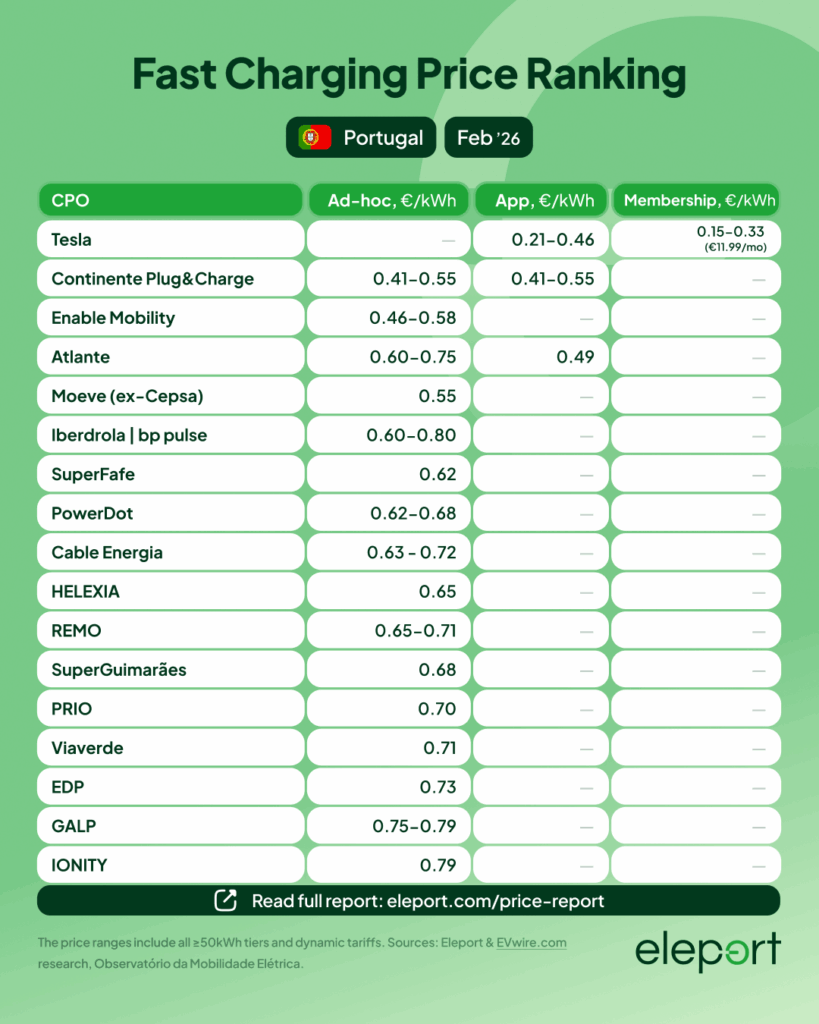
The average (median) public EV charging cost for fast chargers in Portugal is €0.65 per kWh.
52 256 EVs were sold in Portugal in 2025, growing +25,1% year-over-year.
The EV market share rose from 19,9% to 23,2%.
Portugal has Europe’s most complex charging billing system. It is probably the most difficult market to figure out if you’re researching how much fast charging costs across Europe.
The government-run MOBI.E platform splits every charge into three invoiced layers: CEME (energy supplier), OPC (station operator), and taxes. Your total price depends on which CEME card you use at which OPC’s station. This system was relaxed somewhat late last year and is being phased out by December 2026 under new legislation aligning with EU AFIR. This has seemingly led to some operators sticking to the ‘old’ pricing structure while others go direct.
From what we have found in Portugal, Tesla is again with the cheapest price in the off-peak pricing, with €0.21 available without membership in certain times in the cheapest locations. Enable Mobility comes next starting at €0.46, followed by Atlante’s 0.49€/kWh across what seems to be most of its locations. Portugal’s pricing per kWh across CPOs runs up to 0.79€/kWh as of February 2026.
Special thanks to @electric_maik on X for help with the Supercharging data in Portugal. Most of the ad-hoc prices are found from the official portal of Observatório da Mobilidade Elétrica, reported by the CPOs themselves.
| CPO | Ad-hoc €/kWh | App €/kWh | Membership €/kWh |
| Tesla | 0.21-0.46 | 0.15-0.33 (€11.99/mo) | |
| Continente Plug&Charge | 0.41-0.55 | 0.41-0.55 | — |
| Enable Mobility | 0.46-0.58 | ||
| Atlante | 0.60-0.75 | 0.49 | — |
| Moeve (ex-Cepsa) | 0.55 | — | |
| Iberdrola | bp pulse | 0.60-0.80 | — | — |
| SuperFafe | 0.62 | ||
| PowerDot | 0.62-0.68 | — | — |
| Cable Energia | 0.63-0.72 | ||
| HELEXIA | 0.65 | ||
| REMO | 0.65-0.71 | ||
| SuperGuimarães | 0.68 | ||
| PRIO | 0.70 | ||
| Viaverde | 0.71 | ||
| EDP | 0.73 | — | — |
| GALP | 0.75-0.79 | ||
| IONITY | 0.79 |
Fast Charging Price Comparison in Luxembourg
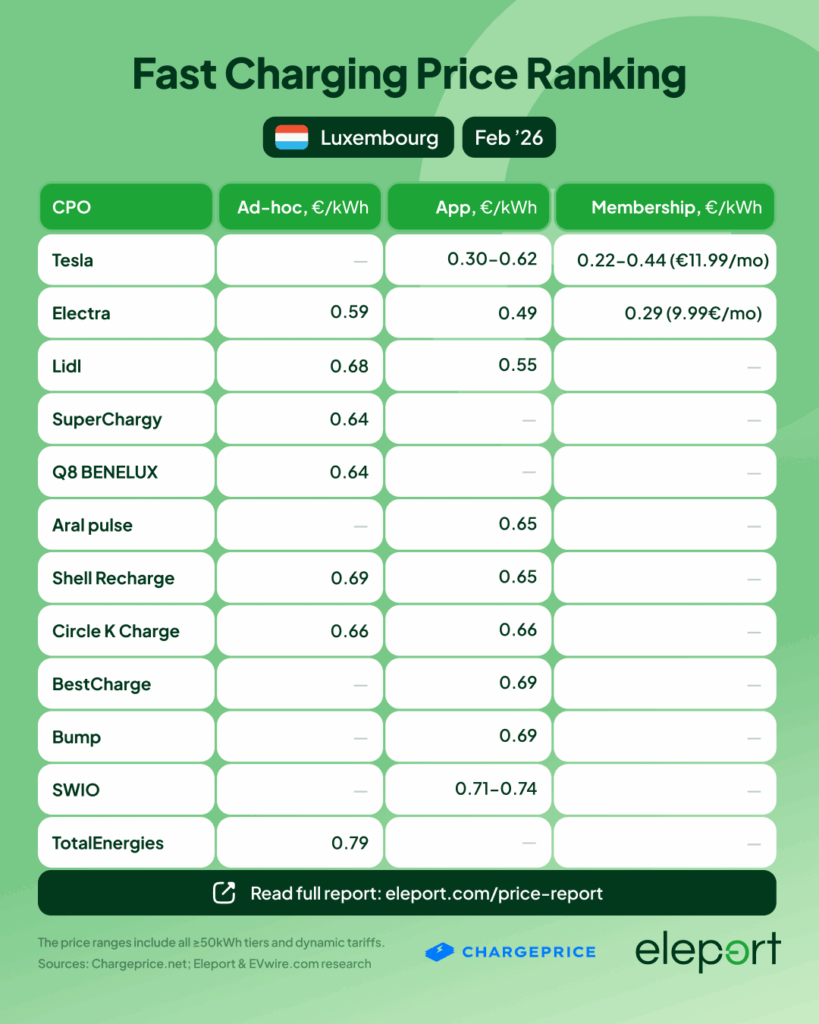
The average (median) public EV charging cost at fast chargers in Luxembourg is €0.65 per kWh.
12 663 EVs were sold in 2025, declining 0,9% year-over-year.
The EV market share fell from 27,4% to 26,9%.
Luxembourg is one of the five EV markets that declined in EV sales in 2025, but that was a minor drop, while EVs still make up around every 4th car sold in the country.
Luxembourg’s most distinctive feature is a government subsidy of €0.14/kWh baked into every public EV charging cost tariff — keeping prices competitive despite the country’s high cost of living. Still, it ends up at a 0.11€ higher median for EV fast charging compared to the rest of Europe.
The cheapest fast charging price in Luxembourg comes from Tesla’s off-peak tariff at €0.30/kWh, again reducing to €0.22/kWh for members with the €11.99/mo plan, and Electra comes in as the first one with a stable €0.49/kWh through its free app.
The TotalEnergies-to-Circle K brand transition has seemingly created a temporary pricing confusion with three fossil-fuel-heritage brands at three different prices, also marking the highest charging price in the country of €0.79/kWh.
| CPO | Ad-hoc €/kWh | App €/kWh | Membership €/kWh |
| Tesla | — | 0.30-0.62 | 0.22-0.44 (€11.99/mo) |
| Electra | 0.59 | 0.49 | 0.29 (9.99€/mo) |
| Lidl | 0.68 | 0.55 | — |
| Chargy (SuperChargy) | 0.64 | — | — |
| Q8 BENELUX | 0.64 | — | — |
| Aral pulse | — | 0.65 | — |
| Shell Recharge | 0.69 | 0.65 | — |
| Circle K Charge | 0.659 | — | — |
| BestCharge | — | 0.69 | — |
| Bump | — | 0.69 | — |
| SWIO | — | 0.709-0.735 | — |
| TotalEnergies | 0.79 | — | — |
Fast Charging Price Comparison in Switzerland

The average (median) public EV charging cost at fast chargers in Switzerland is €0.66 per kWh.
53 250 EVs were sold in Switzerland in 2025, growing +15,4% year-over-year.
The EV market share rose from 19,3% to 22,8%.
The EV sales have been steady for a few years now, hovering at 20% EV market share.
Switzerland ranks 24th out of 29 in our European DC fast charging price comparison, with a median price of €0.66/kWh (CHF 0.57).
On the surface, that makes it one of Europe’s more expensive markets. But there’s a structural nuance — Switzerland’s VAT is just 8.1%, far below the 19–27% charged elsewhere in Europe. Strip out VAT, and the pre-tax charging prices are even higher compared to its country peers.
What makes Switzerland genuinely distinctive is the grocery store charging war. Three of the country’s biggest retailers — Migros (M-CHARGE, CHF 0.48), Lidl (CHF 0.42 via app), and Coop (CHF 0.55 via Energie360°) – all undercut most of the dedicated charging operators in price.
The cheapest charging price in Switzerland again comes from Tesla’s off-peak rates at CHF 0.33/kWh, something that not even the paid subscriptions of other CPOs can match.
The Swiss market also features two business models you rarely see elsewhere. GOFAST, the country’s largest independent DC network with over 100 charging sites, operates as a cooperative of Swiss energy companies — a structure that’s practically unique in European EV charging.
And AMAG, Switzerland’s biggest auto dealer group (VW, Audi, Škoda, Porsche), runs its own charging network where AMAG vehicle owners get CHF 0.28/kWh — a 57% discount over the ad-hoc rate of CHF 0.65. This is the steepest OEM loyalty discount we’ve found in our entire dataset across 29 countries. At the expensive end, Shell Recharge tops the Swiss market at CHF 0.79–0.89, with an additional CHF 0.35 start fee on app sessions.
Switzerland also has one of the most thorough fast charging price comparison tools created in any European country, at ChargeGuide.ch.
| CPO | Ad-hoc CHF/kWh | App CHF/kWh | Membership CHF/kWh |
| Tesla | CHF 0.33-0.89 | CHF 0.24-0.64 (CHF 11.99/mo) | |
| Lidl | CHF 0.62 | CHF 0.42 | — |
| Migros (M-CHARGE) | CHF 0.48 | — | — |
| AVIA Volt | CHF 0.50 | — | — |
| Coop (Energie360°) | CHF 0.55 | — | — |
| Energie360° | CHF 0.55 | — | — |
| M-CHARGE | CHF 0.55-0.59 | — | — |
| AMAG | CHF 0.65 | CHF 0.56 | 0.28 CHF/kWh for AMAG owners |
| GOFAST | CHF 0.59 | CHF 0.65 | — |
| Electra | CHF 0.64 | CHF 0.59 | CHF 0.39 (CHF 9.99/mo) |
| Aldi (GOFAST) | CHF 0.63 | CHF 0.65 | — |
| AGROLA | CHF 0.65 | — | — |
| SOCAR | CHF 0.65-0.75 | — | — |
| Fastned | CHF 0.73 | CHF 0.657 (-10%) | CHF 0.51 (CHF 11.99/mo) |
| MOVE | CHF 0.69 | CHF 0.67 | CHF 0.59 (CHF 4.9/mo) |
| Eni (Plenitude) | — | CHF 0.70 | — |
| IONITY | CHF 0.80 | CHF 0.76 | CHF 0.46 (11.99/mo) |
| Shell Recharge + Evpass | CHF 0.89 | CHF 0.79 | CHF 0.59 (CHF 9.95/mo) |
Fast Charging Price Comparison in Ireland
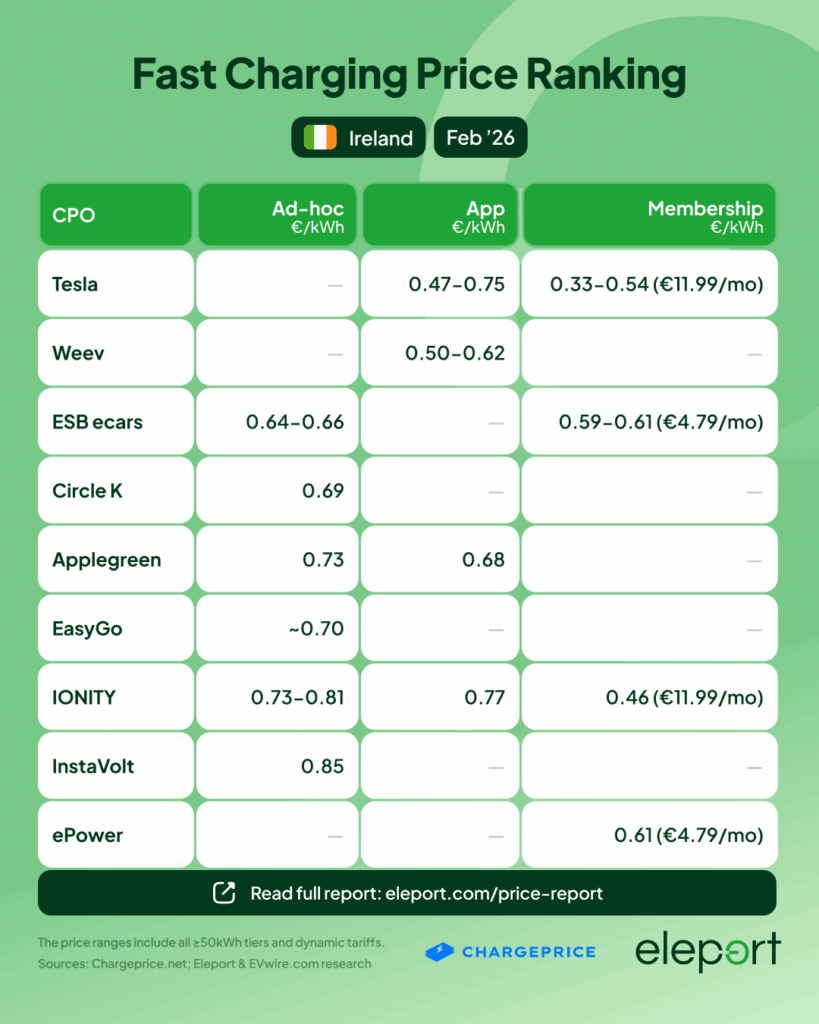
The average (median) public EV charging cost at fast chargers in Ireland is €0.68 per kWh.
23,601 EVs were sold in Ireland in 2025, growing +35,2% year-over-year.
The EV market share rose from 14,4% to 18,9%.
ESB ecars dominates the charging scene with over 400 DC points island-wide while commanding the third-cheapest price (0.64-€0.66/kWh), but Ireland’s most interesting development is the proliferation of challengers. Weev (cross-border NI/ROI operator) offers nearly Ireland’s cheapest EV charging DC at €0.50/kWh night rate. Only Tesla’s €0.47/kWh competes with it, still becoming #1 in fast charging price in Ireland.
Circle K is pivoting from hosting other networks’ chargers to building its own 400kW network, arriving at the median price of the market. InstaVolt entered from the UK at €0.85 — the most expensive option in the country for now.
Ireland’s reduced 9% VAT on public EV charging cost (extended to 2030) gives perhaps only a modest structural advantage, as we see the €0.68/kWh median for fast charging is already significantly higher than the European average for countries at €0.54. However, Ireland is still also significantly cheaper to charge at than the UK, which we’ll get to soon.
| CPO | Ad-hoc €/kWh | App €/kWh | Membership €/kWh |
| Tesla | — | €0.47-0.75 | €0.33-€0.54 (€11.99/mo) |
| Weev | — | €0.50-€0.62 | — |
| ESB ecars | 0.64-€0.66 | — | 0.59-0.61 (€4.79/mo) |
| Circle K | €0.69 | — | — |
| Applegreen Electric | €0.73 | €0.68 | — |
| EasyGo | ~€0.70 | — | — |
| IONITY | €0.73-0.81 | €0.77 | €0.46 (€11.99/mo) |
| InstaVolt | €0.85 | — | — |
| ePower | — | — | €0.61 (€4.79/mo) |
Fast Charging Price Comparison in Belgium
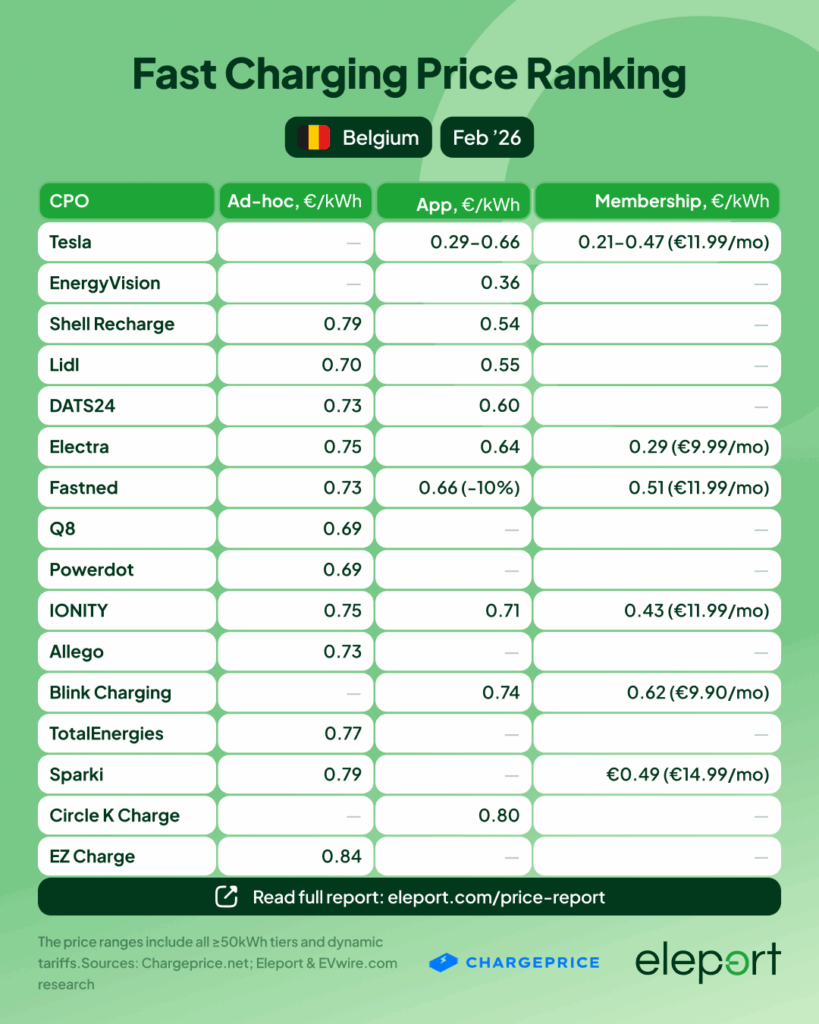
The average (median) public EV charging cost at fast chargers in Belgium is €0.69 per kWh.
143 849 EVs were sold in Belgium in 2025, growing +12,6% year-over-year.
The EV market share rose from 28,5% to 34,7%.
Belgium is one of the EV markets following in the footsteps of the EV giants like Norway and Denmark, with every third car sold already fully electric. And Belgium’s DC market is shaped by a unique demand factor: 82% of the EVs in the country are company-registered.
Looking at the fast charging prices in Belgium, it seems likely that fleet managers absorb charging costs or work around specific fleet deals, reducing price sensitivity and keeping the public prices stubbornly high: typical fast charging in Belgium ends up at €0.69/kWh, well above the European average.
Even if the fleets themselves are getting lower prices via fleet-wide deals, the regular private consumer is stuck with the high ad-hoc prices.
The outlier is EnergyVision at €0.36, the cheapest EV charging price in Belgium after Tesla’s off-peak 0.29€/kWh price, coming from a Belgian energy supplier leveraging its own renewable generation to offer DC at the prices usually only seen for AC in the country.
Their “Energy Earners” promotions via WhatsApp even give free charging during surplus renewable periods — a demand-response model we haven’t seen elsewhere in our analysis.
The higher fast charging pricing side of the Belgian market goes all the way up to €0.84/kWh.
| CPO | Ad-hoc €/kWh | App €/kWh | Membership €/kWh |
| Tesla | — | 0.29-0.66 | 0.21-0.47 (€11.99/mo) |
| EnergyVision | — | 0.36 | — |
| Shell Recharge | 0.79 | 0.54 | — |
| Lidl | 0.70 | 0.55 | — |
| DATS24 | 0.73 | 0.6 | — |
| Electra | 0.75 | 0.64 | 0.29 (€9.99/mo) |
| Fastned | 0.73 | 0.657 (-10%) | 0.51 (€11.99/mo) |
| Q8 | 0.69 | — | — |
| Powerdot | 0.69 | — | — |
| IONITY | 0.75 | €0.71 | €0.43 (€11.99/mo) |
| Allego | 0.73 | — | |
| Blink Charging | — | 0.74 | 0.62 (€9.90/mo) |
| TotalEnergies | 0.77 | — | — |
| Sparki | 0.79 | — | 0.63 (€20/mo) |
| Circle K Charge | — | 0.80 | — |
| EZ Charge | 0.84 | — | — |
Fast Charging Price Comparison in the Netherlands

The average (median) public EV charging cost at fast chargers in the Netherlands is €0.69 per kWh.
156 139 EVs were sold in the Netherlands in 2025, growing +18,1% year-over-year.
The EV market share rose from 34,6% to 40,2%.
The Netherlands has Europe’s highest public charger density — but it’s nearly all AC chargers. That is a deliberate policy legacy of massive AC buildout for residents without driveways, which has worked great for EV adoption, leading the country to a 40% EV market share. Now, the DC charging operators have taken the lead on growth, and one of the pan-European charging giants, Fastned, originated from this country.
Tesla takes the lead as the cheapest public EV charging cost offer with the off-peak DC price again (€0.40€/kWh), which, granted, would be considered as a high price in some of the countries we started with. The non-dynamic pricing for charging in the Netherlands starts at €0.53 with some TotalEnergies locations, but most charging operators have aimed for the 0.60€-0.70€/kWh range. Allego tops the list at €0.793/kWh.
In the Netherlands, however, Tesla’s off-peak pricing in the membership side (0.28€/kWh) does not actually come off as the lowest available price – LEAP24 is the most aggressive price disruptor: their PartnerPas (€4.99/mo) weekend rate of €0.24/kWh is comparable to home charging — at a DC fast charger.
Grid constraints are driving innovation: battery-backed chargers are becoming the standard deployment model.
| CPO | Ad-hoc €/kWh | App €/kWh | Membership €/kWh |
| Tesla | €0.40-€0.62 | €0.28-€0.44 (12.99€/mo) | |
| TotalEnergies | €0.53-€0.79 | — | — |
| AVIA VOLT | — | €0.62 | — |
| Electra | €0.69 | €0.64 | €0.39 (€9.99/mo) |
| JOLT Energy | €0.69 | €0.65 | €0.45-0.49 (€5.99/mo) |
| Vattenfall InCharge | €0.653 | — | — |
| LEAP24 | €0.69 | — | €0.24-€0.44 (€4.99/mo) |
| Tango Electric | €0.69-€0.70 | — | — |
| bp pulse | €0.69 | — | — |
| Fastned | €0.77 | €0.69 | €0.54 (€11.99/mo) |
| IONITY | €0.76 | €0.72 | €0.43 (€11.99/mo) |
| Shell Recharge | €0.85 | €0.78 | — |
| Circle K Charge | — | €0.79 | — |
| Allego | €0.793 | — | — |
Fast Charging Price Comparison in Italy
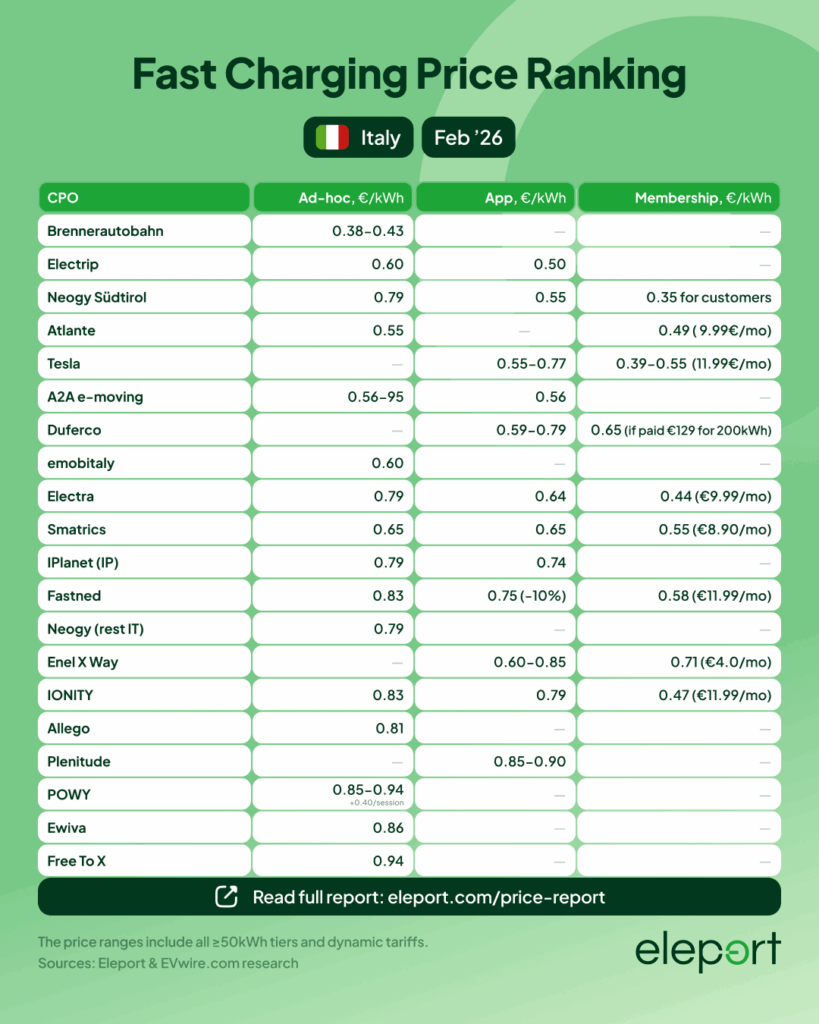
The average (median) public EV charging cost at fast chargers in Italy is €0.71 per kWh.
94 624 EVs were sold in Italy in 2025, growing +44,2% year-over-year.
The EV market share rose from 4,2% to 6,2%.
Italy has the second-worst fast charging price out of all European countries. And in this case, it might even be that this is one of the reasons that has held back the actual EV transition: while the petrol and gas prices are comparable to much of Europe, the average fast charging price in Italy is nearly double than those cheapest, and 31% higher than the European average.
The real culprit also comes from Italy, having the third most expensive regular household electricity price in Europe, at €0.3291 per kWh. To compare, the average DC fast charging price in Finland was 0.38€/kWh…
The Big Four CPOs in Italy (Enel X Way, Plenitude, Ewiva, Tesla) control ~55% of DC capacity. Likely for the electricity price reasons, even Tesla doesn’t offer a very low off-peak DC charging price in Italy, starting at what would be the average price of all of Europe, at 0.55€/kWh, placing it in the 5th place among CPOs.
The cheapest EV charging price in Italy comes from Brennerautobahn on the A22 highway, with 0.38€/kWh, and the second cheapest comes from Electrip at 0.50€/kWh flat.
The average fast charging price the EV drivers have to play with is 0.71€/kWh, and the prices go up to even 0.94€/kWh for Free-to-X on highways, in these cases making EVs even significantly more expensive to refuel than comparable fossil-fueled cars.
It is good to see that, despite all this, Italy’s EV adoption is turning positive, with 2025 bringing 44.2% more EVs on the road and the EV market share jumping to 6.2%.
| CPO | Ad-hoc €/kWh | App €/kWh | Membership €/kWh |
| Brennerautobahn | 0.38-0.43 | — | — |
| Electrip | 0.6 | 0.5 | — |
| Neogy Südtirol | 0.79 | 0.55 | 0.35 for customers |
| Atlante | 0.55 | — | 0.49 ( 9.99€/mo) |
| Tesla | — | 0.55-0.77 | 0.39-0.55 (11.99€/mo) |
| A2A e-moving | 0.56-95 | 0.56 | — |
| Duferco | — | 0.59-0.79 | 0.645 (if paid €129) |
| emobitaly | 0.6 | — | — |
| Electra | 0.79 | 0.64 | 0.44 (€9.99/mo) |
| Smatrics | 0.65 | 0.65 | 0.55 (€8.90/mo) |
| IPlanet (IP) | 0.79 | 0.74 | – |
| Fastned | 0.83 | 0.747 (-10%) | 0.58, (€11.99/mo) |
| Enel X Way | — | 0.60-0.85 | 0.71 (€4.0/mo) |
| Neogy (rest IT) | 0.79 | — | — |
| IONITY | 0.83 | 0.79 | 0.47, (€11.99/mo) |
| Allego | 0.805 | — | — |
| Plenitude | — | 0.85-0.90 | — |
| POWY | 0.85-0.94 | — | — (+0.40€ activation fee/session) |
| Ewiva | 0.86 | — | — |
| Free To X | 0.94 | — | — |
Fast Charging Price Comparison in the United Kingdom
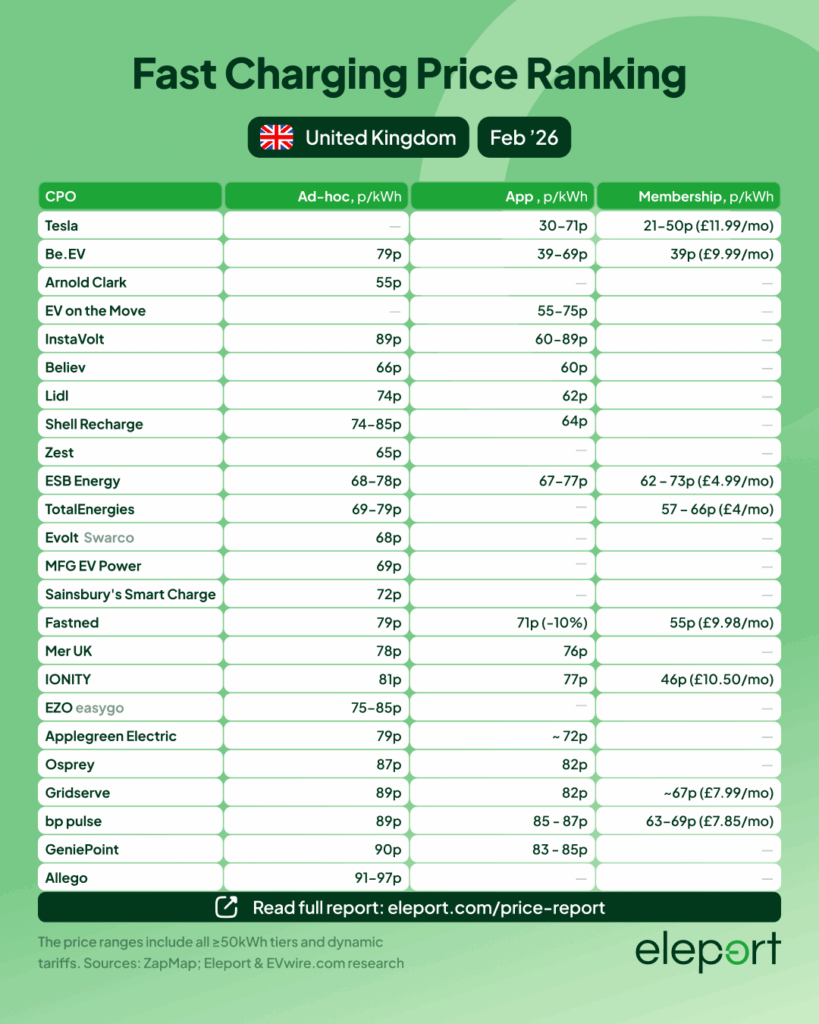
The average (median) public EV charging cost at fast chargers in the UK is €0.82 per kWh (72p per kWh).
473 348 EVs were sold in the UK in 2025, growing +23,9% year-over-year. The EV market share rose from 19,6% to 23,4%.
If you’re asking how much fast charging costs across Europe and then look at the UK first… you end up with a shocker. The most expensive. But still… works out? Almost every fourth car sold in the UK is now fully electric.
Zapmap’s weighted average PAYG (pay as you go, ad-hoc) price is 76p/kWh (~€0.91), which is roughly double that of France or Finland. The structural issue is UK electricity costs, which are higher than in most European countries.
Tesla’s off-peak charging makes for the cheapest public EV charging cost in the United Kingdom, with a 30p (€0.34) off-peak kWh rate. From the locals, Be.EV comes next with the 39p-69p price range for its stations, and we’ll see if the pricing of the Mer stations the company just acquired will end up at the same pricing.
Meanwhile, you’ll also find Tesla Superchargers at EV on the Move stations, but these are priced higher than Tesla’s own, at 55-75p per kWh.
While the median price for the country comes at 72p per kWh, there are another 10 CPOs we’ve listed on the pricier side, going all the way up to the 91–97p rates per kWh.
This makes the UK come out as the market with the craziest price variety with a real 3x difference between the cheapest fast charging at 30p and most expensive at 97p rates.
A useful tool for comparing the fast charging market in the UK is ZapMap.
| CPO | Ad-hoc p/kWh | App p/kWh | Membership p/kWh |
| Tesla | 30-71p | 21-50 (£11.99/mo) | |
| Be.EV | 79p | 39p-69p | 39p (£9.99/mo) |
| Arnold Clark Charge | 55p | — | — |
| EV on the Move | 55-75p | ||
| InstaVolt | 89p | 60–89p | — |
| Believ | 66p | 60p | |
| Lidl | 74p | 62p | — |
| Shell Recharge | 74–85p | 64p | |
| Zest | 65p | — | — |
| ESB Energy | 68–78p | 67–77p | 62–73p (£4.99/mo) |
| TotalEnergies | 69–79p | — | 57–66p (£4/mo) |
| Evolt (Swarco) | 68p | — | — |
| MFG EV Power | 69p | — | — |
| Sainsbury’s Smart Charge | 72p | — | — |
| Fastned | 79p | 71p (-10%) | 55p (£9.98/mo) |
| Mer UK | 78p | 76p | — |
| IONITY | 81p | 77p | 46p (£10.50/mo) |
| EZO (easygo) | 75–85p | — | — |
| Applegreen Electric | 79p | ~72p | — |
| Osprey | 87p | 82p | — |
| Gridserve | 89p | 82p | ~67p (£7.99/mo)) |
| bp pulse | 89p | 85–87p | 63–69p (£7.85/mo) |
| GeniePoint | 90p | 83–85p | — |
| Allego | 91–97p | — | — |
Fast charging across Europe is as different as you’d expect
| Rank | Country | Median €/kWh |
| 1 | Finland | €0.38 |
| 2 | Bulgaria | €0.38 |
| 3 | Lithuania | €0.40 |
| 4 | Latvia | €0.40 |
| 5 | Estonia | €0.41 |
| 6 | Iceland | €0.46 |
| 7 | Spain | €0.47 |
| 8 | Denmark | €0.49 |
| 9 | Romania | €0.49 |
| 10 | Norway | €0.51 |
| 11 | Greece | €0.51 |
| 12 | France | €0.52 |
| 13 | Sweden | €0.53 |
| 14 | Hungary | €0.53 |
| 15 | Slovakia | €0.54 |
| 16 | Czechia | €0.54 |
| 17 | Croatia | €0.55 |
| 18 | Slovenia | €0.55 |
| 19 | Poland | €0.58 |
| 20 | Austria | €0.59 |
| 21 | Germany | €0.59 |
| 22 | Luxembourg | €0.65 |
| 23 | Portugal | €0.65 |
| 24 | Switzerland | €0.66 |
| 25 | Ireland | €0.68 |
| 26 | Belgium | €0.69 |
| 27 | Netherlands | €0.69 |
| 28 | Italy | €0.71 |
| 29 | United Kingdom | €0.82 |
Looking at the overview commissioned by the Eleport team with help from EVwire, ChargePrice, and local comparison sites, the picture is clear: nothing in the pricing is working in exactly the same way all across Europe.
The market dynamics vary thanks to the differences in electricity price, policy, CPO presence, and even EV adoption. However, the overview finds that the EV adoption in a country is often not a direct indicator of how competitive the DC charging prices in a country are.
In lower EV-adoption countries like the Baltics, some of the cheapest EV fast charging prices in the whole of Europe can be found, while some of the highest adoption countries like the Netherlands have the third-most expensive DC charging price on average.
With this overview, we’re hoping we have made another small dent in accelerating the EV adoption in Europe – with a detailed fast charging price for every country in Europe, EV drivers can have more confidence in their choices and know how to fine-tune their experience better.

Kārlis Mendziņš