
It’s 2026.
EVs are already a “normal” sight across Europe.
And for good reason, as the latest sales figures showing that every fifth car sold across Europe was fully electric.
While countries are adopting EVs at different paces, the direction is clearly fully electric.
But EVs started from a disadvantage.
While all the benefits of owning an electric car are clear, the upfront cost of an EV has been a serious limiter of adoption until the prices reach parity. Even if the total cost of ownership has been lower for quite a while now.
That limiter, the purchase price, is what the EV incentives across Europe have been targeting. And since every country here does it on its own, which means where you live in Europe can actually have a much bigger factor in what an EV costs you than people think.
There are countries with zero direct purchase subsidies in today’s Europe, if EV incentives by country in 2026.
Some play it off as valuable tax incentives.
And there are ones that throw in a ‘casual’ 6000€.
We even found a country that offers up to 19 000€ off a new BEV.
Here’s our extensive analysis on all EV incentives by country 2026 as we’ve collected info on 31 countries across Europe, surfacing the largest, smallest, strangest subsidies in any form.
Do use the table of contents to jump to your country of choice for details, but first, here are takeaways from across the whole Europe and where each country placed:
Key Takeaways on EV incentives 2026 across Europe
Your EV grant depends almost entirely on which border you are sitting behind.
What is the largest EV subsidy in all of Europe? You can get up to 19 000€ off purchasing an EV if you meet certain eligibility in Cyprus… while you get nothing direct in Bulgaria, Croatia, or Poland. Same continent, wildly different deal.
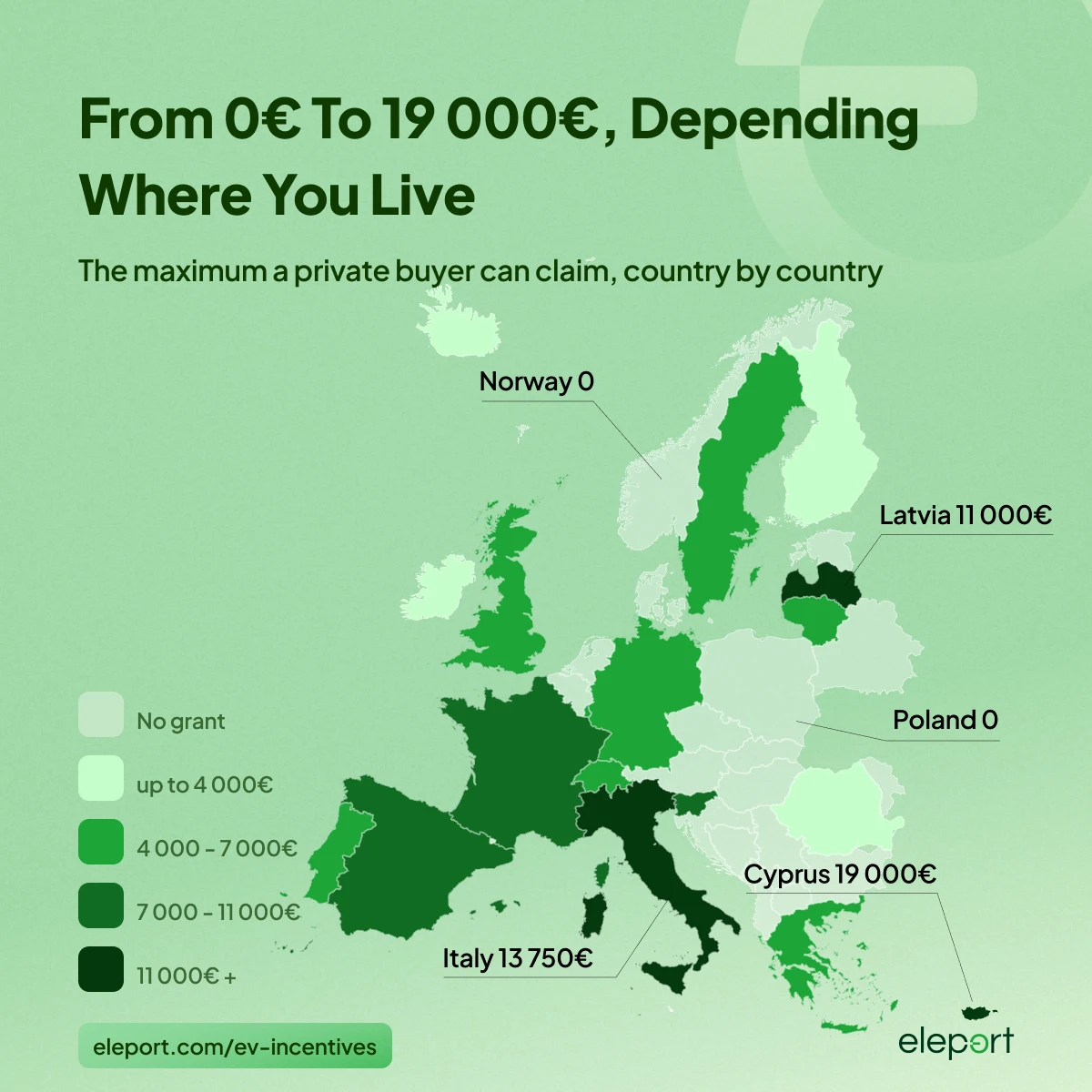
We have found that the market is splitting two ways: depending on how many EVs a country already sells, and whether it still pays you to buy one.
We’ve split the map at around 20% of EV adoption here on the X axis, and you’ll see subsidies ramping up or pulling back in the vertical axis:
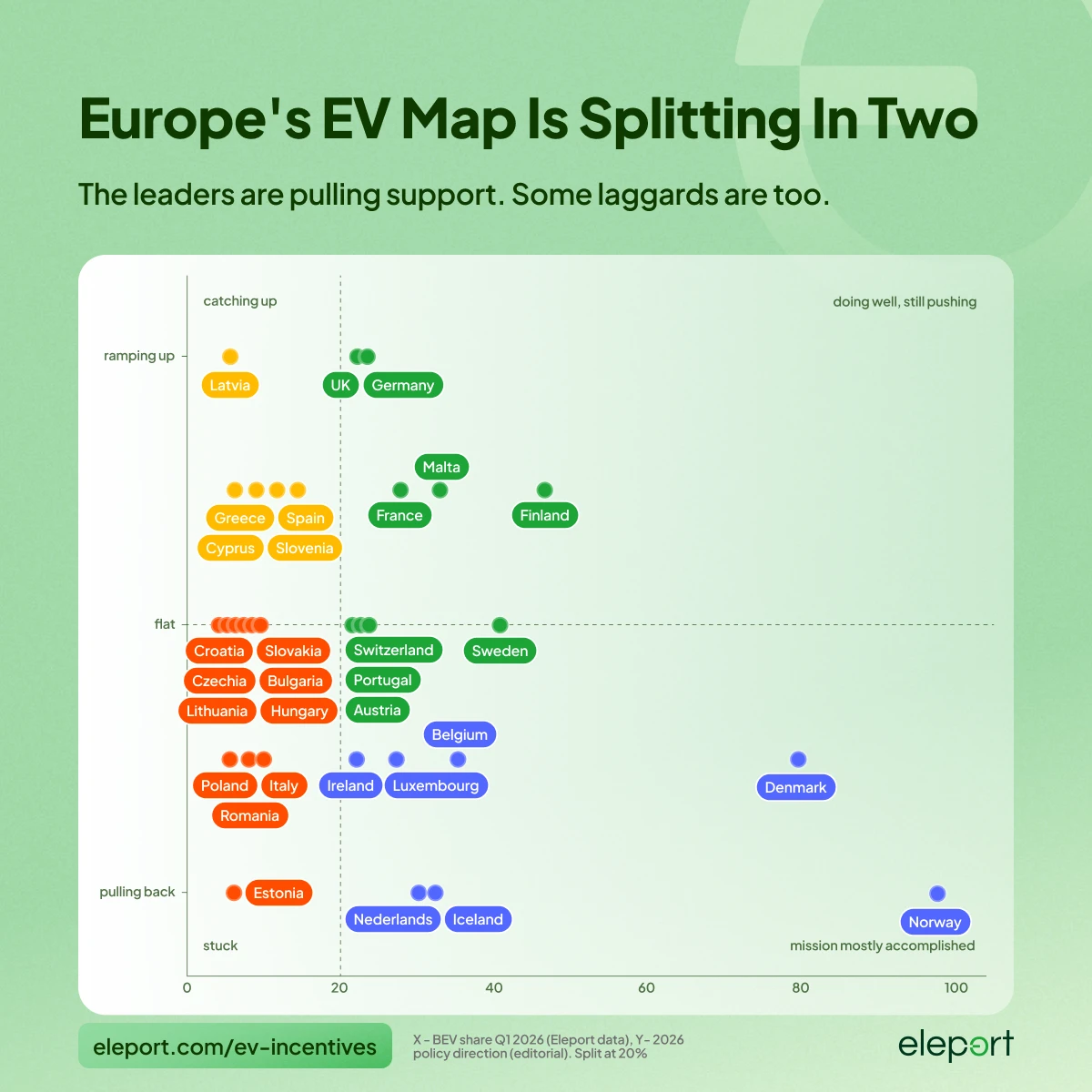
The leaders are easing off the EV subsidies… because they can. The surprise sits in the other corner when looking at the EV incentives by country, where Germany and the UK keep ramping support at fairly modest adoption, while Finland and Malta add schemes despite already passing 30%.
The biggest EV grants cluster in Europe is in the south and the Baltics, with Cyprus, Italy and Latvia all above 11 000€.
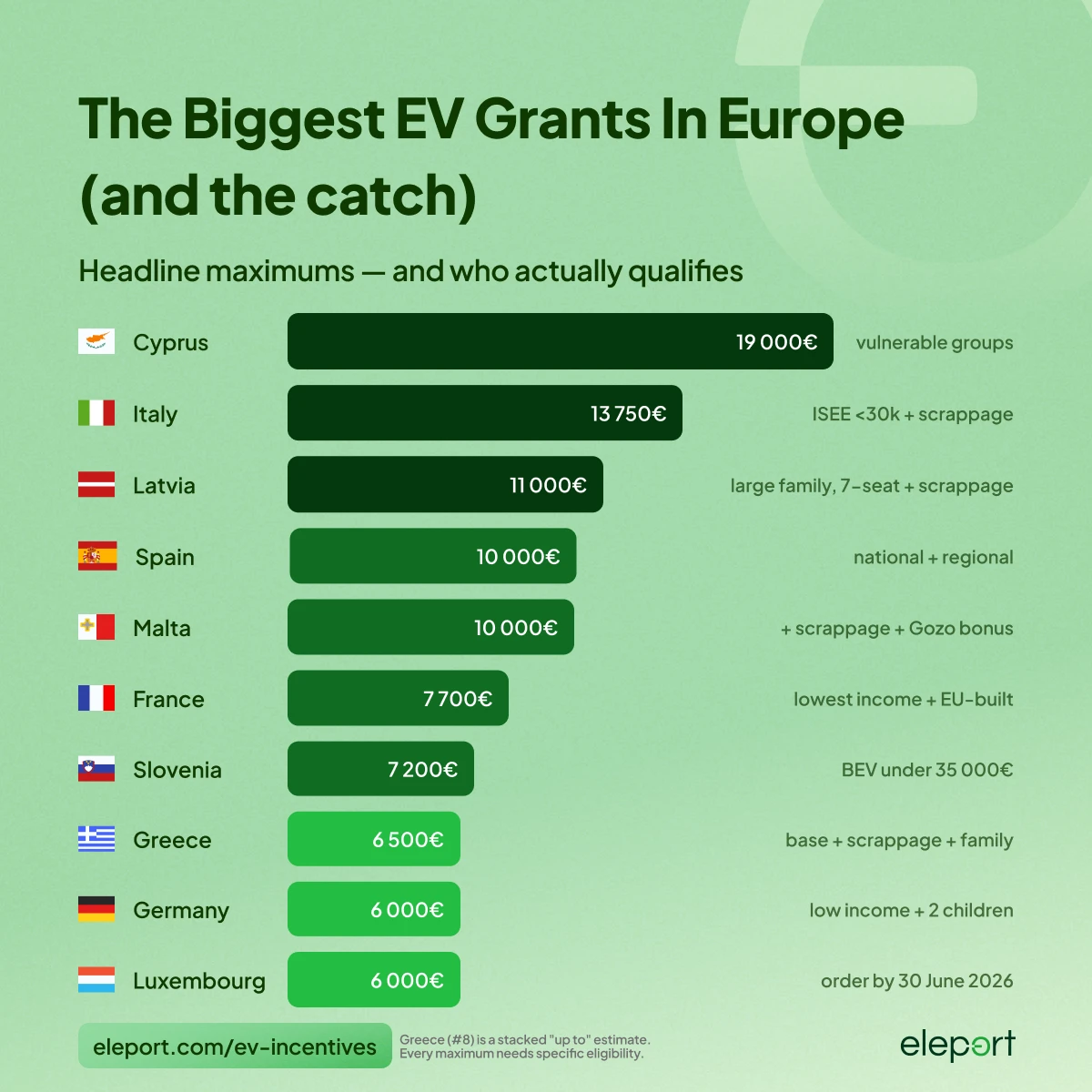
Each one comes with a catch, though, namely focused on low-income or large families, scrappage schemes, or mandating an EU-built car. So it’s not all available to the standard buyer every time.
Which countries are spending the most on charging grants?
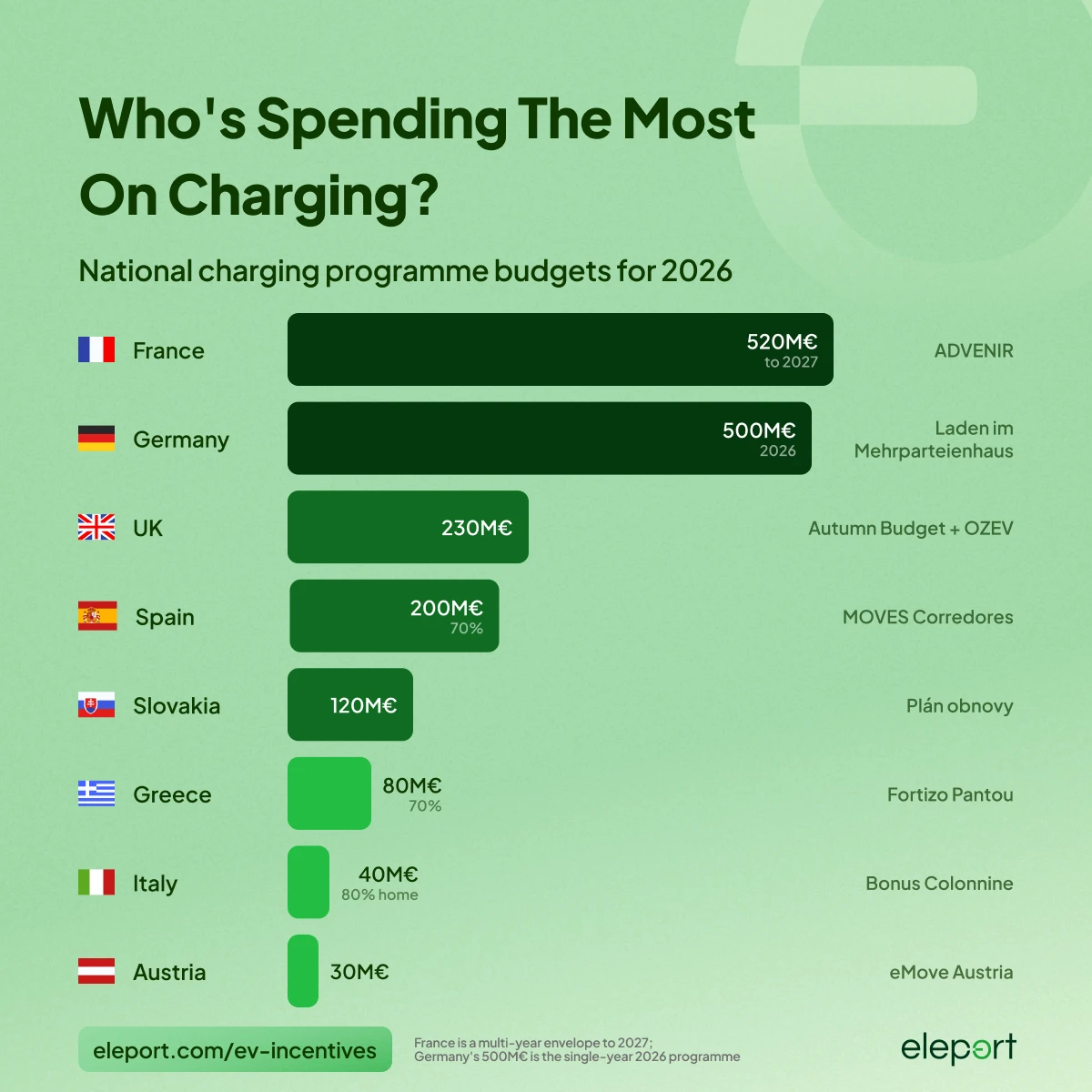
Sometimes, purchase grants are only half the money. While there are EU funds available as a whole other topic to cover, France and Germany are each spending around half a billion euros on charging infrastructure in 2026, which dwarfs their direct car subsidies. For a home charger specifically, Italy is the most generous, covering 80% of the cost.
Twelve countries give no direct electric car subsidy for private buyers on the car purchase itself.
The twist is who is on the list:
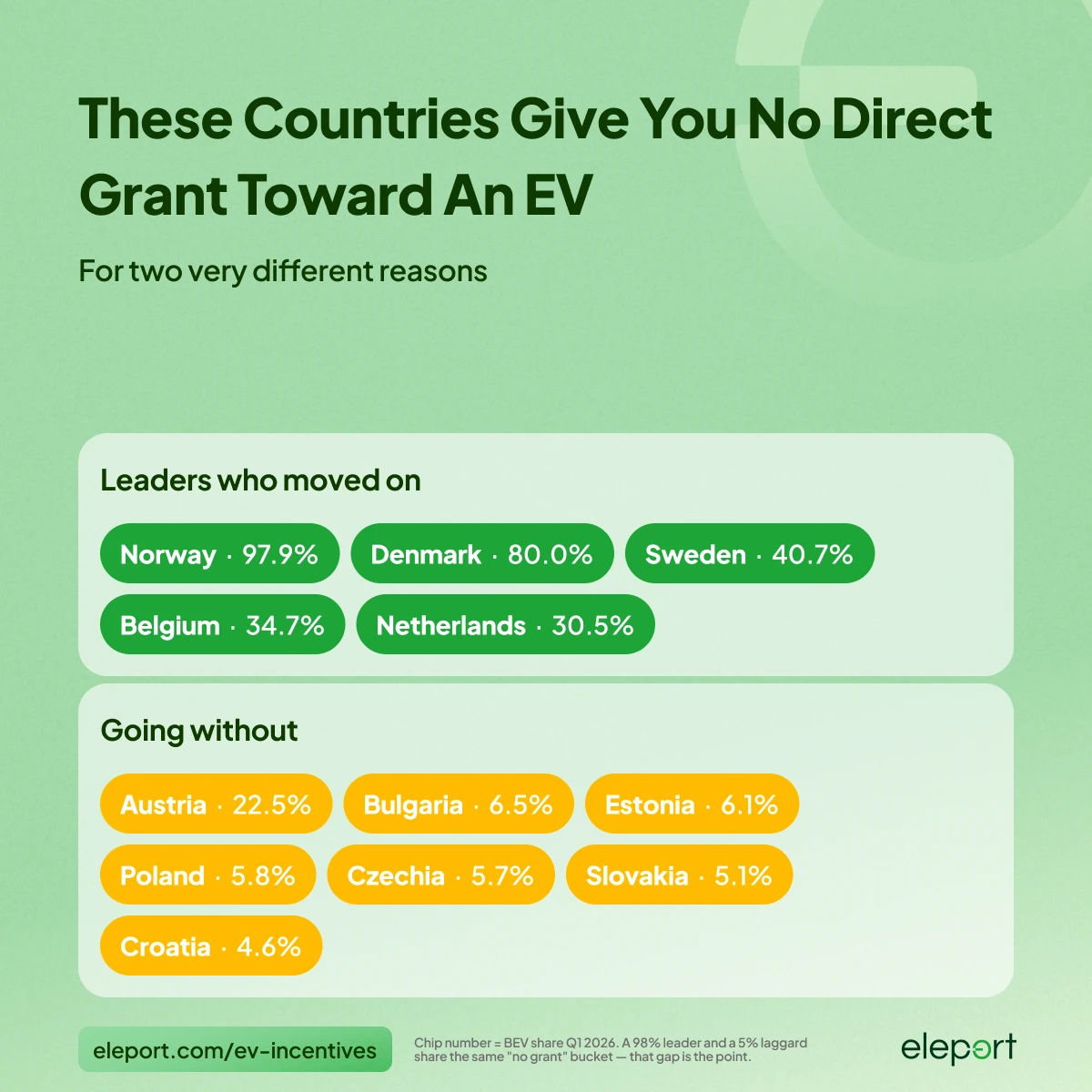
When will EV incentives end? High adoption countries like Norway, Denmark, Sweden and the Netherlands already sell so many EVs that the direct EV subsidy has done its job, and often it is the tax rules that ar kept to make the EVs comparable (or better) than ICE car purchases. The rest of the countries with no direct EV incentives, including Poland, Estonia and Slovakia, are going without subsidies yet still at single-digit adoption.
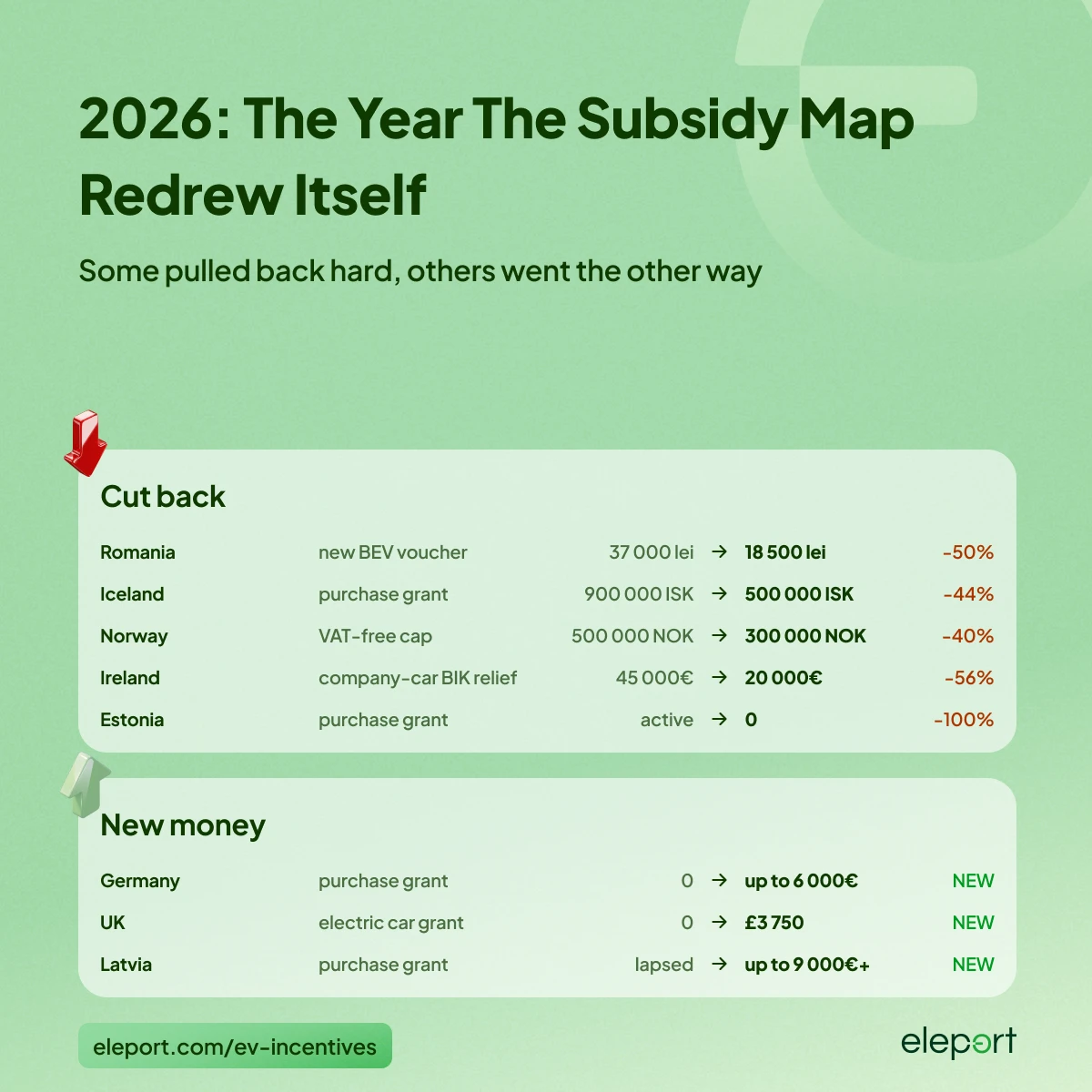
How has 2026 changed the EV incentives by country across Europe? A lot has changed this year, as Romania halved its grant, Iceland cut its by nearly half, and Norway and Ireland pulled back their biggest perks. Going the other way: Germany, the UK and Latvia all launched or relaunched grants worth thousands.
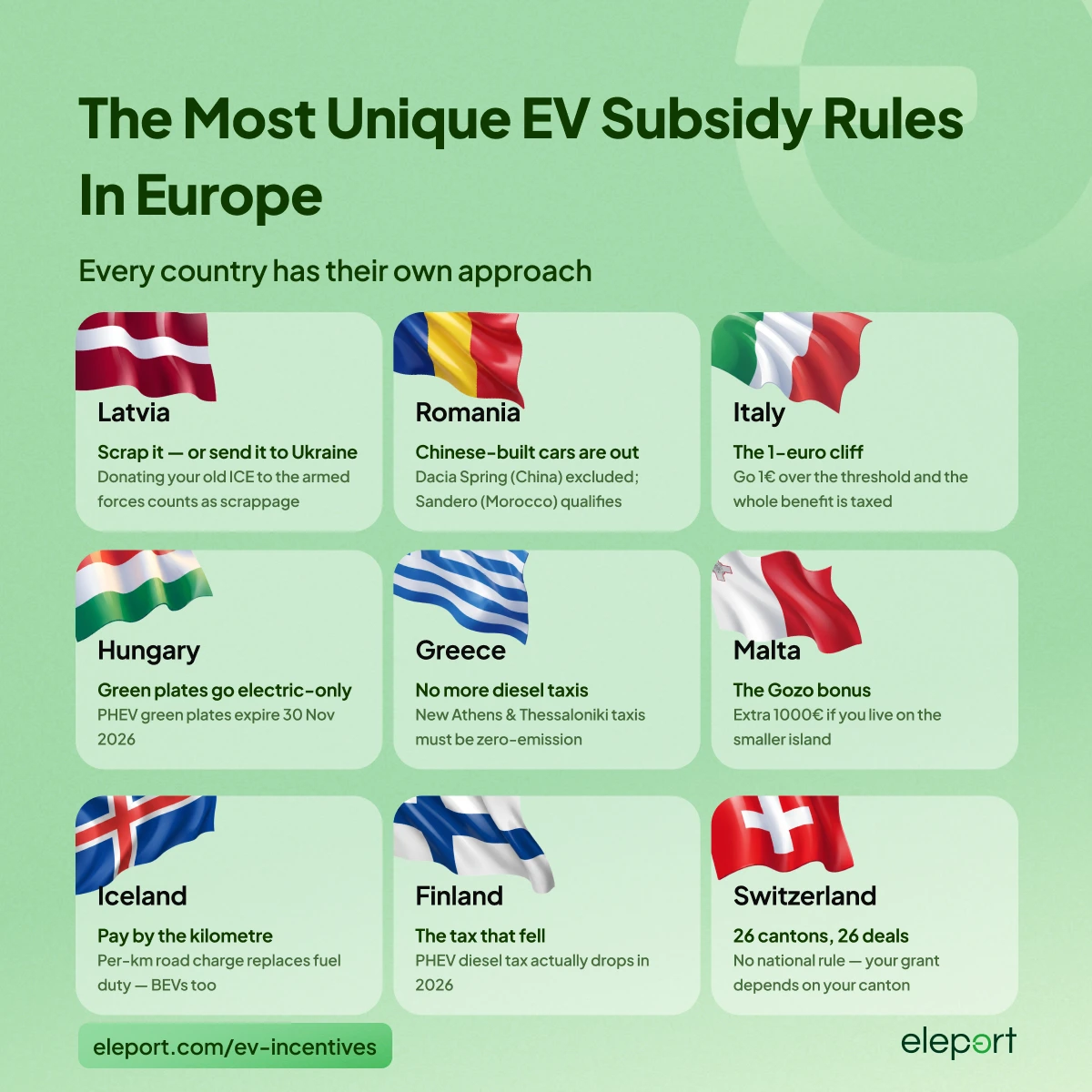
Every country also has its own quirk with EV subsidies.
Latvia, for example, counts donating your old car to the Ukrainian Armed Forces as scrappage.
Romania bars Chinese-built EVs from its grant, so the Dacia Spring is out but the Moroccan-built Sandero is in.
And in Italy, going 1€ over the company-car threshold makes the entire benefit taxable:
Now, let’s take a closer look at each country we’ve gathered the data for. Feel free to use the table of contents you saw to jump right into any country.
Austria EV Incentives 2026
Q1 2026 BEV market share in Austria: 22,5%
Individuals: no purchase grant for new BEV cars in 2026. E-mopeds and E-motorcycles get up to 1800€ via E-Mobilitätsbonus.
EV subsidies for businesses:
- Up to ~7333€ EV subsidy per vehicle via the raised Eco-IFB (Investitionsfreibetrag), now 22% of investment (up from 15%) for spending between 1 November 2025 and 31 December 2026. Covers BEVs, charging, renewables.
- VAT deduction on business BEVs: full up to 40 000€ gross, partial 40-80k.
- Company car BIK: 0% on zero-emission cars
EV charger grants:
- 400€ for a home wallbox, 800€ for a single multi-party wallbox, 1500€ for community installations with load management. Via the eMove Austria call (~30M€), applications until 31 March 2026 or budget exhaustion.
Other benefits:
- BEVs exempt from NoVA (the federal acquisition tax)
- Motorbezogene Versicherungssteuer applies to BEVs since 1 April 2025: 80€-700€+/year by power and weight
- Home-charging electricity tax exemption tightened from 1 January 2026: only actual measured kWh at 0,32806€/kWh is tax-free (the flat 30€/month perk is gone)
Sources: Grant Thornton IFB summary · eMove Austria · WKO Versicherungssteuer guide
Belgium EV Incentives 2026
Q1 2026 BEV market share in Belgium: 34.7%
Individuals: no federal cash electric car grants.
City of Ghent offers 4500€ for shared BEVs via approved car-sharing organisations (Cambio, Cozycar, Partago, Dégage!, Bolides, Battmobiel), plus 3000€ for electric taxis with a Ghent permit.
EV subsidies for businesses:
- 100% tax deductibility on company BEVs and FCEVs through 31 December 2026, then phasing down to 67,5% by 2031. New ICE company cars ordered from 1 January 2026 are immediately 0% deductible
- Employee benefit-in-kind on an electric company car: ~1690€/year in 2026, versus 3000-5000€ for petrol or diesel equivalent
- Residential electricity taxed at 6% VAT vs 21% standard, benefiting home charging
Other benefits:
- Brussels: 74,29€ BIV minimum, ~100€/year road tax.
Wallonia: 61,50€ BIV minimum, 102,96€/year road tax for BEVs, with a 250€ reduction for large families (and from 1 July 2026, the same for single-parent families)
Belgium runs almost entirely on fleet electrification: 89,1% of new BEV registrations in the first nine months of 2025 were ordered by companies. The 100% deductibility window closing end-2026, combined with the immediate 0% on new ICE, creates an unusually strong push toward BEV company cars right now.
Sources: BNP Paribas Fortis 2026 changes · FLEET.be Q3 2025 data · Forum for the Future PHEV analysis · Stad Gent VZW scheme
Bulgaria EV Incentives 2026
Q1 2026 BEV market share in Belgium: 6.5%
Individuals: no EV subsidy available in 2026.
Electric car grants 2026 for businesses:
- 50% accelerated depreciation on business EVs under the corporate tax reform from 1 January 2026. No direct purchase grants for electric car.
Other benefits:
- BEVs fully exempt from excise duty on acquisition and from annual ownership tax
- Sofia: free parking in Blue and Green Zones through 2026 (drops to 3 hours/day from 1st of January 2027 per the Sofia City Council reform)
- Plovdiv: free parking in Blue and Green Zones with a municipal sticker
Sources: pravko.bg legal analysis · Danybon Sofia parking reform · Ministry of Transport on rail station chargers
Croatia EV Incentives 2026
Q1 2026 BEV market share in Croatia: 4.6%
Individuals: no electric car grant active in 2026
Electric car grants for businesses:
- Up to 9000€ per BEV (40% of price, vehicle max 50 000€ ex-VAT) and
Up to 40% or 90 000€ for buses and trucks for legal persons and sole traders, open from 24 February 2026 to the end of 2026 or until funds run out - 45M€ Modernisation Fund scheme for taxi, delivery, and car-sharing operators opened 15 January 2026; deadline 30 September 2026
Other benefits:
- BEVs exempt from annual road motor vehicle tax and from the special tax on motor vehicles (PPMV); reduced environmental fee
Sources: FZOEU EnU-4/25 call · FZOEU EnU-4/26 · E.ON DRIVE-E release
Cyprus EV Incentives 2026
Q1 2026 BEV market share in Cyprus: 11.6%
EV subsidy for individuals:
- Up to 12 000€ for a new BEV; up to 19 000€ for vulnerable groups: low-income, persons with disabilities, large families.
- The fourth call’s application window was short (5 to 9 December 2025) and is now closed, with a public lottery used because demand outran the grants.
Its budget was about 5,62M€ (~450-520 grants), and the minister expected it to be exhausted well before the deadline. 30 June 2026 is the registration deadline for already-approved vehicles, not an open application window
Other benefits:
- 0€ registration tax for BEVs
- Annual road tax (circulation license fee) fully exempt for BEVs, regardless of vehicle value or power
Cyprus electric car grant is one of the most generous headline BEV grants in southern Europe, with the vulnerable-groups uplift to 19 000€ particularly notable. But the figure is no longer claimable by a new applicant: the fourth call closed for applications in December 2025 and its funds are reportedly near depletion.
Sources: Fast Forward Cyprus on 4th call · Digicare road tax 2026 · Cyprus Mail RRP context
Czechia EV Incentives 2026
Q1 2026 BEV market share in Czechia: 5.7%
Individuals: no direct EV subsidy in 2026.
Electric car grant for businesses:
- Business BEVs and hydrogen vehicles fully depreciated in two years
(60% year 1, 40% year 2) - Company car Benefit-In-Kind: 0,25% of list price per month for BEVs (versus 1% for ICE), confirmed through end-2028
- Charging station depreciation reduced from 10 to 5 years for businesses
EV charger grants:
- 15 000 Kč (~€620) for a home wallbox via Nová Zelená Úsporám program (~50% of cost); current call nearing exhaustion, new call expected June 2026
Other benefits:
- BEVs, PHEVs, FCEVs exempt from road tax and registration charges
- Zero-emission cars exempt from the annual highway sticker (2570 Kč, ~105€)
- “EL” number plates give free or reduced municipal parking in many cities
Sources: Money S3 tax guide · BusinessInfo.cz · Ušetřeno.cz NZÚ guide
Denmark EV Incentives 2026
Q1 2026 BEV market share in Denmark: 80.0%
Electric car grants 2026 for Individuals: no direct purchase grant.
BEVs under ~419 300 DKK (~ 56 100 €) are exempt from registration tax in 2026; above that, they pay 40% of the calculated rate.
EV subsidies for businesses:
- Fri bil company car Benefit-In-Kind: 22,5% of vehicle value per year, plus a miljøtillæg of 700% of the green ownership tax (min 160 000 DKK base). BEVs benefit from lower list prices (registration tax discount) and lower green ownership tax
- Zero-emission taxis newly exempt from periodic fuel-consumption tax
EV charger grants:
- Employer-installed home charging station tax-exempt after 6 months of fri bil status, then transferable to employee tax-free
- Charging point operators continue to claim refund of electricity tax through 2030
Other benefits:
- ~920 DKK/year (~ €123/year) annual green ownership tax (grøn ejerafgift) for BEVs, paid semi-annually at ~460 DKK
A proposed electricity tax reduction (from 72,7 to ~0,8 øre/kWh) was tabled but not finalized at the time of writing.
Sources: Ayvens postponement explainer · FDM 2026 calculations · SKAT fri bil guidance
Estonia EV Incentives 2026
Q1 2026 BEV market share in Estonia: 6.9%
Individuals: no direct EV subsidy available in 2026 (the “KIK ostutoetus” grant has been dormant since the budget was exhausted on 21 March 2025).
EV charger grants:
- 900 300€ KIK budget for apartment-building charging, available to apartment associations with 10+ parking spaces and municipalities. Explicitly excludes two largest cities, Tallinn and Tartu, and Tallinn’s surroundings
Other benefits:
- “Automaks” applies to BEVs at reduced rates: 150€ base + 2€/kg over 2400kg for registration (capped ~2200€); 50€ base + 0,40€/kg over 2400kg annually (capped ~440€). Most ICE vehicles pay substantially more.
- Tallinn: free parking in the central paid zone for BEVs owned by Tallinn-registered residents only, several other cities have removed or reduced parking benefits
Sources: KIK exhaustion announcement · KIK charging infrastructure call · RUP on Tallinn parking
Finland EV Incentives 2026
Q1 2026 BEV market share in Finland: 46.9%
Electric car grant for individuals:
- 2500€ for a new BEV or FCEV, 2000€ for a low-emission car (≤140g CO2 WLTP), via the new scrappage scheme. Scrapped car must have been registered in 2015 or earlier and in active use.
- Total 20M€ budget split across 2026-2027; applications open via Traficom through 31 December 2028; new car must be held 12+ months
- Up to 6000€ planned for low-income individuals on new or used BEVs via a future EU Social Climate Fund scheme (hybrids excluded)
Electric car grants 2026 for businesses:
- 170€/month BEV company car tax reduction continues through end of 2029
- Workplace EV charging becomes a taxable benefit from 1 January 2026: 30€/month for a BEV, 20€/month for a PHEV. Applies to käyttöetu (the company-car basis where the employee pays running costs) and own-car workplace charging; vapaa autoetu (the basis where the employer covers running costs) already includes charging
Other benefits:
- BEVs exempt from autovero (one-off registration tax) since 1 October 2021
- Ajoneuvovero (the annual vehicle tax) has risen 1 January 2026: BEV perusvero (the base component) 106,21€/year for pre-October 2021 cars, 171,17€/year for those registered from 1 October 2021 (includes surcharge). Käyttövoimavero (a weight-based daily tax) up from 1,5 to 1,9 c/day/100kg; typical total BEV tax increase was 80-90€/year
The 2026 measures rebalance toward scrappage and away from ongoing-cost relief. The new scrappage scheme is Finland’s fourth such campaign; as of mid-May 2026, around 10% of the budget had been used.
Sources: Traficom guidance · Ayvens Finland ajoneuvoverot 2026 · Secto Automotive 2026 company car guide · PwC 2026 changes overview
France EV Incentives 2026
Q1 2026 BEV market share in France: 27,9%
Electric car grants for individuals:
- Up to 7700€ for BEVs: 3500€ for autres ménages (standard households), 4700€ for modeste (lower-income) households, 5700€ for précarité énergétique (energy-poverty) households via the Prime Coup de pouce (the state purchase bonus).
Add a 1200-2000€ surbonus (top-up) for European-assembled vehicles with European batteries. Price cap 47 000€, including all taxes, weight under 2400kg. - 6500-9500€ aid via Leasing social 3rd edition opening around 1 July 2026 (~50 000 vehicles), scaled by European origin. Income ceiling RFR per part (reference tax income per household unit) ≤16 300€. Monthly rents 95-200€; not combinable with the Prime Coup de pouce
EV subsidy for businesses:
- 4000€ per missing low-emission vehicle in 2026 (rising to 5000€ in 2027) for companies with fleets above 100 vehicles falling short of the Taxe Annuelle Incitative quota. The quota rises from 18% in 2026 to 48% in 2030.
EV charger grants:
- ADVENIR program continues for collective and professional installations
Other benefits:
- BEVs remain fully exempt from the CO2 malus écologique (the emissions penalty tax) in 2026. The planned weight malus on BEVs was dropped from the final 2026 finance law
- Carte grise (registration tax): only Hauts-de-France maintains a 50% discount from 1 April 2026.
France’s EV car incentives architecture was largely rewritten mid-2025: direct state subsidy replaced by an energy-supplier-financed prime, with reinforced 2026 amounts and a European-origin surbonus that pushes buyers toward EU-assembled vehicles.
Sources: Ministère de l’Économie · Service Public fiche · Arrêté du 24 décembre 2025 · eonergie TAI 2026 fleet analysis · ISIOHM carte grise breakdown
Germany EV Incentives 2026
Q1 2026 BEV market share in Germany: 22,8%
Electric car grant for individuals:
- Up to 6000€ stacked via the new E-Auto-Förderung: 3000€ base for BEV/REX (range-extender)/FCEV,, plus 500€ per child (max 2), plus 2000€ if household taxable income is under 45 000€ (1000€ if under 60 000€)
- Income ceiling 80 000€ household taxable income; +5000€ per child up to 90 000€
- Eligible: BEV, FCEV, BEV with range extender. Used cars not covered. Purchase and leasing both qualify. 36-month minimum holding
EV subsidy for businesses:
- 75% degressive depreciation (Sonderabschreibung) for E-Dienstwagen (company EVs) purchased between 30 June 2025 and 1 January 2028. Purchase only, not leasing.
- Company car 0,25% rule: BEVs with list price up to 100 000€ qualify (raised from 70 000€).
EV charger grants:
- Up to 2000€ per parking space for a bidirectional wallbox, up to 1300€ for pre-wiring, via the BMV “Laden im Mehrparteienhaus” (charging in apartment buildings) program (500M€, launched 15 April 2026). For WEG (apartment owner associations), landlords, SMEs. Single-family homes excluded
- Several federal states, namely Berlin, Baden-Württemberg and NRW, run their own EV charging incentives by state programs; budgets shift mid-year
Other benefits:
- Kraftfahrzeugsteuer (motor vehicle tax) exemption extended to 31 December 2035 for BEVs first registered or converted by 31 December 2030
Germany is in the middle of the biggest EV policy reset in any large European market: a new socially graduated electric car grant, extended motor vehicle tax exemption, expanded Dienstwagen treatment, and a new federal programme specifically for charging in apartment buildings. A low-income family with two children can stack up to 6000€ in purchase grant.
Sources: Bundesregierung statement · BAFA programme page · Finanztip breakdown · Bundestag KraftSt extension · ADAC programme overview
Greece EV Incentives 2026
Q1 2026 BEV market share in Greece: 6,6%
EV incentives for individuals:
- 3000€ base via Κινούμαι Ηλεκτρικά III (Move Electric III) for a new BEV up to 50 000€ ex-VAT (runs to 30 September 2026 or earlier exhaustion)
- Stack on top: 1500€ scrappage, 400€ smart charger, 1000€ for disabled buyers (AMEA), 1000€ for 3 dependent children (2000€ for 4+), 500€ for buyers under 29
- Budget raised to 60M€ in early 2026; a successor scheme is planned for later in the year
Electric car grants for businesses:
- Company car BIK fully exempt for BEVs (and PHEVs ≤50g CO2/km) with list price up to 40 000€; only the excess above 40 000€ is taxed via the standard scale (4-22%)
- 50% increased deduction on BEV leasing expenses up to 40 000€ (25% on excess); 30% on ≤50g/km PHEV leasing; 50% on N1 BEV purchase; 50% on installation of publicly accessible chargers
- 10 000€ fine for non-compliance with the 25% EV quota on new corporate cars applying to firms acquiring ≥4 cars per year
- New taxis in Attica and Thessaloniki must be zero-emission from 1 January 2026
- Πράσινα Ταξί (Green Taxi) scheme runs in parallel with higher taxi-specific amounts
EV charging grants:
- Up to 70% subsidy for fast and ultra-fast stations at private operators (filling stations, supermarkets, malls, parking), via the Φορτίζω Παντού (Charge Everywhere) program reactivated in March 2026
- 6% VAT on electricity supplied for EV charging, versus 24% standard
Other benefits:
- BEVs fully exempt from registration tax (τέλος ταξινόμησης); PHEVs and hybrids get 50% relief
- BEVs fully exempt from annual circulation tax (τέλη κυκλοφορίας)
Greece is one of the strongest EU stacks: direct grant + complete tax exemptions + company car carve-out up to 40 000€ + 6% VAT on charging electricity instead of 24% usually.
Sources: kinoumeilektrika3.gov.gr · Ayvens Greece tax incentives · e-forologia BIK example · autotriti registration tax
Hungary EV Incentives 2026
Q1 2026 BEV market share in Hungary: 8,8%
Electric car grants 2026 for individuals: the much-anticipated private buyer EV subsidy remains unpublished as of June 2026, despite press reports of a planned 2,5-4M HUF (7000-11000€) scheme. Private buyers in 2026 have no direct cash grant; they rely on the tax exemption stack below.
Electric car subsidy for businesses:
- 2,8M HUF (7800€) for BEVs with battery ≤41 kWh, 3,6M HUF for 41-59 kWh, 4M HUF for >59 kWh, vans, and buses via the RRF-REP-10.10.1-24 grant. Per-company max 64M HUF
- Budget 45 billion HUF (~125M€) split 13,95B for Budapest region and 31,05B for less developed regions. Reimbursement-based; resale ban through 31 December 2027
Other benefits:
- Pure BEVs with green plates (zöld rendszám) exempt from registration tax, the annual gépjárműadó (vehicle tax), cégautóadó (company-car tax), and transfer tax (visszterhes vagyonszerzési illeték)
- Existing green plates on PHEVs and REEVs must be exchanged by 30 November 2026 (the green plate is now reserved for pure BEVs only)
- Free parking for green-plate BEVs in Budapest, Győr, Debrecen, Szeged and others; free access to restricted zones such as Buda Castle and the Citadella. No official bus-lane access, despite common misconception.
Sources: Voltie programme tracker · Adó Online corporate car tax benefits · Tudatos Könyvelés 2025 transition rules · xForest green plate reference
Iceland EV Incentives 2026
Q1 2026 BEV market share in Iceland: 32,2%
EV subsidy for individuals:
- 500 000 ISK (~3500€) for a new BEV or FCEV (M1 or N1) via Rafbílastyrkur, cut by nearly half on 1 January 2026, from 900 000 ISK. Price cap 10 million ISK (~69600€).
- 400 000 ISK (~2785€) for used BEVs imported within 12 months of original foreign registration (nothing after 12 months)
- Both individuals and businesses eligible for the same grants.
EV charger grants:
- 150M ISK fund for fast charging station (hraðhleðslustöð) deployment; application deadline 1 June 2026
Other benefits:
- Universal kilometer charge from 1 January 2026: 6,95 ISK/km for vehicles up to 3500 kg, stepping up by weight. All vehicles now pay (was BEV/PHEV-only since 2024). Fuel excise duties were abolished and rolled into this charge
- Bifreiðagjald (annual vehicle tax) up 3,7%; carbon tax up ~25%, but BEVs were unaffected
Sources: Ísland.is primary · Brimborg dealer summary · Skatturinn kilometer charge
Ireland EV Incentives 2026
Q1 2026 BEV market share in Ireland: 21,5%
Electric car grant for individuals:
- Up to 3500€ for new BEVs with list price between 14 000€ and 60 000€ via the SEAI Private Car Grant.
- Up to 8500€ combined max saving when stacked with VRT (vehicle registration tax) relief, which was extended to 31 December 2026.
EV subsidy for businesses:
- 20 000€ OMV (original market value) reduction for BIK on company BEVs in 2026. Tapered to €20k from €45k in 2025, next to 10 000€ (2027), 2500€ (2028), removed in 2029.
- Budget 2026 introduces a new lowest BIK band specifically for zero-emission vehicles, separating BEVs from petrol PHEVs
- Up to 3800€ for N1 light commercial BEVs for business and public entities
- 7500€ standard, 17 500€ with scrappage, 25 000€ for wheelchair-accessible BEVs via the eSPSV (taxi, hackney, limousine) grants reopened 25 February 2026. Closes 11 December 2026 or on exhaustion
EV charging grants:
- 300€ Home Charger Grant towards installation.
- EV Apartment Charging Grant available for dwellings without driveway access.
Other benefits:
- 120€/year motor tax for BEVs (lowest band) versus 200-600€ for comparable diesel
- Green flash registration plates available since 1 July 2025 (optional, no direct fiscal benefit)
Sources: Citizens Information · SEAI grant amounts · SIMI industry summary
Italy EV Incentives 2026
Q1 2026 BEV market share in Italy: 7,9%
Electric car grants 2026 for individuals:
- Up to 11 000€ for ISEE (the means-test income indicator) ≤30 000€ with scrappage of a Euro 0-5 vehicle, or up to 13 750€ stacked with MIMIT (industry ministry) Ecobonus residuals for ISEE <30 000€ with Euro 0-2 scrappage. No scrappage = no bonus.
- The PNRR program for this is legally open until 30 June 2026 with a 597M€ budget, but the pool was reserved within ~24 hours of the 22 October 2025 launch and AutoScout24 reports it as exhausted and not currently operational. Treat 11 000€ and 13 750€ as best-case nominal figures and confirm portal status before signing
Electric car subsidy for businesses:
- Fringe benefit reform for vehicles registered or assigned from 1 January 2025: BEVs taxed at 10% of ACI (motoring association) value on 15 000 km/year, PHEVs at 20%, petrol/diesel/full hybrid at 50%
- Exemption thresholds: 1000€ for employees without dependent children, 2000€ with. Threshold-trap: crossing by 1€ makes the entire benefit taxable
- Up to 20 000€ for micro-enterprises on N1/N2 commercial BEVs (30% of cost)
EV charger grants:
- 80% reimbursement via Bonus Colonnine Domestiche, max 1500€ for private buyers and 8000€ for condominium common areas.
- Regional schemes vary: Lombardia up to 3000€ plus wallbox extras, Veneto and Piemonte 2000-4000€ periodic bonuses, Emilia-Romagna focuses on residential charging
Other benefits:
- Bollo (annual road tax): BEVs fully exempt for first 5 years from first registration, then 25% of the standard rate
- Major cities give free ZTL (limited-traffic zone) access and free blue-zone parking for BEVs.
The big 2026 story for EV incentives in Italy is structural reorientation: the new 2026-2030 Automotive Fund (1,6 billion €) explicitly steps back from consumer purchase grants in favour of industrial support. What carries weight for fleets is the company-car fringe benefit reform, with the BEV-versus-petrol gap (10% vs 50%) now one of the largest in terms of EV incentives by country 2026 in whole of Europe.
Sources: HD Motori reform explainer · Facile.it 2026 plan analysis · QuiCommercialista bollo guide · MIMIT Bonus Colonnine
Latvia EV Incentives 2026
Q1 2026 BEV market share in Latvia: 6,5%
Electric car grant for individuals:
- Up to 12 000€ total:
4000€ for a new BEV, hydrogen vehicle, or PHEV (3000€ for a used BEV or FCEV) via EKII-10, launched 11 May 2026. Total budget 40M€, runs to 31 December 2029 or budget exhaustion. - Up to 9000€ for Goda ģimene (Honour Family Certificate) holders: 6750€ for a new ≥5 seat vehicle, 9000€ for ≥7 seats. Plus 1000€ per child from the fourth onwards
- 2000€ scrappage bonus for licensed scrap processor OR 2000€ for donating the ICE to the Ukrainian Armed Forces (same amount, handled via approved NGOs)
- The car cannot have received an electric car subsidy from other EU funds;
- Vehicle requirements: M1 or N1, range ≥150 km city WLTP, max speed ≥90 km/h, price cap 45 000€ ex-VAT (60 000€ for ≥6 seats). Used cars must be ≤7 years old, ≤150 000 km, and not Latvia-registered for more than 12 months
- Annual operating tax (TEN) exemption from 1 January 2026 for persons with I or II group disability on one M1 or N1 vehicle
EV subsidies for businesses:
- Pure BEVs fully exempt from UVTN, the company light vehicle tax
Other benefits:
- Pure BEVs fully exempt from TEN, the annual operating tax; PHEVs at reduced rate
- Free parking in Riga and Liepāja with LV number plate, Free entrance in Jūrmala
A Goda ģimene family scrapping their old car for a new 7-seater BEV can stack 12 000€ off the purchase price, with no annual operating tax thereafter. Latvia is rare in formally recognising vehicle donation to Ukrainian Armed Forces as scrappage equivalent, and has one of the most generous large-family subsidies in Europe.
Sources: LVIF primary · EKII-10 competition page · likumi.lv TEN/UVTN consolidated text · Goda ģimene eligibility
Lithuania EV Incentives 2026
Q1 2026 BEV market share in Lithuania: 7,9%
EV incentives for individuals:
- 5000€ for a new BEV or 2500€ for a used BEV up to 4 years old, via APVA compensation
- Runs to 31 December 2026 or budget exhaustion.
- Paid retroactively within 60 days; need to hold the car for 2 years.
Government ev subsidy for businesses:
- 4000€ for a new BEV via APVA legal-entity compensation. Cap 200 000€ per company per 3 years (100 000€ for cargo transport)
- VAT recoverable on M1 BEVs and PHEVs with purchase value ≤50 000€ inc VAT (since 1 January 2023)
Other benefits:
- BEVs fully exempt from the one-time “vienkartinis registracijos mokestis” (pollution tax); PHEVs ≤50g CO2/km pay half rate
- Personal M1 BEVs not subject to the “kelių naudotojo mokestis” (road user charge). Commercial BEVs and FCEVs pay it from 1 January 2026 but with a 75% discount
- Free parking for BEVs in most major city centres; some cities allow BEV access to the bus lane.
The APVA compensation is more mature than most CEE markets: over 10 000 BEVs bought with support by April 2026.
Sources: APVA primary update · Reidas Official 2026 conditions · AutoMokyklos.lt 2026 commercial toll
Luxembourg EV Incentives 2026
Q1 2026 BEV market share in Luxembourg: 27,0%
EV incentives available for individuals in Luxembourg:
- 6000€ for a BEV passenger car consuming ≤16 kWh/100 km WLTP via Klimabonus Mobilitéit; 3000€ for 16-18 kWh/100 km, or ≤20 kWh/100 km with power >150 kW
- Full 6000€ family bonus for 5+ person households buying a 7+ seat vehicle, regardless of consumption
- Orders must be placed by 30 June 2026, with first registration by 30 June 2027. Grant capped at 50% of vehicle cost ex-VAT, 36-month hold. Used BEVs over 3 years also covered under separate conditions
EV government subsidy for businesses:
- Company car BIK: BEV ≤18 kWh/100 km at 0,5% of vehicle value, BEV >18 kWh/100 km at 0,6%, ICE/hybrid/PHEV at 2,0% (four times the BEV rate). Confirmed through 31 December 2026
- ICE company car deductibility reducing: 50% in 2026, then 25% in 2027, 0% in 2028
- 3000€ Klimabonus also available for N1 light commercial BEVs and FCEVs
EV charger grants:
- Home wallbox aid for individuals and non-economic legal entities.
Luxembourg’s incentive scheme for individuals is unique, as it’s built on the efficiency of the EV. It also runs one of the cleanest fleet stacks in Europe: 6000€ purchase grant + 4x BIK advantage + wallbox aid + ICE deductibility headwind from 1 January 2026.
Sources: guichet.lu legal entity application · SD Worx avantage en nature · Hyundai 2026 tax reform · guichet.lu wallbox régime 2026
Malta EV Incentives 2026
Q1 2026 BEV market share in Malta: 32,4%
EV incentives for individuals:
- Up to 10000€ total:
8000€ for a new BEV car or van with invoice up to 40 000€; 6000€ for 40-100k. Above 100k€ not eligible - 4000€ for a used BEV M1/N1 (new from 1 January 2026) if 1 day to 3 months old at Malta registration; 3000€ if 3-6 months old. Older than 6 months not eligible
- Used EV origin restricted to EU member states, UK, Channel Islands, Isle of Man, Monaco, Andorra, San Marino, and Northern Ireland
- Scrappage: 500€ for a car if licence expired >3 months before deregistration, 1000€ if not more; plus a 1000€ Gozo bonus (for residents of Malta’s smaller island)
- 36-month vehicle hold requirement; first-come-first-served
Other benefits:
- BEVs and PHEVs with electric range over 50 km exempt from registration tax AND road licence fees for the first 5 years
For a Maltese family stacking new-purchase + scrappage + Gozo bonus, total reductions can reach 10 000€ off a 35 000€ vehicle (~29%). The used-EV scheme is the rare European program that channels grants toward Western European second-hand inflows.
Sources: Malta Independent on 2026 announcements · Transport Malta used EV scheme · Transport Malta new EV scheme
Netherlands EV Incentives 2026
Q1 2026 BEV market share in the Netherlands: 30,5%
Individuals: no direct purchase electric car grant in 2026. A low-income used-EV scheme has been signalled but is not active.
Electric car government grants for businesses:
- Bijtelling (the company-car tax addition to income) for BEVs registered in 2026: 18% on the first 30 000€ list value, 22% above. Rises to 20% in 2027, flat 22% from 2028. 60-month lock-in.
- Hydrogen FCEVs and BEVs with integrated solar cells: 18% on full value, no cap
- AanZET heavy-duty zero-emission truck grant runs through 7 May 2027; SSEB construction-equipment scheme through 31 December 2026
Other benefits:
- BPM registration tax fixed base amount ~687€ for BEV passenger cars in 2026; commercial BEV (vans) remain BPM-exempt
- MRB (annual road tax) at 70% of the standard rate for BEV passenger cars: 30% discount applies 2026-2028, drops to 25% in 2029, full rate from 2030
The Netherlands runs the clearest phase-down toward full tax equalisation between BEVs and ICE by 2030.
Sources: Belastingdienst MRB 2026 · Belastingdienst bijtelling 2026
Norway EV Incentives 2026
Q1 2026 BEV market share in Norway: 98,0%
Individuals: no direct electric car government grant; the Norwegian framework relies entirely on tax-side advantages rather than direct grants.
EV subsidies for businesses:
- Company car taxation: 30% of listepris (list price) up to 370 300 NOK, 20% above. No BEV preference since 1 January 2023
What other benefits are available for EVs in Norway?
- Several, actually. For example, VAT threshold for BEVs lowered to 300 000 NOK (~27 404€) from 1 January 2026: 25% VAT now applies above that level (was 500 000 NOK in 2025). Further drop to 150 000 NOK in 2027, full VAT from 2028
- Practical impact: a BEV at 500 000 NOK gross becomes ~50 000 NOK more expensive in 2026; a BEV at 350 000 NOK ~12 500 NOK more expensive; a BEV under 300 000 NOK unaffected. VAT determined by Norwegian registration date, not order or contract date
- Engangsavgift (the one-off purchase tax) for BEVs continues at vektavgift (the weight component) only: 12,71 NOK/kg in 2026. ICE component rises 20 000-30 000 NOK per passenger car, preserving the relative BEV advantage
- Bompenger (road tolls): BEVs pay maximum 70% of the standard rate per national rule. Oslo keeps a lower rate. An AutoPASS approved toll tag is required for the automatic discount
- Bus lane access for BEVs largely restricted on weekdays in Oslo, Akershus, and Trondheim; weekend access generally retained.
- Ferry discount: BEVs get at least 30% off the standard fare nationally
Norway hit 95% BEV share of new passenger car sales in 2025 and is now in deliberate phase-down: the 2026 budget marks the visible end of EV-specific incentives. The ICE side is hit harder, preserving relative BEV advantage even as absolute BEV costs rise.
Sources: Regjeringen 2026 phase-down · NAF VAT phase-out schedule · OFV Avgiftskalkulator 2026 · NAF bompenger rates
Poland EV Incentives 2026
Q1 2026 BEV market share in Poland: 5,8%
Individuals: NaszEauto, the national consumer EV grant, closed on 30 April 2026 with its budget exhausted (over 42 000 applications against a pool cut to 1,18 billion zł). No successor has been announced, so private buyers currently have no national purchase grant.
EV subsidies for businesses:
- 225 000 PLN (~54 115€) depreciation limit for BEVs and hydrogen vehicles from 1 January 2026; 150 000 PLN for PHEVs under 50g CO2/km, 100 000 PLN for everything else (down from 150 000 PLN single-tier)
- ~23 750 PLN (~5607€) income tax savings at the 19% CIT rate from the 125 000 PLN extra deductible base BEVs get versus ICE. Applies to vehicles entered in business asset records or under leasing from 1 January 2026, even if the contract was signed earlier
- VAT recoverable on BEVs: 50% on mixed business/private use, 100% on exclusively business use with detailed kilometre log
- Heavy-duty truck grant continues through NFOŚiGW Modernisation Fund; MOZA programme for zero-emission buses also active
Other benefits:
- BEVs and hydrogen vehicles fully exempt from excise tax; ICE pays 3,1-18,6% by engine capacity. Requires a tax office certificate before registration.
- No annual circulation tax for passenger cars; BEVs and ICE both pay nothing recurring
- Bus lane access for BEVs in selected municipalities (Warsaw, others); free or discounted parking in many city centres
The depreciation reform is the substantively new 2026 lever and reshapes fleet economics. The consumer side is harder: NaszEauto exhausted within a year of launch with no replacement on the table.
Sources: TaxLab new tier structure · AutoCentrum 225K tier explainer · Rankomat akcyza 2026 rates · NaszEauto primary
Portugal EV Incentives 2026
Q1 2026 BEV market share in Portugal: 23,6%
EV incentives for individuals:
- 4000€ for individuals buying a new M1 BEV via Fundo Ambiental (the Environmental Fund) Phase 2 with €20M budget. Requires scrapping an ICE M1 over 10 years old, scrapped after 1 January 2023
- 5000€ for IPSS (social-solidarity institutions), local authorities, and transport authorities (max 4 per entity)
- Vehicle price cap 38 500€ inc VAT for M1; raised to 55 000€ for 5+ seater models
EV subsidies for businesses:
- 6000€ per N1 light commercial BEV (max 2 per company, no scrappage required)
- 100% VAT (IVA) deductibility on BEV purchase up to 62 500€ vehicle value (versus typically 50% for ICE)
- 0% Tributação autónoma (a standalone tax on company-vehicle costs) for BEVs up to 62 500€ (versus 10-35% for ICE by price tier)
- Depreciation cap 62 500€ for BEVs accepted by tax authority
EV charger grants:
- Fundo Ambiental also covers home and condominium wallbox installation
Other benefits:
- BEVs fully exempt from ISV registration tax and IUC annual circulation tax.
Portugal stacks one of the cleanest business cases in southern Europe: 100% VAT recovery + 0% tributação autónoma + ISV/IUC exemption on a 50 000€ BEV typically saves 10 000€ to 20 000€ over the first year versus an equivalent ICE, usually exceeding the direct Fundo Ambiental grant.
Sources: Fundo Ambiental aviso · DECO Proteste Phase 2 summary · ChargeGuru Phase 2 analysis · Caetano 2026 incentives guide
Romania EV Incentives 2026
Q1 2026 BEV market share in Romania: 9,5%
Electric car grant for individuals:
- 18 500 lei (~3500€) for a new M1 BEV via Rabla Plus 2026 government grant for electric car, down from 37 000 lei in 2025
- Budget 400M lei (~76M€). Rabla Clasic ICE replacement track: 10 000 lei per vehicle, 300M lei budget
- Vehicle must be produced or assembled in Europe OR in countries with EU strategic agreements (Morocco and Turkey qualify, China excluded). For example, the Dacia Spring (made in China) is excluded; Dacia Sandero (made in Morocco) qualifies
- Vehicle price cap 70 000€ inc VAT. Scrappage no longer mandatory but adds 1500€ per second/third car scrapped (must be ≥6 years old, registered in Romania)
- Voucher applied at point of sale by a dealer validated by AFM (the Environment Fund Administration)
EV charger grants:
- AFM’s Programul Electric Up continues for businesses; Casa Verde Fotovoltaice (the household solar scheme) for households with solar plus charging
Other benefits:
- No separate registration tax in Romania; standard 19% VAT applies to all vehicles
- IUC annual vehicle tax municipally administered; no nationwide BEV exemption but lower rates under municipal schemes
The European-origin rule is the structurally most consequential 2026 change, using Rabla as an industrial-policy lever.
Sources: Autogreen Rabla Plus 2026 guide · HotNews 2026 launch coverage · Financer.ro voucher breakdown · Promotor.ro 2026 framework reset
Slovakia EV Incentives 2026
Q1 2026 BEV market share in Slovakia: 5,1%
Individuals: no direct EV incentives available in 2026. Planned scheme under the Action Plan for E-Mobility 2024-2027 has not yet launched; MH SR (Ministry of Economy) confirmed in October 2025 that fiscal consolidation is delaying it.
EV subsidies for businesses:
- Accelerated depreciation: BEVs and PHEVs depreciated over 2 years instead of the standard 4 years for M1 category
- Reduced non-monetary income tax on company BEVs used privately, since 1 January 2025
- Cestná daň (road tax for company vehicles) reduced for BEVs and PHEVs under municipal scheling
EV charger grants:
- No individual grants, but: ~30M€ for ultrafast charging plus ~90M€ for broader infrastructure via Plán obnovy (the Recovery Plan), running to 31 December 2026. Targets 2600 public AC points, 500 public DC, and 2000 non-public wallboxes. Open to businesses and municipalities only as via ispo.planobnovy.sk
Other benefits:
- Green registration plates (zelené evidenčné čísla) for BEVs and PHEVs give access to municipal parking discounts and clean-zone exemptions in Bratislava, Košice, and others
Sources: SuperPoistenie 2026 overview · Tesla Magazin MH SR position · Transport.sk Plán obnovy
Slovenia EV Incentives 2026
Q1 2026 BEV market share in Slovenia: 13,9%
Electric car government grant for individuals:
- 7200€ for a new M1 BEV up to 35 000€ inc VAT via Borzen scheme; 6500€ for 35-45k; 4500€ for 45-65k. Vehicles above 65 000€ ineligible
- Used BEVs eligible from 2026 if first registered in any EU member state (not only Slovenia)
- 36-month hold requirement from first registration
EV subsidies for businesses:
- 6500€ for an N1 light commercial BEV up to 45 000€ via Borzen; 4500€ for 45-65k.
- 100% VAT (DDV) deductibility on BEV purchases up to 80 000€ vehicle value
- Eko sklad (the Eco Fund) cheap loan facility: 3-month EURIBOR + 1% variable or 2,8% fixed, available to businesses and individuals
EV charger grants:
- Eko sklad covers home charging infrastructure via the same portal
Other benefits:
- DARS (motorway operator) toll discounts for BEVs through the DarsGo system; free transit on selected motorway sections in some categories
Slovenia’s framework is one of the cleanest in CEE: 7200€ on a cheap BEV is among the highest grant-to-price ratios in Europe. The 2026 used-BEV liberalization significantly broadens the second-hand pathway.
The scheme runs as successive calls and demand has been draining each tranche fast: the call raised to about 19M€ in April 2026 ran only to 30 May 2026, and the ministry has said it will keep funding follow-on calls from the Climate Fund (Podnebni sklad).
Sources: Borzen via varcevanje-energije.si · Eko sklad primary · Eko sklad used-vehicle announcement
Spain EV Incentives 2026
Q1 2026 BEV market share in Spain: 9,1%
EV incentives for individuals:
- Up to 5000€ for individuals on a new M1 BEV via Plan Auto+ (400M€ budget). Vehicle price cap 45 000€ pre-tax.
- 15% IRPF (personal income tax) deduction at state level on the cost of a new BEV. Many Comunidades Autónomas (regions) add their own regional IRPF deductions on top
- 15% IRPF deduction on home charging point installation, up to 600€
- Combined national + regional aid can reach 10 000€ for highest-eligibility buyers via the parallel CCAA (regional) schemes.
EV subsidies for businesses:
- Up to 6000€ for autónomos and SMEs via Plan Auto+; up to 7500€ for N1 light commercial BEVs
- Accelerated depreciation for first-registered BEVs under Corporate income tax
- IVA (VAT) recovery: 50% on mixed-use vehicles; 100% on exclusively business use
EV charger grants:
- Plan MOVES Corredores de Recarga continues with first-call resolution published 8 May 2026
Other benefits:
- Impuesto de Matriculación (registration tax): pure BEVs fully exempt (zero CO2 emissions); saves 800-5900€ versus comparable ICE
- IVTM annual road tax: Madrid 100% exemption first 2 years then 75% rebate; Barcelona 100% exemption first 5 years; Sevilla indefinite exemption.
- BEVs with the etiqueta CERO (zero-emission sticker) have unrestricted access to all ZBE low-emission zones, free or reduced parking in most major cities
Spain sits in a 2026 transition window: Plan MOVES III stopped accepting new applications on 31 December 2025; Plan Auto+ is retroactive to 1 January 2026 but the BOE call is pending. Buyers who acquired BEVs from 1 January 2026 should keep all documentation against the upcoming retroactive window.
Sources: Carwow Plan Auto+ guide · Bankinter Impuesto de Matriculación 2026 · Impuesto Circulacion IVTM 2026 · CopilotGestoria fiscal benefits
Sweden EV Incentives 2026
Q1 2026 BEV market share in Sweden: 40,7%
Individuals: no direct consumer purchase subsidy nationally (the Klimatbonus purchase grant was eliminated 8 November 2022). Some rural municipalities run local elbilspremie (EV grant) schemes worth up to 46 800 SEK for income-tested residents.
EV subsidies for businesses:
- 350 000 SEK off new car price before BIK calculation for pure BEVs first taken into traffic from 1 July 2022 (140 000 SEK for PHEVs). This reduction of the taxable benefit value is Sweden’s main BEV-specific incentive today.
- 2026 benefit-value parameters: price base 59 200 SEK (up from 58 800), the government borrowing rate 2,55% (up from 1,96%), capital cost component 2,785%
- 9,50 SEK per mil (10 km) tax-free mileage allowance for company BEVs from 1 July 2026, even with partial workplace charging (previously required entirely home-charged)
EV charger grants:
- 50% rebate on home wallbox material plus labour via the Grön Teknik tax credit, shared cap 50 000 SEK per person per year across charging, solar, and battery storage. Applied directly on invoice.
- Klimatklivet (the climate investment programme) continues for business charging investment
Other benefits:
- 360 SEK/year (€33/year) of fordonsskatt (vehicle tax) for pure BEVs, the legal minimum. Comparable diesel pays 8000-12 000 SEK/year (~ 734€-1100€), one of the steepest fixed-cost differentials in Europe
Sources: Hybridio post-Klimatbonus landscape · Tjänstebilsfakta 2026 fiscal comparison · E-fordon förmånsvärde 2026 · Företagarna workplace charging
Switzerland EV Incentives 2026
Q1 2026 BEV market share in Switzerland: 21,5%
EV incentives for individuals:
- Up to CHF 4000 (~€4344) in Ticino region for vehicles up to CHF 50 000; up to CHF 2000 in Vaud region (income-dependent); up to CHF 3500 in Basel-Stadt region for vehicles ≤50g CO2/km. No EV government incentives as a direct subsidy.
EV charger grants:
- Up to CHF 1000 for home wallbox in Ticino and Valais; Basel-Stadt and Aargau focus on multi-unit buildings
- Some municipalities (Bern, others) add one-off support; some electricity utilities offer CHF 200-500 EV-customer subsidies
Other benefits:
- The federal Automobilsteuer (car tax, 4% of vehicle value at first registration) is exempt for BEVs; worth ~CHF 800-2000 on a typical purchase
- The cantonal Motorfahrzeugsteuer (annual motor vehicle tax) is where the real recurring benefit sits: Zürich 100% rebate for 8 years; Bern 50% for 4 years; Luzern variable free years by vehicle value; Solothurn and Nidwalden full exemption. Vaud gives a 90% bonus for vehicles <95g/km NEFZ or <118g/km WLTP
Switzerland is the most decentralised EV market in Europe: no federal government EV incentives, 26 cantons each running independent frameworks. Combined cantonal + municipal + utility support typically lands in CHF 1500-5000 (up to ~5430€), but generous Motorfahrzeugsteuer treatment in Zürich, Bern, Luzern and others extends value over 4-8 years. Really shows how the market can work out even without a central government electric car grant.
Sources: Baloise federal overview · auto-vergleich-schweiz cantonal comparison · TCS Motorfahrzeugsteuer guide
United Kingdom EV Incentives 2026
Q1 2026 BEV market share in the United Kingdom: 22,4%
EV incentives for individuals:
- £3750 (Band 1) or £1500 (Band 2) via the government Electric Car Grant. Banding based on production-emission and grid-carbon scoring, not just tailpipe emissions.
- Vehicle price cap for government Electric Car Grant is £37 000. About 46 qualifying models by early 2026. Applied automatically at point of sale; no consumer application required
- Funding: original £650M plus £1,3 billion added in the 26 November 2025 Autumn Budget; runs through 2028-29
EV subsidies for businesses in the UK:
- 4% Benefit-in-Kind for pure BEV company cars in 2026/27 (versus up to 37% for petrol/diesel at the same list price). Rises to 5% (2027/28), 7% (2028/29), 9% (2029/30)
- 20-50% combined Income Tax and NI savings via BEV salary sacrifice schemes
- 100% First-Year Capital Allowance for businesses buying new BEVs: full vehicle cost deductible against taxable profits in year one
- Plug-in Van Grant continues for commercial vehicles
EV charger grants:
- Up to £350 per socket for businesses via OZEV Workplace Charging Scheme (up to 40 sockets)
- Up to £350 toward home wallbox for renters and flat owners via OZEV EV Chargepoint Grant, runs until 31 March 2026
- £200M allocated for charging infrastructure in the November 2025 Autumn Budget
Other benefits:
- £10 first-year VED (vehicle excise duty), £195 standard annual from year two for new BEVs registered from 1 April 2025 (previously fully exempt)
- £410/year for five years from year two for BEVs over £40 000 (Expensive Car Supplement). Total annual VED for an expensive BEV runs £605/year in years 2-6
- ULEZ (ultra-low-emission zone) exemption for BEVs across all London boroughs (versus £12,50/day for non-compliant vehicles). Similar in Birmingham, Bath, Bristol, Sheffield, Portsmouth, Tyneside Clean Air Zones. Saves ~£3250/year for daily London commuters
- VAT differential remains: 5% on domestic electricity for home charging versus 20% on public charging (not addressed in November 2025 Autumn Budget)
The UK in 2026 has the most actively expanding EV framework of any large European market, reinforced by the November 2025 Autumn Budget that turned the ECG from pilot into a serious multi-year programme.
A private buyer of a £30 000 ECG-eligible Band 1 BEV gets £3750 ECG at point of sale, £10 first-year VED, plus ULEZ exemption if London-based. A company car driver at 4% BiK can save thousands annually versus an equivalent petrol BIK through salary sacrifice.
Sources: Electric Car Scheme 2026 guide · Autocar ECG vehicle list · Honest John ECG eligible models · loveelectric 2026 UK EV tax incentives
Wrap-up on the EV incentives by country
This concludes our thorough analysis of every country in Europe and their EV incentives. Keep in mind that while a subsidy across the border might look tempting, it is usually also tied to local holding requirements of mostly 2-3 years, which means you really can’t use an electric car government grant in Cyprus and immediately ship it to Germany.
Not covered here is what other benefits can be available from car brands, electric vehicle grants can sometimes be a way automakers make their own EVs more attractive seasonally.
Each country is really pushing their own system here and, hopefully, tries to learn from the best practices of the others when designing these programs. This tool, we hope, will prove useful in surfacing the best schemes across Europe.