When you buy your first EV, nobody sits you down and teaches you to read the EV charging sign at a charging station, or all the symbols on the vehicle.
Europe is past a million public charging points, and the cars, the cables, and the connectors have converged on a small set of shared standards.
The signs have not.
If you cross from Slovenia into Austria, the EV charging sign you were following stops being a regulated traffic sign and becomes a local practice they just made up to have something solid for their drivers. In Germany, it changes shape yet again.
This leaves the usual EV driver decoding three separate systems at once – one of the signage types usually says which plug fits for your car, another type says where the chargers are, and the third decides whether you may leave the car sitting there charging at all.
Only the first of those, the charging plug type, is standardised across the EU. So let’s look at them in that order through this article.
What Does The Hexagon EV Charging Symbol On Your Car Mean?
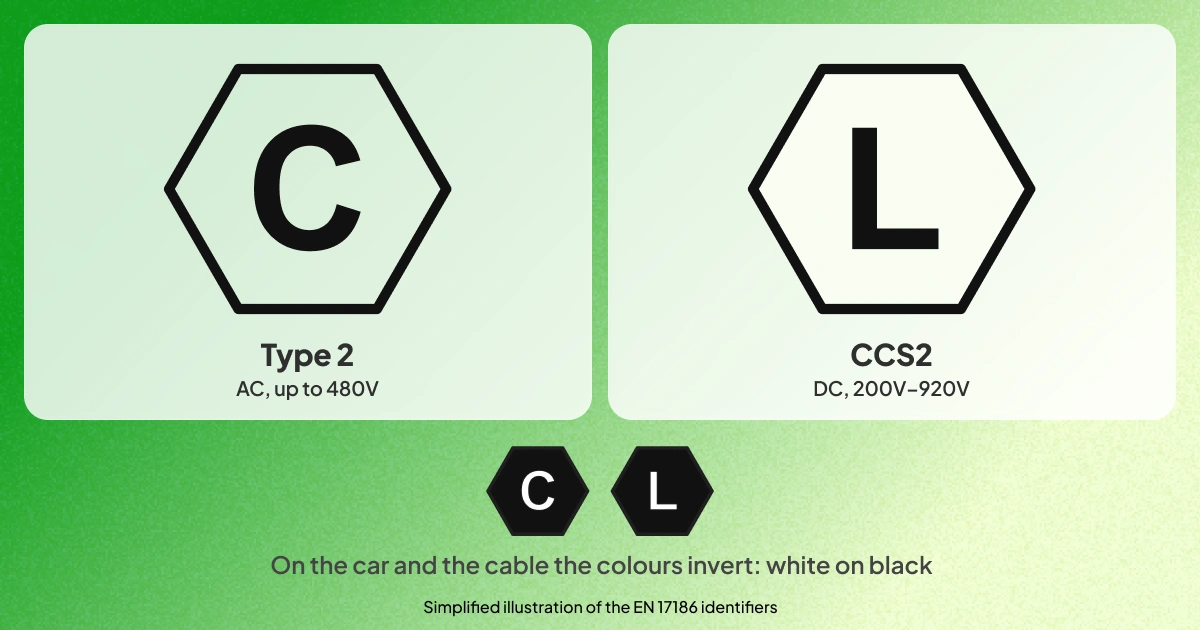
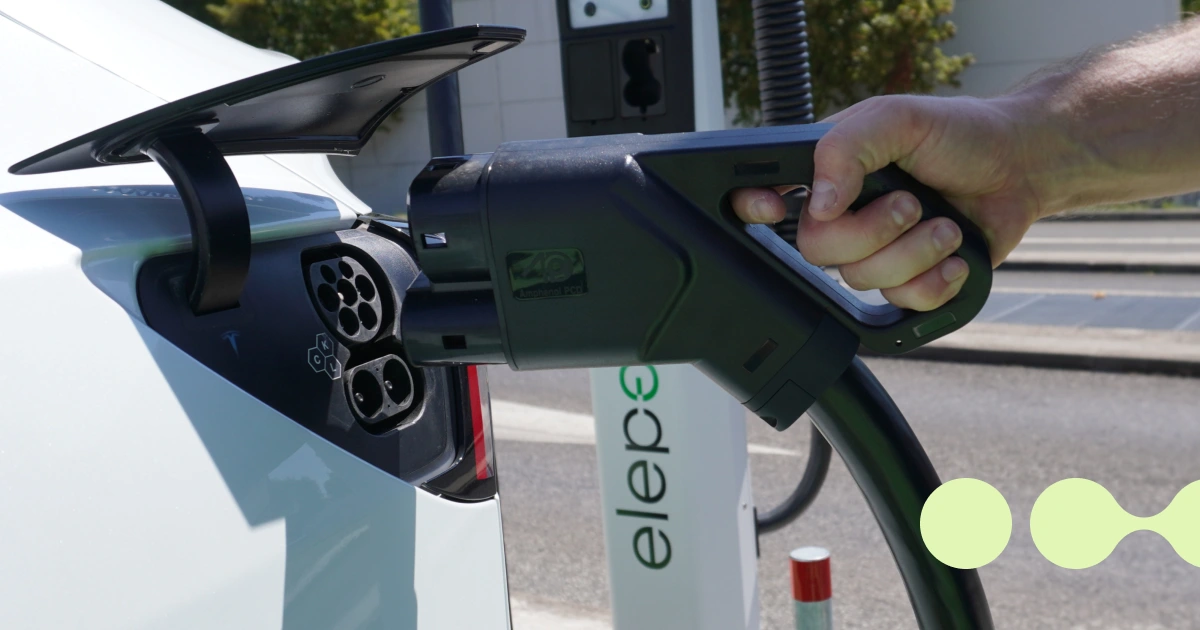
If you look at the flap covering your charge port, there should be a hexagon on or near it, with a single letter inside. That small shape is the EV charging icon the European system runs on.
Since 20 March 2021, the label has been mandatory across the EU, on every newly built public charging station and on every newly produced electric car, van, truck, bus, moped, motorcycle and quadricycle.
The requirement arrived with the 2014 alternative fuels directive, which AFIR (the Alternative Fuels Infrastructure Regulation) replaced in 2024. The design itself comes from the European standard EN 17186, and the industry bodies behind the rollout, ACEA, ACEM, CharIN, ChargeUp Europe and Eurelectric, publish the reference sheets for consumers and operators.
Nine letters are defined. B, C, D and E cover alternating current (AC), while K, L, M, N and O for direct current (DC)
Two of them do nearly all the work in Europe.
- C is Type 2 alternating current up to 480V, which is the socket on almost every AC charge point in Europe.
- L is Combined Charging System Type 2 (CCS2) direct current, rated 200V to 920V, and that is what you plug into at most fast chargers.
Notice what the letter carries that a picture could not. K and L are both CCS2, separated only by the voltage band the equipment is rated for.
An EV charging point symbol is two facts in one glyph: the plug and the volts.
The label has no picture on it, no plug outline, no car, no lightning bolt. That’s because a letter survives cheap printing and a decade of car park weather better than a more sophisticated electric vehicle symbol would, and it needs no translating.
The same hexagon turns up in four places: beside the charge port, in the handbook, on the charger, where the charging station symbol sits next to the socket outlet or the connector holster, and on the connector of each tethered cable, or on a flag beside it.
What does the EV charging icon on a car’s charging flap mean? It is a hexagon holding one letter, set by the European standard EN 17186, and the letter names both the connector and the voltage band. C is Type 2 alternating current up to 480V. L is Combined Charging System Type 2 direct current between 200V and 920V. If the letter on the car appears on the charger, the connector fits.
That one EV charging symbol replaced a decade of guesswork about Type 2, Combo, CHAdeMO, even though, of course, you could always test the cable also visually or whether it… fits.
Everything above the socket is where the consistency runs out.
Why Is There Still No Standard EV Charging Sign On European Roads?
The hexagon tells you what fits once you have arrived. Arriving is the unsolved half when it comes to signage. Is there a standard EV charging sign across Europe? The answer is: not yet.
In June 2025, four national EV driver associations from Hungary, the Netherlands, Austria and Slovenia presented a survey of European charging signage at EVS38 in Göteborg. Their central finding fits in one line:
As of April 2025, they wrote, EV charging station signs are not regulated within the Vienna Convention. And that is a bigger hole than it sounds. The 1968 Vienna Convention on Road Signs and Signals is the reason a stop sign in Portugal is recognisable to a driver from Poland, and charging is simply absent from it.
So every country drew its own. Several drew more than one, actually.
Which makes an EV charging sign in Europe a category of something that has about as many designs as there are transport ministries.
In practice, an electric vehicle charging station sign can be a plug, a car trailing a cable, a modified fuel pump, or a blue rectangle with a word on it, depending on which border you crossed most recently.
Drivers sometimes pay for that difference in signage in the dullest possible way, especially if they don’t use an EV route planning app. They miss the exit, whether on a motorway or also in the city.
What Does An EV Charger Sign Look Like In Germany, Slovenia And Austria?
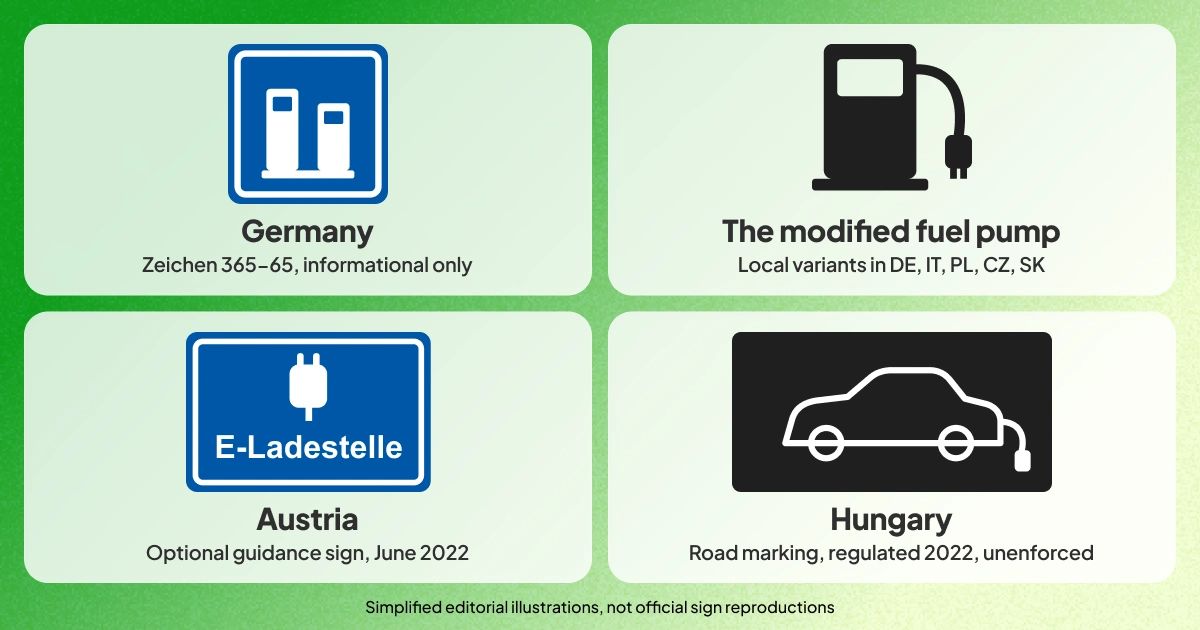
Germany has a dedicated charging station sign, number 365-65, showing two charging columns. It is the official EV charger sign there, the one you meet on the approach to a site.
It also comes with a trap. ADAC points out that 365-65 is purely informational. It tells you a charger exists somewhere ahead. And on its own, this EV charging sign grants you no right to park.
A second symbol runs alongside it. The EVS38 authors found a modified fuel pump, or a local variant of one, in use in several countries including Germany, Italy, Poland, the Czech Republic and Slovakia. Same silhouette as the petrol symbol every driver already knows, cable where the hose goes.
Slovenia came out of that survey as the most fully regulated of the countries the authors examined, with a traffic sign for designated EV parking, a sign requiring you to charge while you are there, a directional sign ahead of service areas and standardised road markings. Enforcement there rests on the signs being right in the first place.
Austria sat at the other end. As of April 2025, the field was largely unregulated, an optional “E-Ladestelle” guidance sign had existed since June 2022, and the motorway operator ASFINAG had gone ahead with symbols of its own. Street markings carried no enforcement behind them.
Hungary regulated a marking in 2022, an outline car with an electric cord, and then never enforced it, which leaves using it up to the operator.
Britain, meanwhile, went and tested the question properly. Research the Department for Transport published in 2025, from fieldwork run in 2022, put three candidate symbols in front of 1107 drivers in England: a fuel pump with a lightning bolt, a car seen head-on with a plug, and a car in profile with a lightning-shaped cable.
An electric vehicle charging sign has to be read at speed, in traffic, by someone who has never thought about it before. Harder than the EV charging symbol on your charge flap, which is part of why so few countries have completed the whole work in getting it regulated.
Can you park at a charging bay without plugging in? Often not. Germany treats it as a 55€ offence and allows the car to be towed, and British councils issue penalty charge notices to any vehicle, electric or not, sitting in a dedicated bay without charging. Read the small plate under the blue P sign, because the rules and the permitted times are set locally.
What Belongs On Charging Station Signage At A Charging Site?
For charge point operators, the legal minimum is now short and specific.
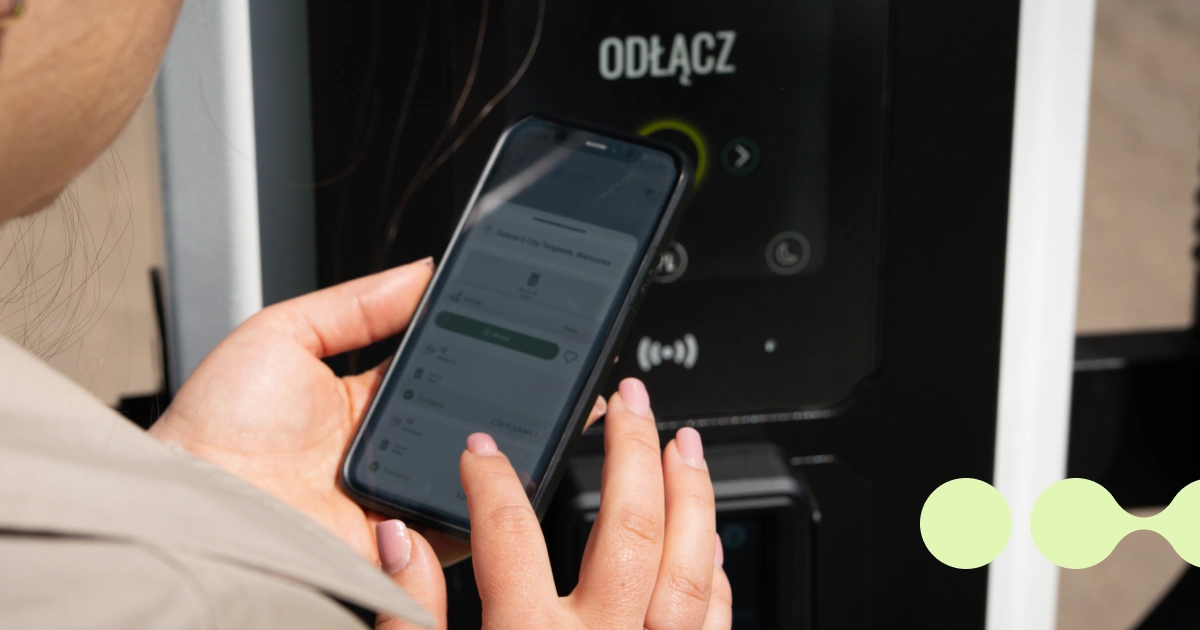
For recharging points built from 13 April 2024, AFIR requires the ad hoc price to be shown before anyone plugs in. The European Commission’s own questions and answers on the regulation spell out what “shown” means: at points of 50 kW and above the price has to be visibly present at the station itself, on a screen or on a sticker, while below 50 kW it can be made available electronically, through a QR code or a link.
Then the EN 17186 hexagon, which is the EV charging station symbol the law itself specifies, adjacent to the socket outlet or the connector holster, plus a label on the connector of each tethered cable or on a flag beside it.
That is the compulsory part. Everything after it is a design decision, and it’s also where good sites separate themselves.
An EV charging station sign board at the entrance, readable from the road, saves drivers the slow crawl around a retail park. Numbered bays turn a support call into a five-second conversation. The operator’s name and a fault number on the unit itself do the same job.
Good EV charging station signage also answers the questions the law ignores. How many charging stalls. What power is available. Whether the site is open at three in the morning. Whether the parking costs anything.
The EV charging station symbol should be put where a driver at the far end of the car park can see it. And charge point operators should keep the electric vehicle charging station sign at the road consistent with whatever the map app is showing.
What Changes Next For Charging Station Signage In Europe?
The UK is the market moving fastest, mostly because it started from the strictest rules.
Until 2025, a charging site could only be signposted from the strategic road network if it also sold petrol and diesel, which shut out standalone hubs. In July 2025 the Transport Secretary announced that larger hubs could be signposted from the A-roads National Highways manages, the all-purpose trunk roads.
The criteria for an EV charging sign in National Highways’ signing guidance are demanding. At least twelve open-access chargepoints of 150 kW or more, running around the clock, hot drinks and cooked hot food, Wi-Fi, a free emergency telephone, and parking for visitors who are not charging. For motorway signs the fuel requirement still stands.
Then in February 2026 the Office for Zero Emission Vehicles opened a call for evidence, and it closed the following month. InstaVolt, char.gy, Octopus Electric Vehicles and Electric Vehicles UK all weighed in, and the asks overlap.
We can think of charging like fuel in the signing rules, standardizing the symbols and the advance signs. And this should make it far easier for a council to add charging to a direction sign it already has in the ground. The addition from char.gy was that lamppost and kerbside chargers need wayfinding too, not only the hubs beside the A-roads.
None of that touches EV charging station signage on the site itself, which AFIR already covers.
The EVS38 authors argued for adopting the modified fuel pump everywhere, on the grounds that several countries and most car dashboards already use it, it reads at motorway speed, and it leaves room for local styling.
The EV charging infrastructure Europe has built since the 2014 directive is now large enough that the signing gap shows. A charger nobody can find sits idle, and an EV charging sign is a great deal cheaper than another cabinet.
Until The Rules Catch Up, Keep Your Eyes Peeled
We’ve established we are actually all set on the charging port symbols for connector types… the one that almost no EV driver actually checks.
But when it comes to the road signs to find charging sites, it looks very different based on which country you’re in. So unless you have a great EV charging app that does the job of finding and navigating to a charging station properly for you, you’ll have to pay a lot of attention to anything looking like a plug sign around town or on motorways.
Even worse, if the EV charging sign is adapted from the gas station sign, it might not look like a charging site at all at first glance.
And once at the charging site and trying to get the information on where any specific stalls are located, either for accessibility, different power levels, or something else, you’ll see this isn’t just different per country, but also varies significantly based on which charging operator site you’ll end up at.