
Three quarters of 2026 are done, and electric vehicle sales in Europe have picked up speed instead of settling down.
Across the 31 European markets we follow, 2 549 810 new battery electric vehicles (BEVs) were registered between January and September. That is 752 752 more (41,9% more) than in the same nine months of 2025, while overall new car sales Europe-wide grew just 6,3%.
Are EV sales increasing in Europe? Yes, and faster as the year goes on. Battery-electric vehicle sales across Europe rose 41,9% in the first nine months of 2026, up from 35,1% at the half-year mark, which we showed in the previous report H1 in July.
A year earlier, January to September 2025 had grown 25,4% on 2024, so the growth has been accelerating.
Below is the full country-by-country picture for all 31 markets, based on data from ACEA along with all the reasons for any market movements we’ve researched.
Almost every fourth new car sold in Europe this year is electric
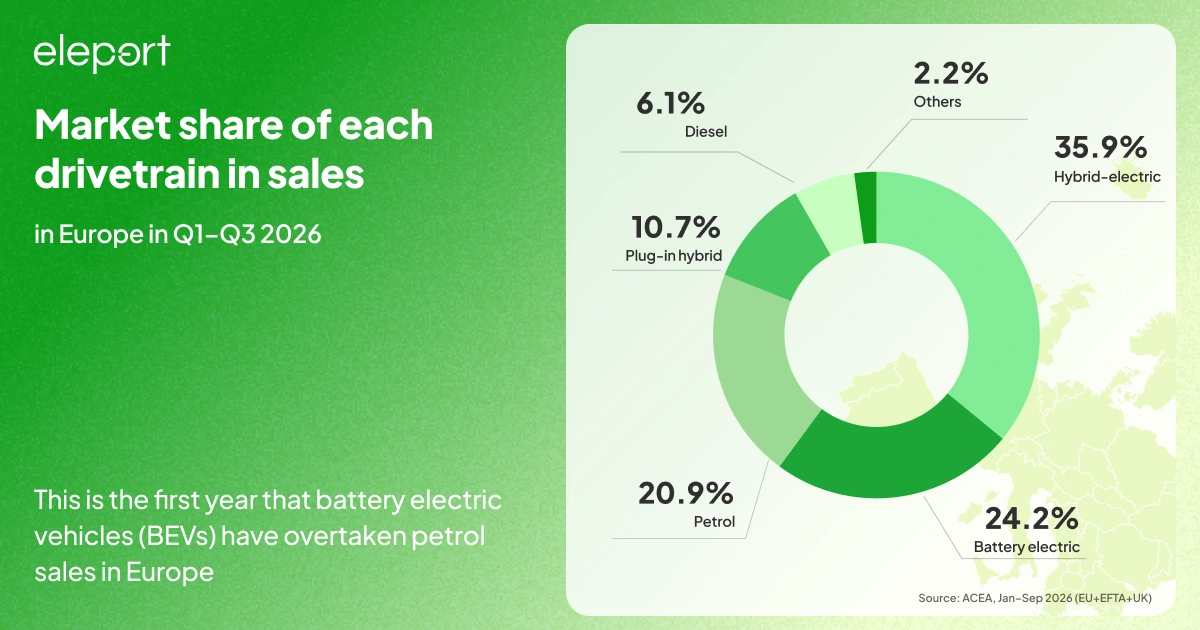
What percentage of new car sales are electric in Europe? Battery-electric cars took 24,2% of all new car sales Europe-wide in the first nine months of 2026, up from 18,1% a year earlier, and 30,5% in September alone.
The bigger change sits inside the EU numbers. Across Europe as a whole, battery-electric cars had already outsold petrol by the end of June. Inside the EU they had not, with petrol still ahead at the half-year mark (1 309 153 against 1 220 890).
Over the summer, that flipped, and the nine-month count ended with 1 931 465 battery-electric cars against 1 802 078 petrol ones.
The hybrid electric car remains the most popular choice, at 35,9% of the European market. Petrol took 20,9%, plug-in hybrids 10,7%, diesel cars 6,1% and other fuels the remaining 2,2%. Battery cars now outsell plug-in hybrids by more than two to one.
September on its own was something else. Electric car sales across Europe reached 416 433 that month, according to ACEA’s monthly table, 59,9% more than in September 2025 and a 30,5% share of the market. That is close to every third car sold being fully electric.
The big three: Germany, the UK and France lead in EV volume
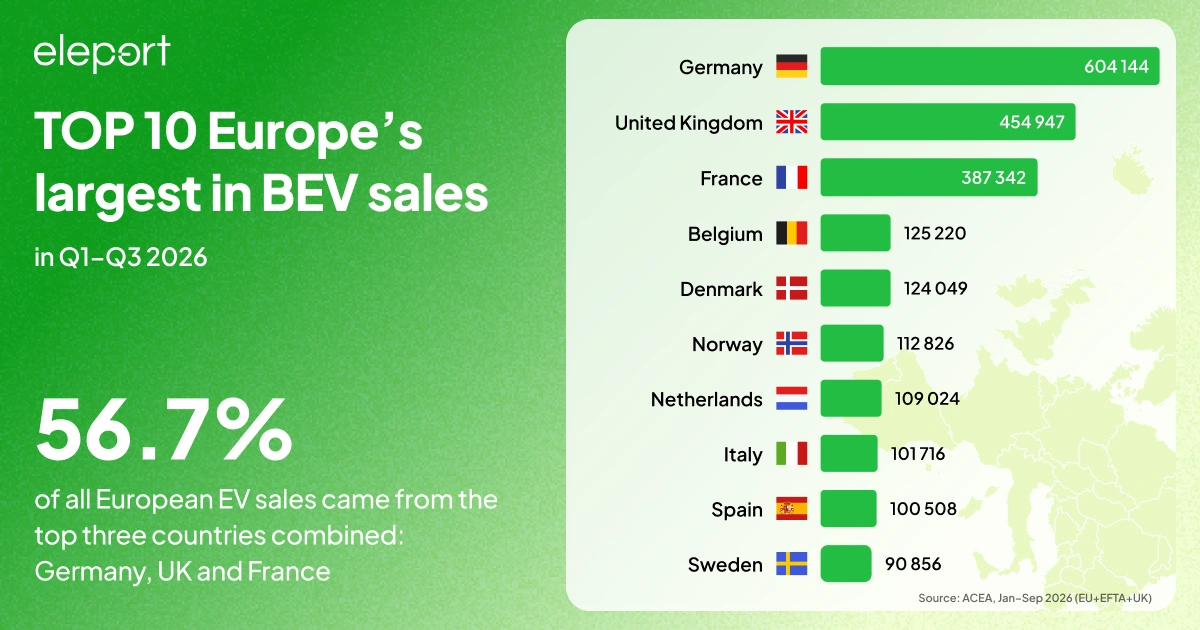
Germany, the UK and France accounted for 56,7% of all electric vehicle sales in Europe over the nine months, up from 55,6% at the half-year mark – so their influence in the EV realm is even slightly growing. Two of the three are also among the fastest growers on the continent this year, which is not something you would usually expect from markets this size.
Germany: 604 144 EVs sold in the first nine months of 2026, growing +58,1% year-on-year. BEV market share climbed from 18,1% to 27,2%.
Germany’s new purchase grant now has real weight behind it. Applications opened on 19 May for cars registered from 1 January, and by 1 October BAFA had approved 97 790 applications and paid out 432 million euros, 89 594 of them for fully electric cars. German electric vehicle sales almost doubled in September alone, to 88 599, and the 221 942 extra EVs compared to last year are the largest absolute gain anywhere in Europe.
In other words, Germany added more EVs compared to last year’s sales than nearly any other country saw sold in total. Well, except these two:
United Kingdom: 454 947 EVs sold in the first nine months of 2026, growing +30,2% year-on-year. BEV market share rose from 22,1% to 26,2%.
September brought the UK’s best month ever for electric car sales, 99 201 of them, and SMMT credits carmaker discounts, the grant and high fuel prices. Even so, the year-to-date share is still well short of the 33% the ZEV mandate asks of carmakers for 2026. From August to late October, the government consulted on easing the mandate’s targets from 2027 onwards. Underneath it all, the Electric Car Grant keeps paying up to £3750 a car.
France: 387 342 EVs sold in the first nine months of 2026, growing +79,1% year-on-year. BEV market share jumped from 18,2% to 31,4%.
No large market moved further this year; what a jump from 18,2% to 31,4%! One of the reasons is likely the third round of social leasing opening on 16 July with at least 50 000 places for lower-income households at up to 200€ a month.
Ten European countries are now above 30% EV market share
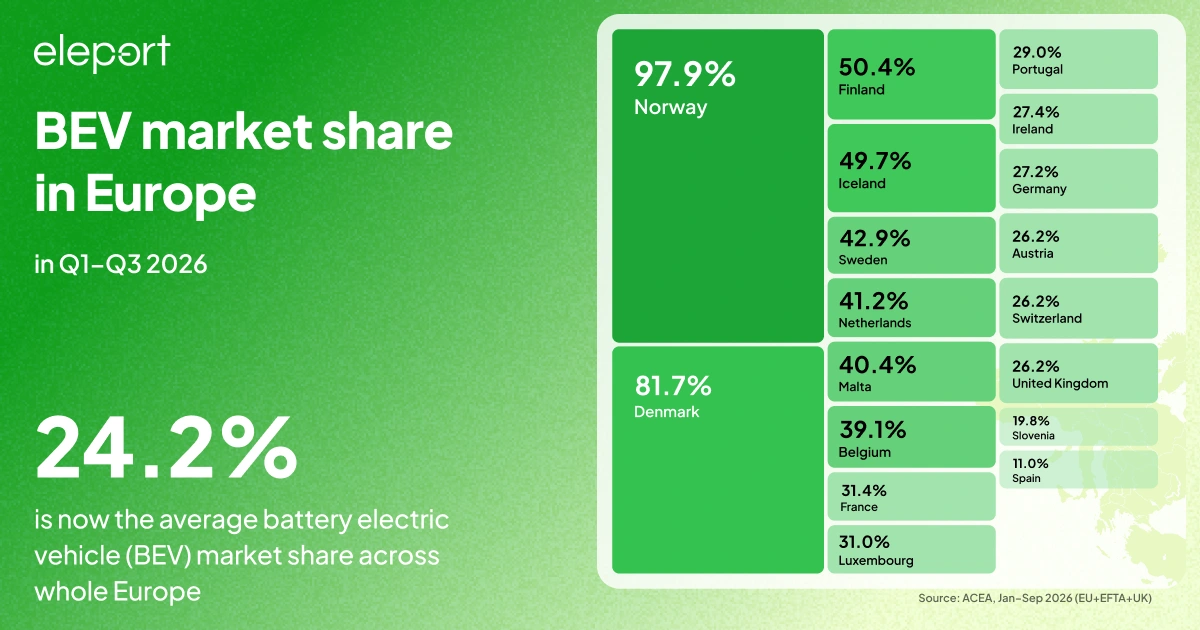
When we wrote up EV Sales in Europe Q1 2026 in the spring, six countries sat above the 30% line. By the end of June there were eight, the same eight as after the first nine months of 2025, and now there are ten, with France and Luxembourg the newest arrivals. One of the ten has also crossed a line of its own, as Finland is now selling more electric cars than everything else combined.
Norway still has the highest EV market share in Europe:
Norway: 112 826 EVs sold in the first nine months of 2026, growing +4,6% year-on-year. BEV market share rose from 94,5% to 97,9%.
The market made up for its slow start, and September reached a 98,8% EV share, a record according to OFV. The next step for Norway’s EV tax break is already on the table. The 2027 budget bill cuts the VAT-free part of an EV’s price from 300 000 NOK to 150 000 NOK from 1 January 2027, so we expect a busy end to the year.
Denmark: 124 049 EVs sold in the first nine months of 2026, growing +40,3% year-on-year. BEV market share jumped from 65,9% to 81,7%.
The growth curve of Denmark has been wild to witness. What helps is likely the fact that electric cars in Denmark still pay only 40% of the calculated registration tax this year. Under current rules, that discount shrinks from 1 January 2027, unless politicians step in first. Will it put a dent in the growth curve at all? We will see.
Finland: 28 677 EVs sold in the first nine months of 2026, growing +49,1% year-on-year. BEV market share climbed from 35,6% to 50,4%.
More than every second new car in Finland is now a battery electric vehicle, the third country above that line this year, after Norway and Denmark.
Iceland: 5108 EVs sold in the first nine months of 2026, growing +36,2% year-on-year. BEV market share rose from 35,1% to 49,7%.
Iceland is almost back at the 50% line in BEV market share, so every second car sold in the country is now fully electric. Early this year, the purchase grant shrank to 500 000 ISK in January, but on the same day, Iceland scrapped the excise duty on electric cars and raised it on combustion ones, and the EV share has climbed 14,6 percentage points in a year.
Sweden: 90 856 EVs sold in the first nine months of 2026, growing +25,8% year-on-year. BEV market share rose from 35,4% to 42,9%.
Private buyers are doing the heavy lifting in Sweden, with their share of electric car sales up from 33% to 40% this year, according to Mobility Sweden. There is also a new state grant this year, the elbilspremie, open since 18 March to lower-income households in rural areas. It is worth up to 46 800 SEK (~4200 €) over three years and covers used and leased electric cars as well as new ones.
Netherlands: 109 024 EVs sold in the first nine months of 2026, growing +16,2% year-on-year. BEV market share rose from 34,8% to 41,2%.
Dutch electric car sales went from -0,1% at the half-year mark to solid growth in one quarter. In September, the BEV share even hit 52,8%.
Malta: 2425 EVs sold in the first nine months of 2026, growing +57,4% year-on-year. BEV market share rose from 33,3% to 40,4%.
As we mapped out in our overview of all Europe EV incentives per country report, Malta’s is one of the more generous ones: the 2026 grant pays 8000€ towards an electric car priced up to 40 000€, with a scrappage top-up on top. Growth has cooled from +78,2% at the half-year mark, but +57,4% still puts Malta in the largest-growth group below.
Belgium: 125 220 EVs sold in the first nine months of 2026, growing +15,7% year-on-year. BEV market share rose from 33,4% to 39,1%.
September was the first month ever with BEV share above 50% (50,9%) for the Belgian market, and for the first time more than a fifth of private buyers chose a fully electric car. Company cars still drive the market, because a fossil company car ordered since January is no longer tax-deductible, while an electric one ordered in 2026 remains 100% deductible.
France: already covered above as one of the big three, and its 31,4% places it ninth in this group.
Luxembourg: 11 615 EVs sold in the first nine months of 2026, growing +23,6% year-on-year. BEV market share rose from 25,7% to 31,0%.
Luxembourg crossed the line this quarter. In March, the government announced it would extend the Klimabonus Mobilitéit grant of up to 6000€ to 30 June 2030, although still waiting for its plenary vote at the time of writing.
European countries with the largest electric vehicle sales growth in the first nine months of 2026
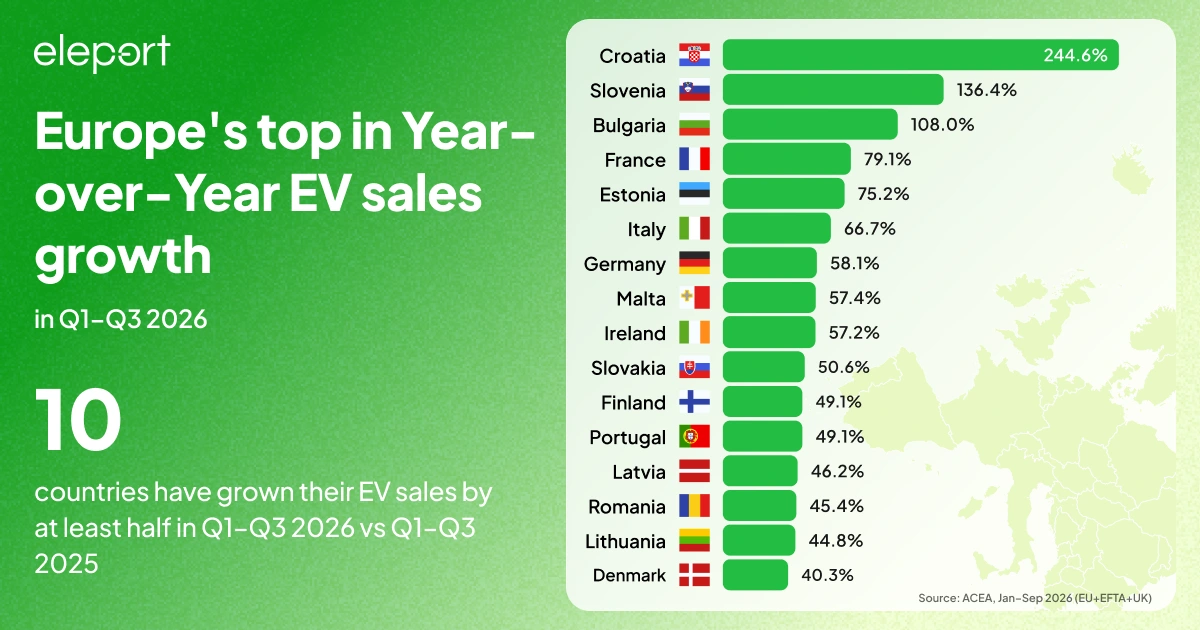
Ten countries grew their EV car sales by at least half compared to a year ago.
Croatia: 2457 EVs sold in the first nine months of 2026, growing +244,6% year-on-year. BEV market share jumped from 1,3% to 4,2%.
Croatian electric vehicle sales grew more than any other country’s, although from a very low base. From the incentives side, for most of the year, the only grants on offer were for companies, including a 45-million-euro call for taxi and car-sharing firms. Private buyers get their turn now, with a 20-million-euro scheme paying up to 9000€ a car and taking applications from 28 October, so we might actually see acceleration in these numbers into the next year.
Slovenia: 10 457 EVs sold in the first nine months of 2026, growing +136,4% year-on-year. BEV market share climbed from 10,0% to 19,8%.
EV car sales more than doubled, perhaps on the back of one of Europe’s most generous EV subsidies, which paid households up to 7800€ on a car costing 25 000€ or less. That money has now run out. By 12 August, the applications had already exceeded the funds available, so we’ll be watching if Q4 brings any drawdown here or the market continues towards EVs naturally.
Bulgaria: 3480 EVs sold in the first nine months of 2026, growing +108,0% year-on-year. BEV market share rose from 4,6% to 8,8%.
Sales more than doubled without a national purchase grant. Bulgaria has never had significant EV subsidies, and in June Capital put the growth down to cheaper models, with some Chinese brands starting below 20 000€, to company fleets, and to fuel prices. Additionally, Eleport’s unique European Fast Charging Price Report 2026 just found that Bulgaria has the third-cheapest median fast charging prices in all of Europe.
France: already covered above as one of the big three, and its +79,1% growth places it fourth in this group too.
Estonia: 1153 EVs sold in the first nine months of 2026, growing +75,2% year-on-year. BEV market share edged up from 7,0% to 7,8%.
Fast growth, although a small share gain. The whole Estonian car market is up 56,4%, rebounding from a 2025 in which new car sales halved after the registration fee arrived, and hybrids already took about two thirds of it. In April, dealers said company fleets and rental firms were leading the recovery, and there is still no purchase grant for electric cars on the market.
Italy: 101 716 EVs sold in the first nine months of 2026, growing +66,7% year-on-year. BEV market share rose from 5,2% to 8,0%.
As one of the largest car markets in Europe, it is encouraging to see Italian electric vehicle sales passing 100 000 in significant growth. Now we will have to see if the momentum will fade somewhat due to the EV incentive ending on 30th of June or not, as there is no new scheme set yet for private buyers.
Germany: already covered above as one of the big three, and its +58,1% places it seventh in this group.
Malta: already covered above among the countries over 30% EV market share, and its +57,4% growth places it eighth in this group too.
Ireland: 35 179 EVs sold in the first nine months of 2026, growing +57,2% year-on-year. BEV market share jumped from 18,4% to 27,4%.
July was Ireland’s best EV month on record, with 9682 registrations. On the incentives side, it followed a pilot scrappage scheme that paid 5000€ on top of the regular 3500€ grant. Its 10-million-euro budget went within hours of opening on 1 July.
Slovakia: 4470 EVs sold in the first nine months of 2026, growing +50,6% year-on-year. BEV market share rose from 4,4% to 7,0%.
Slovakia has no purchase subsidy, and most of its EVs bought are company cars. Since 2025, electric and plug-in hybrid company cars have been taxed at half the benefit rate of other cars, and the SEVA association says companies took more than 80% of new electric cars in the first quarter.
Two European countries where electric vehicle sales haven’t grown this year
Out of 31 markets, 29 grew, and only two posted an EV sales decline. Both were still growing at the end of June.
Poland: 24 404 EVs sold in the first nine months of 2026, declining -5,5% year-on-year. BEV market share slipped from 6,0% to 5,2%.
The one large market moving the wrong way. Importers’ association PZPM puts Poland’s EV sales decline down mainly to the absence of state support. The NaszEauto grant’s money was effectively gone by the end of January, and the programme stopped taking applications on 30 April. Since in 2025 Poland was at the top of the charts in growth, there’s already a high bar for Poland to clear, let’s see if the market lands on a more sustainable growth from now on.
Cyprus: 1099 EVs sold in the first nine months of 2026, declining -4,4% year-on-year. BEV market share still rose from 9,7% to 10,4%.
The drawdown was likely a distortion caused by a specific grant call ending by 30th of June, and no new call has opened since. The share rose anyway, because new car registrations of every kind fell faster still (-10,9%).
Other European countries that are silently moving towards EVs
Between the leaders and the two decliners sits the rest of the continent, where electric vehicle sales gain a point or two of share a year and the totals still add up to a lot of cars.
Spain: 100 508 EVs sold in the first nine months of 2026, growing +39,5% year-on-year. BEV market share rose from 8,4% to 11,0%.
Spain crossed 100 000 EVs and 10% share in the same quarter. It was likely helped by the Plan Auto+ grant opening on 4 August with 350 million euros for private buyers, paying up to 4500€ a car and backdated to purchases from 1 January. Spanish electric car sales rose 71,7% in September.
Austria: 63 172 EVs sold in the first nine months of 2026, growing +36,9% year-on-year. BEV market share rose from 21,5% to 26,2%.
Austrian electric vehicle sales grew faster than in the first half without any purchase grant at all.
Portugal: 54 726 EVs sold in the first nine months of 2026, growing +49,1% year-on-year. BEV market share climbed from 21,4% to 29,0%.
Nearly three in ten new cars in Portugal are now fully electric, and very little of that comes from grants, since the 2026 Fundo Ambiental money went within hours of opening in June. The bigger factor on incentive side is tax. Electric cars pay no registration or road tax, and companies pay no autonomous taxation on an electric car costing up to 62 500€, against 8% to 32% on a petrol or diesel one.
Switzerland: 45 464 EVs sold in the first nine months of 2026, growing +27,3% year-on-year. BEV market share rose from 21,1% to 26,2%.
September even set a Swiss record of 35,7%. Buyers still get almost nothing in incentives so we’re looking at natural growth.
Czechia: 13 806 EVs sold in the first nine months of 2026, growing +35,6% year-on-year. BEV market share rose from 5,6% to 7,4%.
Still no purchase subsidy in Czechia so the steady growth is all natural, and still also Škoda’s home game. September brought a record 11,2% BEV sales share, the Enyaq and Elroq were the country’s two best-selling EVs through August, and two more Škoda EVs, the Epiq and the Peaq, joined the registration tables over the summer. These also happen to be among the best-selling cars in all of Europe.
Hungary: 10 443 EVs sold in the first nine months of 2026, growing +30,1% year-on-year. BEV market share rose from 8,4% to 9,6%.
Growth has eased from +43,7% at the half-year mark. Hungary’s corporate purchase grant ran through its 45-billion-forint budget in early April and required the cars to be registered by 12 June, which pulled fleet deliveries into the first half. No replacement has been announced, although Hungary is also where BYD Europe is about to start building cars which should soon energize the market.
Greece: 8180 EVs sold in the first nine months of 2026, growing +32,9% year-on-year. BEV market share rose from 5,5% to 7,1%.
September was Greece’s best EV month on record. The Kinoumai Ilektrika 3 subsidy, worth 3000€ towards a battery-electric car, stays open until 31 December 2026 with a budget of 76 million euros, which should further boost the market.
Romania: 7889 EVs sold in the first nine months of 2026, growing +45,4% year-on-year. BEV market share rose from 5,0% to 8,1%.
EV sales grew while the total Romanian car market fell 10,6%. The 2026 Rabla round for private buyers finally opened on 20 July, and the 120 million lei set aside for electric and other zero-emission vehicles was already gone by 30 July, ten days after opening.
Lithuania: 3143 EVs sold in the first nine months of 2026, growing +44,8% year-on-year. BEV market share rose from 6,9% to 8,5%.
After the old grant ran out in early June, a new round opened on 31 July, paying private individuals 5000€ towards a new electric car registered from 1 May onwards, which in turn seems to have helped further energize the sales.
Latvia: 1831 EVs sold in the first nine months of 2026, growing +46,2% year-on-year. BEV market share rose from 7,1% to 10,4%.
The slowest Baltic grower at the half-year mark now has the highest EV share of the three, above 10%. Latvia’s old purchase grant ran out of money in August 2025, and a new 40-million-euro programme was approved in April, with currently ~ 17 million euros still left in the pot.
What electric cars are Europeans buying?
Looking at the top 10 of BEV models sales in Europe compiled by Jose Pontes at Cleantechnica for January to August 2026, we find familiar cars up top. Fully electric vehicle (BEV) sales:
- Tesla Model Y with 126 377 sales
- Skoda Elroq with 77 437
- Renault 5 with 68 419
- Tesla Model 3 with 64 250
- Skoda Enyaq with 60 492
- BYD Seal U BEV with 57 627
- VW ID.4 with 54 823
- VW ID.3 with 49 408
- Mercedes CLA EV with 45 325
- BYD Atto 2 BEV with 44 530
Is BYD outselling Tesla in Europe? Counting every powertrain, yes. BYD Europe registrations reached 283 997 in the first nine months of 2026, up 134,6%, against 260 575 for Tesla, according to ACEA. Much of BYD’s volume is plug-in hybrids, though, and in September Tesla sales Europe-wide were also higher in total, 68 776 to 49 953.
Tesla sales Europe-wide are up 50,0% on last year. According to Dataforce, Tesla Model Y yet again leads all car sales Europe-wide this year regardless of fuel type, with 167 369 registrations against 162 969 for the Dacia Sandero.
Electric vehicle sales in Europe in the first nine months of 2026: an overview in six key numbers
The latest EV sales data puts Europe only 35 377 EVs short of the 2 585 187 sold in the whole of 2025, with a full quarter still to go.
- 2 549 810 new battery electric cars were registered across Europe, up 41,9% on the first nine months of 2025. In absolute terms, that’s 752 752 extra EVs.
- BEVs took 24,2% of the European market, up from 18,1% a year earlier, and 30,5% in September alone.
- Battery-electric cars outsold petrol across Europe (EU+EFTA+UK), and over the summer they overtook petrol inside the EU as well.
- 29 of the 31 markets grew their electric vehicle sales. Poland (-5,5%) and Cyprus (-4,4%) were the exceptions.
- Ten countries stand above 30% BEV market share, and also ten grew their EV sales by 50% or more.
- Germany, the UK and France together accounted for 56,7% of all European EV sales.
The direction of this year has not changed since spring, only the pace.
More competitive EVs, grants, company car taxes and high fuel prices all pushed electric vehicle sales the same way this year. Among the previous high growers, Poland and Cyprus show how quickly growth can stall once a subsidy ends, which is a natural pause after strong incentives. Several deadlines fall on 1 January 2027, from Belgium’s fully deductible company EVs to Denmark’s registration tax and the Dutch levy on non-electric company cars. Norway’s budget bill would cut its EV VAT break the same day.
But while the incentive structures can distort the markets in both directions, the sustained growth we see across markets makes it clear – Europe is going fully electric.