

2026 has been a great year for EV sales across Europe, and the latest data coming in from January to the end of June, the first half of 2026, has shown 1 608 200 new battery electric vehicles (BEVs) registered across the continent, according to fresh ACEA data.
That marks 35,1% growth compared to the first half of 2025, when 1 190 106 EVs were sold across the same 31 markets. Below, we will take a look at the EV sales across every country in Europe.
Are EV sales growing or slowing in Europe in 2026? Confirmed now as growing, and faster than last year. Electric car sales H1 2026 rose 35,1% across Europe, against the 24,9% growth recorded over the same period in 2025 when 1 190 106 EVs were sold in the same 31 markets.
Out of the 31 countries we looked at, just one saw a decline. And that, only by 45 cars compared to the year before.
But first, here is how the European market was split by powertrain in first half of 2026, looking beyond just electric car sales in Europe 2026:
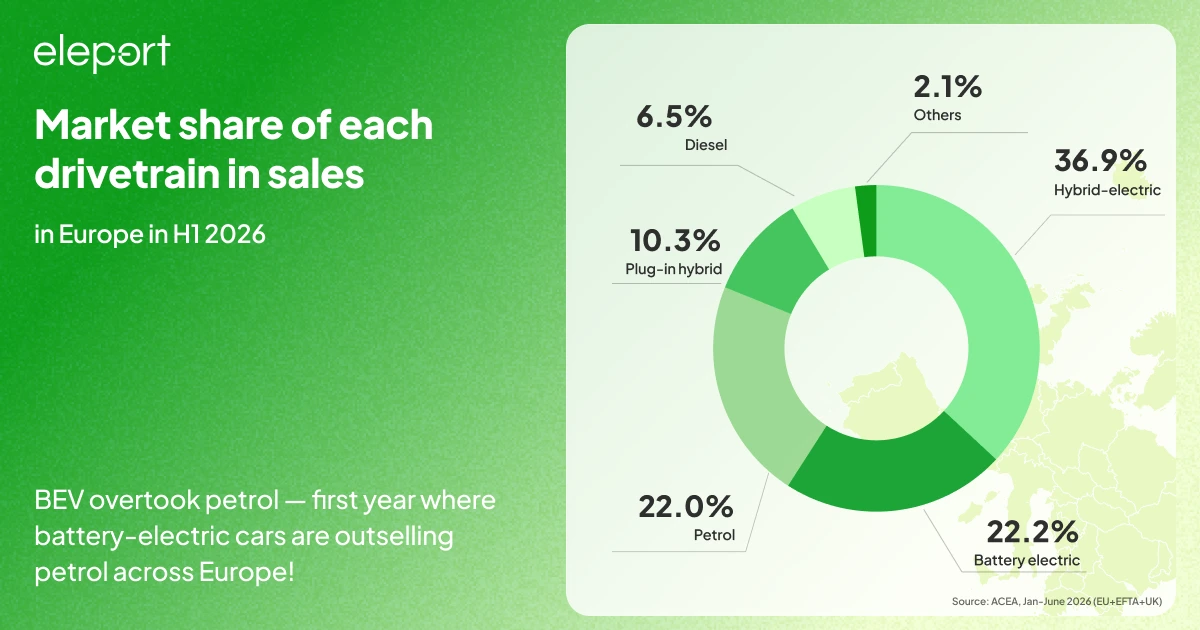
BEV market share (22.2%) is well ahead of diesel (6.5%) in Europe by now, and BEV sales are now officially also ahead of petrol (22.0%) through the whole first half of 2026! A year ago, petrol had 27.8% of the European market and BEVs only 17.5%. Hybrid-electric vehicles are taking up the largest share of the market, having actually grown from 35% last year to now 36.9%.
Now, let’s break down the EV adoption growth across each country in Europe in the first half of 2026.
* Note: all values for “EV” here refer to battery-electric vehicles (BEVs) only. EV sales in Europe refers to EU+EFTA+UK. Not plug-in hybrids (PHEVs) or any ICE variant included. You can read more about the drivetrain differences in our EV vs ICE comparison.
The big three: Germany, the UK, and France continue to lead in EV volume
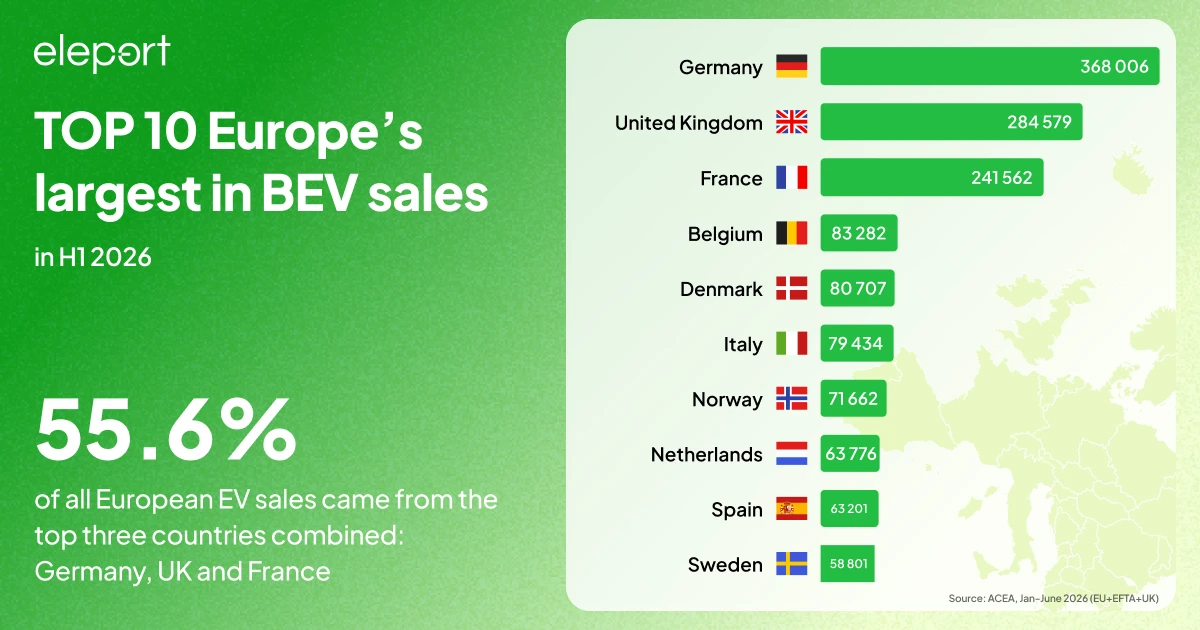
More than half of all EV sales in Europe over the first half of 2026, 55,6% to be exact, came from three countries, the same three that have carried the volume story for years now.
Germany: 368 006 EVs sold in the first half of 2026, growing +48,0% year-on-year. BEV market share climbed significantly from 17,7% to 24,8%.
The recovery that started in 2025, after the environmental bonus drama of late 2023 going into 2024, is still running at full speed. Every fourth new car sold in Germany is fully electric this first half of 2026, and with 119 280 more EVs registered than a year ago, the gap between Germany and everyone else in terms of sales keeps widening. With 22.8% of all EV sales, every fifth of each EV sales in Europe lands in Germany.
The new purchase grant is not the explanation for the great run this year, or not yet, since BAFA only opened applications on 19 May 2026, so we can expect more of this.
United Kingdom: 284 579 EVs sold in the first half of 2026, growing +26,6% year-on-year. BEV market share rose from 21,6% to 25,0%.
Every fourth new car sold in the UK now runs fully on a battery, with the ZEV mandate doing what it was designed to do. Its target rose to 33% for 2026 from 28% the year before, and underneath it the Electric Car Grant has been paying up to £3750 a car since mid-July 2025.
France: 241 562 EVs sold in the first half of 2026, growing +62,9% year-on-year. BEV market share jumped from 17,6% to 28,2%.
What a turnaround for France this year. A year ago, France was the only one of the big three losing ground (-6,4% in the first half of 2025). Then the ecological bonus relaunched in September 2025, two rounds of social leasing filled up at 50 000 contracts each, and a third round is planned for June 2026. France now grows faster than either of the other two in EV sales in Europe, and more than every fourth new car sold in France is now fully electric.
Eight European countries are already at over 30% EV market share
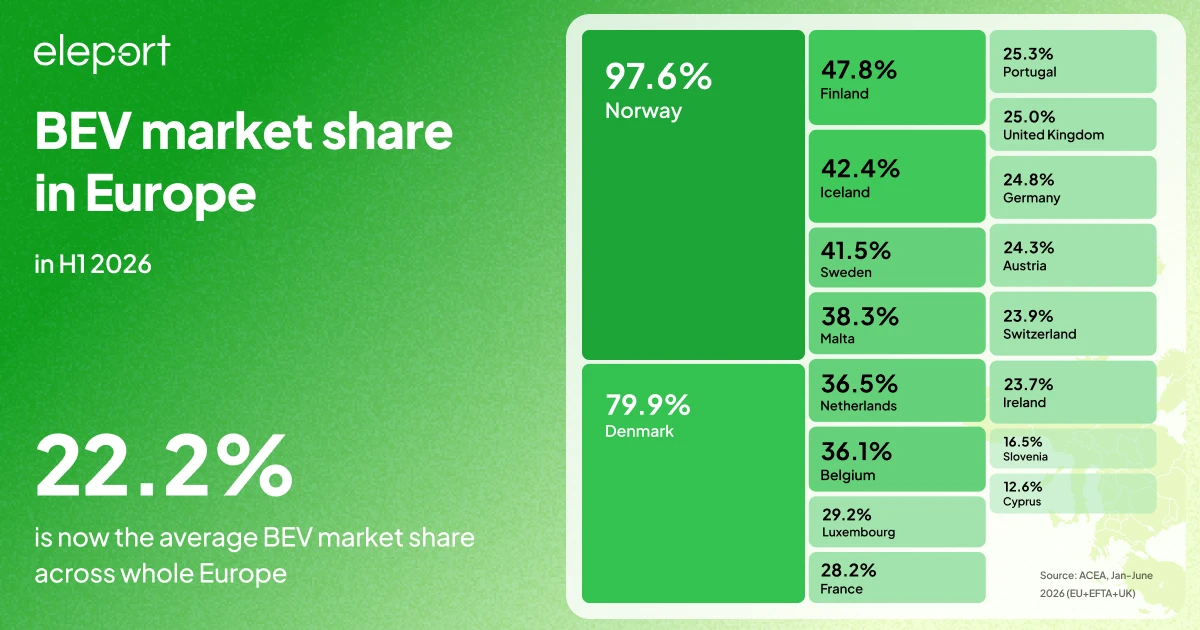
When we wrote up the EV sales of first quarter of 2026, and the first half of 2025 before it, six countries sat above the 30% line. For a while it looked as though the club had settled at that size for a while now. This same list now counts eight members, as Iceland and Malta have joined, and the top of the EV sales in Europe table keeps getting more crowded.
Which European country has the highest EV market share? Norway, obviously, where 97,6% of new cars sold in the first half of 2026 were fully electric. Denmark comes second at a remarkable 79,9%, Finland third at an also impressive 47,8%.
Norway: 71 662 EVs sold in the first half of 2026, growing +1,3% year-on-year. BEV market share rose from 93,0% to 97,6%.
Norway EV market share is now a rounding error away from complete. Fewer than 3 non-electric cars in every 100 sold. Worth noting too that unit sales swung back to growth after the first quarter’s dip, which was always about a shrinking total market, never about falling EV demand. The thin unit growth does have a cause, though.
From 1 January 2026 the VAT exemption only covers the first 300 000 NOK of the price, down from 500 000 NOK, and Norwegians did the natural thing and just bought a lot of their usual planned cars earlier.
Denmark: 80 707 EVs sold in the first half of 2026, growing +41,2% year-on-year. BEV market share jumped from 63,8% to 79,9%.
Four out of every five new cars sold in Denmark are fully electric. A fun fact for the road: Denmark bought more EVs in six months (80 707) than Norway sold cars in total (73 404). Also note the +16.1 percentage point jump in EV market share here, as it’s certainly not easy to do that when the adoption already runs so high. Denmark is now officially outpacing Norway in terms of EV adoption curve (once it got started).
Finland: 17 798 EVs sold in the first half of 2026, growing +39,8% year-on-year. BEV market share rose from 34,2% to 47,8%.
Almost every second new car sold in Finland is now fully electric. Finland has been one of the fastest share climbers EV sales in Europe H1 2026, up 13,6 percentage points compared to last year.
Iceland: 3180 EVs sold in the first half of 2026, growing +39,5% year-on-year. BEV market share recovered from 28,9% to 42,4%.
In the first quarter, the market share had dipped as returning buyers flooded the total market with non-EV purchases (even though EV purchases still grew). That normalised over the spring, and Iceland is back above 40%. Iceland managed that on a smaller grant as before, since state support for a new electric car fell from 900 000 ISK to 500 000 ISK on 1 January 2026. Iceland is now officially past its dip that happened when the per-km taxes for EVs were introduced, and it moves to become the 4th-best in EV adoption across Europe today.
Sweden: 58 801 EVs sold in the first half of 2026, growing +18,4% year-on-year. BEV market share rose from 35,2% to 41,5%.
More than two of every five new cars sold in Sweden is now fully electric, and Sweden keeps climbing even without any national purchase subsidy to lean on, however the vehicle tax benefits are one of the steepest fixed-cost differentials in Europe, per our EV incentive tracker.
Malta: 1472 EVs sold in the first half of 2026, growing +78,2% year-on-year. BEV market share jumped from 28,0% to 38,3%.
The smallest car market in this list keeps punching far above its weight, which might have also something to do with an up to 10 000€ total subsidy stack available.
Netherlands: 63 776 EVs sold in the first half of 2026, declining -0,1% year-on-year. BEV market share still rose from 35,0% to 36,5%.
Netherlands is the odd one out, and really a story of two very different quarters this year. Dutch EV sales fell 23,3% in the first quarter, then the second quarter clawed nearly all of it back, leaving the full first half of 2026 down by exactly 45 cars. With the total market shrinking faster, the EV market share went up anyway.
Belgium: 83 282 EVs sold in the first half of 2026, growing +8,2% year-on-year. BEV market share rose from 32,8% to 36,1%.
A similar story in Belgium, which was slightly down in the first quarter, then ICE company car taxation and a strong fleet spring pulled the half year look firmly back into growth.
European countries with the largest EV sales growth in the first half of 2026
Eight countries grew their EV sales by at least half compared to a year ago, and the EV sales in Europe H1 2026 growth table is where the smaller markets finally get their moment.
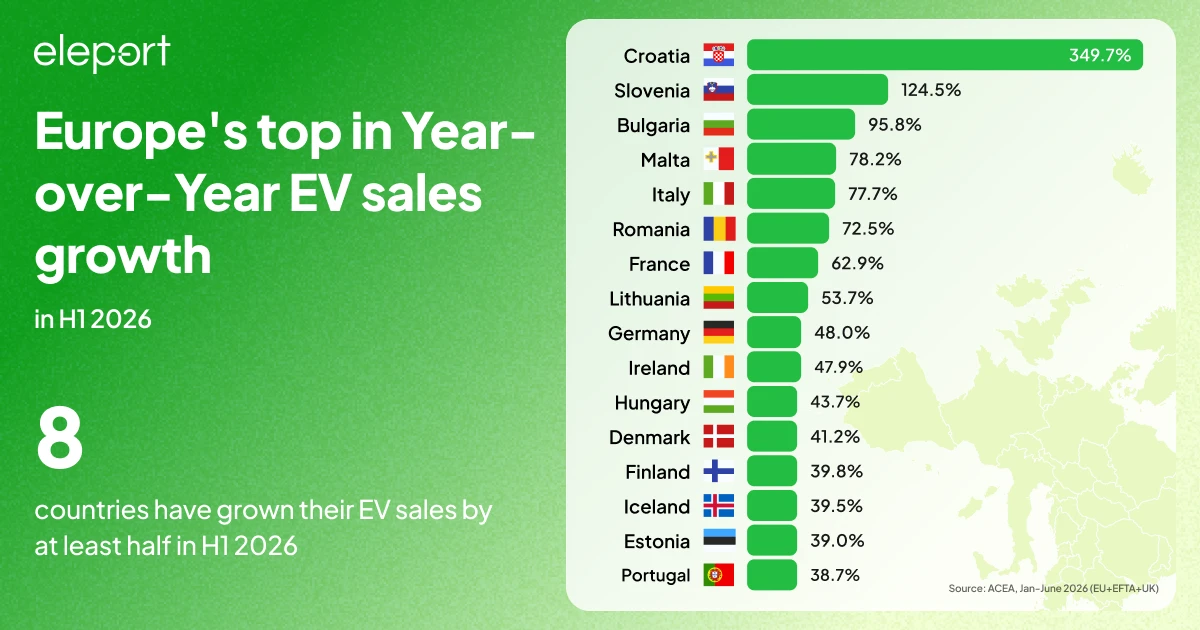
Croatia: 1781 EVs sold in the first half of 2026, growing +349,7% year-on-year. BEV market share jumped from 0,9% to 4,0%.
The biggest jump in EV sales in Europe by far, admittedly from a very low base. Croatia has been among the absolute last in EV adoption in Europe for years, so this sudden jump is especially interesting to watch.
It was also bought almost entirely by businesses, after the national environment fund opened a 45-million-euro line for taxi operators, delivery firms and car-sharing companies in January with up to €9000 per BEV, while Croatian households still currently have nothing at all to apply for. We’re looking forward to a similar jump in private ownership.
Slovenia: 6062 EVs sold in the first half of 2026, growing +124,5% year-on-year. BEV market share climbed from 9,0% to 16,5%.
EV sales in Slovenia more than doubled, and BEV market share went from 9,0% to 16,5% in a single year. Some of it was helped by the subsidy scheme, one of the more generous in Europe, with Borzen paying up to 7200€ on a car costing 35 000€ or less and 4500€ at the top of the eligible range.
Bulgaria: 2029 EVs sold in the first half of 2026, growing +95,8% year-on-year. BEV market share rose from 4,3% to 7,8%.
Bulgaria is getting started and managed to nearly double its EV sales compared to the previous year.
Malta falls here with its 78,2% growth, but due to its 38,3% EV market share we already covered it in the category above.
Italy: 79 434 EVs sold in the first half of 2026, growing +77,7% year-on-year. BEV market share rose from 5,2% to 8,5%.
The largest volume gain outside the big three comes from the third-largest car market in Europe. Some of this growth is reated by Italy’s EV bonus of up to 11 000€ for lower-income households launched on October 2025. Its roughly 600-million-euro budget was fully reserved within 24 hours. Even so, Italy still sits well below the European average EV share (22.2%).
Romania: 5522 EVs sold in the first half of 2026, growing +72,5% year-on-year. BEV market share rose from 4,9% to 8,5%.
Romanias big run in the first half of 2026 is interesting given their Rabla subsidy programme ended in mid-2025. And the new 2026 round only opened on 20th of July, which means it couldn’t yet affect the first half of the year numbers. We could expect the second half of the year doing even better, perhaps pushing Romania over the 10% EV market share.
France: already covered above as one of the big three, and its +62,9% growth is the only big-three entry to reach this list.
Lithuania: 1852 EVs sold in the first half of 2026, growing +53,7% year-on-year. BEV market share rose from 5,8% to 7,7%.
Like its Baltic neighbours, Lithuania is still early in its EV curve, but moving in the right direction in terms of electric car sales in Europe.
Other European countries that are silently moving towards EVs
Between the leaders and the laggards we’ve brought out, sits most of the continent, where electric cars in Europe gain ground a percentage point at a time, most of them actually steady growers and perhaps even ahead of the European average.
Ireland: 20 159 EVs sold in the first half of 2026, growing +47,9% year-on-year. BEV market share jumped from 16,7% to 23,7%.
Ireland didn’t fit into our biggest EV growth list, nor into the over-30% list on EV adoption, but it is actually having a remarkable year in EV sales. That’s because it has recorded one of the biggest share gains anywhere in Europe this half, jumping by 7 percentage points in a year, now with nearly every fourth car sold in Ireland being fully electric.
Hungary: 7497 EVs sold in the first half of 2026, growing +43,7% year-on-year. BEV market share reached double digits, up from 7,9% to 10,0%.
Hungary shows a strong first half of 2026 in EV sales, although it might have something to do with the corporate purchase grant ending which required the vehicle to be registered by 12 June 2026. In Hungary, BYD took first place ahead of Tesla, which might become a common sight after BYD opens its production plant in Szeged, Hungary, in Q4 2026.
Estonia: 617 EVs sold in the first half of 2026, growing +39,0% year-on-year. BEV market share slipped from 7,2% to 6,2%.
Estonian market remains a curious one. EV sales, albeit on one of the smallest bases, grew fast, but the total Estonian car market grew faster still (+62,1%) as buyers returned after the distortions caused by the motor tax introduced in 2025. Things should smooth out over the coming quarters.
Portugal: 34 706 EVs sold in the first half of 2026, growing +38,7% year-on-year. BEV market share climbed from 20,2% to 25,3%.
Every fourth new car in Portugal is now fully electric, ahead of the average electric car sales H1 2026 in Europe and well ahead on the adoption curve of its neighbor:
Spain: 63 201 EVs sold in the first half of 2026, growing +36,7% year-on-year. BEV market share rose from 7,6% to 9,8%.
Spain, the fifth-largest car market in Europe, is gaining slightly faster than average EV sales in Europe H1 2026, and its new Plan Auto+ subsidy scheme was only approved in late July 2026, worth up to 4500€ a car and backdated to January.
Slovakia: 2678 EVs sold in the first half of 2026, growing +33,4% year-on-year. BEV market share rose from 4,4% to 6,2%.
Slovakia has no purchase subsidy and has not had one since 2019. Thanks to company car tax benefits, most of the sales growth comes in from the corporate buyers.
Austria: 40 060 EVs sold in the first half of 2026, growing +27,0% year-on-year. BEV market share rose from 22,0% to 24,3%.
The federal scheme for private buyers ended early with its budget exhausted, so Austria’s sales growth almost on par with the average EV sales in Europe H1 2026 leans mostly on company car tax and some private exemptions instead.
Czechia: 8630 EVs sold in the first half of 2026, growing +24,9% year-on-year. BEV market share rose from 5,6% to 6,6%.
Czechia hasn’t offered a purchase subsidy to private buyers, but the market keeps growing steadily nevertheless.
Cyprus: 911 EVs sold in the first half of 2026, growing +23,9% year-on-year. BEV market share jumped from 8,9% to 12,6%.
Cyprus electric car grant has been one of the most generous headline BEV grants in southern Europe, with the vulnerable-groups uplift to 19 000€ particularly notable, but now the fourth call for the applications closed in December 2026, and the cars had to be registered by 30th of June. Read that 12,6% market share carefully as well, because it counts new cars only and two-thirds of what Cypriots register are used imports, which are also much harder to track.
Greece: 5284 EVs sold in the first half of 2026, growing +23,9% year-on-year. BEV market share rose from 5,5% to 6,3%.
Switzerland: 27 889 EVs sold in the first half of 2026, growing +20,2% year-on-year. BEV market share rose from 20,5% to 23,9%.
As per the other years we’ve tracked all EV sales in Europe, Switzerland lands just ahead of the European market share average, with steady growth year after year.
Luxembourg: 7745 EVs sold in the first half of 2026, growing +18,1% year-on-year. BEV market share rose from 26,0% to 29,2%.
A comeback by Luxembourg, after more than a year of softening. A deadline perhaps explains the timing of the growth, because the Klimabonus Mobilitéit grant, worth up to 6000€, only covers orders placed by 30 June 2026, the exact end date of our report here. We’ll report back again soon whether the country still runs towards the EV future without, but currently the EV market share is quite notable and almost breaks into our 30%+ category, still significantly higher than the average market share of EV sales in Europe H1 2026.
Poland: 16 479 EVs sold in the first half of 2026, growing +15,6% year-on-year. BEV market share edged up from 5,0% to 5,3%.
Poland recorded a massive +161,5% growth in the whole of 2025, so we’re now seeing a bit of a return to the base here but still growing. Poland also ran out of its subsidy money mid-half, with NaszEauto closing to new applications on 30 April 2026 once demand overshot its budget. No successor has been announced, so private EV buyers in Poland currently have no national purchase grant.
Latvia: 839 EVs sold in the first half of 2026, growing +12,3% year-on-year. BEV market share rose from 6,6% to 7,4%.
Latvia has just relaunched its subsidy program with up to 12000€ available total for larger families. However, since it’s a fairly fresh program, it didn’t yet affect the current numbers and we’ll track closely how it will do in EV sales in Europe for the second half of 2026.
Europe’s best-selling EV in the first half of 2026
ACEA counts registrations by country and fuel type, not by model name, so for that part you go to the registration trackers. They add a detail worth having. The title went to the Tesla Model Y, which finished less than 2500 cars behind the Dacia Sandero in the model ranking across fuel types, with volumes up 59% year-on-year. Second place among the best selling EV cars in Europe went to the Tesla Model 3 for the usual double-win.
So the most popular electric car in Europe is now about one good week away from being the most popular car of any kind. Electric car sales at the model level have stopped being a niche column in the registration tables. If you want to explore the models further, we’ve created a separate analysis of the best electric cars in Europe.
EV sales in Europe H1 2026 in five key numbers
Halfway through the year, the EV sales in Europe 2026 total already stands at more than 1,6 million cars.
- 1 608 200 new battery electric cars were registered across Europe, up 35,1% on the first half of 2025. In absolute terms, 418 094 extra EVs.
- The electric car registrations Europe reported for these six months beat petrol for the first time in any half-year period.
- 30 of the 31 markets grew their EV sales. The single decline, in the Netherlands, amounted to 45 cars (-0,1%).
- Eight countries stand above 30% BEV market share, and eight countries grew their EV sales by 50% or more.
- Germany, the UK and France together accounted for 55,6% of all European EV sales.
What share of new cars sold in Europe are fully electric? Battery-electric cars took 22,2% of all new car sales across Europe in the first half of 2026, up from 17,5% a year earlier. Within the EU alone, the share was 20,7%. More than every fifth new car sold on the continent now runs on a battery alone.
2026 looks promising for EV sales in Europe, with all countries now going directly in a single direction. All electric.