


After a record-breaking 2025 for EV sales in Europe, the first quarter of 2026 is continuing towards EVs in full power.
In the first three months of 2026, 723 704 new battery-electric vehicles (BEVs) were registered across Europe. That marks a 26,2% growth compared to Q1 2025, when 573 439 EVs were sold across the same 31 markets.
Out of the 31 countries we looked at, only four have seen a decline early this year.
What percentage of cars in Europe are electric? The market share of fully electric vehicles in Europe has reached 20,6% as of the first quarter of 2026. This means every fifth car sold in Europe is fully electric today.
Here’s how the European market was split by powertrain in Q1, looking beyond just electric car sales in Europe 2026:
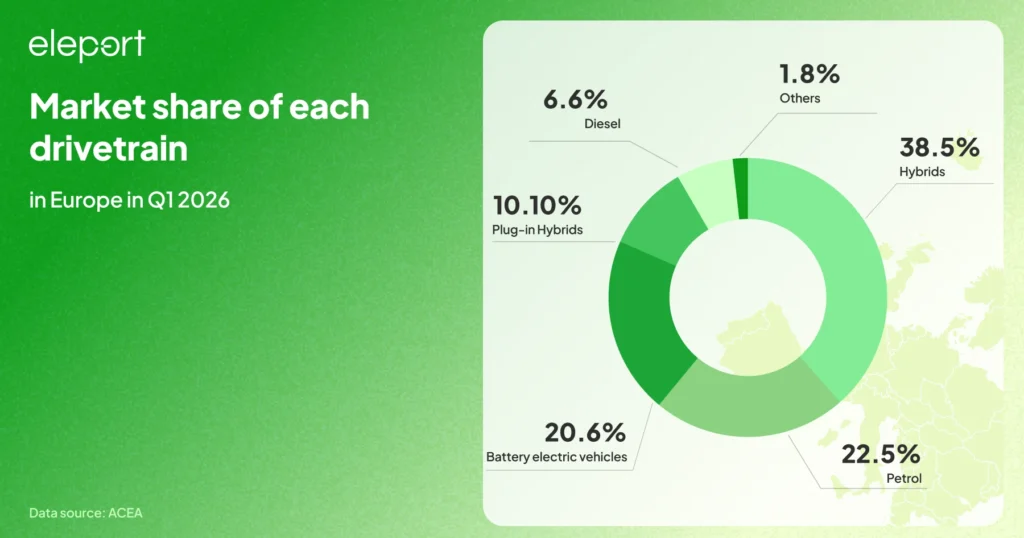
BEVs are well ahead of diesel in Europe by now, with the gap to petrol closing fast. A year ago, petrol had 28,7% of the European market and BEVs only 15,2%. Today, petrol is at 22,5% and BEVs at 20,6%. EU EV sales specifically follow the same logic.
Our country-by-country breakdown below is based on the ACEA data for EV sales in Europe for January to the end of March (Q1) of 2026.
* Note: all values for “EV” here refer to battery-electric vehicles (BEVs) only. EV sales in Europe refers to EU+EFTA+UK. Not plug-in hybrids (PHEVs) or any ICE variant included. You can read more about the drivetrain differences in our EV vs ICE comparison.
The big three: Germany, the UK, and France lead in EV volume
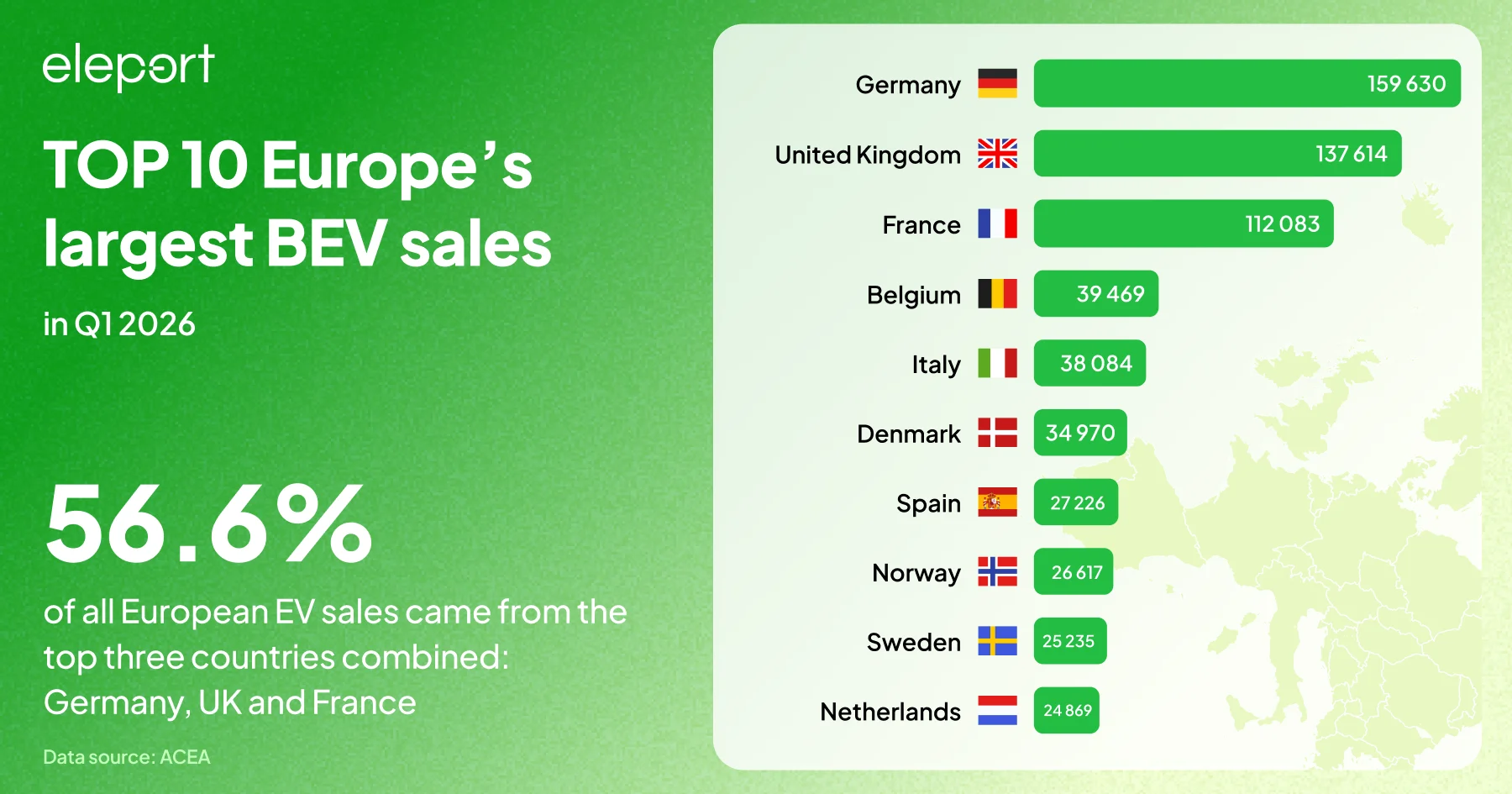
Let’s start with the three countries that are still doing the heavy lifting when it comes to EV sales in Europe. Germany, the UK, and France together registered 409 327 BEVs in Q1 2026.
That is 56,6% of all BEV sales in Europe 2026 – and together, their sales hav grown 33,0% compared to Q1 2025.
Which country has the most electric cars in Europe? The answer is straightforward:
Germany: 159 630 EVs sold in Q1 2026, growing +41,3% year-on-year. BEV market share climbed from 17,0% to 22,8%.
Germany is the largest car market in Europe, and also the largest when it comes to EV sales in Europe per units sold, too. The recovery that started in 2025, after the whole environmental bonus drama of late 2023, is still running in full speed in 2026. Every fifth car sold in Germany in 2026 first quarter was fully electric. And 41,3% YoY growth on a market this big makes Germany one of the fastest-growing large EV markets in Europe right now.
United Kingdom: 137 614 EVs sold in Q1 2026, growing +14,5% year-on-year. BEV market share rose from 20,7% to 22,4%.
The UK keeps on a steady path. The growth rate has cooled a bit from the 23,9% the UK posted in full-year 2025, but that is only natural for a market with such a large EV base already. Nearly every fourth car sold in the UK in Q1 2026 was fully electric.
France: 112 083 EVs sold in Q1 2026, growing +50,4% year-on-year. BEV market share jumped from 18,2% to 27,9%.
France is the breakout story of the big three. The ecological bonus that relaunched in late September 2025 is clearly doing its job. A 9,7 percentage point BEV market share jump from one Q1 to the next is really rare to see in a market the size of France. And it is happening while the overall French car market actually shrank by 2,1% in Q1 2026. Nearly every third new car sold in France in Q1 2026 was fully electric. Well done, France.
Eight European countries are already at over 30% EV market share
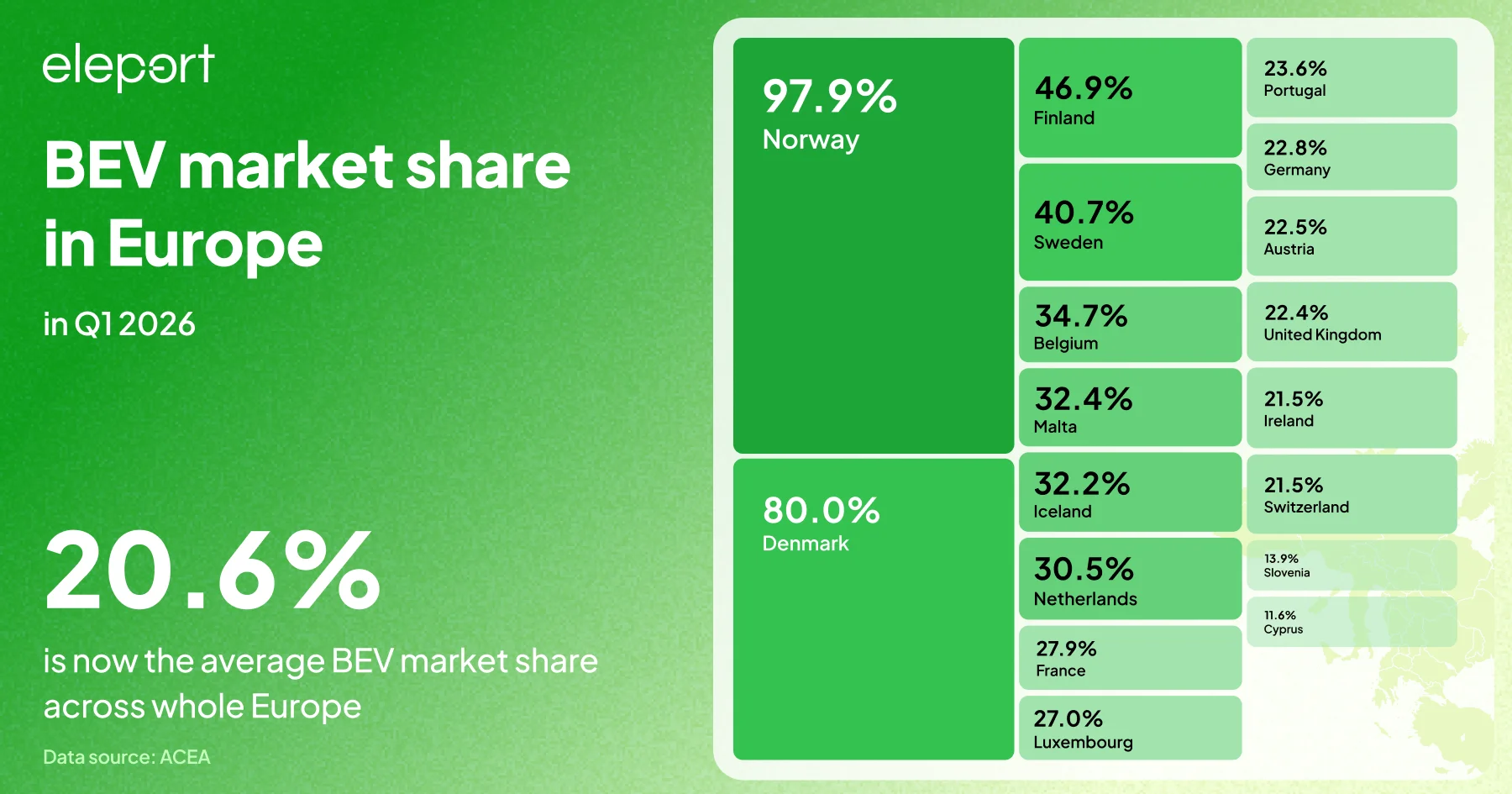
Same as in full-year EV sales in Europe for 2025, eight European countries already have their BEV market share of all car sales above 30%. The cast is the same, but the order has changed a bit. Here they are, ranked by their Q1 2026 BEV share.
Which European country has the highest EV adoption? Almost anyone I know knows the answer to this question today.
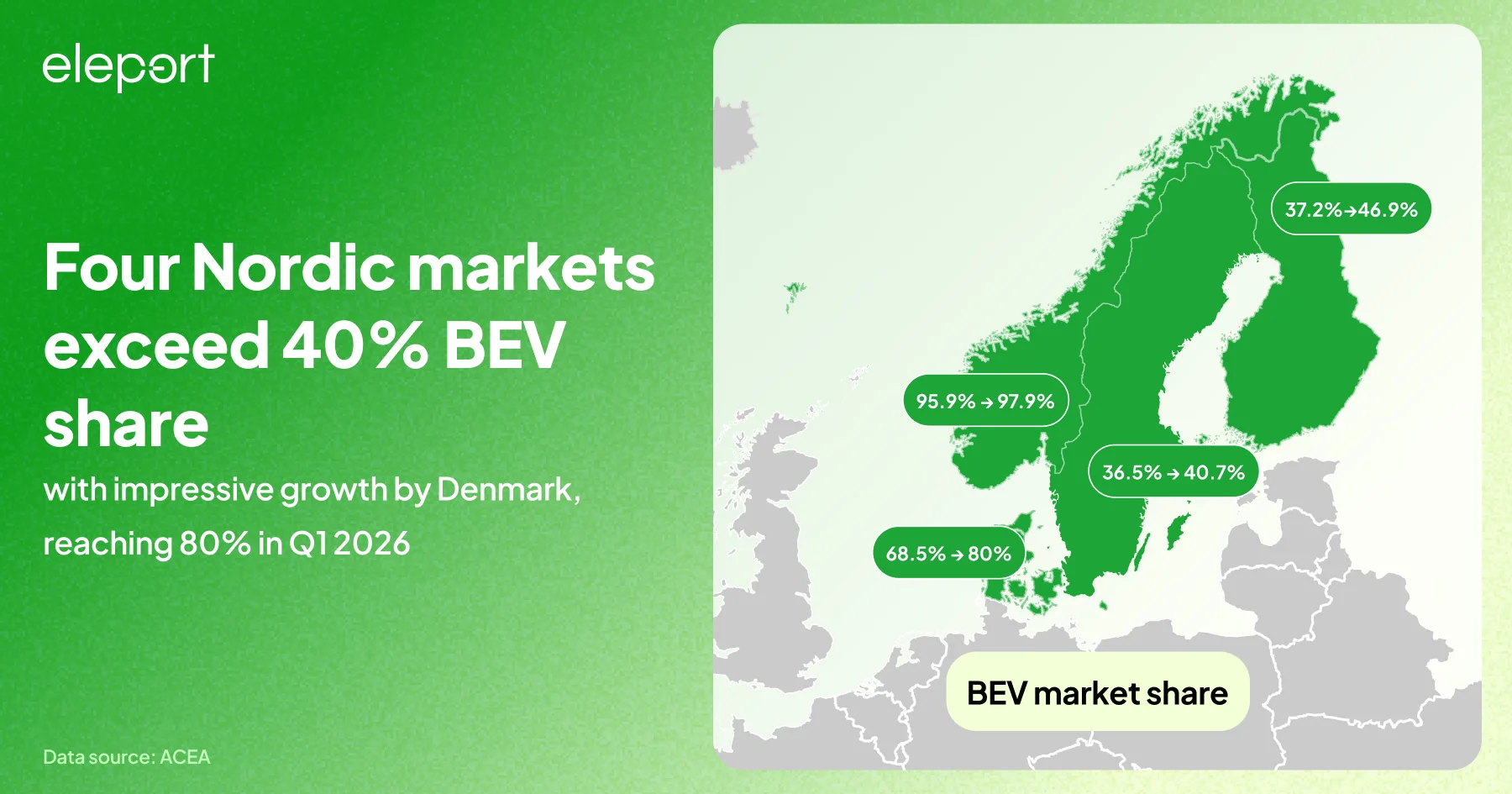
Norway: 26 617 EVs sold in Q1 2026, declining -7,0% year-on-year. BEV market share rose from 89,0% to 98,0%.
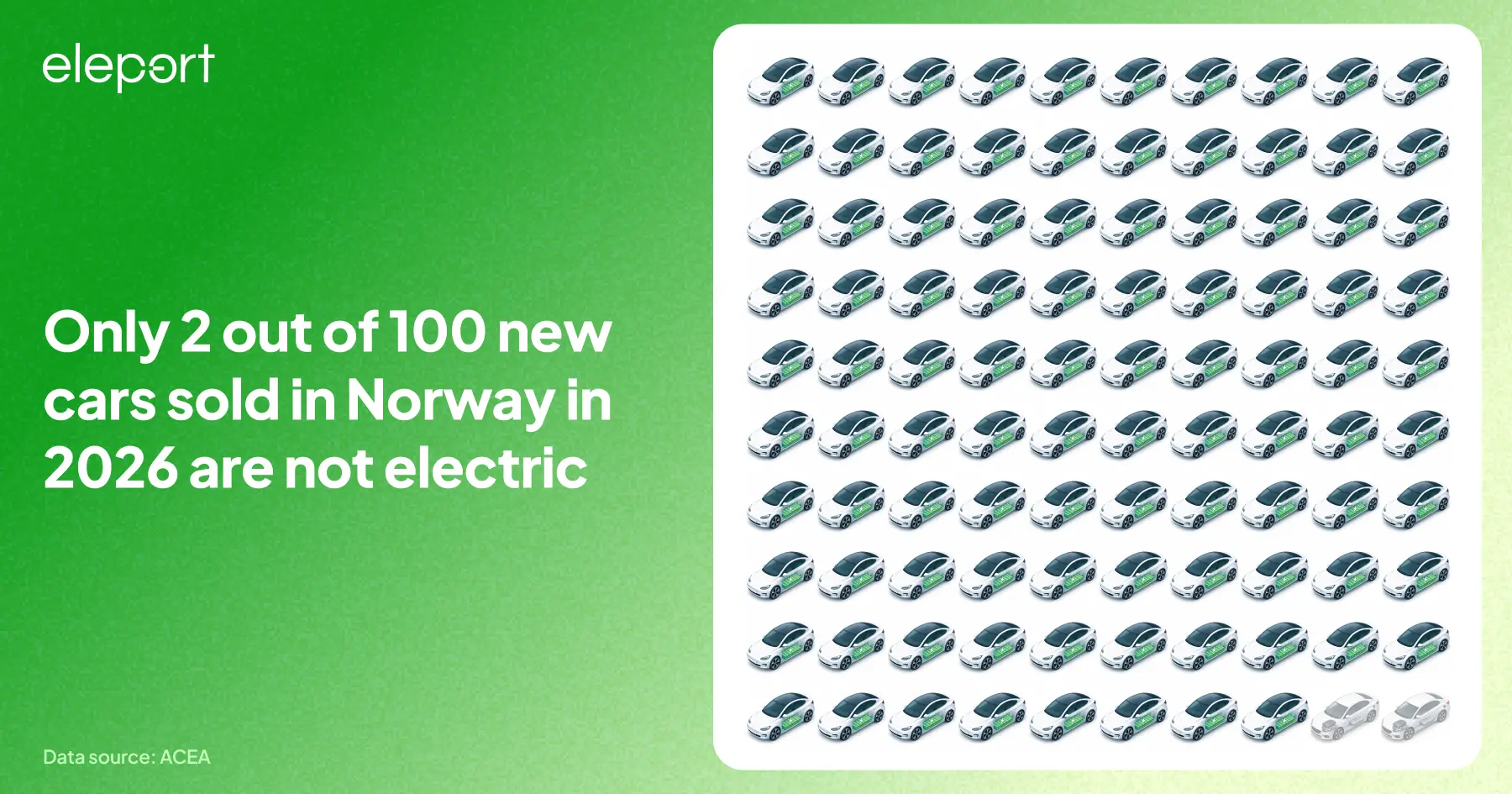
Norway is basically at the ceiling. At 98,0% BEV share, just 2 out of every 100 new cars sold in Norway are not fully electric. The 7,0% decline in BEV unit sales does not mean EV demand is falling. The total Norwegian car market actually shrank 15,5% YoY in Q1 2026, which means fewer cars of every kind were sold, including BEVs. The EV share is what matters here, and that one just keeps going up.
Not everyone, however, knows who comes next after Norway, and how close they actually are!
Denmark: 34 970 EVs sold in Q1 2026, growing +42,6% year-on-year. BEV market share jumped from 65,5% to 80,0%.
Denmark keeps pulling ahead. Four out of every five new cars sold in Denmark in Q1 2026 were fully electric. Let that sink in. A 14,5 percentage point jump in market share in a single year, in a market that was already at 65%, is a serious feat. Denmark might be the most impressive EV adoption story in Europe right now.
Finland: 8 063 EVs sold in Q1 2026, growing +43,0% year-on-year. BEV market share rose from 33,8% to 46,9%.
Finland has done it again. After a quiet 2024, the country added 13 percentage points of BEV market share in a single year. Right on the back of reaching 37,2% share in full-year 2025. Almost every second new car sold in Finland in Q1 2026 was fully electric, a very strong achievement in EV sales 2026.
Sweden: 25 235 EVs sold in Q1 2026, growing +20,6% year-on-year. BEV market share rose from 33,0% to 40,7%.
Sweden keeps going up, significantly ahead of the average Europe EV sales 2026. Together with Denmark, Finland, and Norway, Sweden is now part of a Nordic club where all four countries have gone past 40% BEV market share. The North is, quite clearly, where EVs are most at home in Europe. Also… so much for cold not being a suitable environment for EVs?
Belgium: 39 469 EVs sold in Q1 2026, declining -2,3% year-on-year. BEV market share rose from 33,4% to 34,7%.
Belgium is a bit of an odd one this quarter. BEV unit sales actually dropped slightly, but the total Belgian car market shrank faster (-5,9%), so BEV market share still ended up going up. So this one isn’t really about EV demand falling apart, it’s the overall car market being softer compared the Q1 last year. Belgium is still significantly ahead of EU EV sales on average.
Malta: 505 EVs sold in Q1 2026, growing +67,2% year-on-year. BEV market share rose from 23,7% to 32,4%.
Malta may be small in absolute numbers compared to Europe EV sales, but it is pretty big on EV uptake. After a rough full-year 2025, the little island country has bounced back hard, adding nearly 9 percentage points of BEV share in just one quarter, becoming one of the eight largest in uptake of EV sales in Europe 2026.
Iceland: 1 122 EVs sold in Q1 2026, growing +17,4% year-on-year. BEV market share fell from 42,1% to 32,2%.
Iceland is the only country in this over-30% club where the BEV share actually dropped, event though it is still ahead of the average Europe EV sales 2026. EV sales 2026 still grew 17,4% in the first quarter, but the total Icelandic car market jumped a wild 53,4% YoY. So a lot of non-EV buyers came back to the market, and perhaps it’s not that EV demand suddenly fell apart.
Netherlands: 24 869 EVs sold in Q1 2026, declining -23,3% year-on-year. BEV market share fell from 35,5% to 30,5%.
This is the plot twist of EV sales in Europe 2026. The Netherlands has always been one of the original EV markets in Europe. But in Q1 2026, BEV units fell by nearly a quarter YoY, and the total Dutch car market dropped 10,8% too. End result: a 4,9 percentage point drop in BEV market share in a single year.
The Dutch market has historically been one of the ones that sets the tone for what many European markets do next across EU electric car sales, so this is the story to keep an eye on for the rest of 2026.
European countries with the largest EV sales growth in Q1 2026
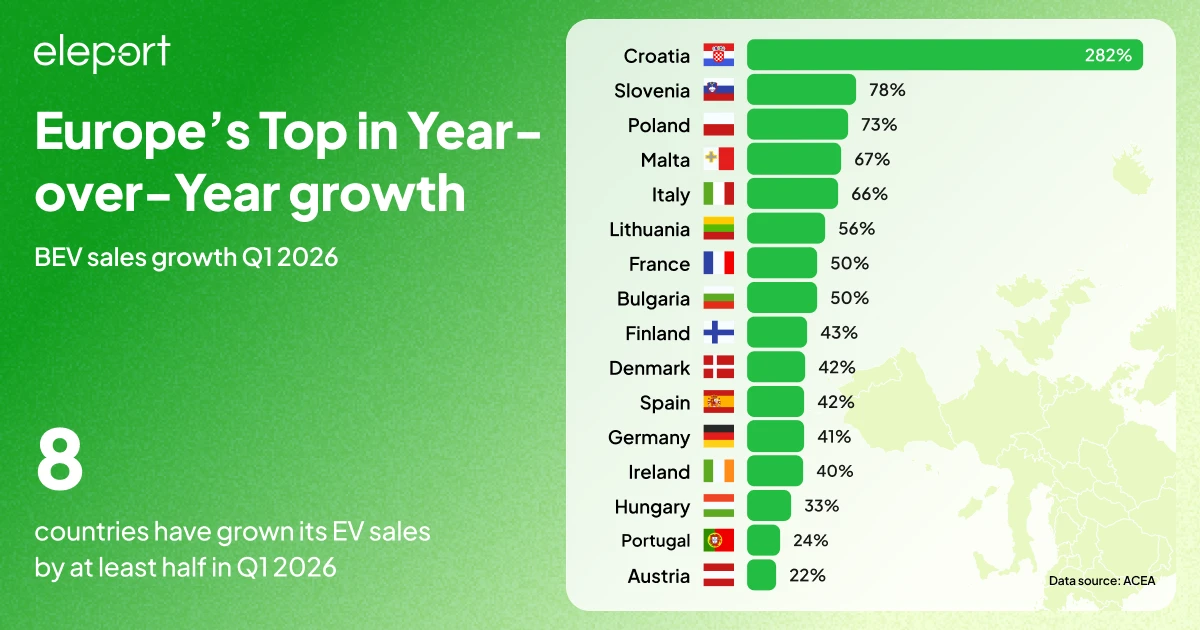
Some of the biggest percentage growth numbers in Q1 2026 come from markets that are still very early in their EV journey. Here they are, with biggest growers listed first:
Croatia: 780 EVs sold in Q1 2026, growing +282,4% year-on-year. BEV market share rose from 1,3% to 4,6%.
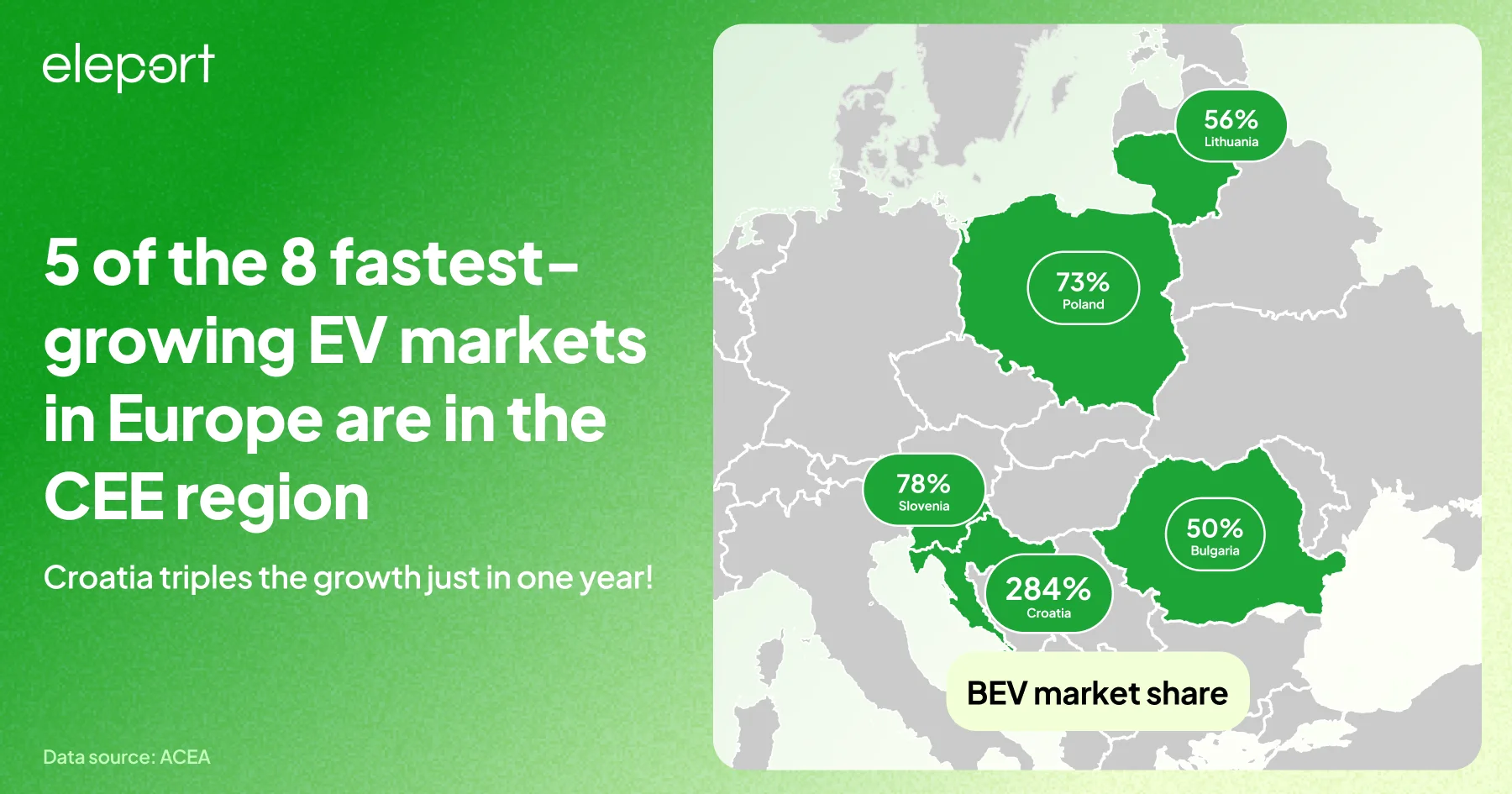
Croatia has long been the last place in overall EV sales in Europe, both units and market share wise. Now, Croatia takes the top spot across Europe EV sales percentage growth, although it is off a very small base of just 204 EVs in Q1 2025. Still, almost quadrupling EV sales in a year is not nothing. And it pulls Croatia off the bottom of the Europe EV sales market share table, where the country sat in 2025, to a respectable 4.6% share, more than tripling it in just one year. Eleport’s recently-opened largest charging site in Croatia should help keep these EVs recharged.
Slovenia: 2 297 EVs sold in Q1 2026, growing +78,2% year-on-year. BEV market share rose from 8,8% to 13,9%.
Slovenia has been on an up-and-down EV ride for years now. Q1 2026 firmly puts the country back in growth mode, nearly doubling sales and adding over 5 percentage points of BEV market share on top.
Poland: 8 841 EVs sold in Q1 2026, growing +73,1% year-on-year. BEV market share rose from 3,6% to 5,8%.
Poland picks up right where it left off in 2025. After more than tripling EV sales last year (+161,5% YoY in full-year 2025 and becoming the highest grower), it is seeing another 73% jump in EV sales 2026 first quarter. The BEV share is still low at 5,8%, but the direction is very clearly upwards, much like the rest of Europe EV sales 2026.
Italy: 38 084 EVs sold in Q1 2026, growing +65,7% year-on-year. BEV market share rose from 5,2% to 7,9%.
Now, this one is big news: Italy is the third-largest car market in Europe, and in Q1 2026, it finally found its EV gear. 65,7% BEV growth in a market this size adds over 15 000 extra BEVs to the roads compared to the previous year.
Lithuania: 758 EVs sold in Q1 2026, growing +56,3% year-on-year. BEV market share rose from 5,4% to 7,9%.
Lithuania rejoins the growth story after a few quieter quarters. Like its Baltic neighbours, Liithuania is still early in its EV curve, but moving in the right direction in terms of electric car sales in Europe.
Bulgaria: 747 EVs sold in Q1 2026, growing +50,0% year-on-year. BEV market share rose from 4,3% to 6,5%.
Bulgaria adds another strong quarter to its recent run. The market is still small in terms of EV sales 2026 in Europe, but 50% YoY growth on BEV units is exactly the kind of pace that builds an EV market over time. We also recently found in our European Fast Charging Pricing Report 2026 that Bulgaria ties with Finland for the cheapest EV fast charging prices in all of Europe.
Spain: 27 226 EVs sold in Q1 2026, growing +41,6% year-on-year. BEV market share rose from 6,9% to 9,1%.
Spain, the fifth-largest car market in Europe, keeps its EV growth going and contributes well to the Europe EV sales 2026. A 41,6% jump in a market this big means about 8 000 extra BEVs on Spanish roads compared to same time last year. Ideally, Spain will gain also its spot as fifth-largest in EV sales in Europe one day.
Ireland: 13 982 EVs sold in Q1 2026, growing +40,3% year-on-year. BEV market share rose from 15,4% to 21,5%.
Ireland is really back on track. Over 6 percentage points of BEV share added in a single Q1. More than 1 in 5 cars sold in Ireland in Q1 2026 was fully electric, slightly ahead of Europe EV sales average.
Other European countries that are silently moving towards EVs
Not every European country is on the same page right now. Here are the ones that didn’t fit into any of the categories above, although most of them actually achieved very solid results:
Hungary: 3 192 EVs sold in Q1 2026, growing +32,6% year-on-year. BEV market share rose from 7,3% to 8,8%.
Hungary stays one of the most consistent EV growth stories in Central Europe. No wild swings, just steady growth, quarter after quarter.
Portugal: 15 136 EVs sold in Q1 2026, growing +24,3% year-on-year. BEV market share rose from 20,8% to 23,6%.
Portugal keeps building on the solid base it put together in 2025. Nearly every fourth new car sold in Portugal in Q1 2026 was fully electric. The regulatory changes in late 2025 that opened up the local charging market should keep helping EV uptake through the rest of the year.
Slovakia: 1 014 EVs sold in Q1 2026, growing +22,0% year-on-year. BEV market share rose from 4,1% to 5,1%.
Slovakia just crossed the 5% BEV share line. Tesla’s official entry to the Slovakian market in early 2025 has been slowly doing its thing as well, visible if looking at the numbers per automaker directly. The market does have a lot of catching up to do to average European EV sales.
Austria: 17 347 EVs sold in Q1 2026, growing +22,4% year-on-year. BEV market share rose from 21,5% to 22,5%.
Austria just keeps going steady, and remains above the EV sales in Europe 2026 compared to the average on the BEV market share. So it is doing “exactly fine” in terms of EV sales in Europe.
Romania: 2 587 EVs sold in Q1 2026, growing +19,7% year-on-year. BEV market share rose from 6,4% to 9,5%.
Romania has turned a corner after its 2025 decline. The sudden suspension of the Rabla Plus programme held sales back last year. Now, with that behind them, the country is back on the EV growth path and looking to catch up with the European EV sales.
Cyprus: 425 EVs sold in Q1 2026, growing +17,7% year-on-year. BEV market share rose from 8,1% to 11,6%.
Cyprus keeps ticking higher. Every 10th car sold in Cyprus in Q1 2026 was fully electric.
Estonia: 260 EVs sold in Q1 2026, growing +16,1% year-on-year. BEV market share fell from 10,6% to 6,1%.
Estonia is in a bit of a weird spot once again, acting as an outlier to EV sales in Europe 2026. BEV units grew 16,1%, but the total Estonian car market more than doubled YoY (+100,4%), which made the BEV share drop a lot. This one is mostly due to the distortions caused by the new car tax that was introduced in 2025, and things should smooth out over the coming quarters.
Tesla just opened it’s official presence in Estonia on 24th of April 2026 and given the two most-registered EV models in Estonia are Model 3 and Model Y already before that, it should boost the market somewhat as the owners now know they don’t have to drive to Finland or Lithuania to service the cars.
Greece: 2 294 EVs sold in Q1 2026, growing +13,6% year-on-year. BEV market share rose from 6,1% to 6,6%.
Greece stays roughly steady with a slight growth, now at a 6,6% EV market share after a quiet 2025. Much below the average EV sales in Europe, but to be expected as well, with, naturally, a chance to grow fast and overtake the average EV car sales in Europe in the coming years.
Czechia: 3 439 EVs sold in Q1 2026, growing +10,5% year-on-year. BEV market share rose from 5,2% to 5,7%.
Czechia’s growth rate has cooled off quite a bit. After 70%+ growth in 2023 and 2024, and 26,5% in full-year 2025, Q1 2026 came in at just 10,5%. The BEV share is still low at 5,7%, so there is plenty of room, but the pace has clearly dropped for a moment.
Switzerland: 11 414 EVs sold in Q1 2026, growing +6,3% year-on-year. BEV market share rose from 20,4% to 21,5%.
Switzerland keeps doing Switzerland things. Quiet, steady, adding a bit more each quarter and always staying a bit ahead of the European average (currently at 20.6%)
Latvia: 323 EVs sold in Q1 2026, growing +9,9% year-on-year. BEV market share rose from 6,2% to 6,5%. Similar to its Baltic neighbors, Latvia is hovering at that sub-10% range.
Luxembourg: 3 381 EVs sold in Q1 2026, declining -9,4% year-on-year. BEV market share fell from 29,5% to 27,0%.
Luxembourg has been softening for more than a year now. Still, the country sits well above the European average on BEV market share, so it has some room to play.
First quarter tells a growth story for EV sales in Europe 2026
As you can see from our report above, the real questions should go much further than just “how many electric cars were sold in Europe in 2026 first quarter?” In the first three months of 2026, 723 704 new battery-electric vehicles were registered across Europe – but 56.6% of them were sold in just three countries. However, it seems 2026 might become another record year, and we’ll be here to track it.
A few things really stand out in EV sales in Europe from this quarter:
- The big three are all accelerating. Germany, the UK and France together registered 33,0% more BEVs in Q1 2026 than in Q1 2025. France’s jump to 27,9% BEV share is the biggest among large markets.
- Italy is finally moving. 65,7% BEV growth and +110,1% PHEV growth in Europe’s third-largest car market is a real shift, strongly moving up the average Europe EV sales if continued.
- The Netherlands is the one to watch. A 23,3% drop in BEV units in a previously strong EV market is not just quarterly noise, let’s see what happens next.
- The Nordic countries keep extending their lead. Norway, Denmark, Finland and Sweden all above 40% BEV share, with Denmark at 80,0% and Norway at a near-saturated 98,0%. Europe EV sales 2026 and beyond will see these markets completing the whole EV transition first.
Only 4 of the 31 markets we looked at saw a decline in BEV units in Q1 2026: Belgium (-2,3%), Norway (-7,0%), Luxembourg (-9,4%), and the Netherlands (-23,3%). The other 27 are all growing, and most of them are growing fast.
The direction of the EV transition, as Q1 2026 makes clear once again, is the same all across the continent. All electric.