Once you get deeper into the EV world, coming across weird acronyms here and there doesn’t come as a surprise anymore.
Today, we’ll tackle one “family” of them to make sure we’re all on the same page what it means and what we can do about it.
Your EV spends most of its life doing absolutely nothing, just like a regular fossil-fueled car. Parked at home, parked at work, parked at the shops. Roughly 95% of the time, that big expensive battery is just sitting there idle.
The beauty with EVs, however, is that we can actually have the car do something while it is sitting there idle.
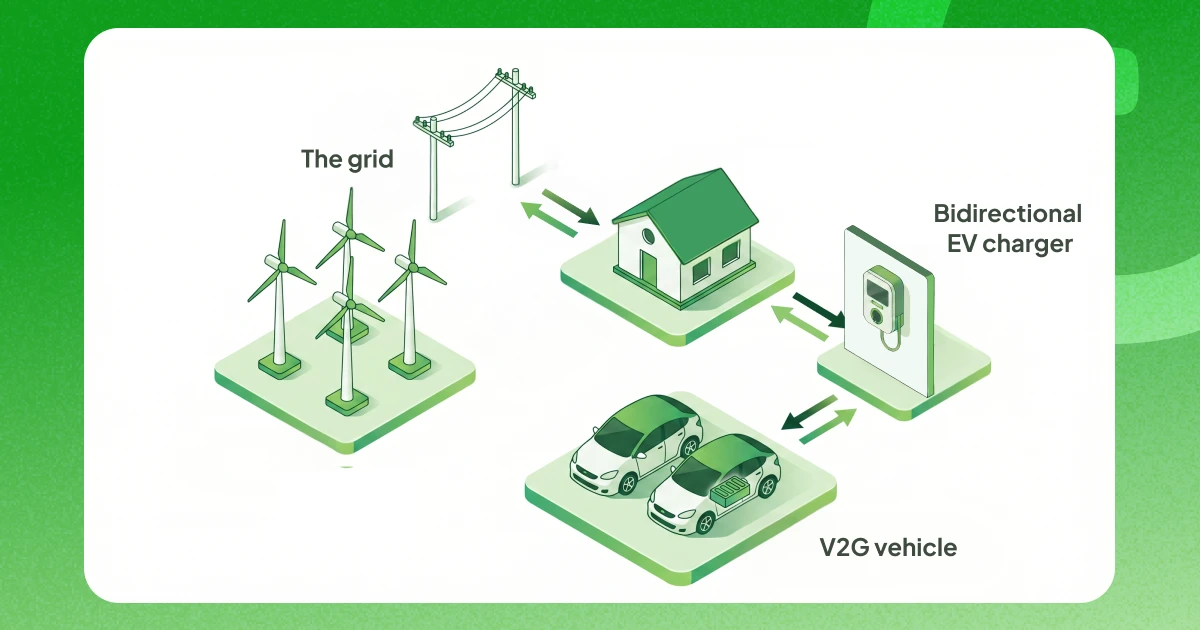
Vehicle-to-Grid (that’s the V2G) is what happens when someone looked at that idle battery in the EV and thought: “hmm, what if the car could send, maybe even sell some of that stored energy back to the grid while it’s parked?”
So the technology is explained in the name: energy flowing from Vehicle to Grid.
Charge up when electricity is cheap or when the sun’s out if you’ve got solar panels, then feed power back during the evening peak when everyone gets home and cranks up the oven. The grid gets a buffer. You get paid. Everybody wins, at least in theory.
I’ve been following V2G projects since the early Utrecht experiments more than a decade ago, back when this was firmly in the “cool idea, maybe someday” category.
Now, that “someday” has arrived. You can now buy actual V2G products in parts of Europe with actual price tags and actual euros changing hands. But I’d be lying if I said every EV driver can just flip this V2G toggle on tomorrow.
You still need the right car, the right charger, the right energy contract, and a regulatory setup that doesn’t penalize you for trying to help the grid. That last part only recently got fixed in Germany.
V2G is part of a bigger shift where EV charging stops being passive (plug in, come back later, done) and starts getting smart about when and how energy moves. Our article today breaks down where that shift actually stands in 2026.
Wait, but is it V2G or V2H or V2L?
People mix these up constantly, so let’s get it out of the way early.
The broadest concept here covering all these is bidirectional charging: energy flowing both ways between your EV and something else. What that “something else” is determines which abbreviation gets used.
V2L, or Vehicle-to-Load, just means your car powers devices directly. Plug a camping fridge into the car’s outlet, run a power drill from it on a worksite, that sort of thing. Plenty of EVs already do V2L, and it doesn’t need any special charger.
V2H, or Vehicle-to-Home, means the car feeds your house. Backup power during a blackout, or discharging during expensive peak hours to cut your electricity bill. For that, you need something called a bidirectional wallbox installed at home – it’s like a charger, but also able to direct the energy in the other direction.
V2G, Vehicle-to-Grid, is the version where the energy goes all the way back into the public electricity grid. This is what grid operators and energy companies get excited about because if enough EVs participate, you’ve effectively got a distributed battery network across the country. The catch is that it also needs the most infrastructure: the car, the charger, the software, the energy contract, and regulations that let it happen. More moving parts, but a lot bigger potential.
You’ll sometimes see V2X (Vehicle-to-Everything) as the catch-all for this whole family.
Most EVs today still only charge in one direction. That’s what’s changing.
Smart charging comes before V2G
Here’s what a lot of V2G-related guides and articles skip over completely.
The biggest near-term shift isn’t that every EV is about to start balancing the grid. It’s that charging itself is getting smarter. Cars, chargers, and the software connecting them are learning to shift load away from peak hours, match charging to cheaper electricity, and reduce stress on local grids. None of that requires bidirectional hardware. It just requires intelligence.
Smart charging is way easier to deploy than full V2G. No special charger needed. No complex hardware. It already works within today’s market rules.
So when people get excited about V2G, what’s actually happening underneath is a broader transition where charging becomes less passive and more dynamic. V2G is the most ambitious version of that, but it builds on a smart charging foundation that’s already rolling out across Europe right now.
How does V2G actually work?
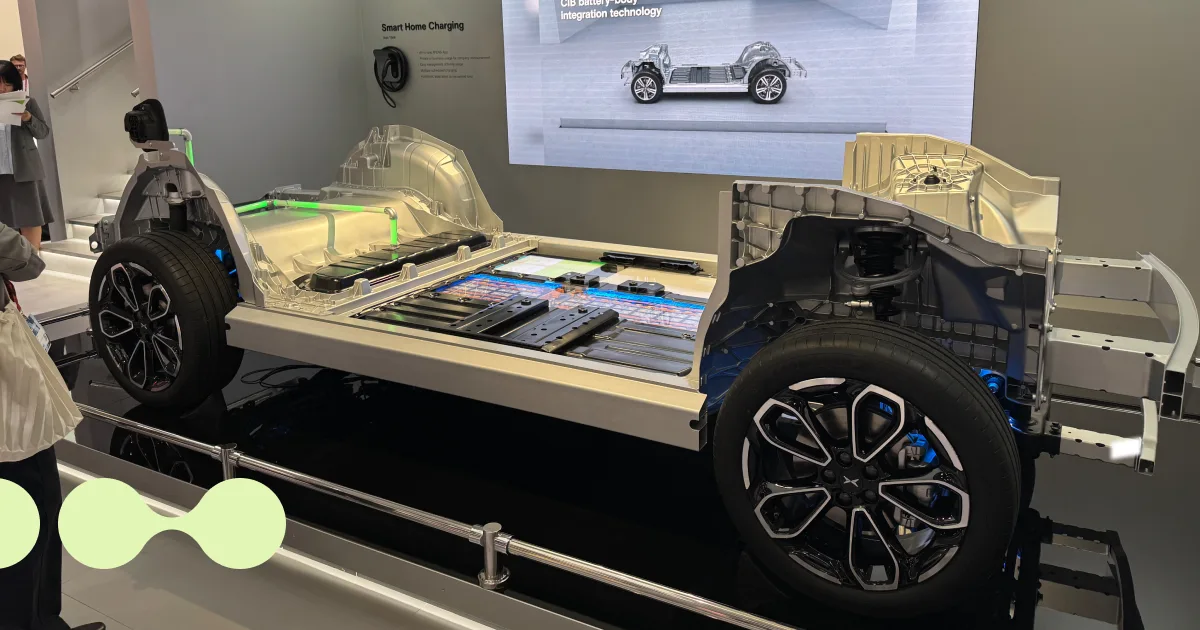
You need more than just a capable car. The EV has to support bidirectional charging. The charger has to support it too.
Then the software manages the whole dance: when to charge, when to discharge, how much battery to keep reserved so you can still drive to work in the morning. And the energy market has to actually want that flexibility and pay you for it.
In practice, it looks something like this:
- You charge overnight when electricity is cheap, or during the day when your solar panels (or the grid’s solar) are cranking.
- Late afternoon hits, everyone comes home, turns on their ovens and TVs, grid demand spikes.
- Your EV sends some of the already stored energy back.
- By morning, the car tops back up during (cheaper) off-peak hours.
You never noticed a thing.
The communication standard making this work is ISO 15118-20, which defines how an EV and charger negotiate bidirectional energy transfer. The big deal here is that CCS2, the dominant connector in Europe, is finally getting proper bidirectional support through this standard. For years, only CHAdeMO (Nissan’s connector, basically) could do two-way charging. That bottleneck is opening up.
Which cars support V2G in 2026?
The list is still short. But it’s growing in a way that feels different from the usual “coming soon” promises we’ve heard for years.
Renault is furthest along commercially. The Renault 5 E-Tech (52 kWh version) ships with V2G capability, and Renault isn’t just saying the car can theoretically do it.
Together with its subsidiary Mobilize and partner The Mobility House, they launched an actual customer-facing V2G service in France: the vehicle, a bidirectional charger, an energy contract, and software that manages charge and discharge automatically, all bundled. Expansion to the Netherlands, Germany, and the UK is planned for 2026.
In Utrecht, more than 100 Renault 5s are already live in Europe’s largest V2G car-sharing project, heading toward 500 vehicles. Even the upcoming Renault Twingo E-Tech, a sub-20,000 euro city car, lists V2G as an option.
Here are some more automaker-specific moves towards V2G that you can actually access
- BMW jumped in with the iX3 as part of Germany’s first commercial V2G offer, together with E.ON. Their Wallbox Professional is one of the first bidirectional CCS wallboxes on the market, and BMW’s entire Neue Klasse platform will support bidirectional charging from the outset.
- Then there’s Mercedes-Benz, which announced bidirectional charging for the new electric GLC in 2026 through its MB.CHARGE Home setup with The Mobility House.
- Nissan committed to affordable V2G in the UK first (they got the UK’s first G99 grid certification for AC-based V2G), then Europe.
- Kia and Hyundai launched a V2G service in the Netherlands late 2025 for the EV9 and IONIQ 9.
- VW Group’s Elli started a bidirectional pilot in Germany.
- BYD is bundling the Dolphin with a Zaptec wallbox and Octopus Energy tariff in the UK.
- And the Cupra Born works with the Wallbox Quasar 2 for V2G over CCS2.
Lots of movement and the direction is great, although rollout remains limited both by region and automakers.
Can you actually earn money with V2G?
Yes. Because the systems need to incentivize you to actually take the effort of sending the energy back to the grid. And we now have a real product with real numbers to point at, not just pilot estimates.
BMW and E.ON’s German V2G offer: you plug your iX3 into the BMW Wallbox Professional, sign up for E.ON’s V2G electricity tariff, and you earn 0.24€ per hour that the car is connected with V2G active.
Importantly, it doesn’t matter whether energy actually flows in or out during that time. Maximum is 60 euros per month, 720 euros per year, assuming about 250 hours of monthly connection time. On top of that, each kWh you actually discharge to the grid gets compensated at 40 euro cents.
BMW says the 720€ annual bonus roughly covers the electricity cost of driving 12,000 to 14,000 km. So in a best-case scenario, your parked car earns back your driving costs.
The obvious catch here is the hardware. Bidirectional wallboxes are still expensive. We’re talking 3,000 to 8,000 euros, depending on brand and power output. BMW gives the first 100 V2G customers a 700 euro discount, which helps, but you’re still looking at payback periods in the 4 to 10 year range.
Luckily, that price will likely compress as more products hit the market, and competition kicks in.
Does V2G accelerate the degradation of your battery?
This question makes a lot of sense. So here’s what the data actually says.
A study in Applied Energy (Sagaria et al., 2025) modelled V2G usage over 10 years and found it adds 9% to 14% extra battery degradation over that full period. The number sounds scary, but breaking it down, that’s roughly 0.31% extra degradation per year.
The reason it stays so low is that 85% to 90% of battery aging is calendar degradation, the battery wearing out just by existing and sitting in various temperatures. The cycling from V2G adds comparatively little.
Real-world evidence backs this up. The University of Delaware ran a fleet of Nissan Leafs in a V2G program for over five years, doing frequency regulation for the grid. No significant degradation. RWTH Aachen and The Mobility House did a joint study and found that V2G has a minor impact when the software avoids extreme charge states and unnecessary deep cycling.
So should you be worried about V2G degrading your battery? If the system is smart about it (keeping your battery in a reasonable range, not cycling it aggressively), V2G adds very little wear. For most people, the compensation would outweigh whatever marginal battery cost there is.
What changed in Europe to make V2G viable?
Two things happened in late 2025 that actually mattered, at least for Germany.
Germany’s parliament amended the Energy Industry Act in November 2025. The problem before: if you fed energy from your EV back to the grid, you got hit with grid fees twice. Once when you charged, again when you recharged after discharging. Pure penalty for trying to help.
The new law treats EV battery electricity the same as any other storage, killing the double fee. Add the Federal Network Agency’s MiSpeL technical framework kicking in April 2026, and Germany now has both legal and technical rails for V2G in its largest economy.
At the same time, the hardware caught up. CCS bidirectional chargers are entering the market, automakers are shipping V2G-ready cars, and energy companies are building the tariff products to go with them. The pieces are actually lining up.
One thing to watch: Germany’s smart meter rollout is still stuck at about 3% of households. The Netherlands, France, Denmark are way ahead here. Smart meters are pretty important for V2G at scale since the system needs real-time data. That gap will be a bottleneck until it’s fixed.
On the EU level, Transport & Environment is pushing for a voluntary “V2G-ready” label on the Certificate of Conformity for new EVs. Small thing, but it would let buyers know before purchasing whether a car supports bidirectional charging.
How far along are we with V2G in 2026?
The lazy version of this story is either “V2G is finally here!” or “V2G is still just hype.” Neither really captures it.
What’s actually happening: Europe moved past the stage where V2G only lived in conference slide decks. Real products exist now.
The EU estimates that a properly deployed V2G system could offset about 25% of the 584 billion euros Europe needs to spend on grid upgrades. That’s a huge number, and it comes from using batteries that are already driving around on European roads.
So no, not every EV is about to power the grid. But charging in Europe is clearly getting more intelligent, and V2G just moved from a pilot-stage curiosity to something with actual price tags, actual vehicles, and actual euros changing hands.
That’s worth paying attention to.