When it comes to fast charging EVs, most of Europe is in a pretty decent spot already.
Even with 2,5 million new EVs hitting our roads per year and accelerating as we noted in our Q1 EV sales Europe analysis, the public charging infrastructure can already handle it in most countries.
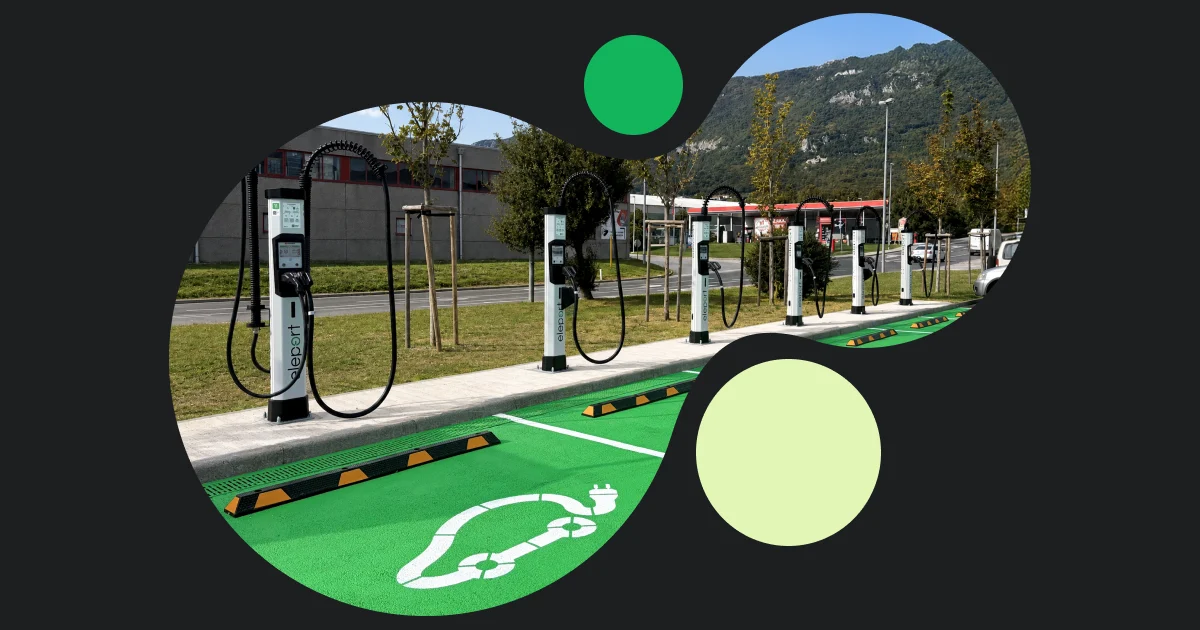
Rewinding just a few years, say about five, the 50 kW chargers were the norm, with very few ultra-fast chargers deployed in Europe. Most public fast chargers deployed by any EV charging network in Europe these days range between 150 kW and 350 kW, with the 50 kW only deployed intentionally for longer dwell times.
The next jump. At least in the case of this one technology entering Europe:
BYD’s new 1500 kW Flash chargers are the most powerful public passenger EV charging hardware announced for Europe. For this article, we’ve explored what’s in them, when they’re coming, and which EVs can use the BYD flash charging technology.
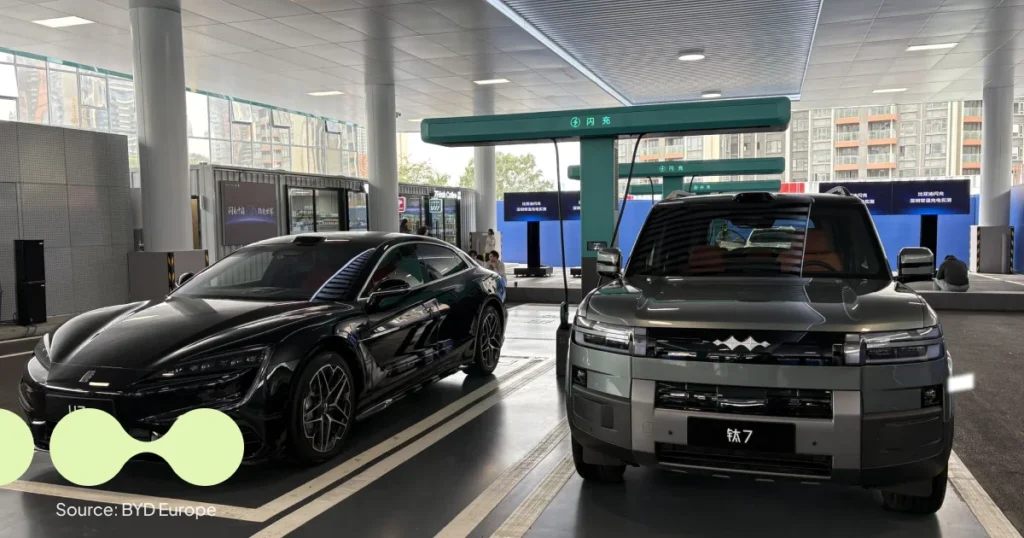
The first BYD Flash Charging Demo in Europe
On April 8, 2026, BYD’s premium brand Denza launched the Z9 GT at the Palais Garnier in Paris. The more consequential reveal that night wasn’t the 115 000€ electric shooting brake, rather the charging station next to it.
BYD Flash Charging, the company’s 1500 kW megawatt-class system, made its European debut alongside the car.
Within twelve months, BYD plans to install 3000 of these stations across the region. In China, BYD wants to reach 20 000 stations built by the end of 2026.
The pitch is to charge your EV:
- 10% to 70% state of charge in five minutes,
- 10% to 97% in nine minutes,
- and even at −30°C, 20% to 97% in twelve.
These numbers would be hard to take seriously… if BYD hadn’t already deployed over 5000 such stations across 297 cities in China. So what is BYD Flash Charging technology, when does it land in Europe, and what does it mean for the way you charge?
What exactly is BYD’s Flash Charging technology?
Flash Charging is BYD’s brand name for its 1500 kW DC public charging system. Capacity, not connector. A BYD Flash Charging dispenser pushes electrons at roughly four times the rate of most “ultra-fast” chargers operating in Europe today.
Note that this system is most likely not ready to deliver these numbers to your EV yet. Or more precisely, your EV is likely not ready to receive it.
What type of EV do you need to use BYD Flash Charging in Europe? To pull the full 1500 kW peak, the car needs Blade 2.0 cells with their 8C charging rate and an architecture that runs at 1000V.
Most European EVs today operate at 400V or 800V and cap their charging acceptance somewhere between 350 and 400 kW. Plugging one of those into a 1500 kW dispenser is still safe. The car simply charges as fast as it can, which is usually well below the dispenser’s ceiling.
How BYD Flash Charging works
Three things came together to enable 1500 kW. Each existed in some form before. What’s new is putting them in one product.
Start with the cell. BYD’s second-generation Blade Battery uses a new “Short Blade” geometry, a multi-level cathode particle structure, and a silicon-carbon anode. The Short Blade supports an 8C peak charge rate, meaning it can take a current eight times its capacity.
In translation, a 100 kWh pack at 8C accepts 800 kW of charging power, which the other EVs just can’t do today.
Next, the platform. BYD’s Super e-Platform pulls the whole vehicle (battery, motor, power supply) up to 1000V. Higher voltage is the easier path to more power. At 1000V, hitting 1500 kW requires ~1500A of current, which is still hard but inside the limits of what current cabling can handle.
At 400V, the same power would mean pushing to ~3750A, which is impractical with today’s connector and cable technology.
Then comes the third side, the dispenser. BYD’s new T-shaped chargers, placed like this also to ensure fast turnover of vehicles charging, operate at 1000V and push 1500A through a single connector under China’s GB/T standard.
For Europe, however, BYD has achieved this via the CCS2 connector, more on that below. The dispenser is backed by an on-site BESS (battery energy storage system), which means the charger draws steadily from the grid and discharges the storage battery in those brief 1500 kW bursts.
Otherwise, it would need to build out huge grid connections in an already limited market. And as any charge point operator could tell you, grid capacity is the main limiter of charging expansion.
Ready in 5, Full in 9, Cold add 3: what the numbers mean
BYD’s tagline for the charging performance is “Ready in 5, Full in 9, Cold Add 3,” and it’s worth unpacking each piece.
“Ready in 5” is a charge from 10% to 70% state of charge in five minutes at normal ambient temperature. On a Denza Z9 GT’s 122,49 kWh pack, that’s roughly 73 kWh of energy added in five minutes. The car needs to accept around 880 kW average over those five minutes, with a peak well above that.
“Full in 9” takes the charge from 10% to 97% in nine minutes. The last third is slower than the first, which is just how lithium battery chemistry works. Most of the time is spent on the upper part of the curve, which is already tapering off way slower than in regular battery charging.
“Cold Add 3” is the cold-weather number. At −30°C, going from 20% to 97% takes 12 minutes. Three minutes longer than the room-temperature time. For comparison, an LFP-equipped EV on a 350 kW charger at −15°C typically loses around half its peak speed and can take well over an hour to reach 80%. The cold-weather result is the impressive bit, enabled by both the new cell chemistry and active battery thermal preconditioning.
There is one caveat to these. BYD’s published times use CLTC (China Light-duty vehicle Test Cycle) and Chinese measurement methods, and the 1500 kW peak figure applies to the Chinese-market GB/T connector. So how do the numbers translate to Europe?
The first independent European CCS2 charging test, conducted on a Denza Z9 GT at the Paris demo by YouTube channel Out of Spec Roaming, hit 10-70% in 5 minutes 20 seconds and 10-97% in 9 minutes 22 seconds. About 20 seconds off the Chinese claim, so we could basically say it’s verified in real (European) life.
Inside a BYD Flash Charging station
A station like this doesn’t look much like the current European EV charging sites – not even like our collection of the most unique charging sites in the world. The T-shaped dispenser uses an upper sliding rail that places the connector overhead, so the cable drops toward the car rather than hanging from a bollard. The cable itself is more compact than current 350 kW units and is liquid-cooled. Less weight, easier to handle, marginally less awkward in winter gloves.
Inside the cabinet, the dispenser pushes 1000V and up to 1500A.
In China, the full 1500 kW comes through a single GB/T connector.
For Europe, BYD took an unusual route.
Rather than buying off-the-shelf CCS2 connectors from third-party suppliers like Phoenix Contact or Amphenol, they engineered their own. Standard CCS2 isn’t rated for the megawatt-class amperage needed. BYD’s plug is rated 1000A continuous and 1500A in boost mode, with the cooling sized so the system never has to come out of boost. The full unit is rated at 2 MW total output, with grid input scaling between 60 and 560 kVA depending on site capacity. That’s enough to serve two cars at 1 MW each simultaneously, or deliver well over a megawatt to a single vehicle.
Every flash charging location also includes an on-site BESS. The standard configuration starts with two 190 kWh units (380 kWh total), using BYD’s own Blade 2.0 cells, rated for 10C charging and discharging. The grid connection stays steady and moderate; the storage handles the brief megawatt-class spikes.
At the low end of the input range, 60 kVA is small enough to fit almost any commercial site, which is what makes the rollout plausible, even though they recommend at least 200 kVA. BYD can put megawatt-class chargers where the grid alone could never support them.
The BYD Flash Charging Network comes to Europe – with partnerships
As we write this overview, BYD is still set to launch its first public Flash Charging site in Europe and plans to do so in June 2026. So far, they’ve only demonstrated the system in April at the Paris launch.
The strategy of thousands of chargers going up so quickly, however, is about partnership rather than a ground-up build. Diego Pareschi, BYD Europe’s Director of EV Charging, told Autocar in April that the European charging market is mature enough that building from scratch wouldn’t make sense, and that BYD will install its dispensers at existing third-party sites alongside operators’ own units. Denza dealerships will get their own branded versions; everywhere else, the public stations will simply carry “Flash” branding. Pareschi has likened the ambition to USB, a standard that’s “its own thing.”
Crucially for European drivers, the system will be open to any EV that fits a CCS2 connector.
How fast can my EV charge at the BYD Flash Charger? Your Volkswagen, your Polestar, your Renault, your Tesla or really any CCS2-using battery electric vehicle can plug in and pull whatever its onboard hardware can accept. If that’s 150 kW, you get 150 kW. The dispenser simply represents the highest available ceiling.
Initial deployment markets line up with the Denza launch: Germany, France, Italy, Spain, the UK, and the Netherlands. Beyond that, the full 30-plus countries Denza plans to enter by year-end.
Flash Charging vs current European fast charging
To understand what BYD is bringing, look at what’s currently the European ceiling. Ionity, the cross-brand network founded by VW, BMW, Mercedes, Ford and Hyundai-Kia, operates over 5000 chargers across Europe at 350 kW. Most other operators (Fastned, Allego, Tesla Superchargers, Eleport itself) sit somewhere between 150 and 400 kW.
Alpitronic’s new 600 kW units, upgradeable to 1000 kW, have been the 2026 headline, deployed at pilot sites by Ionity and a handful of independents. Until BYD fast charging announcement, this was the highest publicly announced power level for European fast charging.
BYD’s 1500 kW peak is more than four times Ionity’s typical 350 kW unit and 50% above the Alpitronic ceiling. On paper, a category jump. The catch is that most European EVs can’t yet use the full power. The 400V architecture in most production cars caps charging acceptance between 250 and 400 kW. Even today’s 800V flagships like the Audi e-tron GT and Porsche Taycan max out around 320 kW. The Denza Z9 GT, with its 1000V Blade 2.0 architecture, is the only car in Europe that can take meaningful advantage of flash EV charging at the 1 MW level.
BYD’s 1500 kW peak introduces a similar category jump in vehicles as we saw in the 50 kW to 350 kW – the vehicles were mostly not able to take in the full charge at the time the new stations launched, but 300’ish is becoming common now, while the entry-level electric vehicles have often stayed at lower capabilities. So it has been proven that when the infrastructure leads, the cars catch up. BYD’s gamble is that European-market BYD Fast Charging stations being widespread at 1500 kW will pressure other manufacturers to bring their own architectures up to 1000V over the next product cycle.
Every BYD model will get the Flash Charging capability
Right now, the answer is one car. The Denza Z9 GT, BYD’s flagship shooting brake priced at 115 000€, is the only European-spec BYD vehicle equipped with the Blade Battery 2.0 and the 1000V Super e-Platform required for the full 1500 kW. Its 122,49 kWh pack accepts the peak power at compatible stations. The first of which will land here in June.
The second model coming is the Denza D9 DM-i. A plug-in hybrid people-mover with a 58,5 kWh battery, the D9 has been engineered to accept up to 559 kW of charging power. That’s not quite the full Flash ceiling, but it still hits the BYD headline charging times.
Importantly, however, BYD’s plan is full-lineup democratization, much further from the Denza premium flagships. Diego Pareschi has told Out of Spec Reviews that the same charging performance will roll out across every BYD model, from the cheapest cars up through Denza and Yangwang.
Battery capacities will differ across segments, but the charging time stays constant regardless of price point. The second-generation Blade cell is already shipping in China across multiple model families, with the Ocean and Dynasty series (Atto, Sealion, Han, Tang) due to receive it from Q3 2026. None of these have been confirmed for European sale yet with the new battery, but the direction is unusual. Within a year and a half, BYD probably won’t be selling a new flash-incapable model in Europe.
What comes next for Europe
As of May 2026, the European footprint is closer to one demo unit in Paris than to a continent-wide BYD flash charging network. Deployments at scale are still ahead. But the announcement, the partner strategy, and the open-CCS2 commitment have already shifted what’s possible.
Whether the 3000-station target lands on time is an open question. The Chinese build pace suggests BYD can move quickly when needed. European deployment however, has its own permitting, grid, and partner-negotiation realities. That’s likely why the network is seeking existing CPO partners when rolling the network out to drop chargers in their stations.
We’re witnessing a new jump in electric car charging, and BYD seems to be the one ushering in the new era.