
Stop and consider, just for a moment, how far we have come.
Just five years ago, a 10-charger charging site in Europe was headline news. Most charging sites were one or two chargers somewhere, maybe four if it was a stronger effort.
Today, we are seeing 30 to 60-stall sites pop up and become some of the most popular electric car charging stations across Europe without a second glance. The world is already seeing some EV charging sites that have several hundred chargers.
As scale becomes the new normal, and so many more players have entered the game, differentiation among charging sites becomes more relevant. Purpose-built EV charging sites and carefully crafted driver charging experiences are what separate the best from the rest.
Do differentiation needs mean the regular values, like reliability, don’t count as unique anymore? Quite the contrary, reliability of the charging systems has become the baseline, keeping uptime high on EV charging sites is still one of the ways to differentiate. But today, we’ll look at more ways of how charging sites can look and feel unique, all across the world.
PS – we’ve already covered the largest car charging stations of the world in a separate piece. It’s a good read.
This one here looks at the top EV charging sites in uniqueness across the world:
1. Tesla Diner & Supercharger, Hollywood, USA
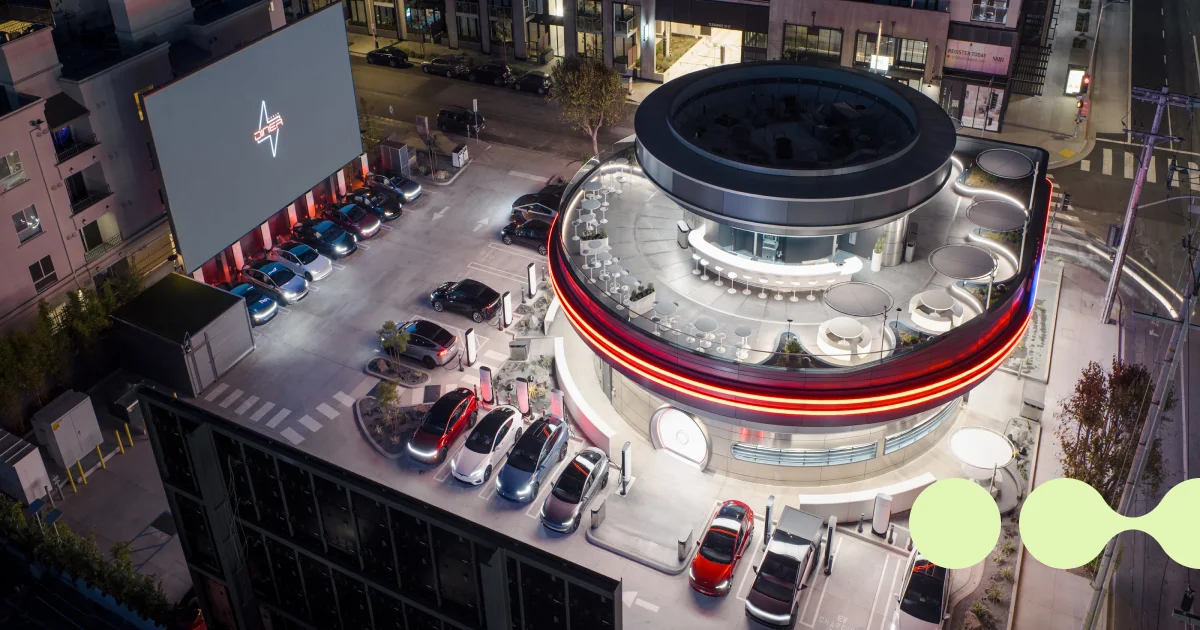
Location: 7001 Santa Monica Boulevard, Hollywood, Los Angeles, California
Operator: Tesla
What makes it unique: Charging meets retro-futurist diner meets drive-in cinema meets branded retail. Nobody else in the world have done this.
Chargers: 80 V4 Superchargers (up to 325 kW), open to all NACS-compatible vehicles
Solar and power: 230 kW of solar canopies, 10 MW of on-site power
Opened: July 21, 2025
If you take “most unique EV charging hub in the world” literally, this is probably the answer.
Tesla opened its first Tesla Diner & Supercharger on Santa Monica Boulevard in Hollywood in July 2025, six years after Elon Musk first floated the idea on Twitter. The finished site is exactly as ambitious as you’d expect from Tesla’s more uniquely designed EV charging sites.
A two-story neon-lit structure designed by Tesla’s automotive designer Franz von Holzhausen, sitting in a parking lot that holds 80 V4 Superchargers running up to 325 kW.
Two 45-foot LED screens at either end of the lot run classic films on a continuous loop, in proper drive-in fashion, with audio piped directly through your Tesla’s speakers while you charge.
The Diner serves upscale roadside food (burgers, fries, milkshakes) with locally-sourced ingredients, and can be delivered by servers on roller skates.
An Optimus humanoid robot scoops popcorn and serves food, doubling as a live demo of Tesla’s robotics ambitions. You can pre-order food through the car’s navigation when routing to the site, and there’s a Tesla merch shop on the upper floor.
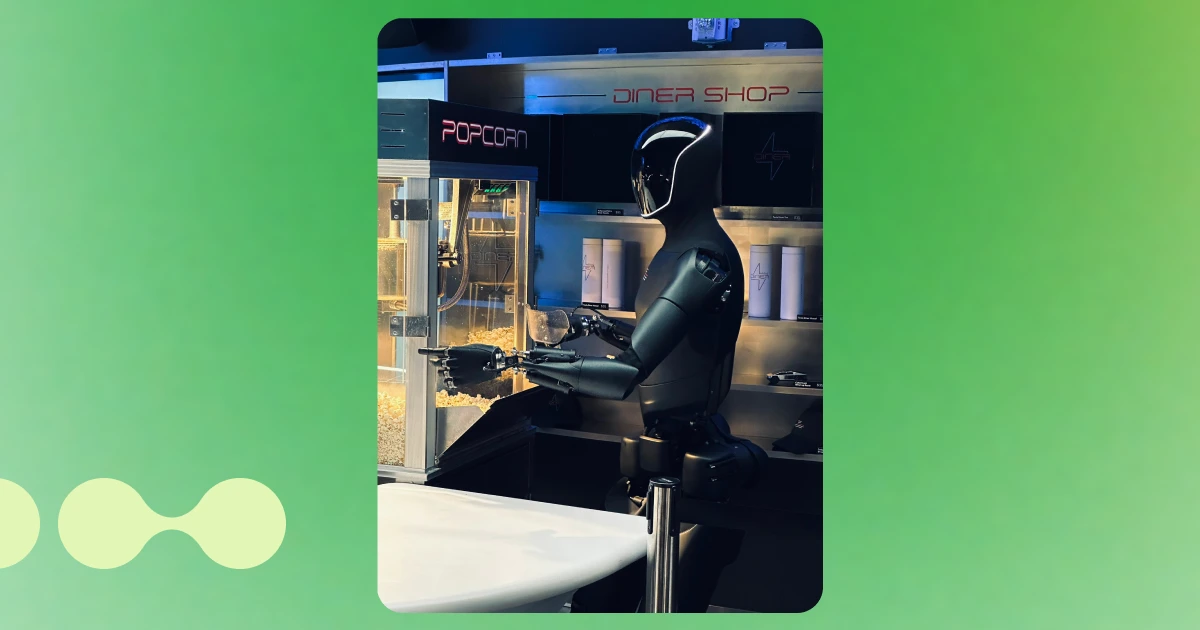
Musk has said Tesla plans to open Diners in major cities worldwide and at Supercharger sites on long-distance routes, which could make Hollywood the template for some of the most popular electric car charging stations of the next decade.
Here is a video of the Tesla Diner, by Tesla.
2. Seed & Greet, Hilden, Germany
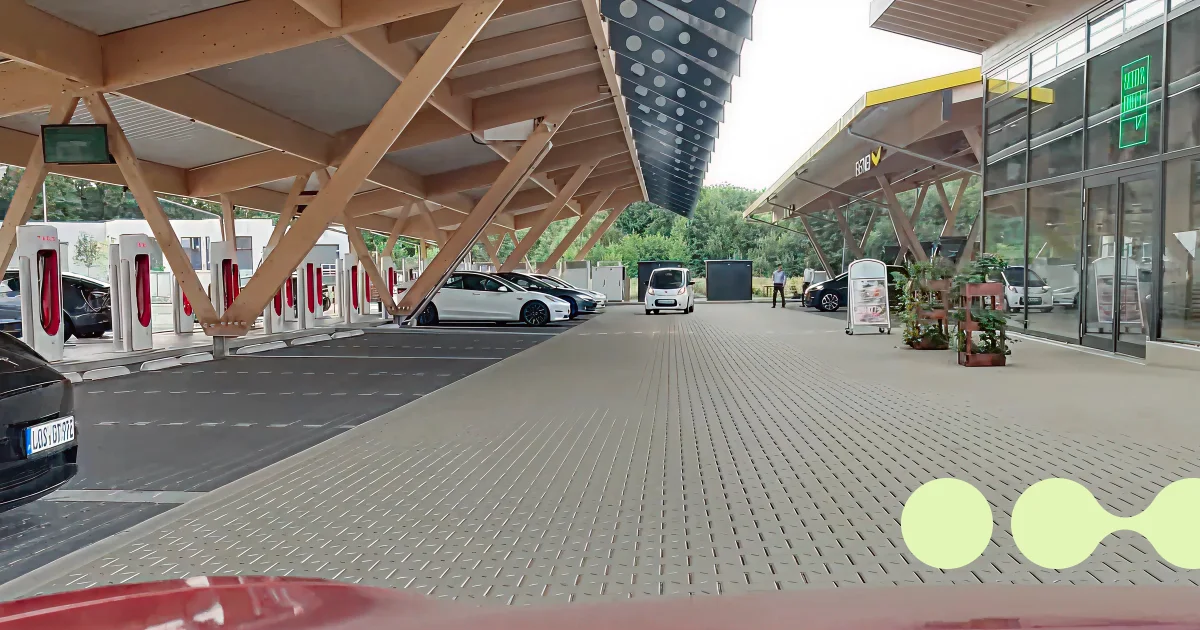
Location: Autobahn A3/A46 interchange (Kreuz Hilden), North Rhine-Westphalia, Germany
Operator: Seed & Greet (Bäcker Schüren family bakery), with Tesla, Fastned, and NIO
What makes it unique: An organic baker built Europe’s busiest charging park, complete with a vertical farm growing produce for the café on site. With an occasional Tesla pool on site.
Chargers: 107 in total. 40 Tesla V3 Superchargers, 22 Fastned/Alpitronic HPCs, 45 AC chargers, plus a NIO battery swap station
Opened: October 2020 (expanded through 2022)
If you’d asked me five years ago to design the most ambitious EV charging site I could imagine, I wouldn’t have come up with anything as good as what Roland Schüren built in Hilden.
Schüren is a fourth-generation organic baker from Hilden.
He looked at the patch of land next to Germany’s busiest motorway junction and decided to combine EV charging, renewable energy, and fresh food production on one site. What followed handles 130 000 to 150 000 charging sessions per year and routinely ranks as one of the busiest charging parks in the EU.
It’s also one of the popular EV charging sites where EV community events tend to be held.
All 62 DC stalls sit beneath a 1 MWp solar canopy and are connected to an on-site 2 MWh battery storage system. Excess solar generation powers the bakery’s ovens and a four-story vertical farm built into the café.
It’s also a true multi-brand hub, with Tesla Superchargers, Fastned high-power chargers, AC charging, and a NIO battery swap station all under one roof. Timber-frame construction throughout, with heating from bakery oven waste heat. A five-story expansion is planned, with a much larger vertical farm.
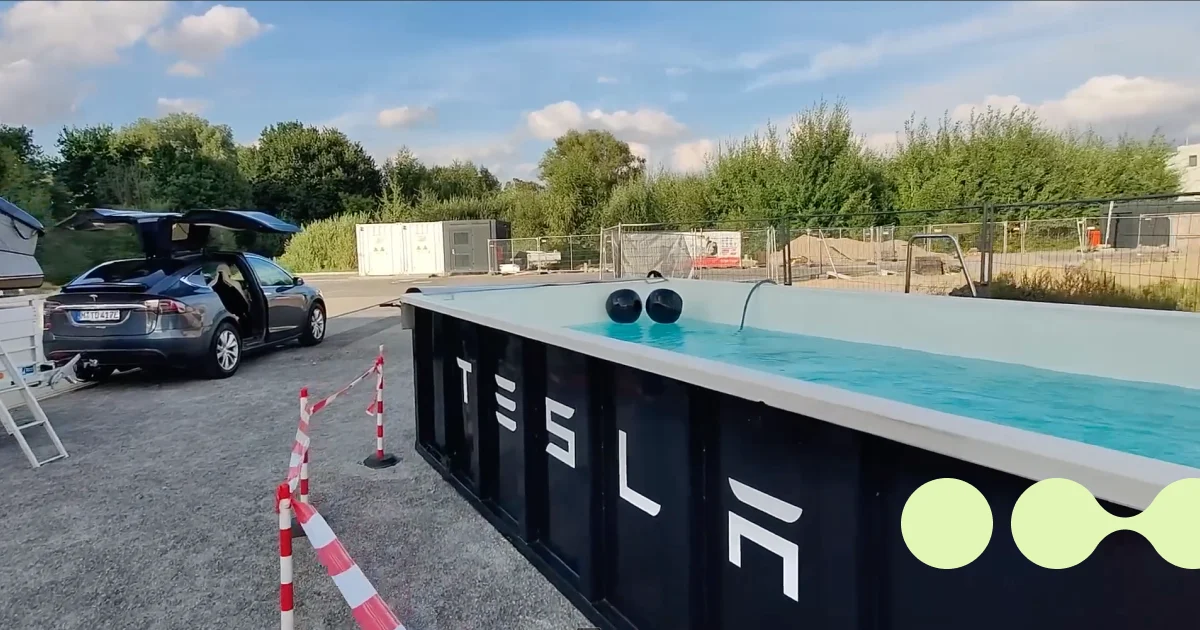
Here’s a video by Tesla Welt of the charging site (and featuring the Tesla pool they once brought to the site for summer sessions – quite unique among the EV charging sites in the world):
3. Fastned Gentbrugge, E17, Belgium
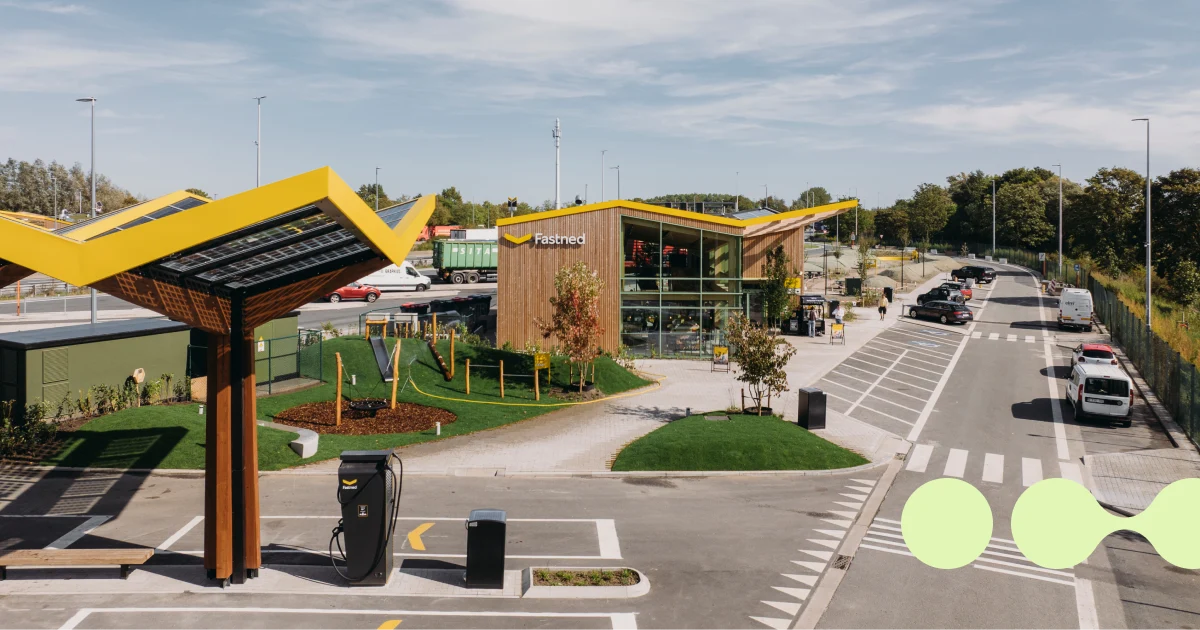
Location: E17 motorway between Ghent and Antwerp, Belgium
Operator: Fastned
What makes it unique: Europe’s first fully electric, zero-emission service area, kitchen included
Chargers: 16×400 kW DC chargers per highway side (32 total), plus 4 dedicated electric truck chargers
Opened: September 2025
This is probably among the top EV charging sites among the motorway rest stops – exactly how it is supposed to look like when you start from a clean sheet.
Fastned Gentbrugge site spans over 8000 square metres across both sides of the E17, on a corridor that handles roughly 26 million vehicle movements per year. The 32 ultra-fast chargers sit in a drive-through layout beneath Fastned’s signature Solar Tree canopies, timber structures shaped like actual trees with solar panels arranged as something like leaves.
The building is what really sets the site apart from other EV charging sites. The entire site runs on electricity, kitchen and retail area included, with no gas connections and zero operational emissions. Construction uses circular materials including biobased insulation, recycled concrete, and crushed seashells.
Components were designed to be disassembled and reused at end of life. One of the public benches is even made from a piece of an old Fastned station.
Beyond the chargers, the site offers a restaurant, a 24/7 self-service shop, clean toilets, warm showers, picnic tables, and a family play area in a landscaped environment.
For a family road-tripping with an EV, a charging stop like this could hardly get any better.
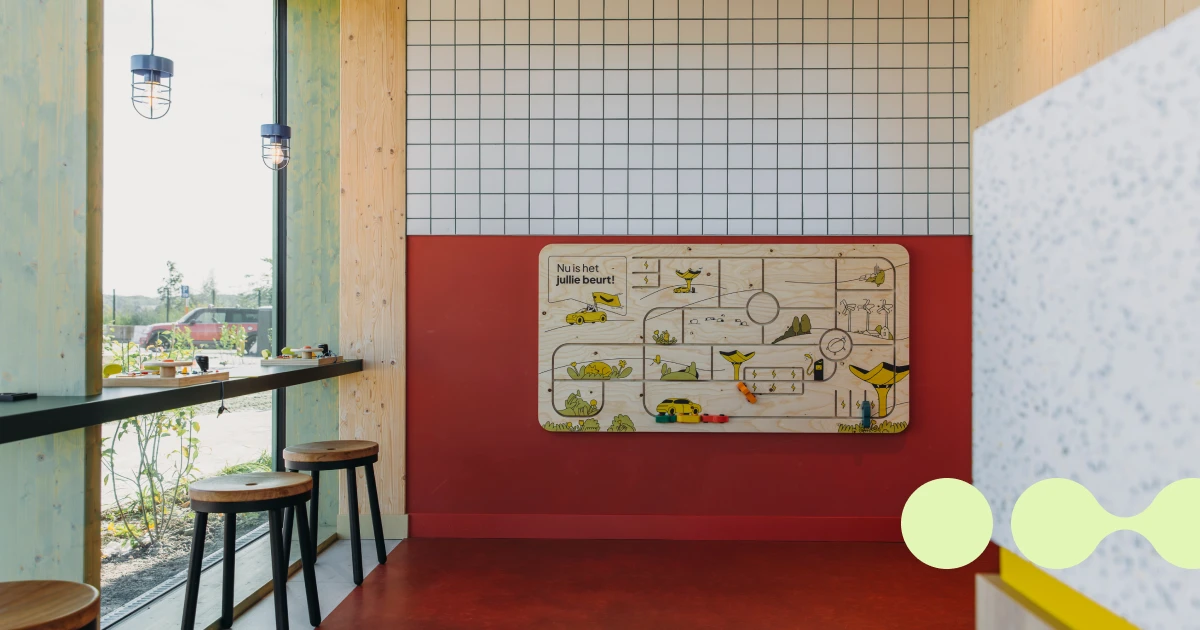
4. Electra Electraline, Malle, Belgium
Location: Malle, Antwerp province, Belgium (not on image above)
Operator: Electra
What makes it unique: Charger pillars that double as giant LED status screens, gamified charging via app, and the first 1000 kW Alpitronic hypercharger in Belgium
Chargers: Alpitronic HYC1000 architecture, up to 600 kW per compatible vehicle
Opened: March 2026 (Electraline concept launched late 2024)
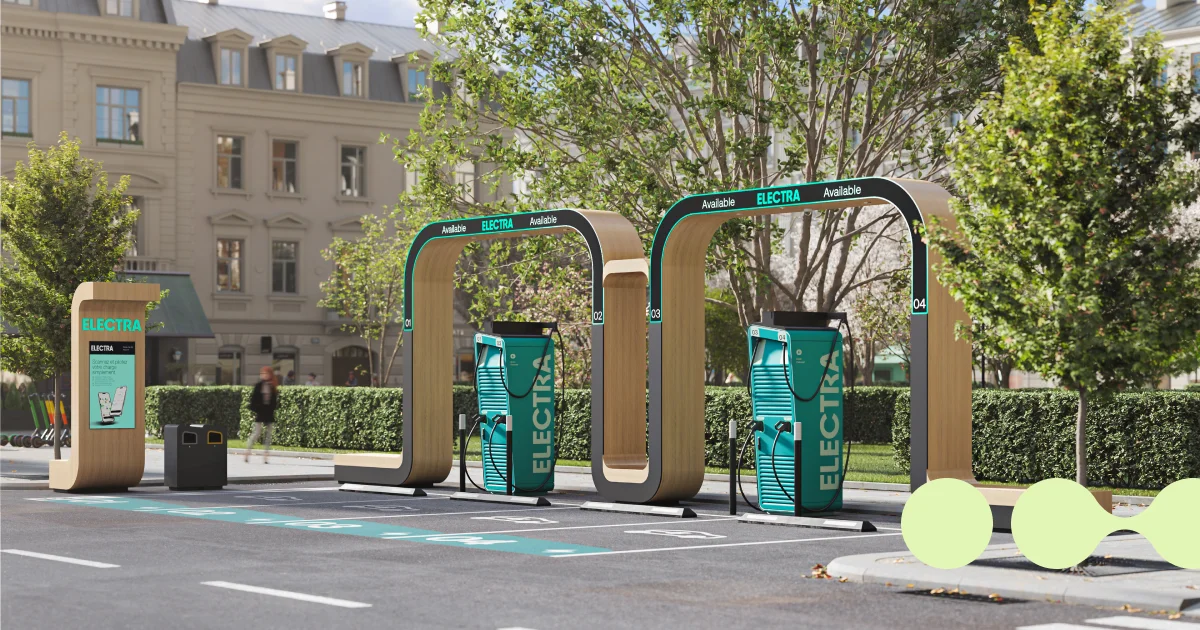
Electra’s Electraline is one of the true visible charging site innovations originated in Europe in the past few years, reimagining how the charging station & sharing the information with the EV driver really looks like.
Electra is the Paris-based ultra-fast charging operator behind a growing roster of popular EV charging sites across Europe. 4000+ charging points across 10 countries, over 860 chargers in Belgium alone, and the overall user-voted winner of the 2025 Chargemap awards. The Malle site is worth knowing about for two reasons: the technology and the design.
On the technology side, Malle was the first deployment in Belgium of the Alpitronic HYC1000 hypercharger architecture. A 1000 kW central power unit feeds the dispensers and delivers up to 600 kW to a compatible vehicle.
For context, most ultra-fast chargers in Europe peak at 400 kW. The HYC1000 puts hundreds of kilometres of range into a car in roughly the time it takes to grab a coffee from the café next door. That is, of course, if the car can accept it, but… that’s a whole other topic.
With the site in Malle, Antwerp, and now many others, Electra is sharing a truly unique charging station design with the world. It’s called Electraline.
What makes the Electraline design unique?
- LED screens are built into the canopy pillars, visible from a distance, displaying real-time price per kWh, charger availability, session status, and even your name when you pull in if you reserved a spot via the app.
- Built-in speakers guide users through the session.
- Integrated cameras and lighting handle security.
- And while you wait, you can play Rock-Paper-Scissors on the Electra app against others and you can see it on the LED screen. You can even win kW discounts on your bill. Yes, literally:
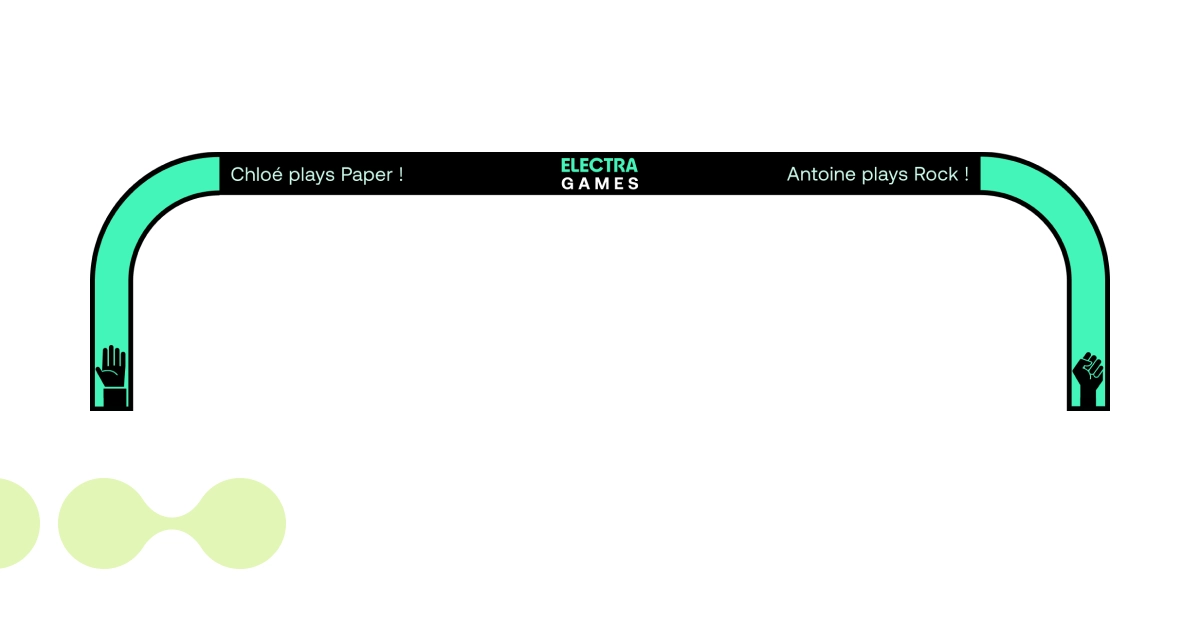
Image source: Electra
Fast, futuristic, and a bit of fun, this line will make people remember Electra as one with unique EV charging sites. Here is a video from the unveiling of the Electraline by AP.
5. NIO Power Swap Station Lier, Norway
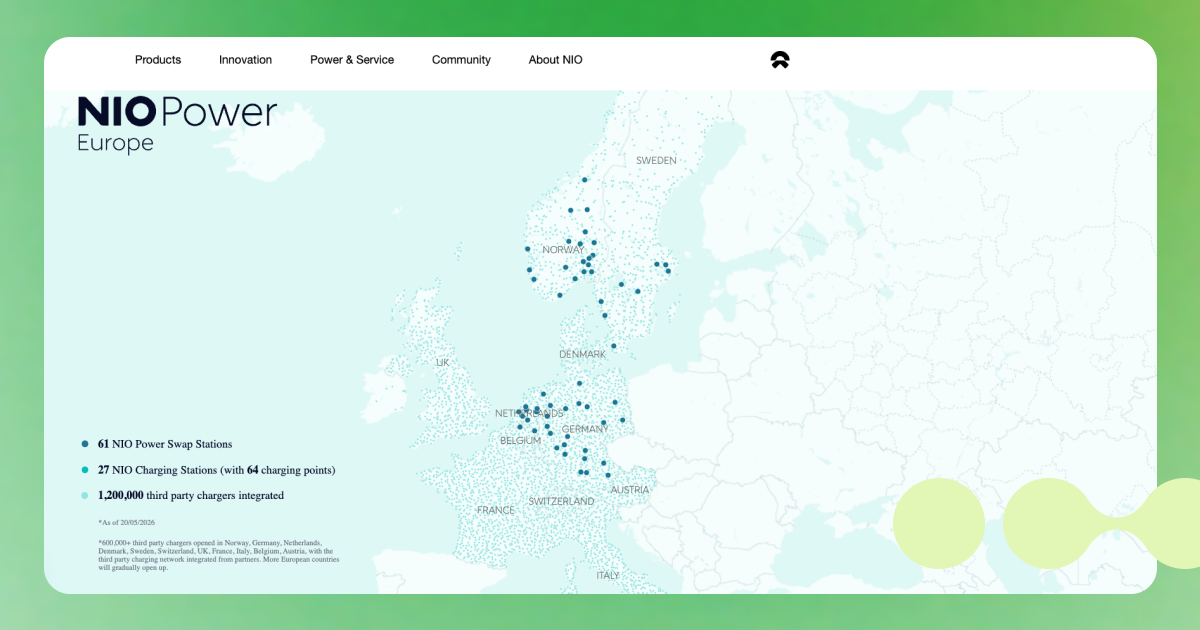
Image source: NIO website
Location: Lier, Buskerud county, Norway (E18 corridor, around 40 km southwest of Oslo)
Operator: NIO
What makes it unique: You don’t charge the car. You swap the whole battery in three minutes. Lier is where the concept arrived on European soil.
Capacity: Third-gen stations store 21 batteries and perform up to 408 swaps per day. Fifth gen, launching now, does a swap in 1 minute and 48 seconds, performing more than 500 swaps per day.
Network: 61 stations across Norway, Germany, the Netherlands, Sweden, and Denmark. 3760+ globally.
Opened: January 2022
This entry is unique on conceptual grounds – especially in Europe – rather than any single site, but Lier is just where the European story started.
NIO opened its first European Power Swap Station in Lier, on the E18 corridor southwest of Oslo, in January 2022. Norway was the obvious starting point, with over 70% of new car sales electric at the time. Today, as you can see from our EV sales in Europe Q1 2026 article, Norway has reached 98%.
The process of NIO battery swapping is straightforward. Unlike conventional car charging stations, NIO’s stations don’t ask drivers to plug in at all. You drive in, stop in the marked spot, and the station does the rest.
It raises the vehicle, unscrews and removes your depleted battery from below, replaces it with a fully charged one, and lowers the car back down. About three minutes, fully autonomous, no cable involved. You drive out with up to 500 km of range.
NIO has since expanded to over 60 Power Swap Stations across five European markets and 3760+ globally. Fifth-generation stations begin deploying in 2026 with multi-brand compatibility, since Geely and Changan have both signed strategic partnerships to use NIO’s swap standard. The stations also work as decentralized grid energy storage, slow-charging batteries off-peak to balance load.
NIO has scaled back European expansion in 2025 amid investment cuts, and whether battery swapping becomes a dominant model or stays a complement to plug-in fast charging is still an open question.
6. Rove, Santa Ana, California, USA
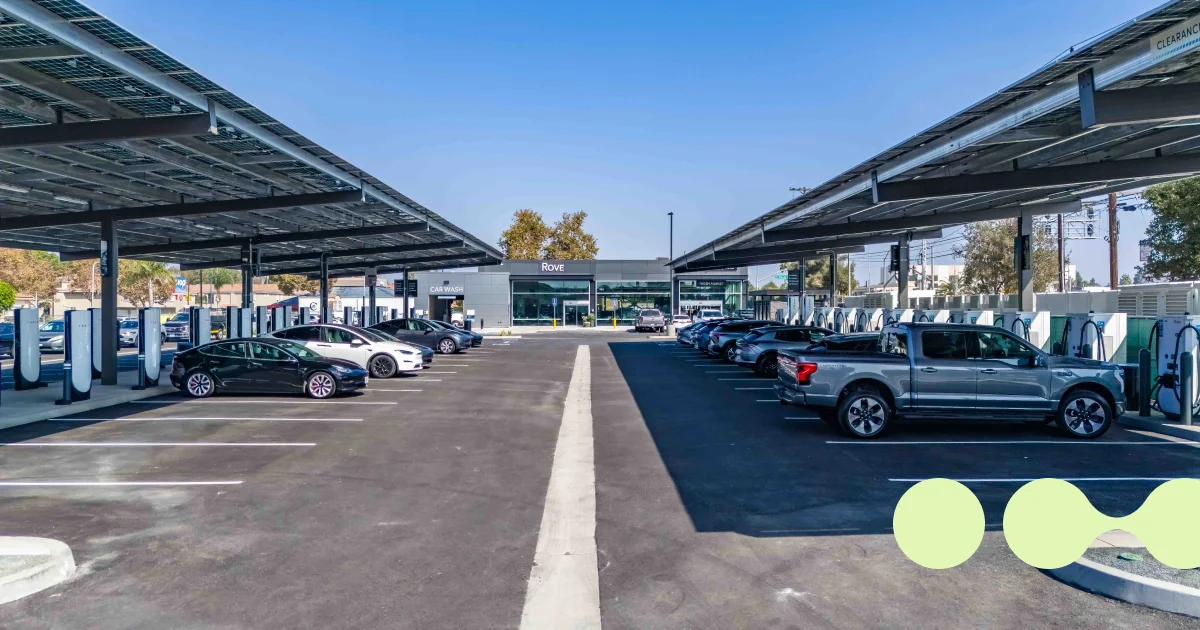
Location: 1008 E 17th Street, Santa Ana, California
Operator: Rove (co-located with Tesla)
What makes it unique: One of America’s first purpose-built full-service EV charging center, designed around hospitality
Chargers: 40 DC fast chargers (28 Tesla V4 Superchargers, 12 ABB DC fast chargers) under solar canopies, plus 24 AC chargers
Opened: October 2024
The thesis behind Rove is simple. If EV drivers are going to spend 20-30 minutes at car charging stations, the stop should be designed around that reality, as a destination in its own right rather than an afterthought stuck in some parking lot.
Rove Santa Ana in California is one of the purpose-built EV charging sites, from the ground up:
- 40 DC fast chargers under solar canopies, all drive-through.
- A Gelson’s mini-market (a Southern California upscale grocery chain) offering fresh sushi, breakfast burritos, salads, beer, wine, and grab-and-go items.
- A glass-fronted lounge with seating, free Wi-Fi, and power outlets.
- Restrooms open 24 hours.
- A car wash with complimentary vacuums and air. A fenced dog area for four-legged passengers in their EV charging sites.
- The site is staffed 22 hours a day.
No membership required. You drive up, plug in, tap your contactless card, and charge. Of course, the app is there, too.
The model is working. Rove won AutoTech Breakthrough’s Best Charging Station Solution of the Year, and the second location opened in Costa Mesa in May 2026, with around 20 sites planned across Southern California.
Here’s a video tour of the Rove Santa Ana by the Out of Spec channel.
7. IONNA Apex Rechargery, North Carolina, USA
Location: Apex (Wake County), North Carolina, USA
Operator: IONNA, which is a joint venture of BMW, GM, Honda, Hyundai, Kia, Mercedes-Benz, Stellantis, Toyota
What makes it unique: Eight global automakers jointly build EV charging sites, starting a network from scratch. The first Rechargery sits in a restored 1925 railroad-town gas station.
Chargers: 10 covered bays at up to 400 kW, supporting both CCS1 and NACS at 800+ V
Network: 107 stations and 1020 stalls as of April 2026, targeting 30 000 by 2030
Opened: February 2025
IONNA is a joint venture founded by eight of the biggest names in the global auto industry: BMW, GM, Honda, Hyundai, Kia, Mercedes-Benz, Stellantis, and Toyota. And their speed of deployment since the start a bit more than a year ago has been a bit dizzying – it has already deployed over 100 stations with more than 1000 stalls in that time.
The mission is bigger: to deploy 30 000 ultra-fast charging points across North America by 2030, one of the most ambitious EV charging sites buildouts ever announced. The first Rechargery opened in Apex, North Carolina, in February 2025, on the site of a restored 1925 gas station in the historic centre of a former railroad town.
The contrast is part of the point.
On site: 10 covered bays at up to 400 kW (both CCS1 and NACS, 800+ V), an indoor lounge with restrooms, coffee, food, and Wi-Fi, plus outdoor pet-friendly amenities. All IONNA chargers run on Alpitronic HYC400 hardware which are used in some of the most popular electric car charging stations across US and Europe.
The network has tiered concepts. Beyond the flagship Rechargeries, there are Rechargery Relay sites for quick stops, Rechargery @ partner locations at Sheetz, Wawa, and Circle K, and a new Beacon flagship tier with 20+ bays and local artwork.
The Garner, NC Rechargery is the first to integrate Amazon’s Just Walk Out cashier-less retail tech, something that would immediately put it among the unique EV charging sites of the world on its own.
Here is a walkaround video of an IONNA Rechargery in Garner, NC, with Ricardo Stamatti, CPO of IONNA.
8. Alfredsson Energy Truck Depot, Norrköping, Sweden
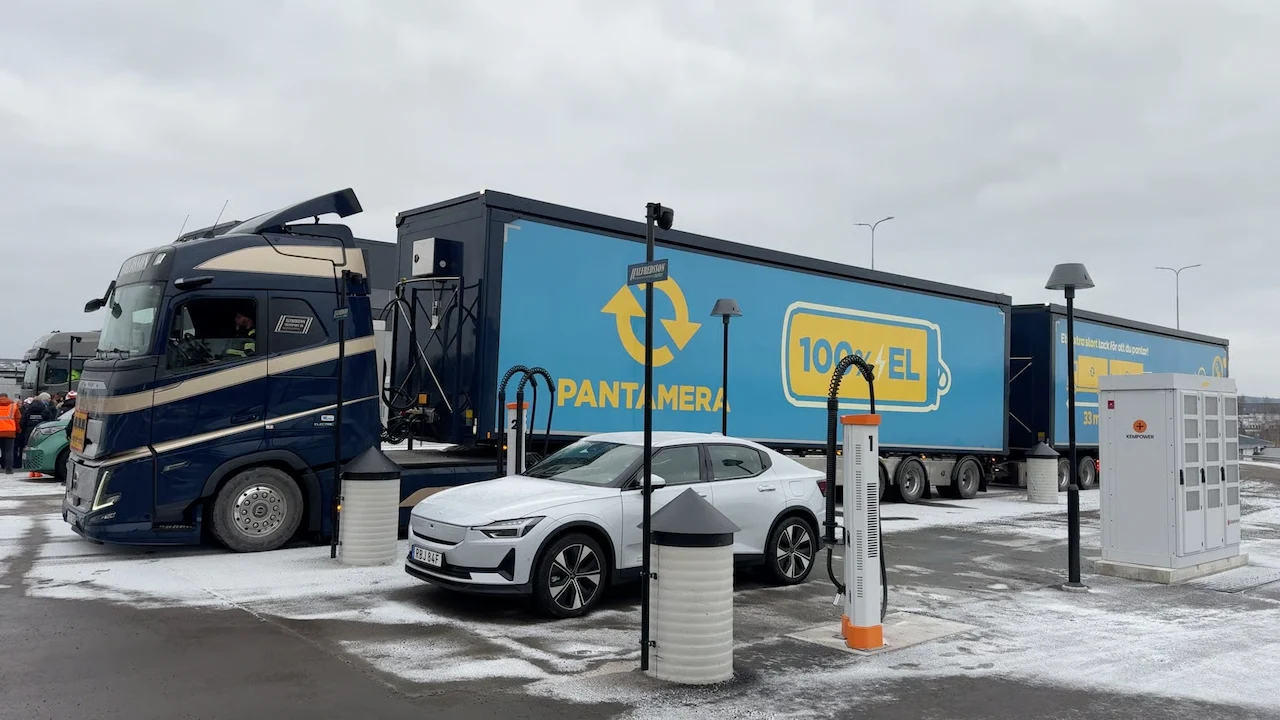
Location: Norrköping, Östergötland, Sweden
Operator: Alfredsson Transport / Alfredsson Energy (Erik Alfredsson), with Kempower hardware
What makes it unique: First MCS (Megawatt Charging System) truck EV charging sites in Sweden, host of the world’s first known public megawatt charging session, built by a logistics company and opened to everyone
Chargers: 12 heavy-duty charging points for vehicles up to 34 metres long, 400 kW to 1,2 MW per stall (CCS1 and MCS)
Energy system: 2,4 MW grid connection, Polarium 1,2 MW / 2,4 MWh battery storage, 400 kWp solar park
Opened: Public MCS launch August 2025
We’ve been talking of the most popular electric car charging stations, but in today’s world – why not limit them to cars at all?
I went to see this site in person at Kempower’s MCS Live Winter Days in February 2026, and it’s the most impressive truck charging infrastructure I’ve come across.
Alfredsson Transport is a Swedish logistics company that has been running a fully fossil-free fleet since 2015, well before most European haulage operators took electrification seriously. Erik Alfredsson didn’t stop at his own trucks.
He built a public truck charging depot in Norrköping for vehicles up to 34 metres long, open to all hauliers, with 7 electric trucks of his own running alongside.
This is one of the rare car charging stations actually built around megawatt charging.
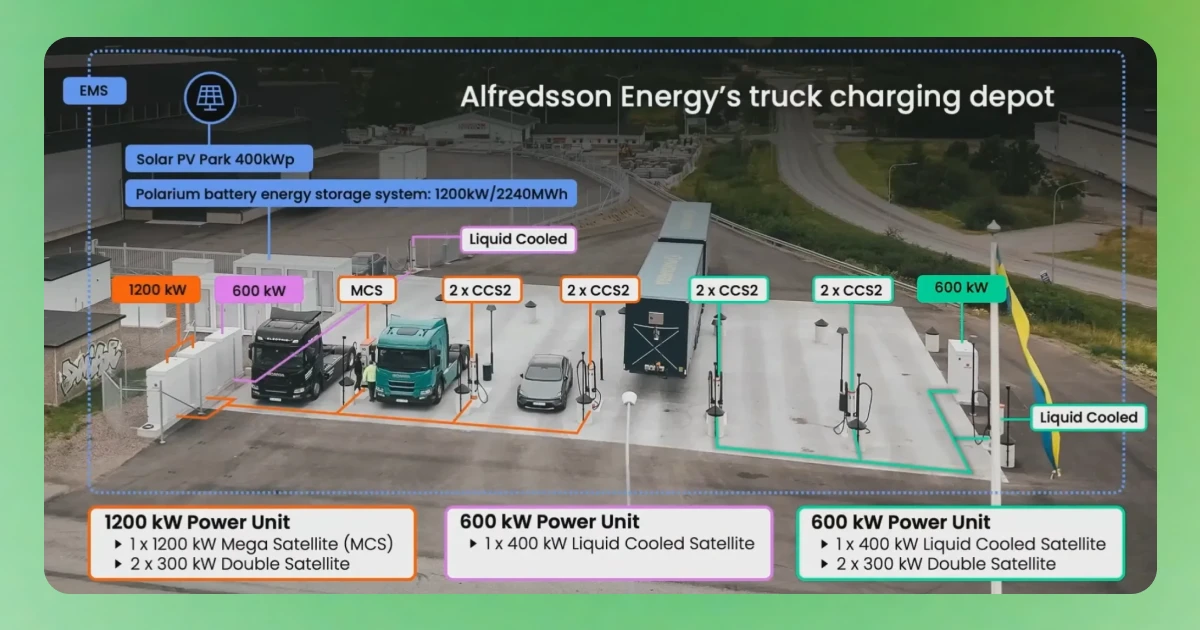
12 heavy-duty stalls delivering 400 kW to 1,2 MW each via Kempower’s distributed system, supporting both CCS1 and the new MCS standard. A 2,4 MW grid connection, a Polarium battery storage system (1,2 MW / 2,4 MWh), and a 400 kWp solar PV park. Kempower’s ChargEye software prioritises power across stalls to ensure MCS-equipped trucks finish within the EU-mandated 45-minute driver break.
On August 27, 2025, the site hosted what Kempower and Traton (Scania’s parent) call the world’s first known public megawatt-protocol charging session. A Scania connected via MCS peaked at 728 kW (1000A) while a second Scania charged on CCS at the same satellite, for a combined 864 kW.
The facility also offers a truck wash and a driver’s lounge with shower, microwave, vending machine, and free Wi-Fi. Trucks can be loaded and unloaded during the charging window. The whole site is designed around the practical reality that long-haul electric trucking only works if drivers can fully charge within the 45-minute breaks regulations already require.
While Europe has some strong public heavy-duty charging players like Milence building out the freight corridors, the logistics companies like Alfredsson here are a very welcome addition.
9. Tesla UFO-themed Supercharger in Roswell, US
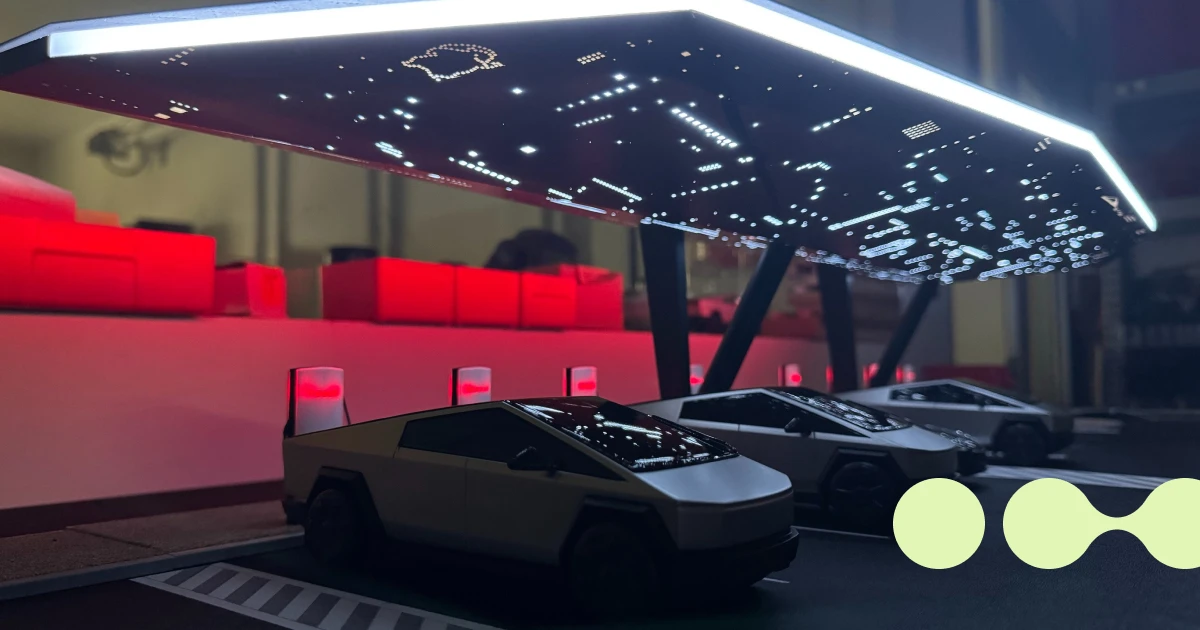
Location: Whataburger parking lot, N Main Street, Roswell, New Mexico
Operator: Tesla
What makes it unique: A Cybertruck-shaped canopy that doubles as a flying-saucer reference, with RGB lighting and pixelated constellations on the underside, dropped into the global capital of UFO tourism
Chargers: 8 V4 Superchargers under the CyberCanopy
Solar: 20,88 kW solar array on the canopy roof
Status: Permitted April 2025, construction phase as of 2026
After Hollywood, Tesla’s second themed Supercharger goes in a direction nobody else in the industry would have predicted. Except for those of us paying attention to permits for EV charging sites, that is. I believe this will become one of the more popular EV charging sites people go to as a destination, not just a stop.
In July 1947, a rancher named W.W. “Mac” Brazel found debris on his property roughly 75 miles north of Roswell, New Mexico. The US Air Force first announced it had recovered a “flying disc”, then walked it back to “weather balloon”, then later to “high-altitude Project Mogul balloon for detecting Soviet nuclear tests”. The believers were never convinced. Eight decades later, Roswell has built its entire tourism economy around alien lore, with little green men on every t-shirt and a UFO Museum on Main Street drawing hundreds of thousands of visitors a year.
Tesla looked at that, looked at New Mexico’s vast Supercharger desert, and decided to build something fitting. These are the actual inspiration renderings by Tesla, discovered along the permit files:
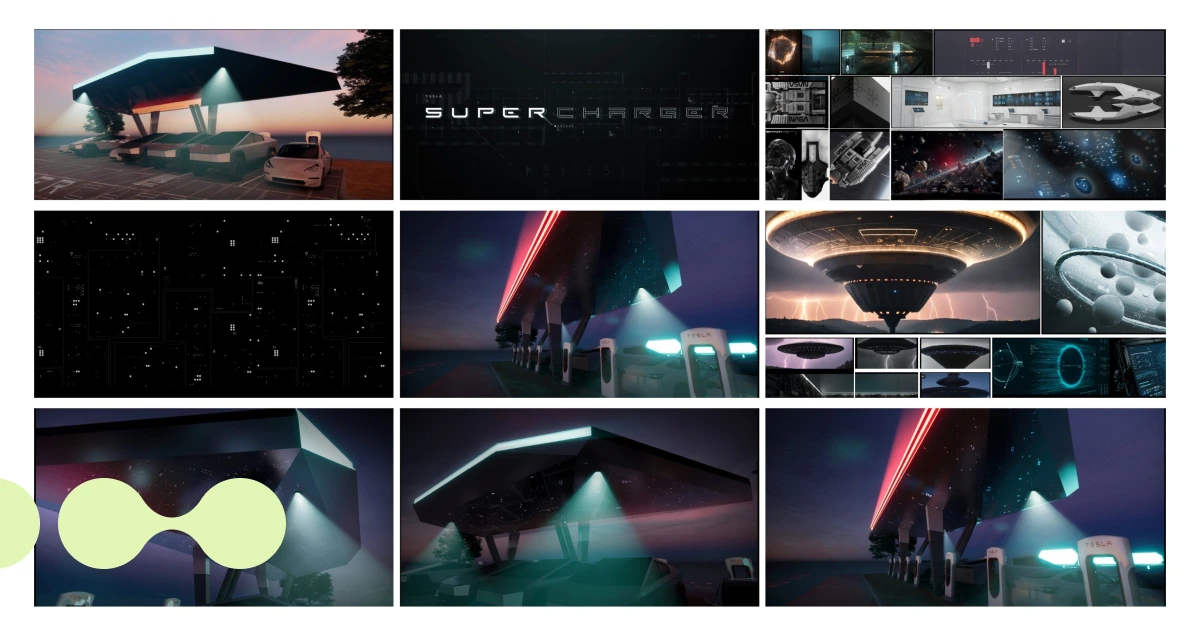
What is the strangest EV charging site you have ever visited? Chances are, this would top your list. The Roswell CyberCanopy Supercharger will sit in the Whataburger parking lot on N Main Street and consists of eight V4 Supercharger stalls beneath a canopy that takes the angular Cybertruck aesthetic and folds it into something closer to a hovering saucer. RGB LED lightbars wrap the canopy edges. A 20,88 kW solar array sits on the roof. The underside features pixelated constellation patterns that include Tesla’s iconic hedgehog motif.
Max De Zegher from the Tesla Supercharging team says why they are building it: “We want to build a few Superchargers cool enough to be worthy of the trip itself.”
10. ADNOC E11 Megahub, Saih Shuaib, UAE
Location: Saih Shuaib, E11 highway between Abu Dhabi and Dubai
Operator: ADNOC Distribution (E2GO network)
What makes it unique: A national oil company in a petro-state building the highway charging network of the future
Chargers: 60 ultra-fast charging points (0-80% in around 20 minutes)
Opened: January 2026
There’s something worth pausing on when a national oil company in one of the world’s major petroleum-producing states launches a flagship hub specifically to electrify its own highway network.
ADNOC Distribution operates over 560 fuel stations across the UAE, the country’s largest fuel network by some distance. The E11 Megahub at Saih Shuaib is the company’s first EV-specific flagship, placed on the highway corridor that connects the UAE’s two largest cities. It runs 60 ultra-fast chargers and is part of a roadmap to open 20 EV charging hubs by the end of 2027, with 15 expected by the end of 2026, covering all core national highways.
The site combines fuel, EV charging, food, and lifestyle in a single destination. This specific location is the first ADNOC site to feature a coworking space, aimed at commuters travelling between Abu Dhabi and Dubai who can do an hour of focused work while their car charges.
The UAE has set a 2050 target for 50% of vehicles on its roads to be battery-electric, and ADNOC is positioning itself as the enabler of that transition.
So what makes a charging hub truly “unique”?
There’s no single answer.
All I know is I could’ve easily written about 20 more of such unique approaches.
It might be brand spectacle (like Tesla’s diner-meets-cinema-meets-Supercharger), or
architecture (Fastned’s Solar Trees, Seed & Greet’s timber bakery),
design at the unit level (Electra’s gamified LED columns),
the business model (NIO’s three-minute battery swap,
the themed experience (Tesla’s UFO Supercharger in Roswell),
the challenges of vehicle size (Alfredsson’s site in Sweden),
a coordinated industry push (IONNA’s eight-automaker JV),
or a geopolitical signal (ADNOC building post-oil infrastructure).
Or something else entirely.
Looking across these 10 rare car charging sites, the common pattern is that the most unique EV charging sites in the world are the ones that started by asking a question that is not just “how many chargers can we fit on this lot?”
The industry is still young. Five years ago, most of these sites didn’t exist. Five years from now, the concepts that work here will have been copied, refined, and deployed at scale across every major market. We’ll keep tracking the most interesting new ones as they go live.