

The pitch for going electric usually leads with saying the running costs for an EV are lower than those of an ICE car, and most drivers assume the easiest logic there – upfront cost higher, fuel costs lower.
We went out to prove (or disprove) the “worst case scenario” around that, something you’ll never put into your EV charging cost calculator by default. We’re going to look at what happens if your EV charging costs are based only on fast charging instead of home charging.
With Eleport’s European DC fast charging price report, we had already fixed the median public fast-charging price in every European market, from Finland to the United Kingdom, so one half of the calculation was done.
The other half of this is comparing EV charging cost with the ICE fuel.
Put petrol and diesel from the same weeks beside those charging prices, convert a kilowatt-hour and a litre to the same cost per 100 km, and you get a like-for-like answer to a question that gets asked far more often than it gets measured: is it actually cheaper to fast charge than to fill up at the petrol station?
The answer depends heavily on when you ask and where you stand. Oh, and of course, whether you’re looking at before or after the recent oil price run-up!
On average across Europe, the recent oil price increases have made DC fast charging cheaper than refueling with diesel or petrol, per 100 km.
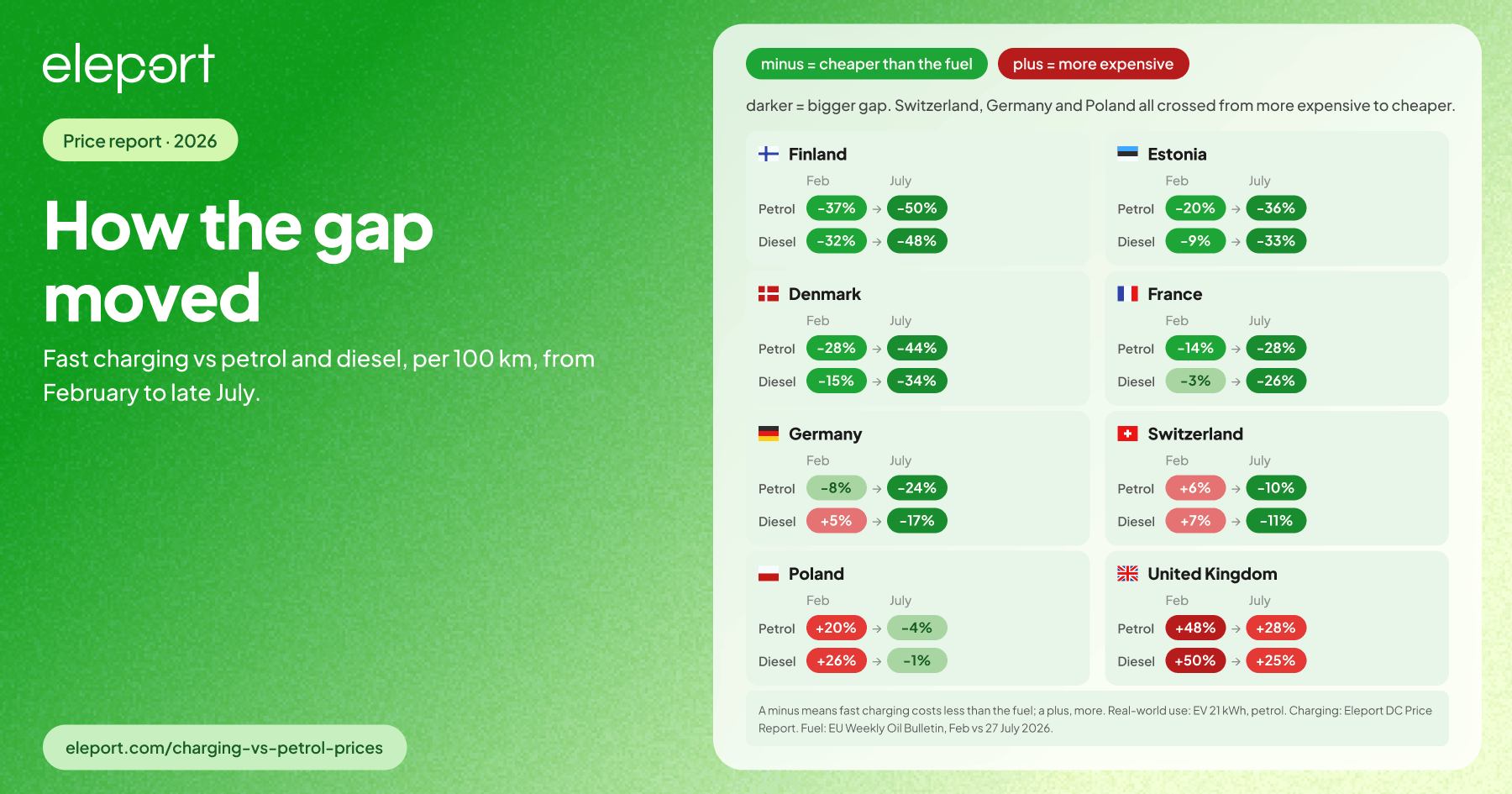
Our analysis found that at February pump prices, before the year’s fuel spike, public fast charging was just barely cheaper than petrol across Europe and, in most countries, more expensive than diesel. Then Middle East tensions drove fuel up hard through the spring, and the comparison bent in the EV charging cost’s favour.
Goes without saying that home EV charging cost has been winning in both cases anyway. Fast charging was never meant to be the cheapest alternative.
This article walks you through the whole map: how the two energies compare per 100 km, why the February picture with EV charging cost was so close, and what the fuel run-up changed. The full 29-country table is a few scrolls down, and the method sits at the very end if you want to check our working.
February’s verdict: it was close, but fast charging wins over petrol
Let’s start with the average to set the tone. Across 29 European countries, the results of our extensive research showed that in February 2026:
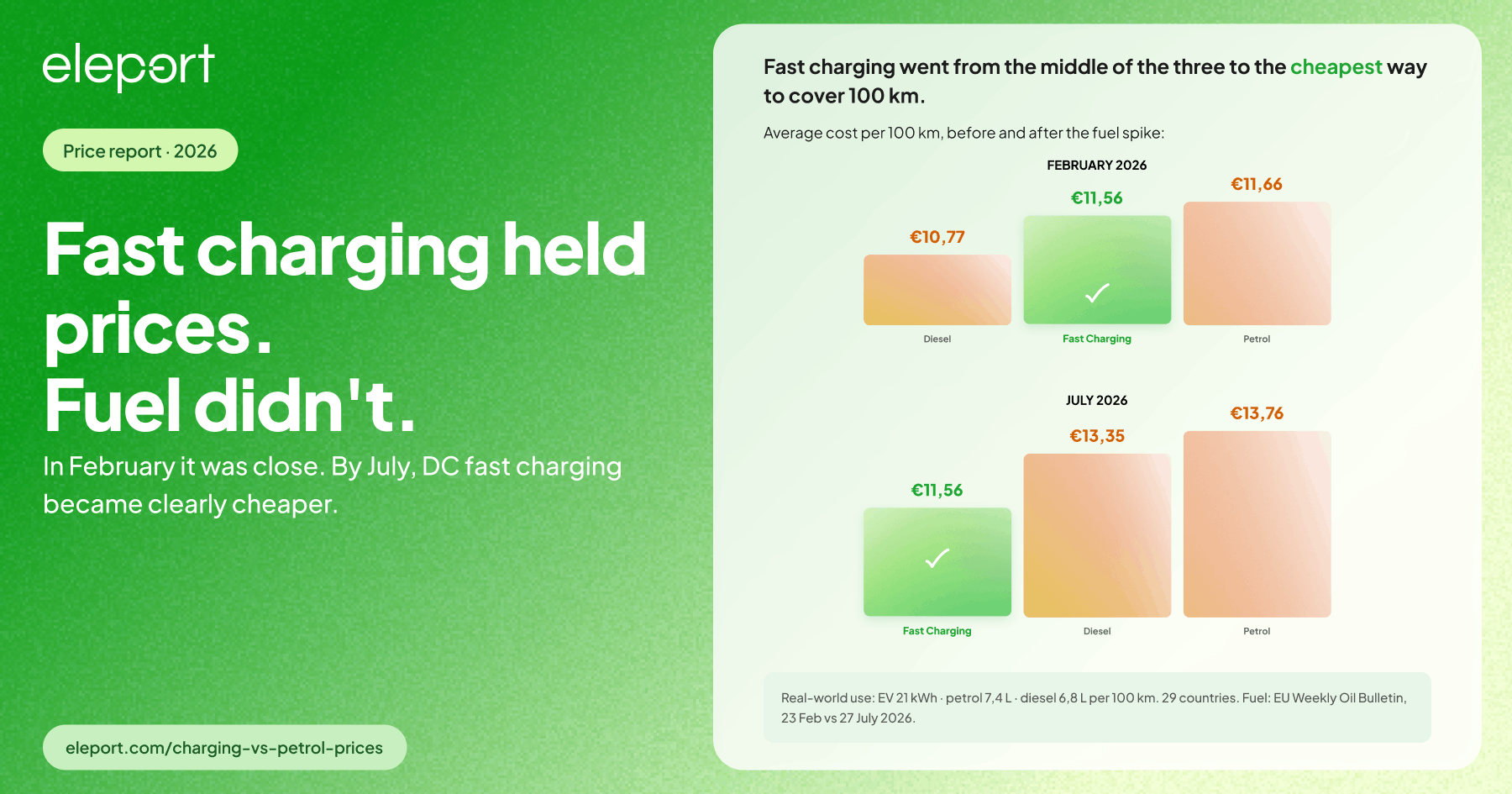
- Diesel 10,77€ per 100 km on average
- DC fast charging at 11,56€ per 100 km on average
- Petrol at 11,66€ per 100 km on average
We worked hard to get the methodology right and based on real efficiency on each, see it explained in a section below the article.
So the public fast charging undercut petrol by about 1% and lost to diesel by roughly 7%.
Fast charging at public networks has never been really pushed as significant savings compared to ICE refueling. It’s home charging where the significant savings are meant to be won, as fast charging is seen more as top-ups for road trips.
However, of course, these are the wide averages, so aiming for the cheaper charging networks and even better, at off-peak times, could still ensure significant EV charging cost wins even in fast charging compared to petrol.
Breaking the average into countries, it reads harder for the plug. Public fast charging cost more per 100 km than petrol in 15 of the 29 markets, and more than diesel in 19 of them.
In Belgium, Italy, Luxembourg and Poland, a fast charge ran comfortably past a tank of petrol. The electric car charging cost pulled clear where kilowatt-hours are cheap, in Finland, the Baltics and Bulgaria, and in high-petrol markets like France, Greece and Denmark.
However, just recently, something changed.
Today’s verdict: fast charging is now cheaper than petrol and diesel, after the oil price hike
Through March and April (and even now in late July), conflict in the Middle East drove crude oil higher, and petrol stations followed with their pricing. The EU average petrol price climbed from 1,551€/L on 23 February to around 1,851€ by late May, and diesel ran further still, past 2,040€ in early April. Of course, many drivers saw even higher prices, but these are the official averages.
Electricity prices at fast charging stations did no such thing. Charging tariffs rest on longer supply contracts and a slower-moving wholesale power price, so as the pump lurched, the plug barely twitched. So now, the price list looks quite different:
- DC fast charging: 11,56€ per 100 km
- Diesel: 13,35€ per 100 km (was 10,77€)
- Petrol: 13,76€ per 100 km (was 11,66€)
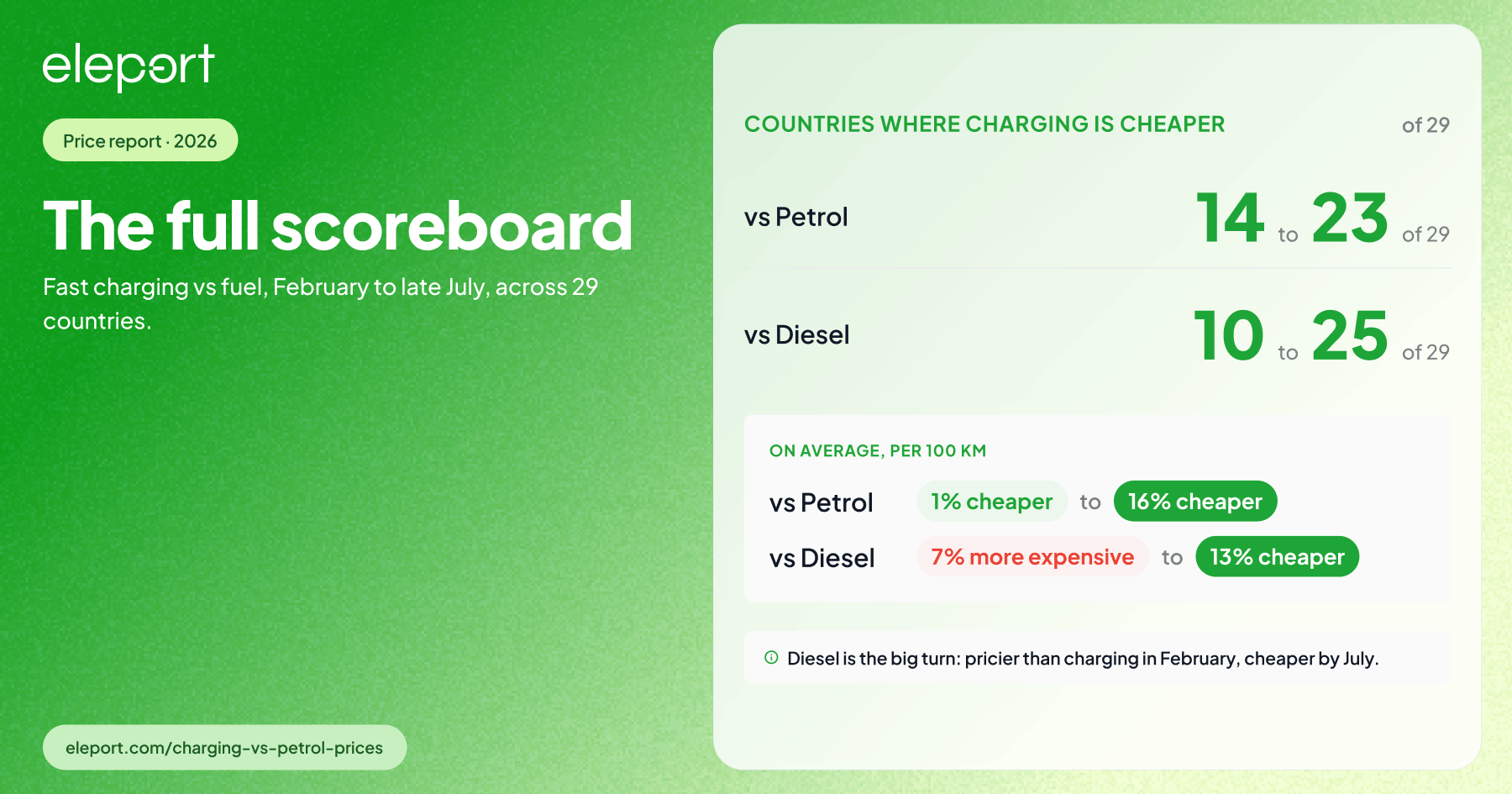
So you can see that on the same real-world basis, fast charging now came in about 16% cheaper than petrol and 13% cheaper than diesel across the 29 countries, and the count of markets where EV charging cost beat petrol climbed from 14 to 23. Against diesel, the swing was even bigger, from 10 markets to 25.
The cost of running electric car vs petrol improved in every country on the board. That is the uncomfortable heart of the story: a genuine electric advantage created by a single geopolitical quarter. Not to mention that EV charging cost will be shielded from any further geopolitical volatility, while we can’t say the same about oil.
The full picture: 29 countries, cost per 100 km
We’ll continue to bring out the highlights in sections below, but if you’re looking for the full comparison table from our EV charging cost analysis, here it is:
| Country | DC €/kWh | EV €/100km | Petrol Feb | Petrol now | Diesel Feb | Diesel now |
| Finland | 0,38 | 7,98 | 12,68 | 16,12 | 11,82 | 15,44 |
| Bulgaria | 0,38 | 7,98 | 9,01 | 11,21 | 8,35 | 11,42 |
| Lithuania | 0,40 | 8,40 | 10,79 | 13,27 | 10,98 | 13,57 |
| Latvia | 0,40 | 8,40 | 11,34 | 13,95 | 10,39 | 13,16 |
| Estonia | 0,41 | 8,61 | 10,75 | 13,41 | 9,46 | 12,76 |
| Iceland † | 0,46 | 9,66 | 10,46 | 11,10 | 10,39 | 11,08 |
| Spain | 0,47 | 9,87 | 10,89 | 12,17 | 9,68 | 11,71 |
| Denmark | 0,49 | 10,29 | 14,34 | 18,40 | 12,10 | 15,57 |
| Romania | 0,49 | 10,29 | 11,44 | 13,08 | 10,93 | 13,57 |
| Norway † | 0,51 | 10,71 | 12,76 | 14,73 | 11,56 | 13,26 |
| Greece | 0,51 | 10,71 | 12,86 | 14,93 | 10,53 | 13,88 |
| France | 0,52 | 10,92 | 12,65 | 15,22 | 11,22 | 14,75 |
| Sweden | 0,53 | 11,13 | 10,61 | 10,77 | 10,68 | 12,41 |
| Hungary | 0,53 | 11,13 | 10,82 | 12,27 | 10,34 | 11,70 |
| Slovakia | 0,54 | 11,34 | 10,91 | 13,06 | 9,98 | 11,81 |
| Czechia | 0,54 | 11,34 | 10,15 | 12,92 | 9,27 | 12,34 |
| Croatia | 0,55 | 11,55 | 10,89 | 11,96 | 10,16 | 12,04 |
| Slovenia | 0,55 | 11,55 | 10,51 | 12,03 | 9,93 | 12,16 |
| Poland | 0,58 | 12,18 | 10,19 | 12,72 | 9,68 | 12,36 |
| Austria | 0,59 | 12,39 | 11,17 | 13,87 | 10,51 | 13,95 |
| Germany | 0,59 | 12,39 | 13,50 | 16,21 | 11,78 | 14,86 |
| Luxembourg | 0,65 | 13,65 | 10,78 | 13,05 | 9,96 | 12,85 |
| Portugal | 0,65 | 13,65 | 12,48 | 14,73 | 10,88 | 13,78 |
| Switzerland † | 0,66 | 13,86 | 13,14 | 15,32 | 12,94 | 15,50 |
| Ireland | 0,68 | 14,28 | 12,87 | 13,01 | 11,81 | 11,91 |
| Belgium | 0,69 | 14,49 | 11,13 | 13,97 | 11,06 | 14,56 |
| Netherlands | 0,69 | 14,49 | 15,26 | 17,65 | 12,74 | 16,27 |
| Italy | 0,71 | 14,91 | 12,25 | 14,51 | 11,57 | 14,56 |
| United Kingdom † | 0,82 | 17,22 | 11,65 | 13,47 | 11,50 | 13,80 |
Where charging wins completely: the Nordic and Baltic edge
Averages, of course, tend to bury those on either edge, both on where fast charging wins and where it is still behind. A few cases stand out at the cheap end:
- Finland: 7,98€ per 100 km to fast charge against 12,68€ for petrol in February, which is a third cheaper before fuel had even moved, and it went a lot further, now even less than half of the petrol price by late July (7,98€ vs 16,12€).
- Bulgaria, Estonia, Latvia and Lithuania: fast charging of 7,98€ to 8,61€ against petrol of 9,01€ to 11,34€, from 11% cheaper in Bulgaria, which sits on Europe’s cheapest petrol, to 26% cheaper in Latvia, all already in February. By late July, the win for fast charging went wider, from 29% to 40% as oil prices climbed.
- Denmark: a quite average fast charging price at 10,29€ / 100 km set against some of Europe’s priciest petrol at 14,34€, so the electric car charging cost landed more than a quarter below the pump in February, and 44% below by late July (18,40€).
- Norway and Iceland: steep pump prices keep fast charging ahead despite mid-table charging, Norway at 10,71€ against petrol of 12,76€ in February and 14,73€ by late July, Iceland at 9,66€ against 10,46€, then 11,10€ for petrol.
The pattern is not an accident.
These markets pair competitive charging tariffs with relatively high fuel taxes, and several sit on grids with plenty of hydro or wind, which keeps the wholesale electricity feeding the chargers comparatively cheap.
For anyone considering a switch to EV here, the public network was the cheaper option even at February fuel prices, and the spring run-up only widened the lead, pushing the EV charging cost further below the petrol prices.
Where petrol or diesel still wins over charging: the UK and the expensive middle
The other end of the table still belongs to the petrol side when it comes to fast charging (not home charging, of course):
- United Kingdom: the clearest case of expensive EV charging cost among them all. Its 0,82€/kWh median fast charging price, the highest in our DC charging report, puts a British fast charge near 17,22€ per 100 km, roughly 48% above petrol in February and still about 28% above it after the fuel price spike. Of course, keep in mind that the cheapest DC charging options can still be much more competitive there.
- Belgium, Ireland, Italy and Luxembourg: charging stayed above petrol into the summer, held there by high DC prices, not cheap fuel. Fast charging of 13,65€ to 14,91€ depending on the country ran well above February petrol of these countries (10,78€ to 12,87€, 11% to 30% more expensive), and stayed above even the late-July petrol pricing (13,01€ to 14,51€), though the gap narrowed to 3% to 10% as petrol prices caught up. This has been mostly about high DC prices, not cheap fuel.
- Poland: was the odd one out, where unusually cheap local petrol beat the plug on both earlier dates. But even that flipped by summer: Polish petrol jumped from 10,19€ / 100 km in February to 12,72€ by late July, so fast charging (12,18€) finally edged ahead there too.
- Switzerland: EV charging cost (specifically of fast charging, of course) was more expensive than petrol and diesel starting (13,86€ vs 13,14€), but the oil price hikes tipped the scales in EV charging favour by late July (13,86€ vs 15,32€ petrol and 15,50€ diesel)
If the EV charging cost argument is hard to make anywhere in Europe, it is in this handful of high-tariff charging markets.
On the other side of things, diesel has historically been cheaper to run on than petrol. A Spanish, Greek or Czech diesel driver was paying less per 100 km than the local fast charger asked, 9,68€ of diesel against 9,87€ to charge in Spain, and 11,34€ against 9,27€ in Czechia in February. Line up the electric car charging cost vs gas, and with diesel in the mix, the pump won outright in 19 of the 29 markets through February.
But by late July, diesel had climbed past fast EV charging cost in both: Spain to 11,71€ per 100 km and Czechia to 12,34€, against 9,87€ and 11,34€ to charge. The old diesel edge has mostly gone.
Here’s why the fast charging vs petrol map is about taxes as much as oil prices
What are the other contributors to the fuel prices? The spread between countries is enormous, and most of it is tax, not crude price itself. Petrol at the pump ranged from about 1,22€/L in Bulgaria to over 2,00€ in the Netherlands in that February week we observed, and the gap is built almost entirely from excise duty and VAT.
The start of 2026 sharpened the point. The Oil Bulletin’s own notes record a wave of duty changes on 1 January:
- Germany, the Netherlands and Poland all raised excise on petrol and diesel.
- Romania lifted duty on every fuel, and Finland nudged its VAT rate up.
- Italy equalised its petrol and diesel excise, raising diesel and lowering petrol in one move.
- France cut duty on both.
- Bulgaria, the cheapest market on the board, adopted the euro.
None of it touched electricity. That is one reason the two sides of this comparison behave so differently over time.
The big picture across Europe on fast charging vs petrol and diesel prices
Putting our two findings around fast charging prices and fuel prices together, a summary emerges that is neither the sales pitch nor the sceptic’s version.
The cost of charging electric car in public fast chargers was not automatically cheaper than fuel in early 2026, and against diesel it often was not cheaper at all. After the spring, however, fast charging moved clearly ahead. And note that we are talking of the average (median) fast charging prices here, which means there are ways to get a significantly cheaper charge if you find one.
The gap is real but not enormous, and it swings with the oil price.
Is EV charging cheaper than petrol in general? Averaged across the continent, the cost of charging an electric car now sits comfortably under both petrol and diesel.
Let’s look at the country tally then and now to explore how the picture really changed with the oil price hike.
In February, fast charging was:
- cheaper than petrol in 14 of 29
- cheaper than diesel in only 10 of 29 countries
Now, in late July, fast charging was:
- cheaper than petrol in 23 of 29
- cheaper than diesel in 25 of 29 countries
When looking at the average across all countries, in February, fast charging was:
- ~1% cheaper than petrol,
- ~7% more expensive than diesel
Now, in late July, fast charging was:
- ~16% cheaper than petrol
- ~13% cheaper than diesel
For most owners the picture is friendlier still, because the public network is the hard case. The cost of charging electric car at home stays far below any public refuelling station, often a third of what a fast charger costs, which is where the everyday savings accrue.
The plug did not win this comparison on merit. It won it because the oil price moved, and a calmer oil market could hand some of that lead back. What will not reverse is the other differences between the two. Weighing the cost of charging electric car against fuel over the life of a car, not a single week, that steadiness is worth as much as the usual savings calculation.
February data told us the race was close. Now in the summer, we see the EV charging pulled ahead.
Methodology: How we ran the comparison
Charging networks publish prices. Fuel retailers publish prices. The two rarely get laid on the same axis, and never across the whole of Europe, because pinning down a median public DC fast charging price is the hard part. It took us months of working through the tariffs of hundreds of charge point operators (CPOs) to build the report this comparison sits on.
The fuel figures come from the European Commission’s Weekly Oil Bulletin, the pan-European standard for pump prices including all taxes, taken for the last full week of February for the baseline and the latest full week, 27 July 2026, for the current picture, to match the electric car charging cost data.
Four non-EU markets in the charging report, namely the United Kingdom, Norway, Switzerland and Iceland, come from national sources and the UK government’s weekly road fuel figures, converted to euros.
That gives 29 countries on one comparable basis: the EV charging cost, per 100 km, against the two fuels almost everyone still drives.
Putting a kilowatt-hour next to a litre
The other part of the conversion is about the real-world consumption, so we wouldn’t be comparing the flattering laboratory numbers on a spec sheet.
A European electric car draws about 21 kWh per 100 km once charging losses are counted, the average from a study of 342 electric car models sold in Europe. Petrol burns roughly 7,4 litres over that distance and diesel 6,8, both from the EU’s on-board fuel monitoring, which shows real driving, which, by the way, runs about a fifth heavier than the official test cycle shows.
Those three figures stay fixed for every country. Only the local price of energy moves.
One caveat sits over all of this. The comparison is about the public fast-charging network, the priciest way to put electrons in a car, and it sets home charging aside entirely. A driver who plugs in overnight was never really part of this contest… because they are the clear winner in cost.