When calculating your costs of running or switching to an electric car, it is usually based on most of the charging happening when the car is at home or at work, with a regular cheap tariff.
In this case, EV charging costs being cheaper were never really in question.
The harder question is what happens when the driveway or garage to charge at… is not there.
Car owners living in apartments, parking on streets, or anyone running long motorway days on a schedule. Plenty of drivers spend far more of the year on public chargers than the usual EV charging calculators assumed, paying well above what the same electricity would cost them at home.
So for this article, we set the comfortable answer aside and built this around the worst case. What happens if you charge at a public DC only, never a home socket, measured against petrol and diesel at the pump.
In a surprising turn of events, actually, in September 2026 Eleport’s DC Fast Charging vs Fuel Prices analysis found that the cost of charging electric car in public sits roughly a quarter below petrol across Europe.
As recently as February the same year it did not. Petrol was winning in half the continent and diesel in rather more of it. We’ll dig right into it all below.
What a public EV fast charge and a tank of petrol cost per 100 km right now
Let’s put the two energies on the same axis. A kilowatt-hour and a litre do not compare directly, so both get converted into what they cost to move a car 100 km.
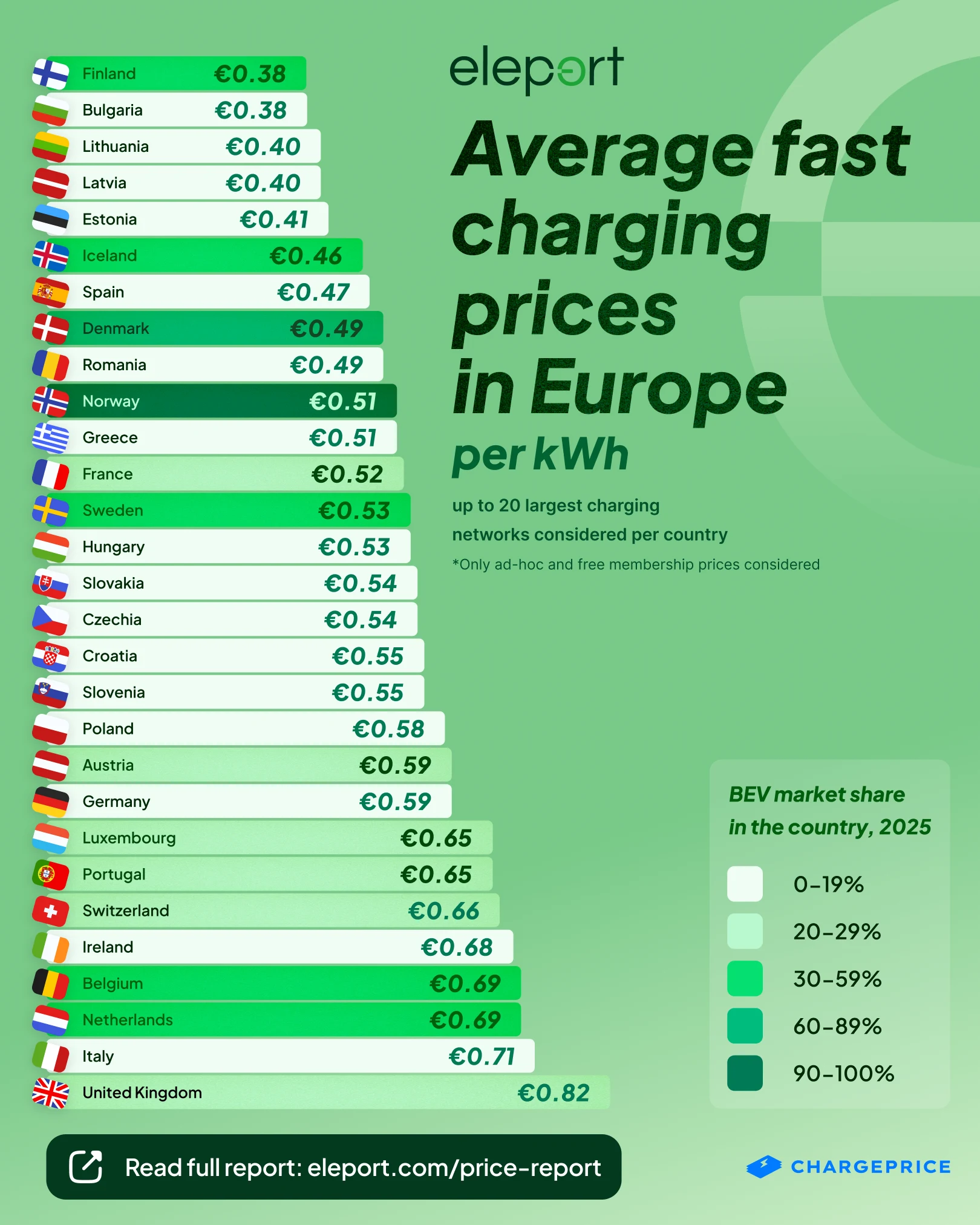
Our European DC fast charging price report pinned down the median public price in each of 29 markets and found it’s around 0.54€/kWh. This research took months of working through the tariffs of hundreds of charge point operators. We’ve already found that an average European electric car draws about 21 kWh over 100 km once charging losses are counted. This is an average taken from 342 models sold here.
So, calculating it together, they put the cost of charging electric car on a public fast charger at 11,56€ per 100 km, averaged across the 29. The full country table sits in our comparison of charging and petrol prices.
The fossil fuel side comes from the European Commission’s Weekly Oil Bulletin, the pan-European standard for pump prices with all taxes included.
In the week of 14 September 2026, the weighted EU average hit 2,063€ per litre of petrol and 2,159€ of diesel, the highest-ever readings in a series that runs back to 2005.
In other words, petrol and diesel are now officially the highest they’ve ever been as an European average.
For the fuel, we also went for real consumption, not the test cycle: 7,4 litres of petrol per 100 km and 6,8 litres of diesel, both from the EU’s on-board fuel monitoring.
Petrol therefore costs 15,27€ per 100 km. Diesel costs 14,68€. On average, across Europe.
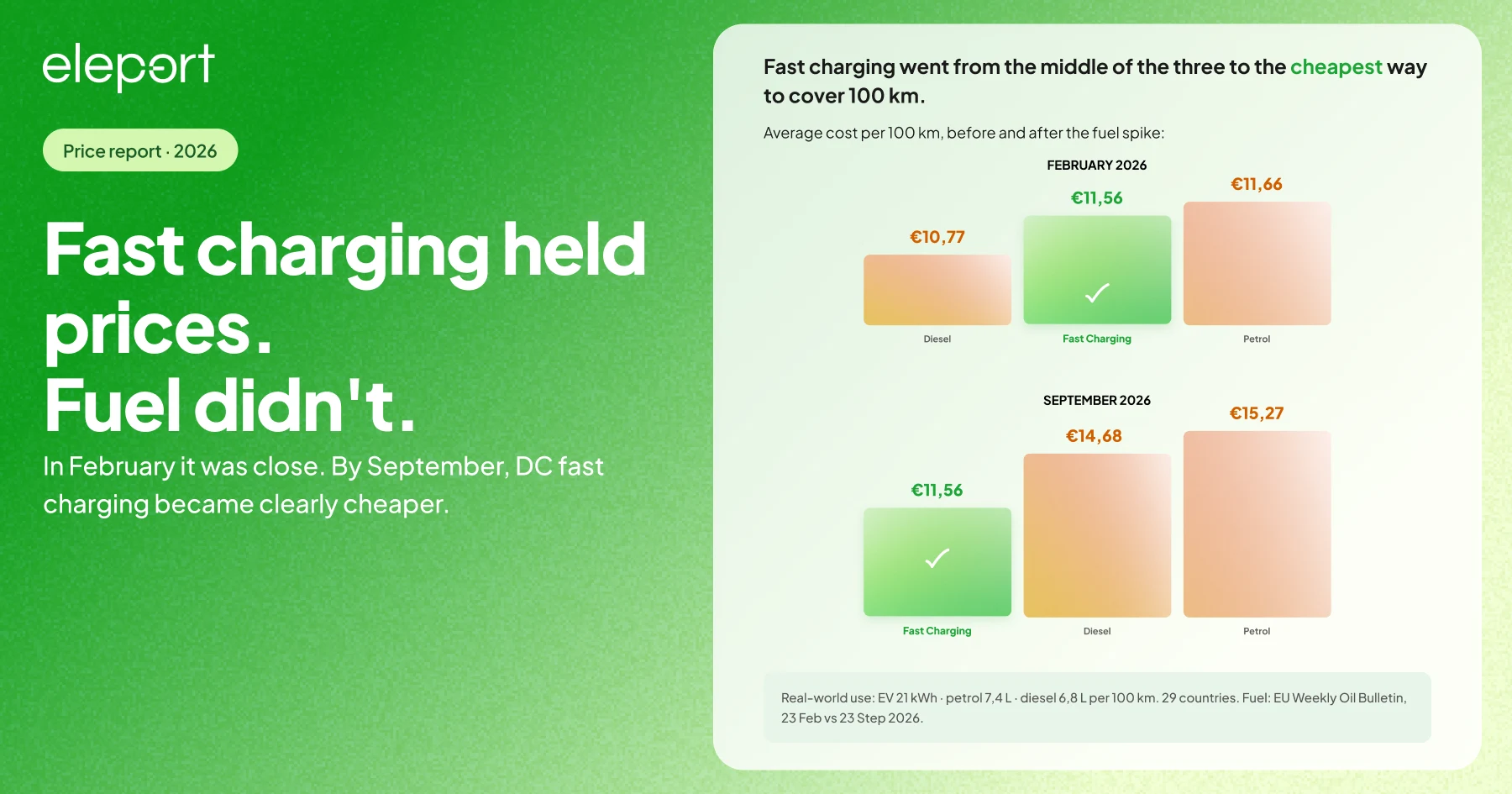
On that basis, the public electric car charging cost vs gas comparison puts the cost of charging an EV in public about 24% under petrol and 21% under diesel.
Before that number travels any further, one caveat. Only the fuel side has been updated to September. The charging figure is February’s, from our own report, held steady because charging tariffs sit on long supply contracts and move far more slowly than crude. We’ll have a fresh report out on DC fast charging prices soon, too, to drive this point home.
The gap opened because fuel moved and electricity didn’t
Is charging an electric car cheaper than gas? Across Europe in September 2026, yes, even on public fast chargers. Public fast charging came in roughly 24% under petrol and 21% under diesel per 100 km. In February the same comparison had petrol winning in half the continent, so the answer moves with the oil price.
In February the cost of charging an EV and the cost of a tank were almost level. Public fast charging at 11,56€ per 100 km, petrol at 11,66€, diesel at 10,77€. Charging squeaked past petrol by about 1% and lost to diesel by 7%.
Conflict in the Middle East then pushed crude oil prices higher through the spring, and the prices at the petrol stations followed. By late July, petrol had reached 13,76€ per 100 km and diesel 13,35€, which is where that published comparison left the story.
It has gone further since. On the Commission’s own figures, petrol is up about 31% since February and diesel 36%.
Electricity did nothing of the sort. Public charging tariffs rest on longer contracts and a slower wholesale power market, which is why the plug barely moved through a spring in which the pump went up by a third.
Tax is the second reason the two behave so differently. Most of the spread between countries at the pump is excise duty and VAT, not the crude price underneath. January 2026 brought a round of fuel duty changes across the EU, with the Netherlands raising excise on both petrol and diesel. None of it touched electricity.
The plug’s lead came from the oil price, and a calmer quarter could technically hand part of it back.
If you want to watch the two lines yourself with the home electricity prices, the European Alternative Fuels Observatory publishes fuel and electricity price data across the continent.
Where you plug in matters more than what EV you drive
Averages often bury the edge cases, and on this map the edges are quite enormous.
How much does it cost to charge an EV in the cheapest corner of Europe? Finland and Bulgaria both sit at 0,38€ per kilowatt-hour for public DC fast charging averages, which works out at 7,98€ per 100 km. Estonia, Latvia and Lithuania follow within a few cents per kWh.
In those markets, the cost of charging an EV beat local petrol already back in February, before fuel had moved at all.
Denmark is the same win but in a different shape. Charging there was unremarkable at 10,29€ per 100 km, but petrol is among Europe’s most expensive, so the plug landed more than a quarter under the pump price, even in February. By late July that gap had opened past 40%. That’s probably one of the reasons Denmark has reached an over 80% EV market share of sales these days.
There is a reason those markets line up. They run competitive charging tariffs on grids carrying a lot of hydro or wind, and in the Nordic cases the pump is expensive on top of that.
At the other end of the table, public EV charging stations cost more in the United Kingdom than anywhere else on the board. A median of 0,82€ per kilowatt-hour puts a rapid charger near 17,22€ per 100 km, which was about 48% above petrol in February and still sits above it today, even with the highest-ever petrol prices in Europe. British drivers who think in cost per mile can’t really find a good argument in just the public fast charging costs over petrol. Certainly can with home charging, of course.
Belgium, Ireland, Italy and Luxembourg also all stayed above petrol into the summer, held there mostly by high charging prices.
Poland was among the last to flip. At 10,19€ per 100 km in February, fossil fuel prices in Poland undercut the local public fast charging station comfortably (on average), and only this summer’s climb to 12,72€/100km for petrol finally put fast charging ahead there.
There can’t be a single electric car charging cost vs gas verdict across Europe. The cost of charging electric car question has 29 different answers across these markets.
The cost to charge electric car at home is still the one to beat
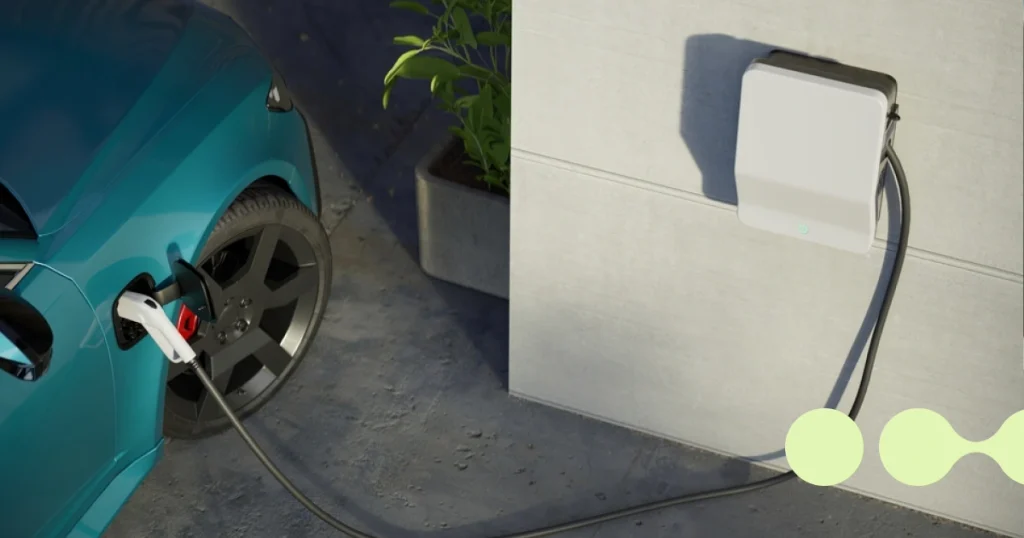
Everything that we covered above is pretty much the worst case scenario, charging only at public fast charging stations. Most owners do not live in it and can actually charge at home, too.
Eurostat put the EU average household electricity price at 0,2896€ per kilowatt-hour in the second half of 2025, which is the most recent full figure.
How much does it cost to run an electric car? At an EU average household electricity price, an electric car refueling costs near 6,08€ per 100 km, against 15,27€ for petrol. Servicing is generally lighter, with no oil changes or exhaust parts, while insurance and depreciation vary too much by model to average usefully.
That 6,08€ is the cost to charge electric car at home on the same 21 kWh, around 60% below September petrol.
The spread across countries is wider here than it is on the fast charging side. Hungarian households pay 0,1082€ per kilowatt-hour, so just 2,27€ per 100 km.
Irish households pay 0,4042€, so 8,49€. Even the most expensive home EV charging in the EU, Ireland’s, comes in below the average public fast charge prices of Europe.
Night tariffs push it lower again in the many markets that now price by the hour.
None of that, of course, makes the public network pointless. It makes it what it was always meant to be, a top-up on a long day, used a handful of times a month. That home figure is what carries electric car running costs across a year, and it is the reason the cost of charging an EV rarely bites the way new owners fear. But nevertheless, it is very interesting to realize that at current stage, even the public fast charging on average will be cheaper than filling up with petrol or diesel in nearly all European countries.
Do you pay to charge an electric car, and is any of it free?
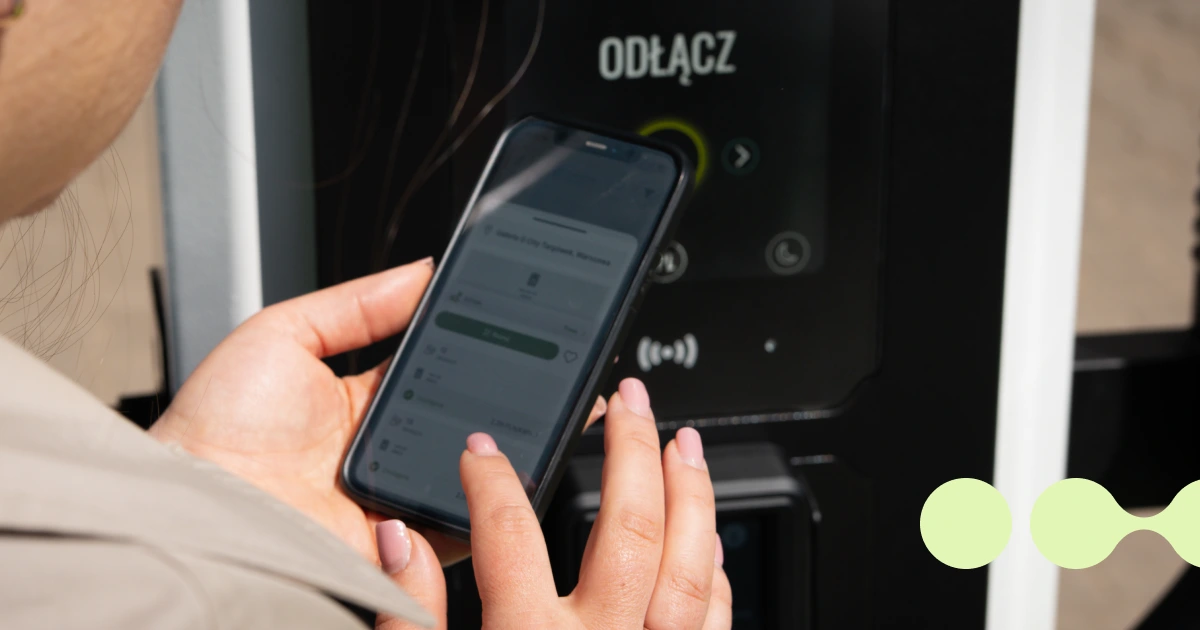
Do you pay to charge an electric car? On the public network, almost always. Charge point operators bill per kilowatt-hour, sometimes with a session fee or a penalty for leaving the car plugged in after it has finished. Free chargers still exist at some hotels, supermarkets and workplaces, usually slow ones meant to keep you on the premises.
Those are where the question of is it free to charge an electric car gets its rare yes. It’s real in a few unique situations or promos, but not something anyone routes a life around.
What sets the price to charge electric car on a public network is the tariff structure, and it varies more than most drivers expect.
Per-kilowatt-hour billing is the transparent version. You pay for the energy you take, and nothing else. Our own EV charging pricing is laid out that way, by country and by charger speed, with AC, DC, and DC+ tiers each carrying their own rate.
Older structure of per-minute pricing is the one to watch for. It bills you for time connected, so a car whose charging curve tapers early ends up paying for kilowatts it never received. In Europe, that’s rarely ever used anymore.
So how much does it cost to charge an electric vehicle at a given stop? The tariff per kWh, times the kilowatt-hours you need, plus any session fee. Easy as that, and as a European median, you’d be seeing the tariff at €0,54/kWh, with the lower end averaging around 0,38€/kWh with higher end in the UK with €0,82/kWh.
Work out your own win from charging, no calculator required
How much does it cost to charge an EV? For the easiest calculation, just take the car’s consumption at the plug, around 21 kWh per 100 km for the European average, and multiply it by what you pay per kilowatt-hour. At the EU average public fast charging price that works out near 11,56€ per 100 km. At the EU average household electricity price it drops to about 6,08€. If you do a mix, you’ll just have to consider the ratios.
Three figures will do it, and you already know two of them.
First, what your car really uses per 100 km. Not the brochure claim. The trip computer’s lifetime average plus roughly 10% for charging losses gets you close enough.
Second, the price per kilowatt-hour you pay, at home and on whichever network you lean on most.
Third, what the equivalent petrol or diesel car would have burned over the same distance, which is the figure your own cost of charging electric car has to beat. You have our averages for that above.
One thing no calculation captures is the electric car charging time, which is the other currency you spend at a fast charger. A 10 to 80% stop on a modern 800V car takes around 20 minutes. With an older model and on rare occasions, you can spend an hour at the charger depending on where you’re headed, at which point a question of how much does it cost to charge an electric vehicle starts to feel more about the time involved.
So, is public charging more expensive than filling up?
Looking at September 2026, across Europe, it is not. Setting February’s charging prices against September’s fuel, public fast charging runs about 24% under petrol and 21% under diesel per 100 km.
In February, the same comparison was nearly a tie, and against diesel it was a straight loss.
That swing came from the oil price and not from anything the charging industry did specifically, so parts of it could reverse. What will not reverse is the steadiness underneath.
Electricity prices are set by contracts and regulators across dozens of national markets, while petrol answers to one global commodity and geopolitics.
Is EV charging cheaper than gas over a full year of ownership in Europe? For anyone with a socket at home, comfortably. The cost of charging electric car at home was never really in this contest, it was a clear win anyway, as on the EU average it costs about half what the public network does.
Public fast charging was always the hard case for this comparison, and we have entered a time in our markets where it still wins out on fossil fuels nevertheless.