Two industries use the V2X acronym, and they are not describing the same thing.
If you ask a telecoms engineer what is V2X, you will hear about cars warning each other around a blind bend.
If you put the same question to somebody who sells chargers, the answer comes back as an electric car running a fridge and a router through a power outage, which is a different technology built on different standards by mostly different companies.
Neither answer is wrong, and we’re here to explain.
V2X means Vehicle-To-Everything: Here’s What’s In It
Let’s start with the older meaning, the one the standards bodies owned until now.
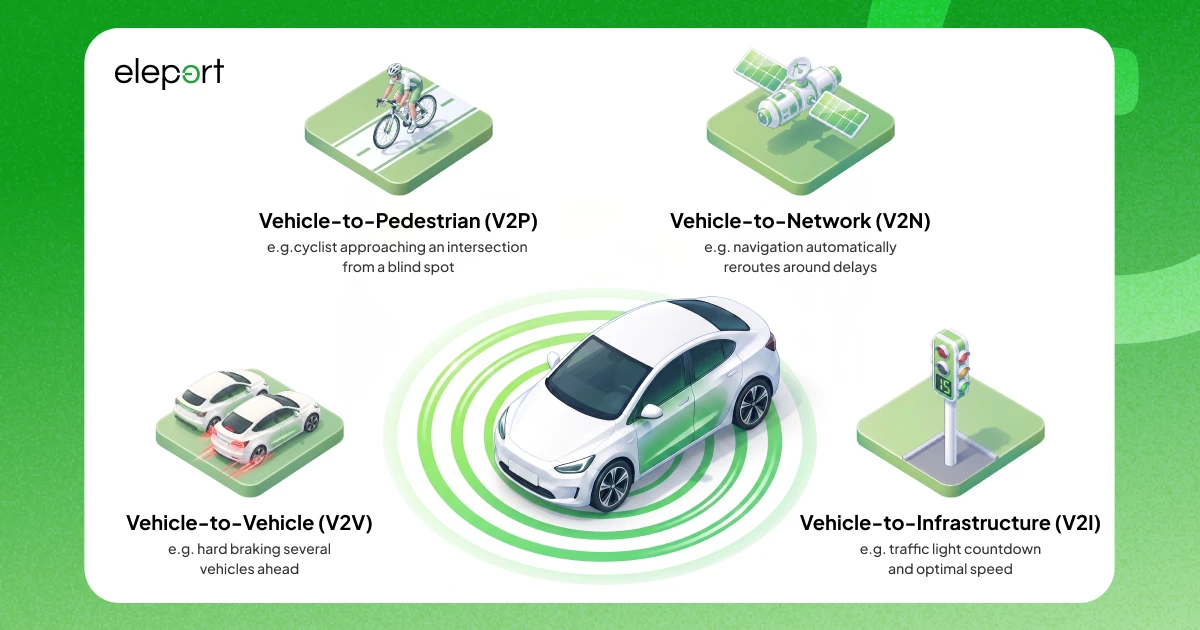
Here, the term V2X is acting as an umbrella for four kinds of radio link. 5GAA, the cross-industry body where carmakers and mobile operators meet, splits them along obvious lines:
- V2V (Vehicle-to-Vehicle) communication is the direct short-range link cars use to warn each other about any hazard ahead.
- V2I (Vehicle-to-Infrastructure) does the same job between the car and roadside infrastructure. For example, a traffic light can announce how many seconds of green are left.
- V2P (Vehicle-to-Pedestrian) is for communications on pedestrians and cyclists.
- V2N (Vehicle-to-Network), the ordinary mobile connection to the cloud, already sitting in your car handling navigation and traffic.
The V2X meaning shifts, and the European Commission has added another layer on top of it, writing about cooperative intelligent transport systems, or C-ITS. All while German carmakers sell the same capability under their own badges.
Volkswagen calls it Car2X. Mercedes-Benz writes it Car-to-X. All of them describe vehicular communications for safety, and the differences between the names are just… marketing.
How Do V2X Communications Work On The Road?
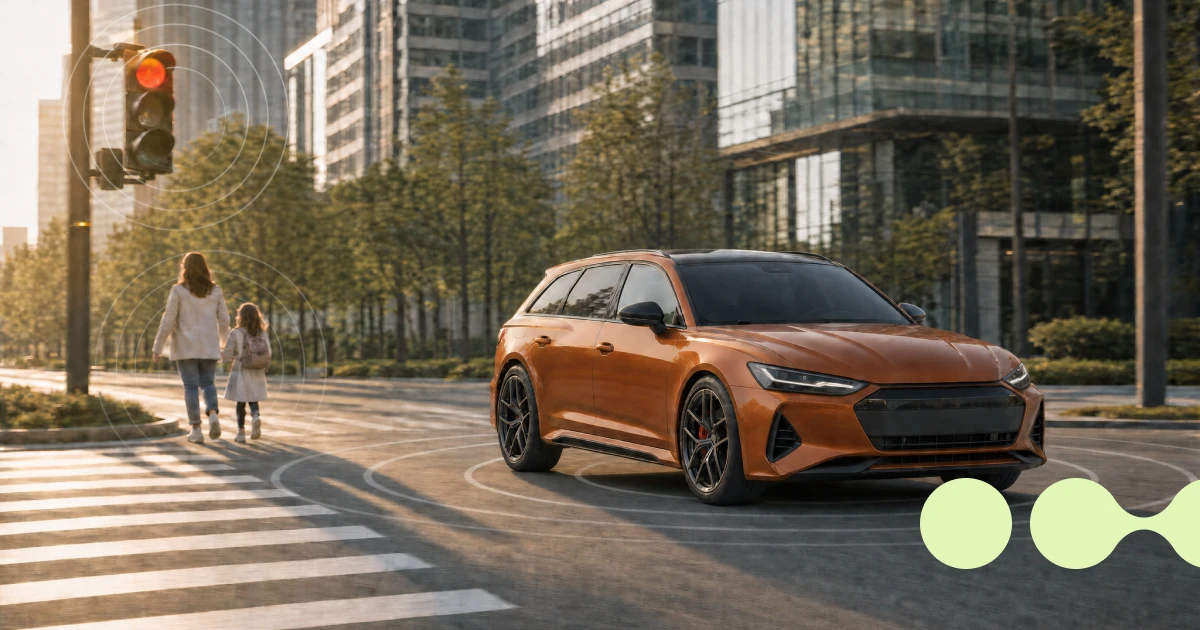
There’s actually two incompatible radio technologies established currently, both of which occupy the 5,9 GHz band, and a message sent on one cannot be read by the other.
The older camp is ITS-G5, built on IEEE 802.11p, which is Wi-Fi adapted for things moving at speed. No network, no SIM card, no subscription. Two cars simply talk to each other.
The newer camp is C-V2X, short for cellular vehicle-to-everything, which came out of 3GPP and reuses mobile phone silicon. Its direct mode, PC5, needs no network coverage at all in the same 5,9 GHz band, while its network mode, Uu, runs over normal cellular spectrum. 3GPP finished the first version in September 2016, built for vehicles at up to 250 km/h and networks holding thousands of nodes.
So what does 5G V2X add on top of that? The requirements written for it reach as far as convoy platooning, sensor sharing and remote driving, the last of which asks for 5 ms latency at 99,999% reliability. So it is no surprise here that we’re seeing several teledriving companies suddenly hit the roads more reliably in the last few years, the tech is finally supporting it.
Which Automakers Are Running V2X On European Roads Right Now?
More than most drivers realise.
Volkswagen has produced over two million cars for Europe with the system since the Golf VIII introduced it, using the Wi-Fi p standard to exchange warnings within a radius of up to 800 m.
That is a serious installed base for any connected car technology. It is standard on the ID.7 and optional across the Golf, T-Roc, Tiguan, Tayron, Passat and the ID.3, ID.4 and ID.5.
On the infrastructure side, the German motorway operator has fitted over 1000 roadworks trailers, Austria has covered its whole motorway network, and Italy, Spain, Czechia, Hungary and Slovenia have deployed roadside units too.
The pan-European tally comes from C-Roads, the platform where the national programmes coordinate. As of February 2026, it counts more than 6000 roadside units and coverage of 30% of the TEN-T road network, along with 3500 equipped public transport vehicles.
China is well ahead on the cellular side, with over three million vehicles fitted with 5G and C-V2X technology in the first seven months of 2025 alone, plus more than 35 000 km of demonstration roads, according to figures its industry ministry gave that September.
Not every system uses a dedicated radio. Mercedes-Benz sends its hazard warnings by mobile radio and a cloud backend, and in a Europe-wide demonstration with TomTom and HERE acting as aggregators, warnings from its cars reached test vehicles from BMW and Ford as well.
It is a connected vehicle platform, in other words, instead of a direct car-to-car link, riding on infrastructure Europe already has in abundance.
Where Does V2X Charging Fit In?
Nowhere near any of the above, which is the single most useful thing to know about it.
In the energy side of things, the V2X acronym means bidirectional charging in all its forms.
ACEA, ChargeUp Europe and smartEn use it this way in their January 2025 joint position paper, which treats the term as the general case behind Vehicle-to-Grid (V2G) and Vehicle-to-Home (V2H). In wider industry use it stretches to cover vehicle-to-building and Vehicle-to-Load (V2L) as well. Power leaves the battery instead of only entering it. Nothing here involves 5,9 GHz, roadside units, or hazard messages.
Is V2X the same as V2G? No. V2G is one specific form of bidirectional charging, in which an electric car exports power to the electricity grid.
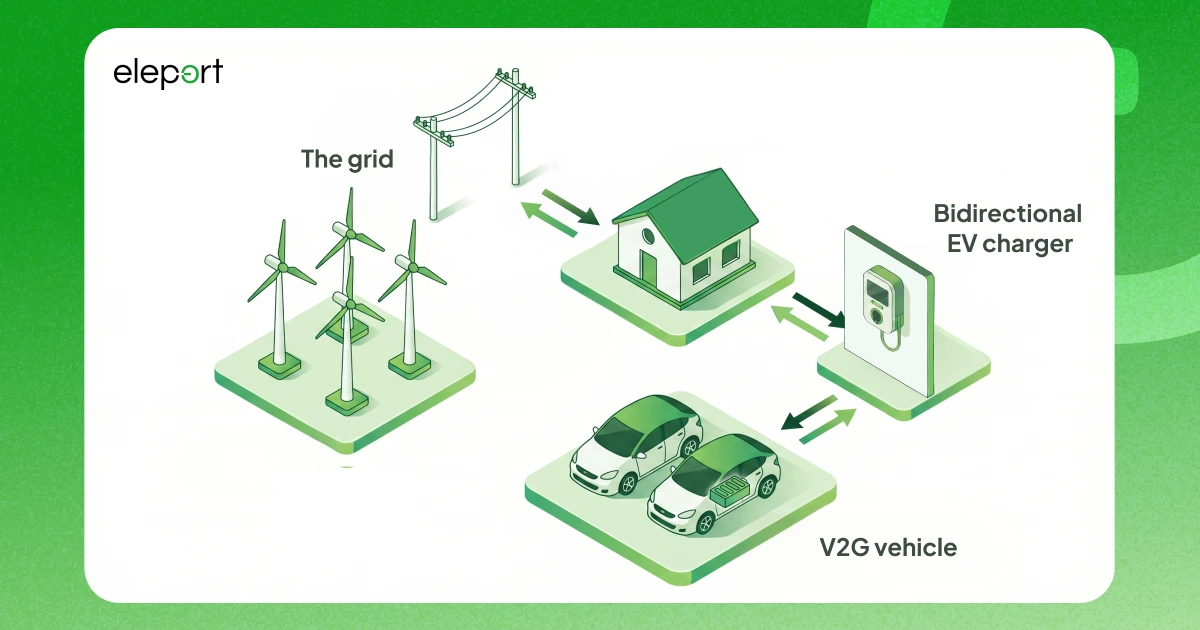
The wider term gets used two ways. In telecoms it means wireless communication for road safety, covering V2V, V2I, V2P and V2N.
In the energy sector it is an umbrella for bidirectional charging including V2G, V2H and V2L. The two share an abbreviation and very little else.
The plumbing differs as much as the purpose. Where safety systems use radio, bidirectional charging talks over the charging cable under ISO 15118-20, published in April 2022, which defines the messages for moving power in both directions.
Two hardware routes exist. A DC bidirectional wallbox holds the inverter and costs, by IEA reckoning, from around 4400€ upwards, while the AC approach puts the inverter inside the car and brings the box in under 1320€ on average. V2L needs neither, which is why a cheap hatchback can run your kettle through a simple V2L adapter.
Which electric cars can send power back to the grid in Europe? As of May 2026, the IEA counted 22 models with vehicle-to-grid capability, under 1,5% of all EV models on sale.
Renault reached the European market first with a commercial offer in France, and Volkswagen’s energy arm Elli follows in Germany from late 2026. Almost every project needs a specific wallbox and a matching energy tariff, so check what your own grid operator allows before counting on the income.
European policy is now pushing V2X Charging
Commercial products arrived first.
Renault and The Mobility House announced their French package in October 2024, pairing the Renault 5 E-Tech and Alpine A290 with an AC bidirectional wallbox and a tariff that pays for the flexibility.
Volkswagen’s energy arm Elli followed on 23 June 2026 with a DC charger, its own tariff and a plug-in bonus of up to 720€ in the first contract year, ordering from the end of 2026, Germany first. Elli reckons roughly one million MEB cars already on European roads are technically ready for it.
And on 24 July 2026, Hyundai and Kia joined in with AllDayEnergy, an energy service the group files under the same umbrella acronym, starting through the Kia App in the UK in the second half of 2026.
Policy caught up in July 2026, too. Is bidirectional charging required by law in the EU? Not yet.
The Electrification Action Plan of July 2026 commits the Commission to introducing vehicle-to-grid requirements by the end of 2027, applying to new EVs placed on the EU market from 2030. So the mandate is coming but is not here quite yet.
The same plan promises updated AFIR technical specifications so that public and private charge points support bidirectional recharging. It also floats smart charging by default in EV electricity contracts by mid-2027. The Commission’s own modelling suggests smart charging and vehicle-to-grid together could be worth over 44 billion euros a year to BEV owners by 2040.
Two Acronyms Wearing The Same Clothes
So when somebody offers you V2X or you see it somewhere in an EV model spec sheet, ask which side of the coin they mean. If the answer involves 5,9 GHz, roadside units and a warning about the queue over the next hill, you are in the safety world. Nothing in it is coming to your driveway.
If the answer involves a wallbox, a tariff and money back at the end of the month, you are in the energy world, and the talk is around bidirectional charging. The standards there were settled four years ago and the tech is finally out there. Rest assured, there’s a lot more of that coming into the spotlight, now with EU’s renewed focus on V2G.
The shape of V2X communications is much the same on both sides. A car that used to be a sealed box is now an active node that talks to things around it. One version talks to the road. The other talks to your electricity meter, and eventually to your bank account.