If you look at the advertised spec sheet of an EV, you’ll see one tidy number. Usually in the format of “X minutes to charge to 80%”.
If you ask an owner of an actual EV, they’ll never say that exactly. The answer is “it depends” instead.
The question of how long does it take to charge an electric car is a nuanced one, and the real range runs from around ten minutes to more than a day. Where it lands depends on what you plug into, what your car will accept, and how much energy you need. Even the weather has its say sometimes.
So let’s do this properly.
We’ll start with the sums behind every EV charging time, and we’ll make a 1000 km road trip the finish line.
How Long Does It Take to Charge an Electric Car? Times by Charger Type
Every charging station falls on one side of a basic split.
Batteries can only be charged with direct current, so an AC point at home or in a car park leaves the conversion to the onboard charger built into your car.
A DC charger does that job itself and feeds the battery directly.
That split explains most of the gap between a charging stop taking hours and the one taking mere minutes.
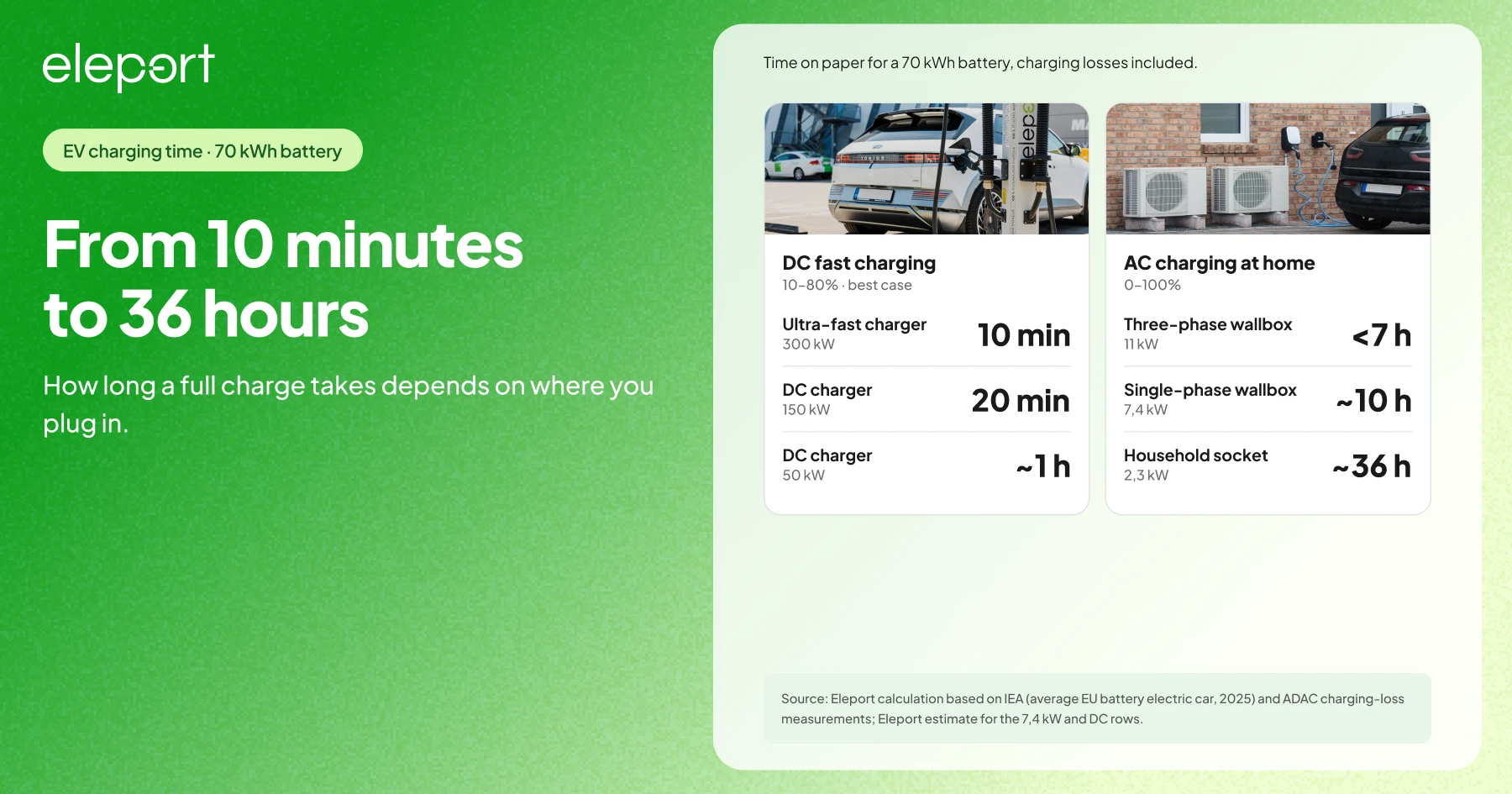
To put numbers on it, we took a 70 kWh battery, which is about the average battery electric car in the European Union in 2025 according to the IEA. Then we added charging losses based on ADAC’s measurements, with our own estimate for the 7,4 kW and DC rows.
| Where you plug in | Power | Charge (70 kWh for 0–100%, 49 kWh for 10–80%) | Time on paper |
|---|---|---|---|
| Household socket | 2,3 kW | 0–100% | about 36 hours |
| Single-phase wallbox | 7,4 kW | 0–100% | about 10 hours |
| Three-phase wallbox | 11 kW | 0–100% | just under 7 hours |
| DC charger | 50 kW | 10–80% | about 1 hour |
| DC charger | 150 kW | 10–80% | 20 minutes at best |
| Ultra-fast charger | 300 kW | 10–80% | 10 minutes at best |
The AC rows hold up as written in daily life in most cases, because they are less dependent on outside influence.
The DC rows here are a floor, because they assume the car takes the charger’s full power all the way from 10% to 80%.
At 150 kW and above, few cars do.
Real sessions fill in the rest. Here’s a study: in one month of customer data from Octopus Electroverse’s September 2026 charging report, the average session on European ultra-rapid chargers (150 kW and up) lasted 28 minutes and delivered 29 kWh.
Kempower’s data from 2022 to 2025 across 11 European countries lands close by.
Roughly 35 minutes as an average fast charge. If you were looking for the info on how much time the actual drivers usually spend on one fast charging session, here’s your real-life average.
How long does it take to charge an EV at a fast charger? On average, DC fast charging sessions in Europe last around half an hour, and on chargers of 150 kW and up, drivers add about 30 kWh, enough for the next leg of the trip and well short of a full 10 to 80% refill.
How Many kWh to Charge an Electric Car, and the Sum for Time
Every EV charging time calculator runs on the same sum. You can do it on the back of a napkin.
First, work out the energy you need. Multiply the battery’s usable capacity by the share you want to add, so going from 10% to 80% on a 70 kWh pack means 49 kWh.
Then divide that by the average power your car will take, which is often well below the number printed on the charger. At an average of 100 kW, those 49 kWh need about half an hour.
Last, add the losses.
For home charging, ADAC’s study of charging losses measured 5,1 to 7,0% lost at an 11 kW wallbox across five current cars, and 12,7 to 24,2% on a household socket.
DC is leaner. ADAC found about 3% lost inside the charger itself, plus 1 to 4% in the car. A cold battery that needs heating pushes the car’s share to 6 to 10%.
On paper, that answers the question of how long does it take to charge an electric vehicle. The weak spot is the middle step, because your car’s charging power moves around during every session.
Why the Charger’s kW Is Only a Ceiling for Charging Speed
Most answers to how long does it take to charge an electric car quote the charger’s power and call it a day.
ADAC explains in its 2026 long-distance charging test that power peaks at low charge levels and then falls as the battery fills, because a fuller battery can safely take less. Carmakers mostly just publish the peak and a 10 to 80% time, both reached under ideal conditions.
ADAC’s 2026 ranking is one of the few like-for-like comparisons. It lists 95 cars, each measured on a 300 kW Alpitronic charger after an overnight soak at 20°C, showing the range it won back in 20 minutes.
The Mercedes-Benz CLA 250+ leads the ranking and won back 556 km in 20 minutes. The Porsche Taycan Performance Plus added 468 km, and the Hyundai Ioniq 6 with the 77,4 kWh battery added 429 km.
Peak kW says little about electric car charging time on its own, since ADAC’s figure blends charging power with how efficiently each car drives. That’s why any answer on how long to charge an electric car has to start with the car’s charging curve and also include the efficiency it “spends” the energy with.
The hardware gap is wide, too. In the IEA’s Global EV Outlook 2026, cars able to use more than 250 kW make up less than 5% of the electric vehicle stock.
At the other end of the power tiers, we are just now witnessing a category jump from ultrafast charging (usually around 350 kW) to flash charging (over a megawatt). BYD says its Flash Charging, which has started arriving in Europe, takes a compatible car from 10% to 70% in five minutes. And they are aiming at that same 5-minute mark for both the high-end large-pack EVs and the entry-level EVs. For most cars on the road, the ceiling still sits in the car.
Oh, and watch for sharing. The EV charging sites can also throttle what each charging plug gives you based on either the site’s overall load, or sharing the max kW shown on charger between the two plugs connected to it. In other words, the 150 kW unit can end up giving each car just 75 kW if they both plug in.
The Last 20% and Battery Temperature: Where EV Charging Time Goes
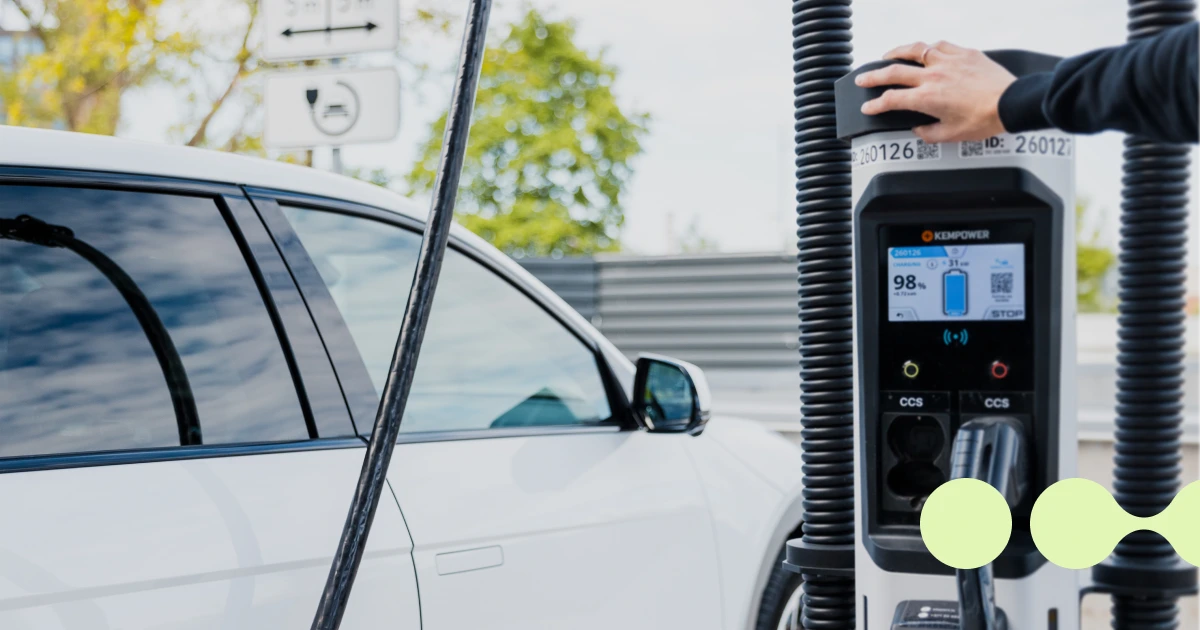
Two things stretch a fast charging stop more than anything else. The first is the “top end” of the battery.
When State of Charge tested the Porsche Macan Electric in the US, 10 to 80% took 20,7 minutes. Getting from 80% to 100% took 50 minutes, more than twice as long for less than a third of the energy.
So on a trip, leaving one charging stop at 80% and stopping again later is usually quicker than staying there until near-100%. And if you keep wondering should I charge my EV to 100 or stop at 80% in daily use, the answer depends mostly on your battery chemistry, see our details in the article linked.
Battery temperature is the second large factor influencing fast charging time, and in a northern climate, it really pays to know this.
Lithium-ion battery charging slows down when the cells are cold, and the car limits power to protect them. How cold the pack is when you plug in matters more than the air temperature while you do it – in other words, yes, an EV coming from a warm garage to a DC charger at −20°C doesn’t have the same limitations as an EV that was sitting in that −20°C for a while.
ADAC’s winter test, published in January 2026, shows both sides. Fourteen family EVs drove a simulated 582 km Munich to Berlin motorway route in a climate chamber at 0°C, starting cold and with charging preconditioning switched off.
By the charger, the drive itself had warmed the batteries enough. In 20 minutes from 10%, the cars won back between 150 and 300 km. The Smart #5 went from 10% to 80% in 17 minutes 16 seconds, which is within the time Smart promises itself.

The harder case is a car that has stood outside all night and only drives a short way to the charger. That’s where warming the pack first earns its keep. At the NAF El Prix winter test in 2026, preconditioning started two hours before the cars charged at around −10°C. Then 14 of 24 EVs charged 10 to 80% in about their stated time, and six charged actually faster than stated.
So in January, how long to charge an electric car depends as much on the last half hour of driving as on the charger. Our guide to EV preconditioning explains how to trigger it.
How Long Does It Take to Charge a Tesla?
Since this is a popular question, let’s tackle it separately: how long does it take to charge a Tesla at a Supercharger? Tesla says a Supercharger can add up to 275 km of range in 15 minutes, at a maximum rate of 250 kW, and that preconditioning the battery makes charging 25% faster. At home, Tesla says its 11 kW Wall Connector adds up to 71 km of range per hour of charge.
With Tesla, you also have to mind exactly which battery your Tesla has – as different model years of different Tesla models have had anything from Tesla’s in-house produced batteries to those from makers like BYD.
Either way, those are Tesla’s own best-case numbers. ADAC’s winter test gives a real one. On the 582 km run at 0°C, the Model Y would have needed a single stop of about 25 to 30 minutes to finish.
Charging at Home: An Average Day Comes Back in Under an Hour
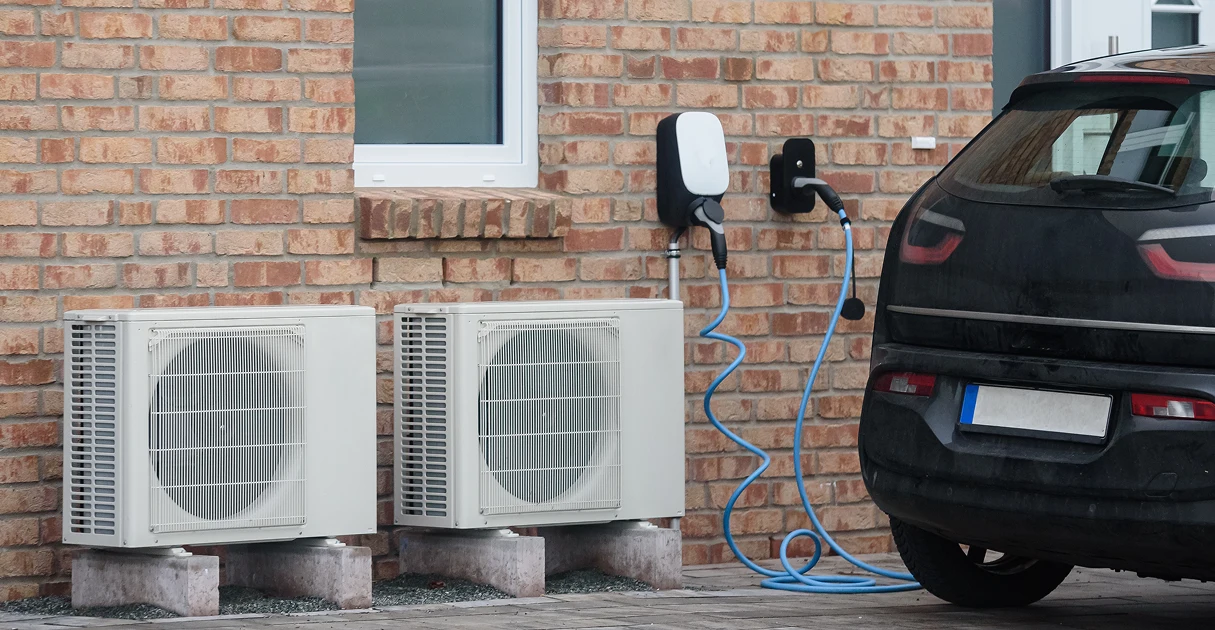
Most charging doesn’t happen at a public charger at all. Survey data in the IEA’s chapter on electric vehicle charging shows owners worldwide charge at home or at work almost 75% of the time, and at public fast chargers only about 10% of the time.
That changes what electric car charging time means day to day.
The IEA’s look at electric car trends puts the average driving range of a battery electric car at almost 380 km, while average daily driving in many markets is around 40 km. So how far can an electric car go on one charge matters less than it sounds, since a normal day uses roughly a tenth of the battery.
At home, the question of how long does it take to charge an electric car mostly answers itself overnight.
For example, let’s look at the most common setup. How long to charge electric car at home with an 11 kW wallbox? A full charge of a 70 kWh battery takes just under 7 hours, while the roughly 7 kWh behind an average 40 km day comes back in about 40 minutes.
On a household socket instead of the wallbox, the same top-up takes 3,5 to 4 hours. That still fits in a night, though ADAC advises against regular socket charging because of the higher losses and lower safety.
Home is also the cheapest place to charge. What a fast charge costs, country by country, can be found in our unique October 2026 price report.
So, How Long to Charge an Electric Car in Real Life?
A long trip is the real test. It’s also the best in answering the naysayers throwing the “what if I need to drive a 1000km” myth at you,
In summer 2026, a Zeekr 7GT set the best time yet in Bjørn Nyland’s 1000 km challenge, where the clock runs through every charging stop. It covered 1000 km of Norwegian and Swedish motorway in 8 hours 50 minutes.
Its first stop came after 408 km and took 10 minutes, from 7% to 63%. The next two took 9 and 12 minutes, each again adding roughly half the battery, before a last stop at a Tesla Supercharger.
The roads are getting easier to plan around as well. Under the EU’s AFIR regulation, charging pools on the core TEN-T road network should by now sit no more than 60 km apart in each direction. Each needs at least 400 kW in total and one point of 150 kW or more.
So how long does it take to charge an electric car? Somewhere between a coffee and a night’s sleep. Once you know your car’s curve, how long does it take to charge an EV turns into something you can plan a trip around. With a warm battery and a stop at 80%, the answer usually lands closer to the coffee.