EV sales are breaking new records across Europe in 2026, with 1 608 200 new battery-electric cars sold in the first half of 2026, 35,1% more than a year earlier.
This means more than every fifth new car sold in Europe (22.2%) is now fully electric.
Considering this, one would expect that finding the info on fast charging prices, to compare every single operator you could possibly charge with in your country, would certainly be easy nowadays, right? So how much exactly does fast charging cost across Europe?
Six months ago we published the first edition of this report, after finding out the hard way that nobody had put every fast charging price in Europe on one page. Not even close. So we built the report ourselves, country by country, with the plan of coming back every six months.
This here is that second look.
This edition is built differently under the hood. Prices come from each operator’s own price page, its pay-without-an-app page, or an official national charging register, read solely in October 2026. That took us through more than 550 operator listings in 29 countries, and 447 of them made it into this ranking. More on that in the methodology section.
First we’ll look at how the average fast charging prices in 29 countries in Europe compare with each other, then at the patterns that repeat across borders, and then at every market in turn with its own leaderboard. If you only care about one country, the table of contents you see will take you straight there.
Public EV charging cost across Europe for fast charging
The median electric car charging cost that an EV driver pays at a fast charger in the United Kingdom is about two and a half times the one in Finland, and that gap is the first thing the map shows.
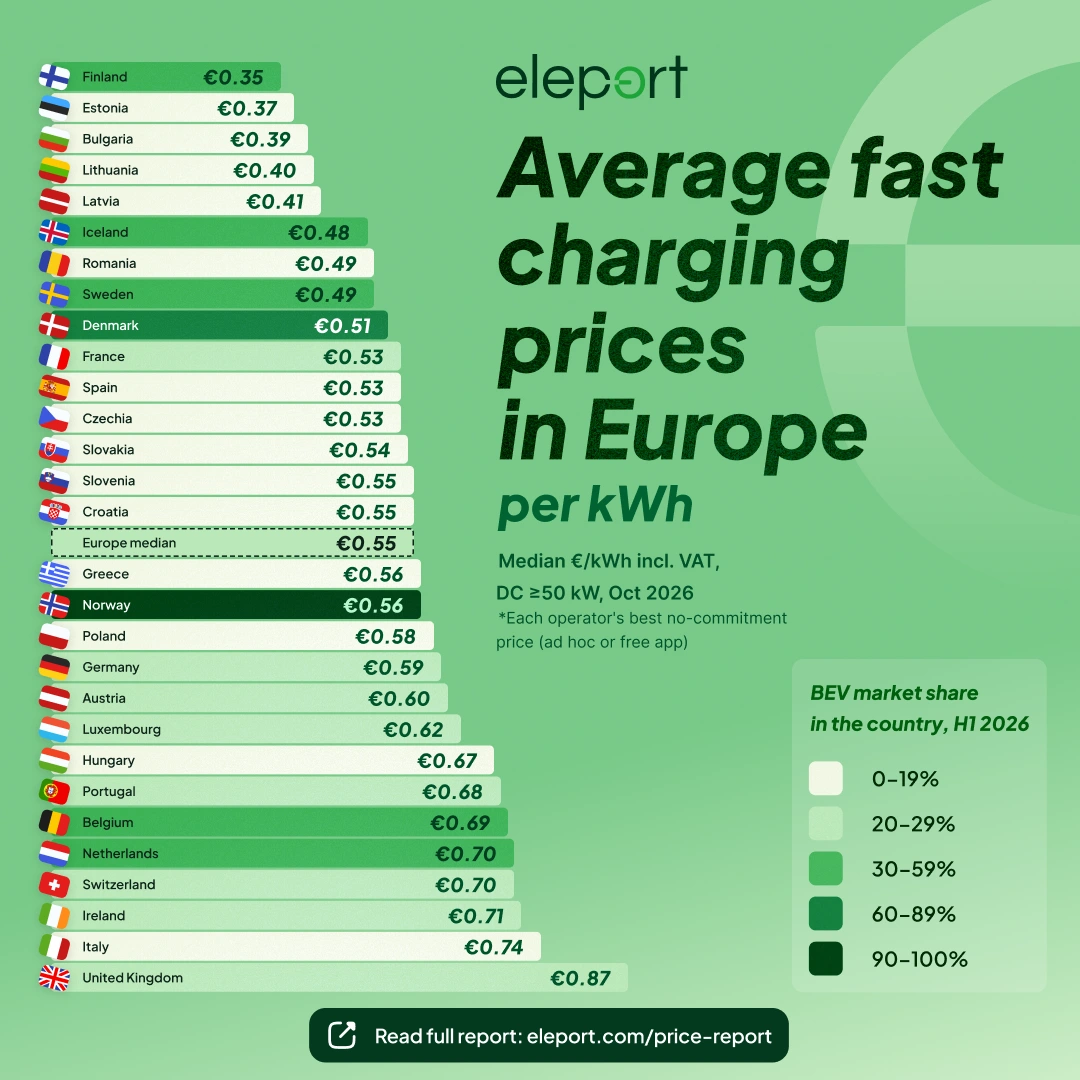
How much does it cost to charge an electric car at a fast charger in Europe? The median fast charging price across the 29 countries in this report is €0.55 per kWh in October 2026, up from €0.54 in March. Country medians run from €0.35 per kWh in Finland to €0.87 in the United Kingdom.
Here is how the fast charging prices compare across Europe:
And here are the same country-by-country fast charging price results put on the map:
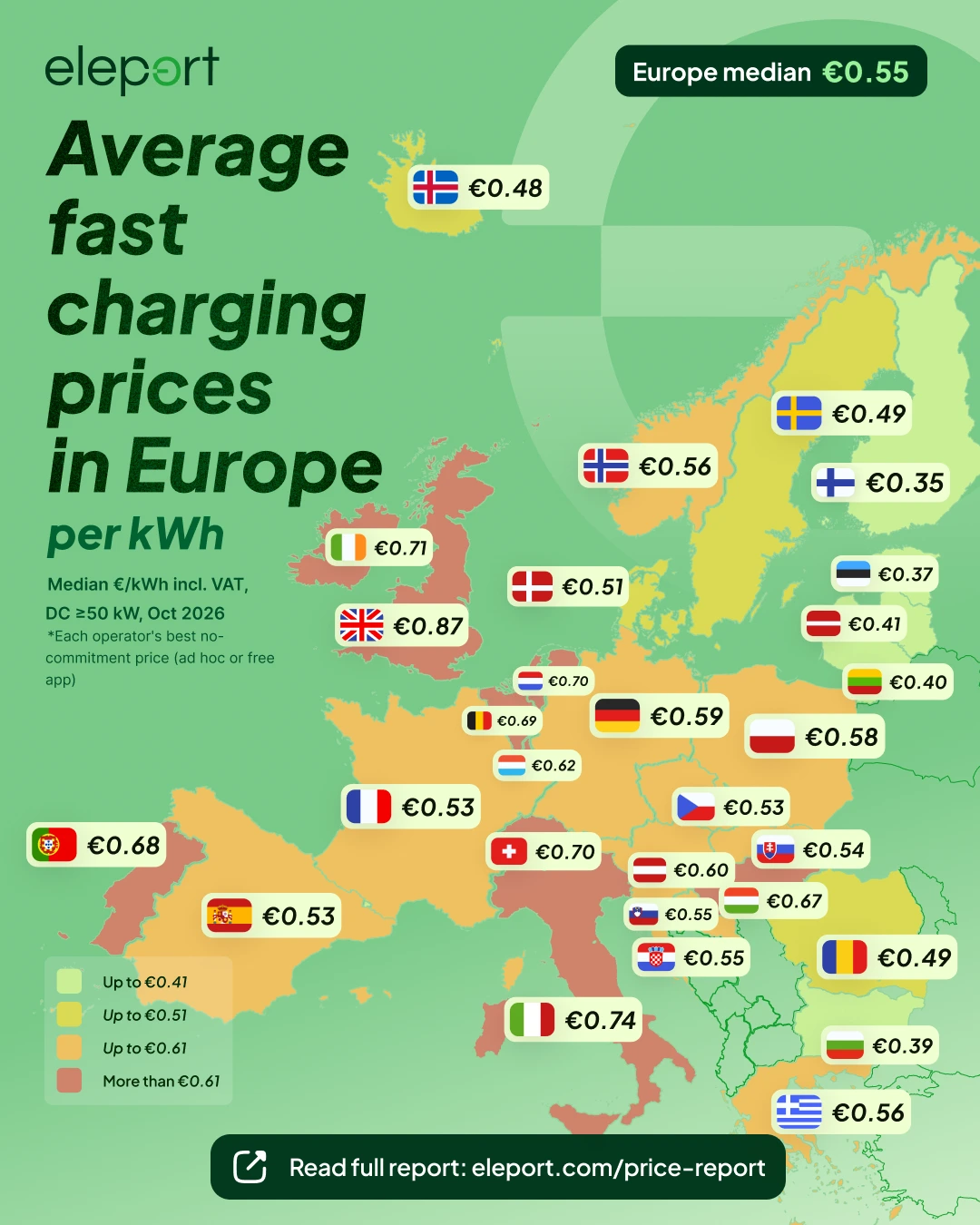
Which country has the cheapest fast charging in Europe? It’s Finland, with a median of €0.35 per kWh across 11 operators. Estonia (€0.37) and Bulgaria (€0.39) follow, then Lithuania (€0.40) and Latvia (€0.41).
Iceland (€0.48) is sixth, Romania and Sweden share seventh and eighth at €0.49, and Denmark (€0.51) completes the top nine.
The European middle sits at €0.55, exactly where Croatia and Slovenia land, with Greece and Norway a cent above.
At the other end, the United Kingdom is again the most expensive market, with a median of 73.50p (€0.87) per kWh across 25 operators. That is more than half again the European median. Italy (€0.74) is second from the bottom, then Ireland (€0.71), with the Netherlands and Switzerland sharing 25th and 26th place at €0.70.
Key Takeaways from our Europe fast charging overview
These are the patterns that we see repeat across borders.
Does cheap fast charging go hand in hand with EV adoption?
The answer is… not as much as you’d think.
Of the seven countries in this report where electric cars now make up more than 30% of new car sales, four sit in the cheapest nine: Finland (47,8% BEV share, 1st as cheapest), Iceland (42,4%, 6th), Sweden (41,5%, 7th–8th) and Denmark (79,9%, 9th). Norway, at 97,6%, is in 16th–17th place at €0.56. Belgium (36,1%, 24th) and the Netherlands (36,5%, 25th–26th) are the high-adoption, high-price exceptions, as they were in March.
At the other end of the adoption scale, Estonia, Bulgaria, Lithuania and Latvia all have BEV shares under 8% and all sit in the top five. A low cost to charge electric car batteries in public clearly does not pull people into EVs on its own.
Italy shows the opposite combination: an 8,5% BEV share and the second most expensive fast charging in Europe. The UK, at 25,0%, shows that a high public EV charging cost hasn’t stopped adoption there either. If you want to see how these prices compare with filling up, we put them side by side in our EV fast charging vs petrol prices across Europe analysis – and there’s a fresh version of this coming up in a few weeks.
Tesla’s off-peak Supercharger price is the cheapest in 23 countries
Is Tesla Supercharging the cheapest fast charging in Europe? Often, if you can charge off-peak. For non-Tesla drivers using the Tesla app, Tesla’s lowest off-peak Supercharger price is the cheapest fast charging price we found in 23 of the 27 countries where its Superchargers are open to all EVs. Including Italy, where it shares the spot with the A22 motorway network. Peak prices at the same sites can become much higher, while the Tesla membership price gets it even lower still.
The four countries where someone else starts cheaper on fast charging sites are Austria (Lidl), Czechia (E.ON Drive), the Netherlands (NXT50Five) and Estonia (most players ahead of it), where Tesla’s three sites start at €0.43.
That off-peak floor is real but narrow. Tesla’s supercharger price changes by site and by hour, so the €0.20 you can find off-peak in France belongs to a range that reaches €0.68 at peak. But importantly, taken at the middle of its range, the Tesla Supercharger cost is still below the national median in 20 of those 27 countries.
Supermarkets are still among the cheapest fast chargers you can use
Lidl is ranked in 20 countries, and its best price is below the national median in 19 of them, Bulgaria being the only exception. In ten countries it is among the three cheapest operators, and in Austria its app price from €0.29 is the cheapest of all.
And if you’re not aware, Lidl has now become one of the largest charging networks in all of Europe.
In Germany, Lidl, Kaufland and ALDI Süd all start at the same €0.44. Elsewhere it’s Migros in Switzerland, Continente in Portugal and the Hrvatski Telekom chargers at Tommy supermarkets in Croatia doing the same job, most likely because they already have the car parks and the grid connections, and charging brings shoppers in. EV charging hubs at shopping centres make a lot of sense for drivers, who can simply charge while they shop, which is also why Eleport has partnered with many shopping centres across the CEE region.
Paying by bank card ad hoc usually costs more than using the app
How you pay can change your EV charging cost quite significantly.
Of the 237 operator listings that publish both a card (ad hoc) price and a free app price, 158 charge more if you just tap a bank card, 76 charge the same. The typical gap is about 11%.
The widest gaps are in Austria (Lidl, €0.60 by card against €0.29 in the Lidl Plus app), Germany (EWE Go, €0.84 against €0.52, and EnBW, €0.79 against €0.56) and Belgium (EnergyVision, €0.61 against €0.37 with its card). If you want to save money, a free EV charging app usually brings the lowest electric car charging cost, if you don’t want to go for a monthly fee.
IONITY is on the expensive end to pay as you go, but not with a subscription
IONITY is listed in 24 countries. It sits last in the leaderboard in 11 of them when looking at the ad-hoc and free app pricing, and its best no-commitment price is below the national median only in Denmark, Norway, France and Portugal.
The Power membership plan, €11.99 a month in most euro countries, changes the picture completely: in Finland it brings IONITY from €0.40 even down to €0.24 per kWh. The spread between countries is wide, too. The same IONITY app price is €0.40 in Finland and 79p (€0.93) in the UK, in step with the rest of the market.
Almost two in five operators offer a membership or customer discount
173 of the 447 ranked operator listings (39%) offer an EV charging subscription or a customer discount with a lower per-kWh price. Whether it lowers your electric car charging cost depends on how often you use that network. Memberships are shown in our tables but never used for the ranking, since you pay for them whether you charge or not.
Utility bundles are becoming more common, too. In the Baltics, Iceland, Austria and Czechia, being a home electricity customer of the right company unlocks a lower charging price at their fast chargers.
Prices that follow the spot electricity market dynamically reach well beyond Denmark
EWII, PowerGo and EDF in Denmark, PowerGo in the Netherlands (15-minute prices), eTAURON and EkoEN in Poland, Alexela in Estonia and enercity’s pilot in Hanover all move their prices with the grid, the hour or demand – if not at all, then in some stations. EWII’s range of 2.44–6.18 DKK (€0.33–0.83) per kWh shows how far that can stretch depending on conditions.
Session fees can undo a good per-kWh price
Three Slovenian networks add €1 per DC session, EZO in Ireland adds a €1.50 access fee and Mobiliti in Hungary adds 500 Ft (€1.38) to its card price. On a 20 kWh top-up, €1 adds five cents to every kWh, so with a session fee, deciding how much to charge an electric car in one go matters as much as where. We show these fees as notes under each table and do not add them to the per-kWh price shown, as it would be, well, impossible to calculate into this.
Where Eleport’s network lands
As one of the largest CEE charging point operators, Eleport appears in six of the 29 leaderboards: Estonia, Latvia, Lithuania, Poland, Slovenia and Croatia.
In every one of them, Eleport charges one flat price per site (you can see them all on Eleport’s EV charging pricing page), with no time-of-day swings and no subscription to buy. Eleport positions itself as a mid-priced yet premium service, without the drivers needing to watch out for dynamic tariffs. Eleport focuses on building DC hubs in convenient locations.
Eleport’s pricing comes in below the national median in Poland, Slovenia and Croatia, is level with it in Lithuania, and two cents above it in Latvia and Estonia, where the median prices are already among the lowest in Europe.
Methodology
This is our own overview of DC fast charging prices, based on publicly available data. It was commissioned by Eleport and put together with the EVwire team.
- Prices were read in October 2026 (data month: October 2026). Non-euro prices are converted at the European Central Bank’s euro reference rates of 15 October 2026.
- Prices are for a DC charger of 50 kW and above, per kWh and including VAT. Start, session and access fees are noted separately and not added to the EV charging cost per kWh.
- Each charge point operator’s price comes from its own price list, app information or pay-without-an-app page first. Where an operator doesn’t publish an ad hoc price, we used the official national register or access point where one exists (for example, Fintraffic’s Digitraffic in Finland, E-Control’s ladestellen. at in Austria, NDW in the Netherlands, MOBI.E in Portugal and UDT’s EIPA in Poland).
- Where an operator shows its prices only inside its app, we used their app or relied on the most recent third-party sources we could find, such as motoring clubs, comparison sites and press reports. These are named under the country text and graphs in question.
- Power tiers, sites and times of day are shown as one price range per operator. The leaderboards are sorted by the lowest price available without a subscription (ad hoc or free app), and the country median uses the middle of each operator’s range.
- Membership prices are shown but never used for the ranking. Per-minute-only tariffs and free charging are shown below the table and not ranked.
- Operators were included if they have at least 50 DC charge points at public charging stations or at least 1% of their country’s DC network (150 points in Germany and France). Tesla and IONITY are included in every country where they are open to all EVs. Networks where each site host sets its own price are not ranked.
- Fast charging prices only tell half the story without the price of electricity at home, which Eurostat publishes for every EU country.
Disclaimer: Eleport is not responsible for any mismatch in data, given the changing nature of market prices and that only publicly available data has been used. The prices are sourced and were current in October 2026. If you find a mismatch or would like to see the direct source for any price shown, please reach out at hello@eleport.com, and we’ll happily update or share it. Please also let us know at this email if you found this resource useful.
Now let’s take a closer look at the fast charging prices in every country.
Fast Charging Price Comparison in Finland for 2026
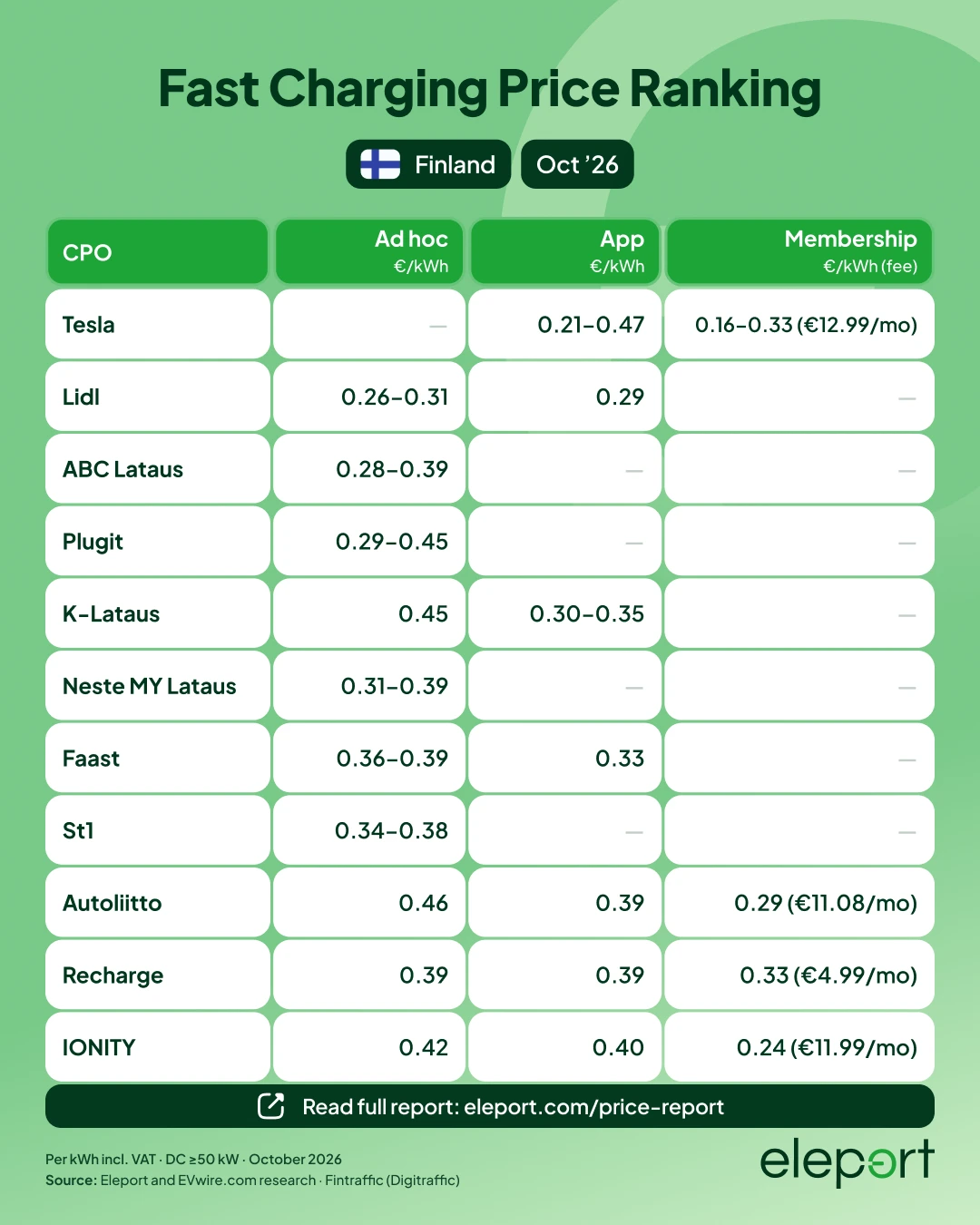
The average (median) fast charging price in Finland is the cheapest in all of Europe, at €0.35 per kWh, just as it was half a year ago.
17 798 EVs sold in the first half of 2026, growing +39,8% year-on-year.
BEV market share rose from 34,2% to 47,8%.
So how much does it cost to charge an electric car in Finland? Less than anywhere else in Europe. Almost every second new car sold in Finland is now fully electric, and the country’s fast charging market is remarkably tight: the middle of every one of its 11 operators’ price ranges sits between €0.29 and €0.40.
Tesla charging cost starts at €0.21 off-peak, the cheapest in Finland (it goes up to €0.47 at peak, but also down to 0.16€/kWh for members), and Lidl follows with €0.26–0.31 by card or €0.29 in the Lidl Plus app. ABC Lataus, Plugit and K-Lataus all have night prices around €0.28–0.30 per kWh.
The flip side is time. ABC Lataus, Plugit, K-Lataus and Autoliitto add €0.20 per minute or more once a session runs past 60 to 180 minutes, so the cheap kWh is meant for charging, not parking, similarly to what Tesla enforces across countries. Idle fees are becoming a common sight across Europe. IONITY is the most expensive option here at €0.40 in its app, and – get this – is still cheaper than the European median.
Some ad hoc prices we used come from Fintraffic’s official charging data (Digitraffic), the rest directly from the CPO sites or their apps.
| CPO | Ad hoc €/kWh | App €/kWh | Membership €/kWh (fee) |
| Tesla | — | 0.21–0.47 | 0.16–0.33 (€12.99/mo) |
| Lidl | 0.26–0.31 | 0.29 | — |
| ABC Lataus | 0.28–0.39 | — | — |
| Plugit | 0.29–0.45 | — | — |
| K-Lataus | 0.45 | 0.30–0.35 | — |
| Neste MY Lataus | 0.31–0.39 | — | — |
| Faast | 0.36–0.39 | 0.33 | — |
| St1 | 0.34–0.38 | — | — |
| Autoliitto | 0.46 | 0.39 | 0.29 (€11.08/mo) |
| Recharge | 0.39 | 0.39 | 0.33 (€4.99/mo) |
| IONITY | 0.42 | 0.40 | 0.24 (€11.99/mo) |
Fast Charging Price Comparison in Estonia for 2026
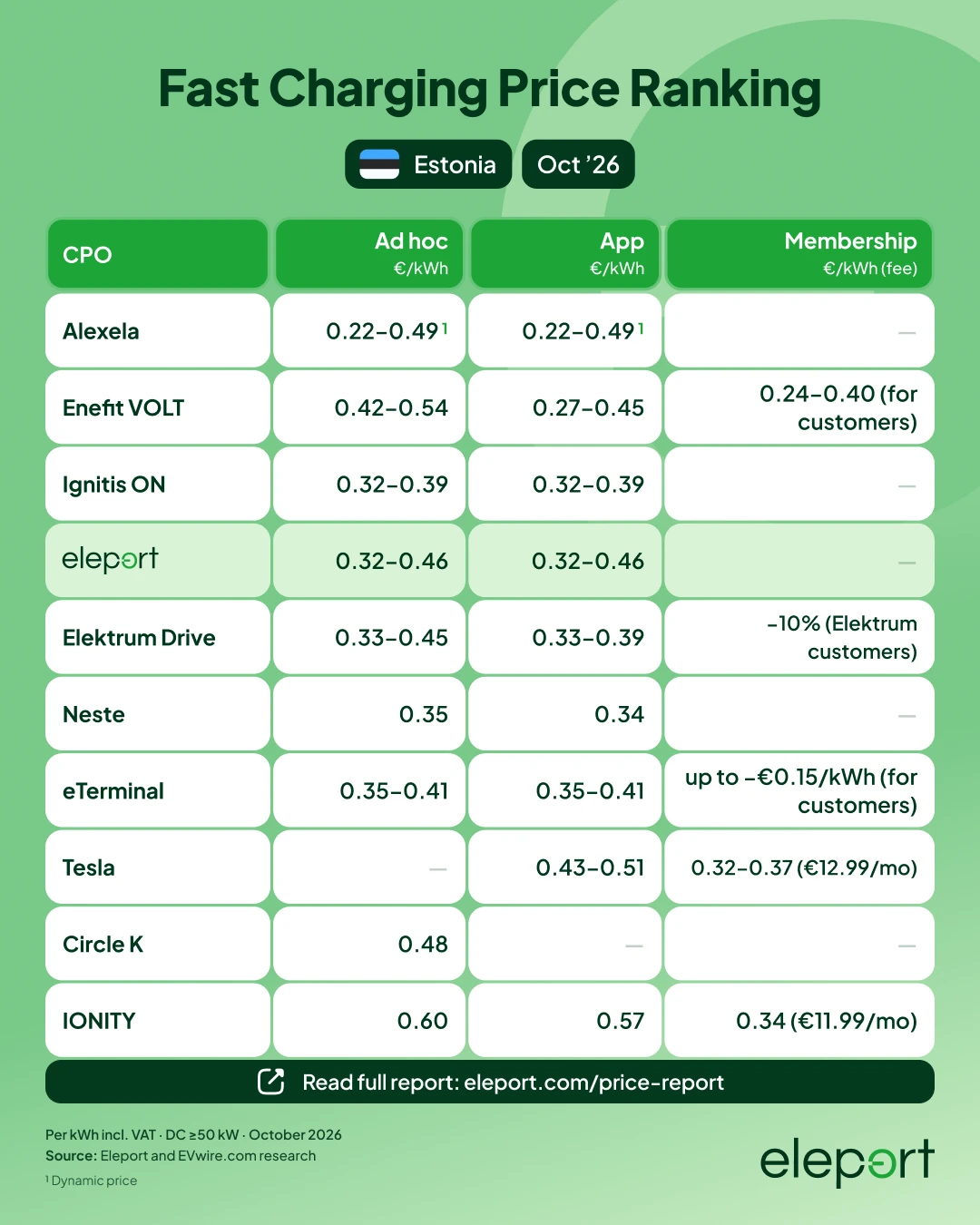
The average (median) fast charging price in Estonia is €0.37 per kWh.
617 EVs sold in the first half of 2026, growing +39,0% year-on-year.
BEV market share slipped from 7,2% to 6,2%.
Compared to what we saw in March, Estonia jumped from fifth to second place in Europe. The fast charging in Estonia costs from €0.22 to €0.60 per kWh across the ten operators, depending on who you use and when. The cheapest start comes from Alexela, whose dynamic price moves between €0.22 and €0.49 depending on location, time, occupancy and the electricity price.
Behind it, the Baltic utilities and fuel retailers are packed tightly together: Enefit’s app price runs €0.27–0.45, Ignitis ON €0.32–0.39 (with a promotion of €0.28–0.33 until the end of the year), Elektrum Drive €0.33–0.45 and Neste €0.35 by card or €0.34 in the app.
Eleport sits fourth by lowest price, at €0.32–0.46 with one price per site, whichever way you pay. The €0.46 price applies as an exemption at three Tallinn malls.
Tesla Supercharging price in Estonia is an unusual approach for them. With only three sites up so far, its Supercharger price starts at €0.43 and lands eighth of ten, even though it is the cheapest offer in so many of the other countries. IONITY here caps the list at the end, with €0.57 in its app without memberships.
The Baltic habit of rewarding home electricity customers is alive, too: Enefit’s electricity customers pay €0.24–0.40 per kWh with no other membership fee, and both Elektrum Drive (-10%) and eTerminal (up to -0.15€/kWh) offer discounts for home electricity customers, too.
| CPO | Ad hoc €/kWh | App €/kWh | Membership €/kWh (fee) |
| Alexela | 0.22–0.49¹ | 0.22–0.49¹ | — |
| Enefit VOLT | 0.42–0.54 | 0.27–0.45 | 0.24–0.40 (Enefit customers) |
| Ignitis ON | 0.32–0.39 | 0.32–0.39 | — |
| Eleport | 0.32–0.46 | 0.32–0.46 | — |
| Elektrum Drive | 0.33–0.45 | 0.33–0.39 | −10% (Elektrum customers) |
| Neste | 0.35 | 0.34 | — |
| eTerminal | 0.35–0.41 | 0.35–0.41 | −0.10 / −0.15 (Nupukas / Pro) |
| Tesla | — | 0.43–0.51 | 0.32–0.37 (€12.99/mo) |
| Circle K | 0.48 | — | — |
| IONITY | 0.60 | 0.57 | 0.34 (€11.99/mo) |
Fast Charging Price Comparison in Bulgaria for 2026
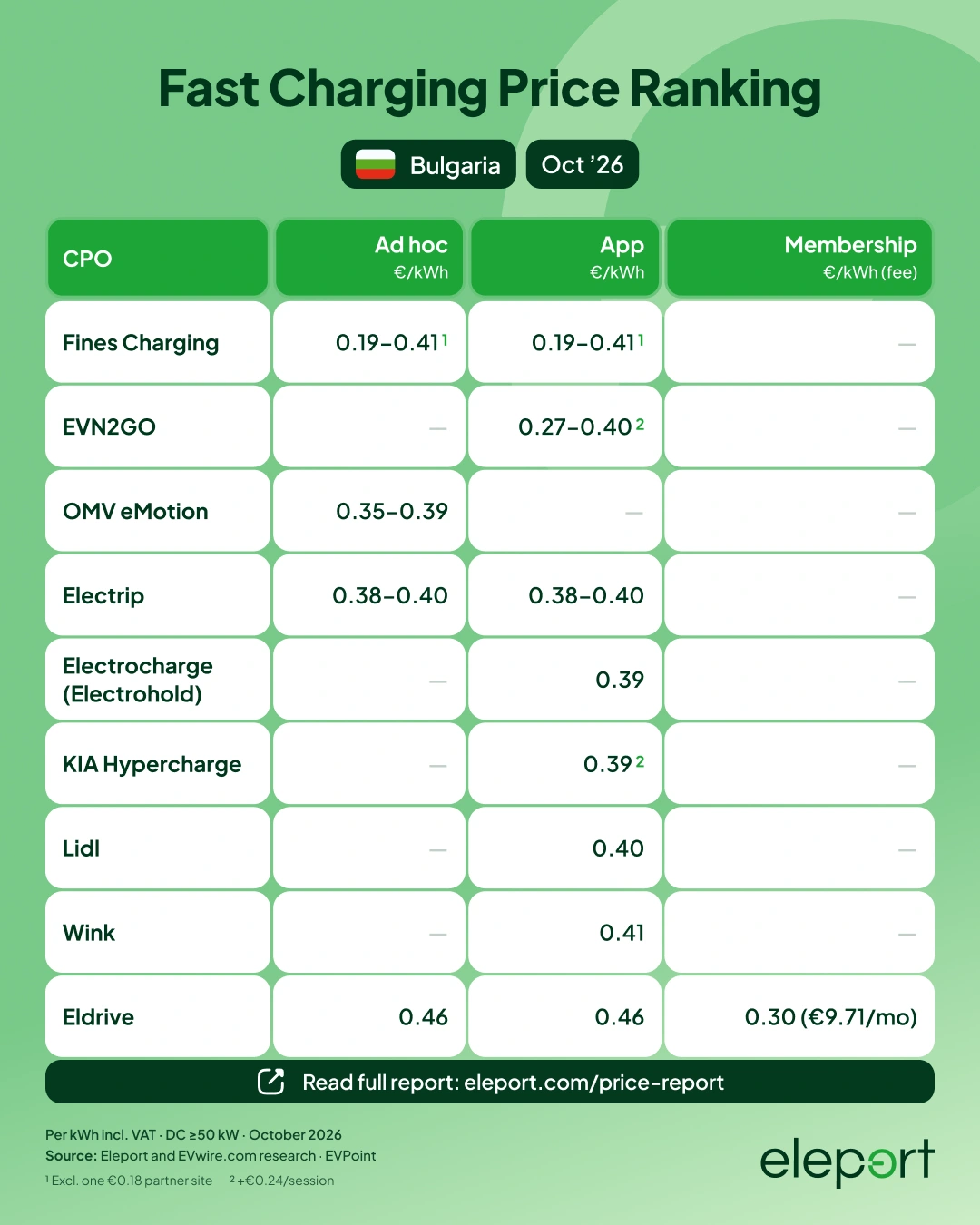
The average (median) fast charging price in Bulgaria is €0.39 per kWh.
2029 EVs sold in the first half of 2026, growing +95,8% year-on-year.
BEV market share rose from 4,3% to 7,8%.
Bulgaria is officially the third-cheapest country in Europe to fast charge your EV in.
Fines Charging, the largest network in our Bulgarian data with 795 DC connectors, starts from €0.19 per kWh, but only at a handful of partner sites. At 711 of its 795 DC connectors, Fines charges €0.39, and that is what most drivers will see.
EVN2GO starts from €0.27 in its app, plus €0.24 per session, and Kia’s own Hypercharge network charges €0.39 plus the same €0.24 session fee. A carmaker running its own public network of 26 sites (excluding the obvious giant) is still a rare but welcome sight in Europe.
Bulgaria’s electric car charging cost is low by any standard at the top end, too: Eldrive’s €0.46 is the highest no-commitment price in the country. We couldn’t find a published price for Megalan or Elfinity, and Tesla’s Bulgarian Superchargers are open to Teslas only, so they are not in this running.
Source note – two of the prices we found come from the EVPoint charging platform.
| CPO | Ad hoc €/kWh | App €/kWh | Membership €/kWh (fee) |
| Fines Charging | 0.19–0.41¹ | 0.19–0.41¹ | — |
| EVN2GO | — | 0.27–0.40² | — |
| OMV eMotion | 0.35–0.39 | — | — |
| Electrip | 0.38–0.40 | 0.38–0.40 | — |
| Electrocharge (Electrohold) | — | 0.39 | — |
| KIA Hypercharge | — | 0.39² | — |
| Lidl | — | 0.40 | — |
| Wink | — | 0.41 | — |
| Eldrive | 0.46 | 0.46 | 0.30 (€9.71/mo) |
Fast Charging Price Comparison in Lithuania for 2026
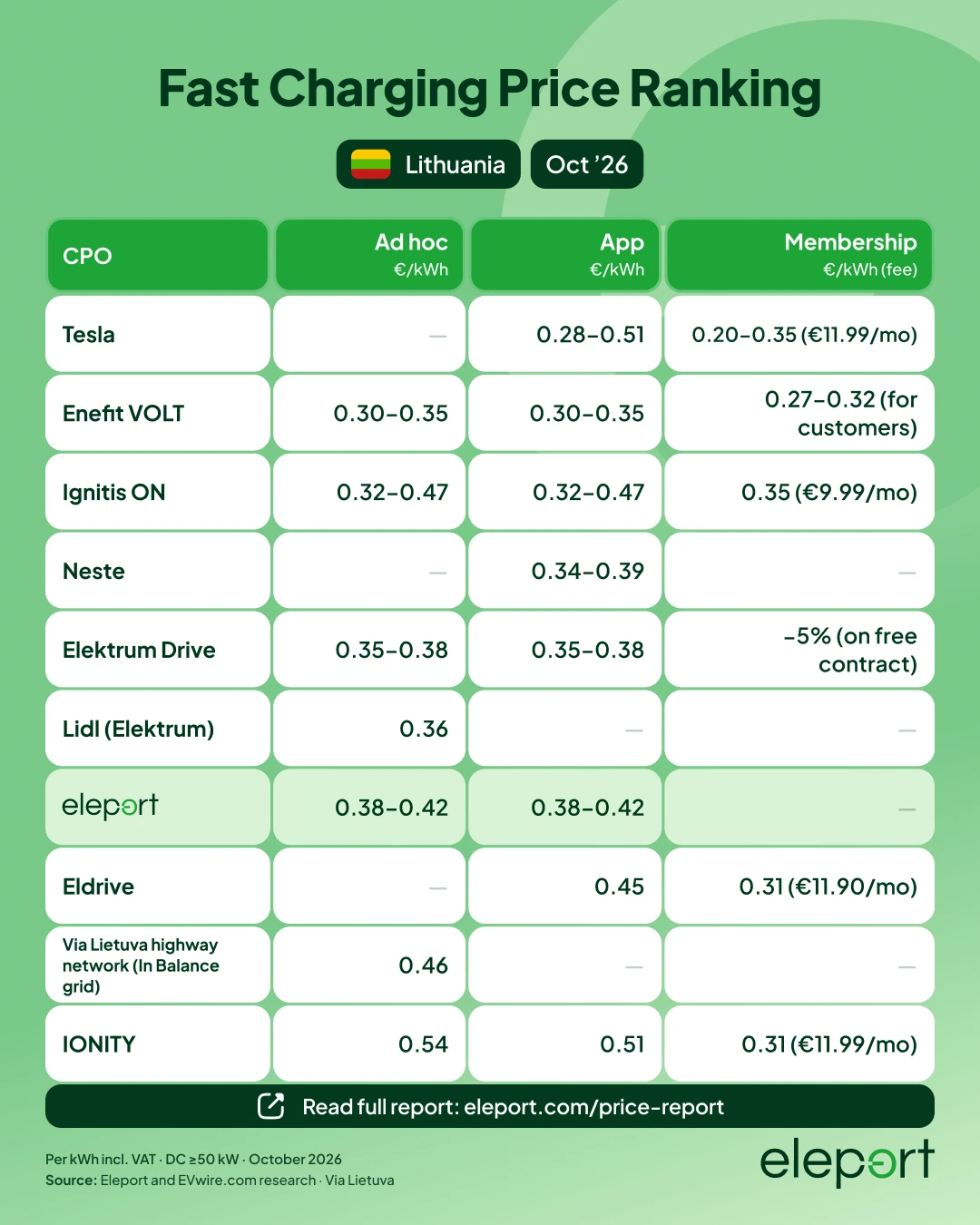
The average (median) fast charging price in Lithuania in 2026 is €0.40 per kWh.
1852 EVs were sold in the first half of 2026, growing +53,7% year-on-year.
BEV market share rose from 5,8% to 7,7%.
Lithuania is fourth-cheapest market in Europe to fast charge your EV in, and the cost to charge electric car batteries barely changes from one network to the next. The Tesla Supercharger cost at the single Lithuanian site, in Kaunas, starts at €0.28 per kWh, and Enefit VOLT follows at €0.30–0.35.
Ignitis ON, the home team, runs by far the largest network with 1071 DC points, at €0.32–0.47 per kWh. Neste charges €0.34–0.39 in its app, depending on the station, and Elektrum Drive €0.35–0.38.
One March storyline has disappeared. Back then, the Lidl chargers run by Elektrum seemed to cost noticeably more than Elektrum’s own. Today Lidl’s Lithuanian sites charge €0.36, right inside Elektrum’s own range.
Eleport is seventh of ten at €0.38–0.42, level with the €0.40 national median. The €0.42 price applies at four mall sites, including NØRDIKA and Akropolis Kaunas.
Apart from IONITY (€0.51 in its app), every operator’s typical price sits between €0.33 and €0.46, which is one of the lowest spreads across markets in Europe. ORLEN’s chargers are something we couldn’t find a published price for.
Source note – two prices come from Via Lietuva’s official charging data.
| CPO | Ad hoc €/kWh | App €/kWh | Membership €/kWh (fee) |
| Tesla | — | 0.28–0.51 | 0.20–0.35 (€11.99/mo) |
| Enefit VOLT | 0.30–0.35 | 0.30–0.35 | 0.27–0.32 (Enefit customers) |
| Ignitis ON | 0.32–0.47 | 0.32–0.47 | 0.35 (€9.99/mo) |
| Neste | — | 0.34–0.39 | — |
| Elektrum Drive | 0.35–0.38 | 0.35–0.38 | −5% (on free contract) |
| Lidl (Elektrum) | 0.36 | — | — |
| Eleport | 0.38–0.42 | 0.38–0.42 | — |
| Eldrive | — | 0.45 | 0.31 (€11.90/mo) |
| Via Lietuva highway network (In Balance grid) | 0.46 | — | — |
| IONITY | 0.54 | 0.51 | 0.31 (€11.99/mo) |
Fast Charging Price Comparison in Latvia for 2026
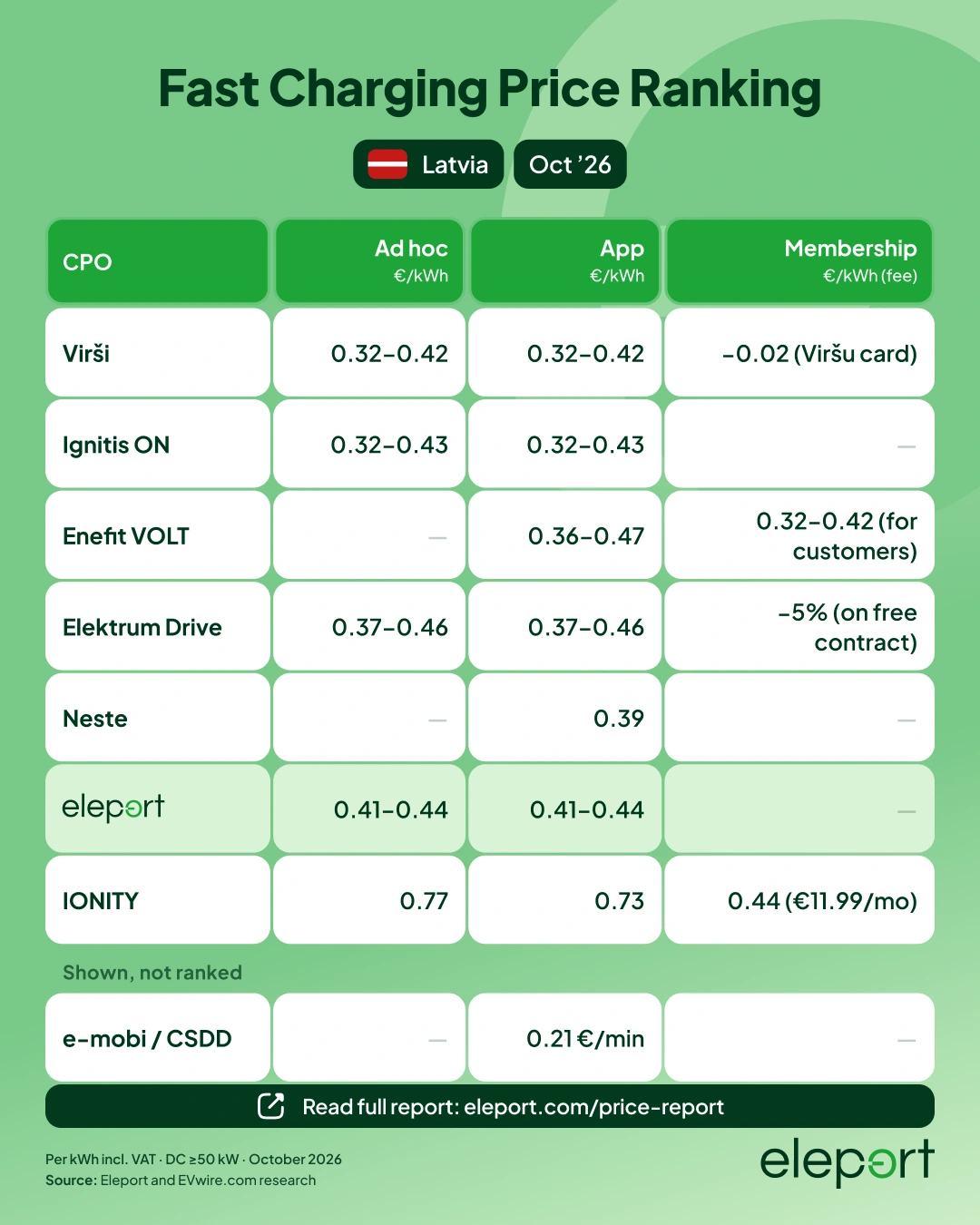
The average (median) fast charging price in Latvia is €0.41 per kWh as of October 2026.
839 EVs were sold in the first half of 2026, growing +12,3% year-on-year.
BEV market share rose from 6,6% to 7,4%.
Latvia ranks fifth in Europe with its fast charging prices. Virši and Ignitis ON share the cheapest start at €0.32. Virši continues to price five power tiers separately, between 80 and 400 kW at €0.32–0.42.
IONITY is the outlier again among the others that price between 0.32-0.47: the cost of charging electric car batteries jumps to €0.77 ad-hoc, is slightly lower at €0.73 in its app, but still significantly more than others. The membership price brings it down to the higher end of other providers’ app prices.
The old e-mobi/CSDD network still charges per minute, now €0.21 per minute, so it is shown under the table without a rank. Tesla’s two Latvian Superchargers remain open to Teslas only, so we didn’t rank them here – its app currently shows a €0.25-€0.32 per kWh range for charging.
| CPO | Ad hoc €/kWh | App €/kWh | Membership €/kWh (fee) |
| Virši | 0.32–0.42 | 0.32–0.42 | −0.02 (Viršu card) |
| Ignitis ON | 0.32–0.43 | 0.32–0.43 | — |
| Enefit VOLT | — | 0.36–0.47 | 0.32–0.42 (Enefit customers) |
| Elektrum Drive | 0.37–0.46 | 0.37–0.46 | −5% (on free contract) |
| Neste | — | 0.39 | — |
| Eleport | 0.41–0.44 | 0.41–0.44 | — |
| IONITY | 0.77 | 0.73 | 0.44 (€11.99/mo) |
| Shown, not ranked | |||
| e-mobi / CSDD | — | 0.21 €/min | — |
Fast Charging Price Comparison in Iceland for 2026
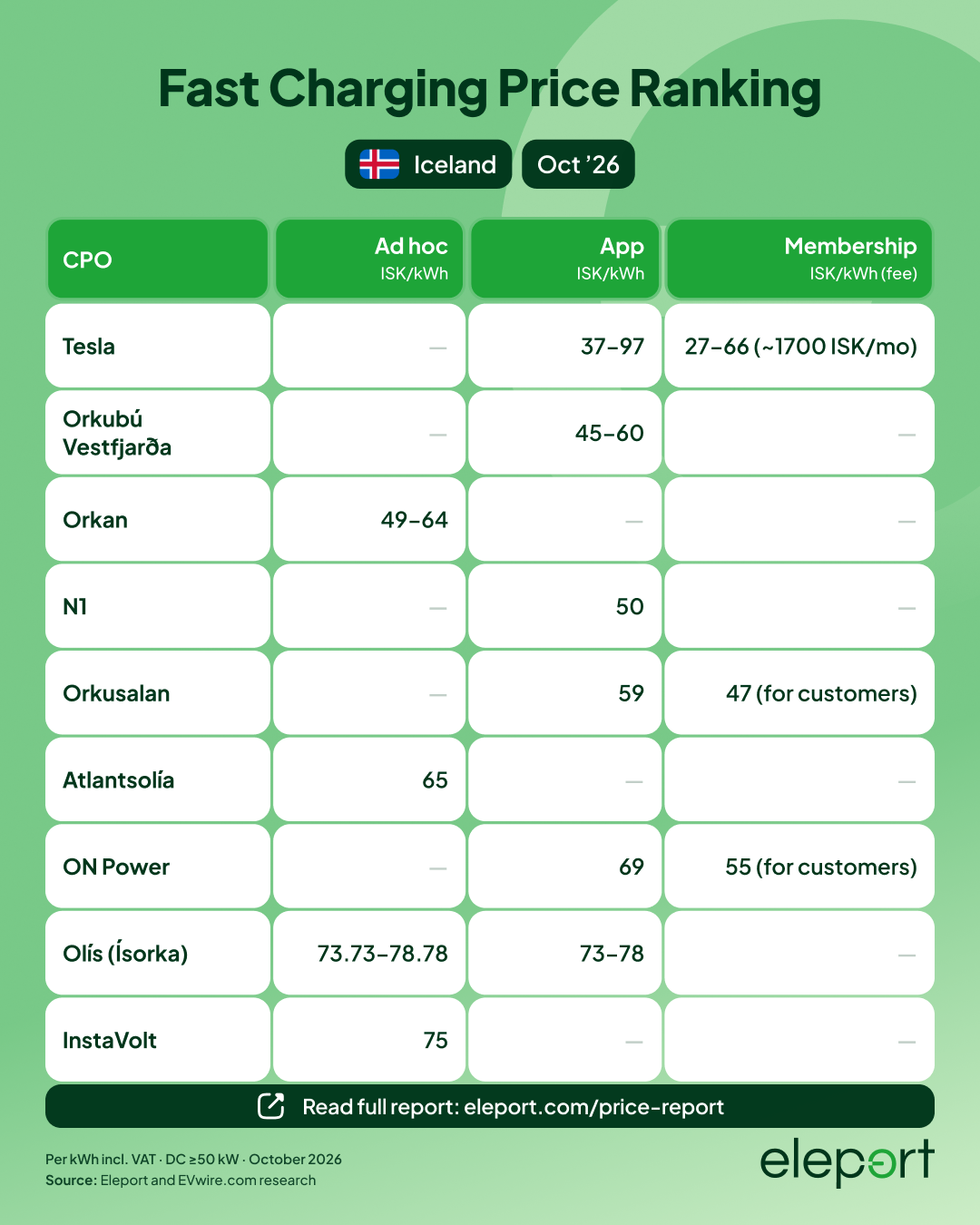
The average (median) fast charging price in Iceland is 65 ISK (€0.48) per kWh as of the end of 2026.
3180 EVs were sold in the first half of 2026, growing +39,5% year-on-year.
BEV market share recovered from 28,9% to 42,4%.
Iceland comes in sixth in fast charging price in Europe, just like earlier this year. Tesla’s off-peak supercharger price of 37 ISK (€0.27) is the cheapest start (seven of its 16 sites’ prices by time of day), but its peak price of 97 ISK can also be the highest in the country.
Among the local players, the Westfjords utility Orkubú Vestfjarða charges 45–60 ISK in the e1 app, Orkan 49–64 ISK depending on the station, and N1 50 ISK in its app.
Utility loyalty is the Icelandic way of lowering the electric car charging cost. Orkusalan charges 59 ISK, but 47 ISK to its HleðsluOrka home electricity customers, and ON Power charges 69 ISK, or 55 ISK to its household electricity customers.
The highest no-commitment prices come from Olís (Ísorka) at 73–78 ISK in the Ísorka app and InstaVolt at a flat 75 ISK by contactless card. We couldn’t find a published price for Bílorka (Brimborg) so far.
| CPO | Ad hoc ISK/kWh | App ISK/kWh | Membership ISK/kWh (fee) |
| Tesla | — | 37–97 | 27–66 (~1,700 ISK/mo) |
| Orkubú Vestfjarða | — | 45–60 | — |
| Orkan | 49–64 | — | — |
| N1 | — | 50 | — |
| Orkusalan | — | 59 | 47 (for customers) |
| Atlantsolía | 65 | — | — |
| ON Power | — | 69 | 55 (for customers) |
| Olís (Ísorka) | 73.73–78.78 | 73–78 | — |
| InstaVolt | 75 | — | — |
Fast Charging Price Comparison in Romania for 2026
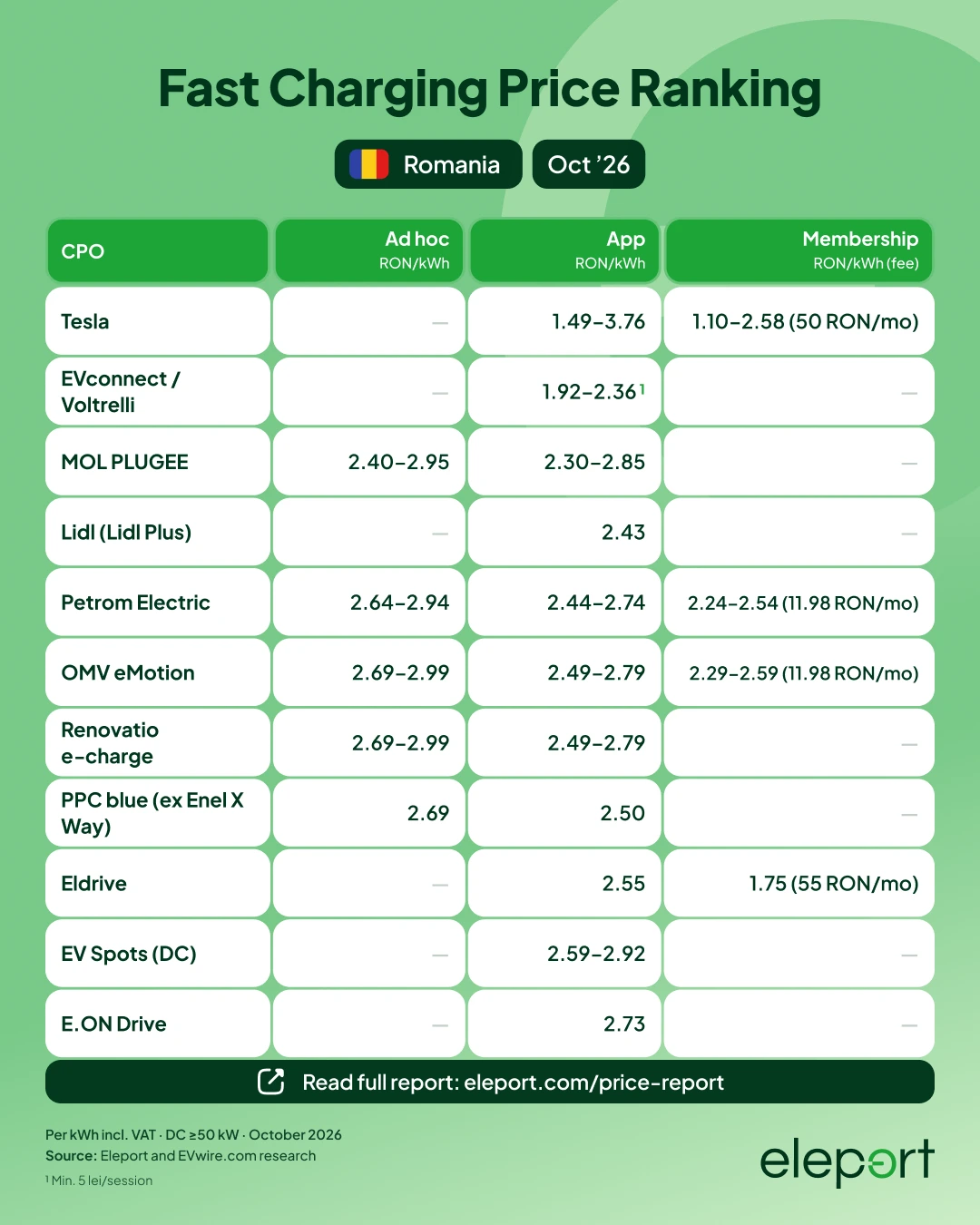
The average (median) fast charging price in Romania is 2.59 RON (€0.49) per kWh.
5522 EVs were sold in the first half of 2026, growing +72,5% year-on-year.
BEV market share rose from 4,9% to 8,5%.Romania shares seventh and eighth place in Europe with Sweden, and the cost of charging electric car batteries varies little between networks: the typical prices of all 11 ranked operators sit between €0.40 and €0.52.
Tesla charging cost, with all 17 Romanian sites open to every EV, starts at 1.49 RON (€0.28) off-peak. EVconnect / Voltrelli comes next at 1.92–2.36 RON in its app, with the lower price at shopping-centre sites and a minimum of 5 lei per session. MOL Plugee (2.30–2.85 RON in its app) and Lidl (2.43 RON in Lidl Plus) follow.
The OMV Petrom group still runs three price lists. Petrom Electric charges 2.44–2.74 RON in the app, while OMV eMotion and Renovatio e-charge charge 2.49–2.79 RON, and since 24 September 2026, Petrom Electric’s app has been merged into OMV eMotion.
PPC blue, formerly Enel X Way Romania, charges 2.50 RON in its app and 2.69 RON as a guest. EV Spots (2.59–2.92 RON) has the highest typical price, and E.ON Drive’s 2.73 RON requires a prepaid account. Rompetrol’s chargers are something we also noticed, but we found no published price anywhere so they are currently out of the ranking.
| CPO | Ad hoc RON/kWh | App RON/kWh | Membership RON/kWh (fee) |
| Tesla | — | 1.49–3.76 | 1.10–2.58 (50 RON/mo) |
| EVconnect / Voltrelli | — | 1.92–2.36¹ | — |
| MOL PLUGEE | 2.40–2.95 | 2.30–2.85 | — |
| Lidl (Lidl Plus) | — | 2.43 | — |
| Petrom Electric | 2.64–2.94 | 2.44–2.74 | 2.24–2.54 (11.98 RON/mo) |
| OMV eMotion | 2.69–2.99 | 2.49–2.79 | 2.29–2.59 (11.98 RON/mo) |
| Renovatio e-charge | 2.69–2.99 | 2.49–2.79 | — |
| PPC blue (ex Enel X Way) | 2.69 | 2.50 | — |
| Eldrive | — | 2.55 | 1.75 (55 RON/mo) |
| EV Spots (DC) | — | 2.59–2.92 | — |
| E.ON Drive | — | 2.73 | — |
Fast Charging Price Comparison in Sweden for 2026
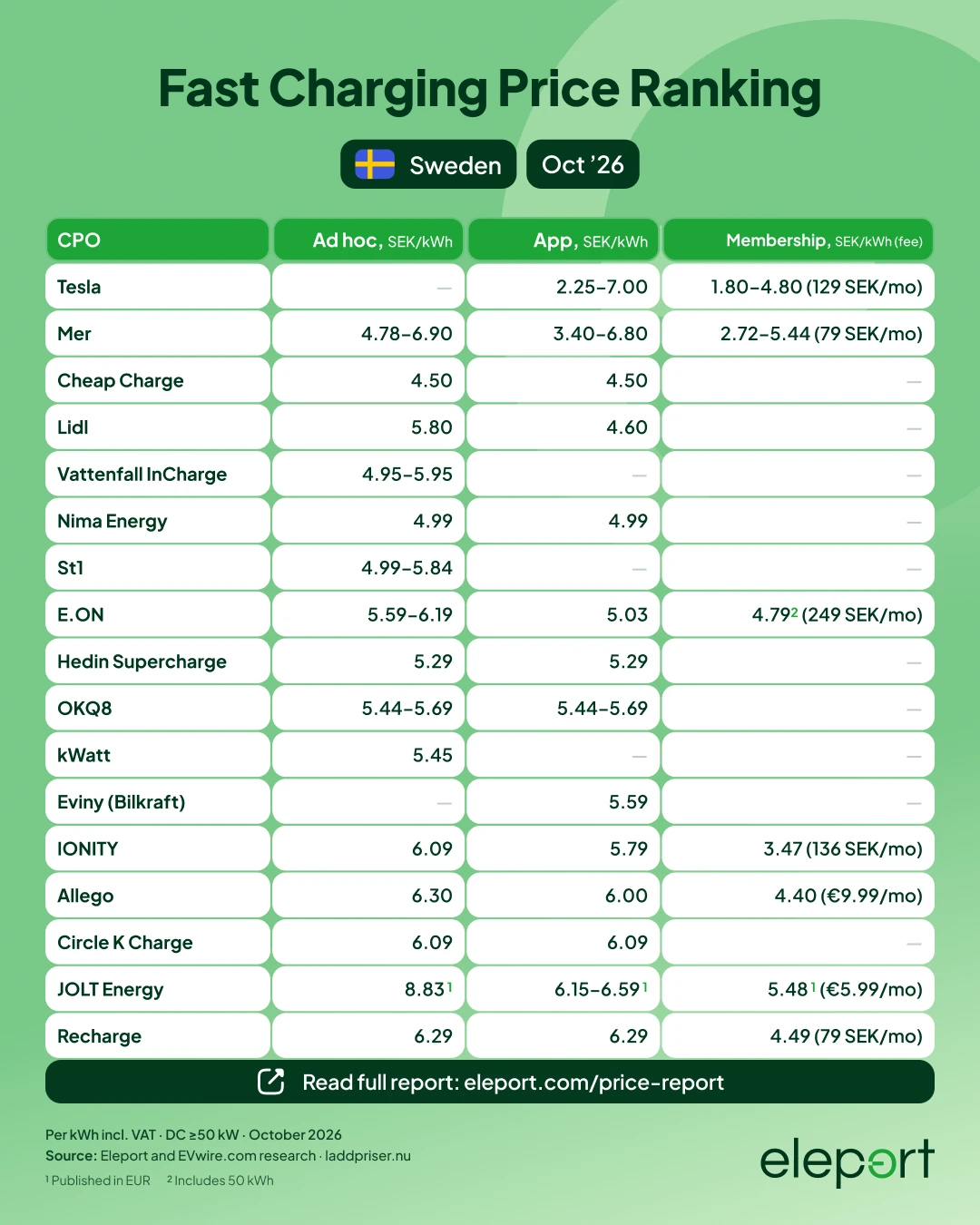
The average (median) fast charging price in Sweden is 5.45 SEK (€0.49) per kWh.
58 801 EVs sold in the first half of 2026, growing +18,4% year-on-year.
BEV market share rose from 35,2% to 41,5%.
Sweden shares seventh and eighth place with Romania. If you look at the EV market share between the two countries, it’ll serve as solid proof that fast charging prices don’t really cause a market share rise one-on-one.
How much does it cost to charge an electric car in Sweden? Most operators sit between 4.50 and 6.30 SEK per kWh, with Tesla well below… and also well above that band, depending on the time.
Tesla’s off-peak supercharger price of 2.25 SEK per kWh (€0.20) is one of the lowest prices in Europe, matching Tesla’s off-peak price in France, though the Tesla Supercharger cost at peak goes up to 7.00 SEK (0.63€). Mer prices by site and time of day, from 3.40 SEK at night in its free app to 6.90 SEK by card at the priciest sites. Cheap Charge lives up to its name at a flat 4.50 SEK, and Lidl charges 4.60 SEK in the Lidl Plus app… or 5.80 SEK by card.
E.ON charges from 5.59 SEK by card or 5.03 SEK in its member app, and it is set to become sole owner of the 19 Swedish sites it ran with Clever, as the joint venture splits.
JOLT Energy publishes its prices in euros (€0.79 by card, €0.55–0.59 in its free Community app), which converts to the highest typical price in Sweden. Recharge, at 6.29 SEK, has the highest starting price.
laddpriser.nu helped us with finding Vattenfall InCharge pricing.
| CPO | Ad hoc SEK/kWh | App SEK/kWh | Membership SEK/kWh (fee) |
| Tesla | — | 2.25–7.00 | 1.80–4.80 (129 SEK/mo) |
| Mer | 4.78–6.90 | 3.40–6.80 | 2.72–5.44 (79 SEK/mo) |
| Cheap Charge | 4.50 | 4.50 | — |
| Lidl | 5.80 | 4.60 | — |
| Vattenfall InCharge | 4.95–5.95 | — | — |
| Nima Energy | 4.99 | 4.99 | — |
| St1 | 4.99–5.84 | — | — |
| E.ON | 5.59–6.19 | 5.03 | 4.79¹ (249 SEK/mo) |
| Hedin Supercharge | 5.29 | 5.29 | — |
| OKQ8 | 5.44–5.69 | 5.44–5.69 | — |
| kWatt | 5.45 | — | — |
| Eviny (Bilkraft) | — | 5.59 | — |
| IONITY | 6.09 | 5.79 | 3.47 (136 SEK/mo) |
| Allego | 6.30 | 6.00 | 4.40 (€9.99/mo) |
| Circle K Charge | 6.09 | 6.09 | — |
| JOLT Energy | 8.83² | 6.15–6.59² | 5.48² (€5.99/mo) |
| Recharge | 6.29 | 6.29 | 4.49 (79 SEK/mo) |
Fast Charging Price Comparison in Denmark for 2026
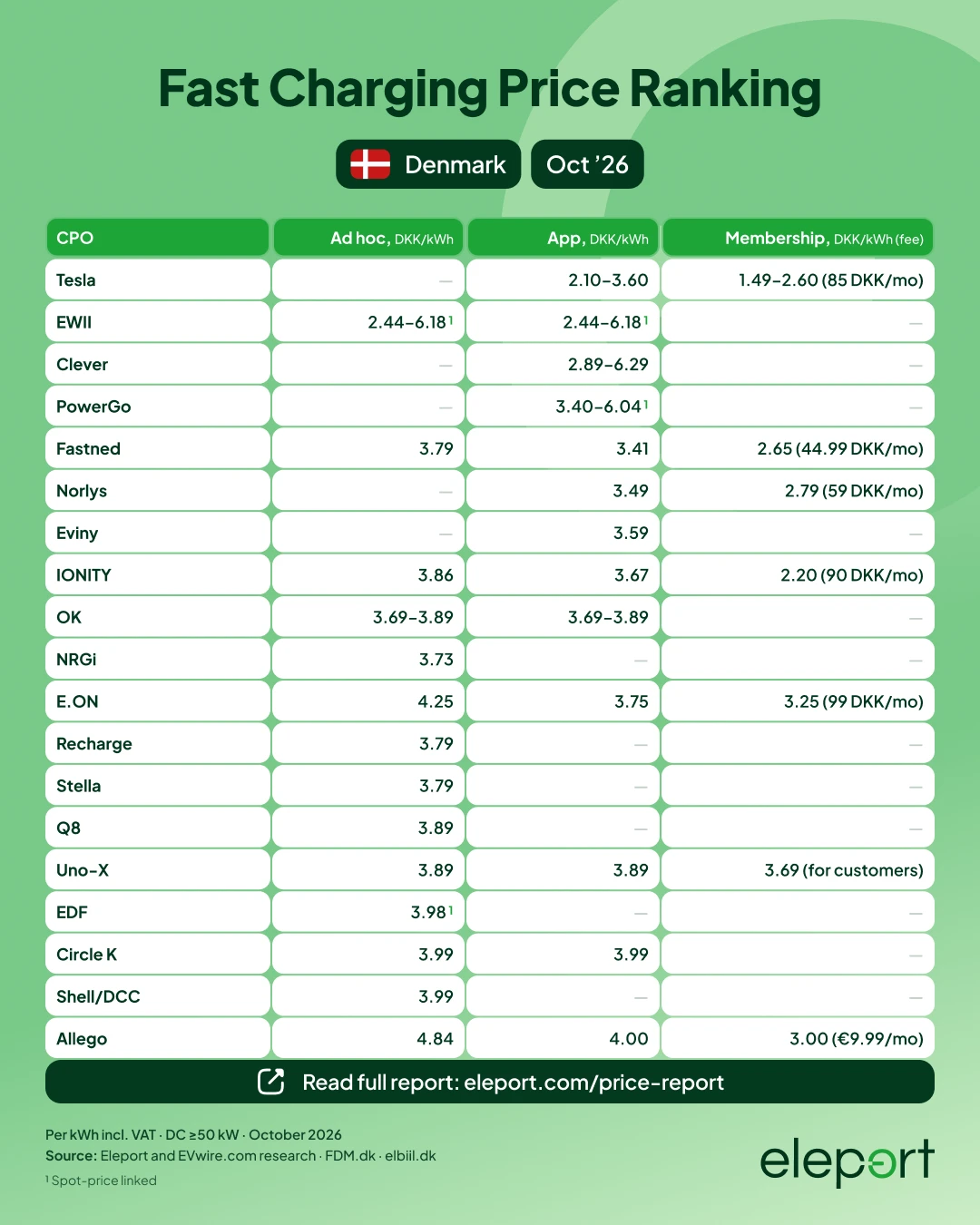
The average (median) fast charging price in Denmark is 3.79 DKK (€0.51) per kWh in October 2026.
80 707 EVs sold in the first half of 2026, growing +41,2% year-on-year.
BEV market share jumped from 63,8% to 79,9%.
Four out of five new cars sold in Denmark are now fully electric, and its fast-charging median of €0.51 is ninth in Europe.
How much does it cost to charge an electric car in Denmark? A lot depends on the hour, because Denmark is where prices follow the electricity market most visibly. EWII’s hourly prices, linked to the Nord Pool spot price, ran from 2.44 to 6.18 DKK, PowerGo’s from 3.40 to 6.04 DKK, and Clever prices by site and time of day from 2.89 to 6.29 DKK in its free app.
To note, EDF’s spot-linked price has averaged 3.98 DKK over three months.
Tesla charging cost starts at 2.10 DKK (€0.28) off-peak, the cheapest in Denmark, and Fastned follows at 3.41 DKK with its 10% app discount.
Then comes a wall. 13 of the 19 ranked operators charge between 3.49 and 3.99 DKK per kWh at their best no-commitment price, from Norlys and Eviny at the cheaper end of that band to Circle K and Shell/DCC at the top. Allego, at 4.00 DKK in its app and 4.84 DKK on ad-hoc, is the most expensive start.
Source note – in Denmark, the FDM.dk and elbiil.dk price overviews helped us with finding info on five operators.
| CPO | Ad hoc DKK/kWh | App DKK/kWh | Membership DKK/kWh (fee) |
| Tesla | — | 2.10–3.60 | 1.49–2.60 (85 DKK/mo) |
| EWII | 2.44–6.18¹ | 2.44–6.18¹ | — |
| Clever | — | 2.89–6.29 | — |
| PowerGo | — | 3.40–6.04¹ | — |
| Fastned | 3.79 | 3.41 | 2.65 (44.99 DKK/mo) |
| Norlys | — | 3.49 | 2.79 (59 DKK/mo) |
| Eviny | — | 3.59 | — |
| IONITY | 3.86 | 3.67 | 2.20 (90 DKK/mo) |
| OK | 3.69–3.89 | 3.69–3.89 | — |
| NRGi | 3.73 | — | — |
| E.ON | 4.25 | 3.75 | 3.25 (99 DKK/mo) |
| Recharge | 3.79 | — | — |
| Stella | 3.79 | — | — |
| Q8 | 3.89 | — | — |
| Uno-X | 3.89 | 3.89 | 3.69 (Uno-X card) |
| EDF | 3.98¹ | — | — |
| Circle K | 3.99 | 3.99 | — |
| Shell/DCC | 3.99 | — | — |
| Allego | 4.84 | 4.00 | 3.00 (€9.99/mo) |
Join our newsletter
No fluff, no spam.
Fast Charging Price Comparison in France for 2026
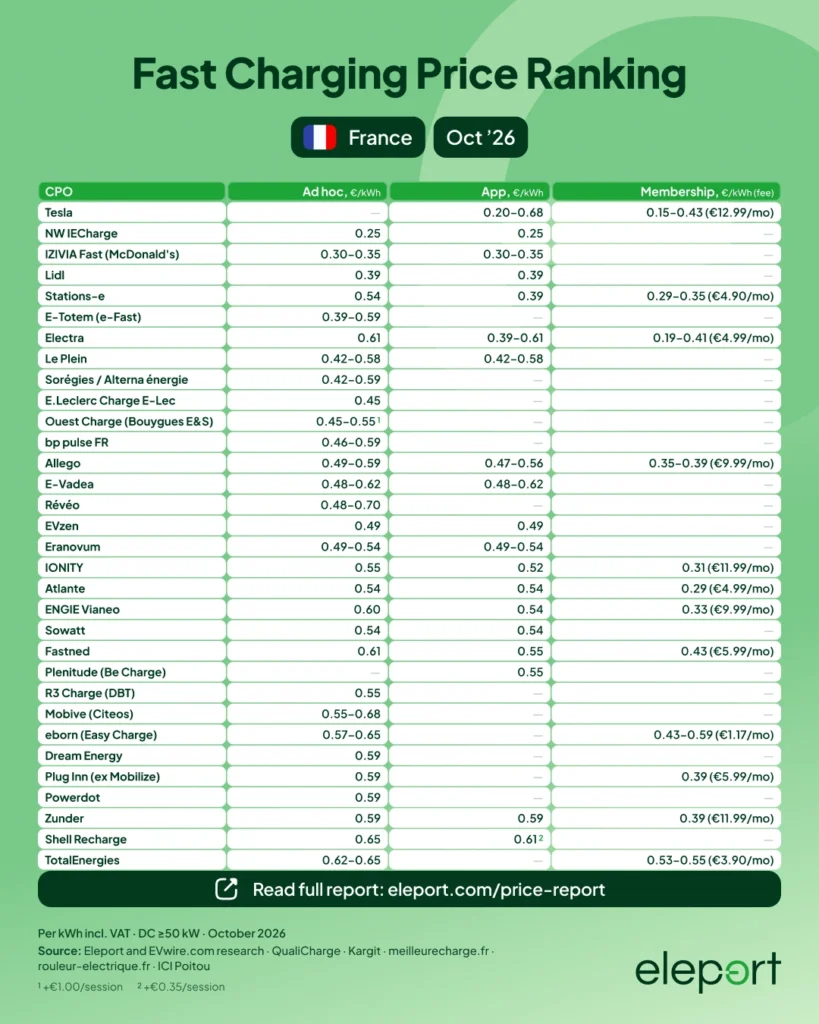
The average (median) fast charging price in France is €0.53 per kWh as of October 2026.
241 562 EVs sold in the first half of 2026, growing +62,9% year-on-year.
BEV market share jumped from 17,6% to 28,2%.
France has the second-longest leaderboard in this report after Germany, with 32 ranked operators, and the country’s pricing shares 10th–12th place with Spain and Czechia – a bit below the €0.55/kWh median of Europe!
So how much does it cost to fast charge an electric car in France? It can be as little as €0.20, and the cheap end may be the best in Europe.Tesla’s off-peak supercharger price of €0.20 is one of the lowest on the continent, NW IECharge charges a flat €0.25 by card or app across 645 DC points, and IZIVIA Fast, the network at McDonald’s restaurants, charges €0.30–0.35 across more than 3000 DC points.
Stations-e (€0.39 with its free badge or app), Lidl (€0.39 across more than 2000 DC points), E-Totem (from €0.39) and Electra (from €0.39 in its app) complete a group of seven operators that start at €0.39 or less.
The other 25 operators start between €0.42 and €0.62. TotalEnergies has the highest typical price at €0.62–0.65 by card.
The roster keeps moving. Mobilize Fast Charge has been renamed Plug Inn fast charge, bp pulse’s French network is being sold to Sorégies (Alterna énergie), and neither Carrefour nor Casino gets its own row – Carrefour’s chargers are run by Allego, Driveco and Powerdot, and Casino’s sites carry Allego’s chargers.
Source note – Kargit, meilleurecharge.fr, rouleur-electrique.fr, QualiCharge and ICI Poitou helped us with mapping out operators that don’t publish prices online.
| CPO | Ad hoc €/kWh | App €/kWh | Membership €/kWh (fee) |
| Tesla | — | 0.20–0.68 | 0.15–0.43 (€12.99/mo) |
| NW IECharge | 0.25 | 0.25 | — |
| IZIVIA Fast (McDonalds) | 0.30–0.35 | 0.30–0.35 | — |
| Lidl | 0.39 | 0.39 | — |
| Stations-e | 0.54 | 0.39 | 0.29–0.35 (€4.90/mo) |
| E-Totem (e-Fast) | 0.39–0.59 | — | — |
| Electra | 0.61 | 0.39–0.61 | 0.19–0.41 (€4.99/mo) |
| Le Plein | 0.42–0.58 | 0.42–0.58 | — |
| Sorégies / Alterna énergie | 0.42–0.59 | — | — |
| E.Leclerc Charge E-Lec | 0.45 | — | — |
| Ouest Charge (Bouygues E&S) | 0.45–0.55¹ | — | — |
| bp pulse FR | 0.46–0.59 | — | — |
| Allego | 0.49–0.59 | 0.47–0.56 | 0.35–0.39 (€9.99/mo) |
| E-Vadea | 0.48–0.62 | 0.48–0.62 | — |
| Révéo | 0.48–0.70 | — | — |
| EVzen | 0.49 | 0.49 | — |
| Eranovum | 0.49–0.54 | 0.49–0.54 | — |
| IONITY | 0.55 | 0.52 | 0.31 (€11.99/mo) |
| Atlante | 0.54 | 0.54 | 0.29 (€4.99/mo) |
| ENGIE Vianeo | 0.60 | 0.54 | 0.33 (€9.99/mo) |
| Sowatt | 0.54 | 0.54 | — |
| Fastned | 0.61 | 0.55 | 0.43 (€5.99/mo) |
| Plenitude (Be Charge) | — | 0.55 | — |
| R3 Charge (DBT) | 0.55 | — | — |
| Mobive (Citeos) | 0.55–0.68 | — | — |
| eborn (Easy Charge) | 0.57–0.65 | — | 0.43–0.59 (€1.17/mo) |
| Dream Energy | 0.59 | — | — |
| Plug Inn fast charge (ex Mobilize Fast Charge) | 0.59 | — | 0.39 (€5.99/mo) |
| Powerdot | 0.59 | — | — |
| Zunder | 0.59 | 0.59 | 0.39 (€11.99/mo) |
| Shell Recharge | 0.65 | 0.61² | — |
| TotalEnergies | 0.62–0.65 | — | 0.53–0.55 (€3.90/mo) |
Fast Charging Price Comparison in Spain for 2026
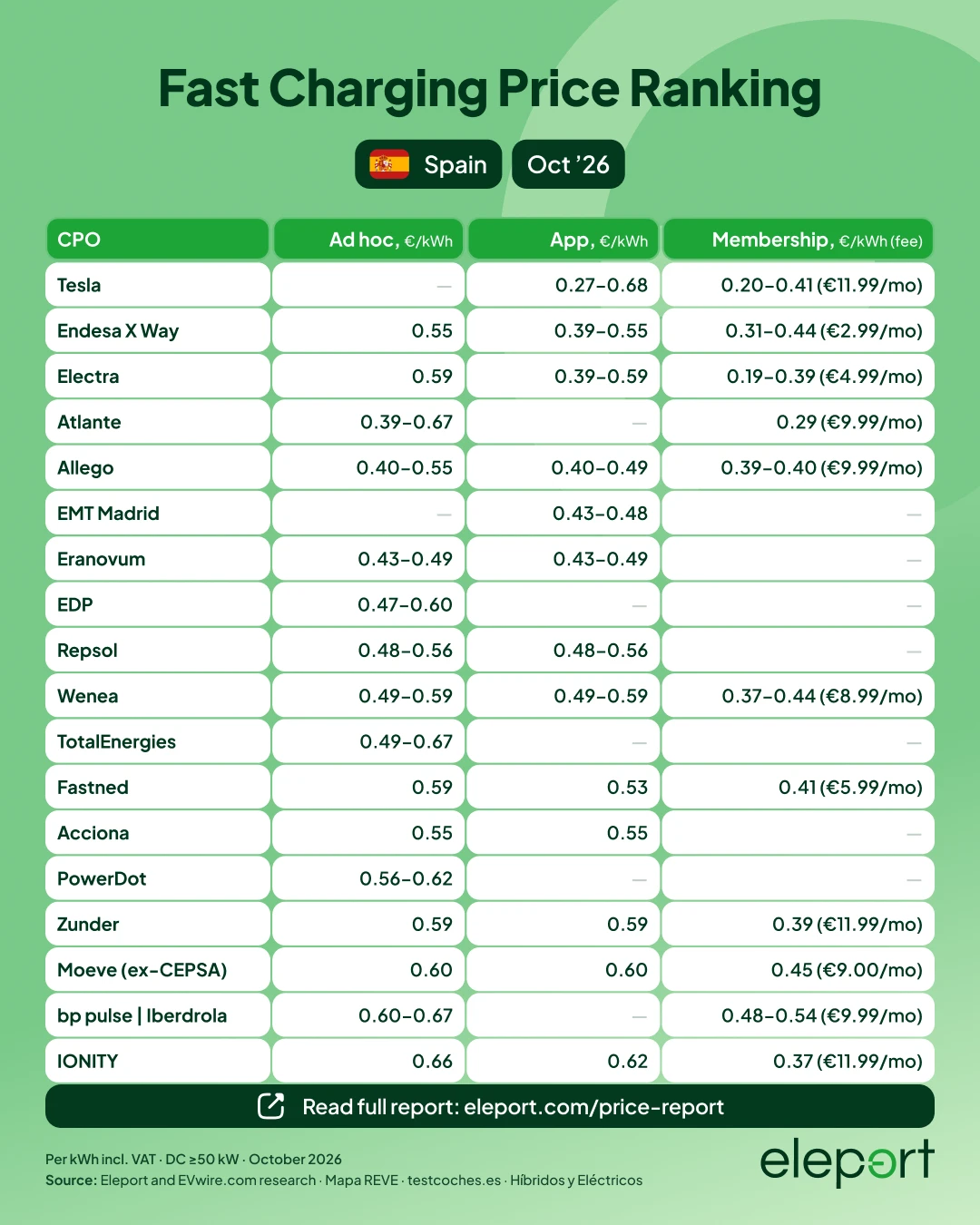
The average (median) fast charging price in Spain is €0.53 per kWh as of October 2026.
63 201 EVs were sold in the first half of 2026, growing +36,7% year-on-year. BEV market share rose from 7,6% to 9,8%.
Spain shares 10th–12th place in Europe with France and Czechia. How much does it cost to charge an electric car in Spain? Between €0.27 and €0.68 per kWh without a subscription, and less with the memberships.
The Tesla Supercharger cost opens the table at €0.27 off-peak. Endesa X Way (€0.39–0.55 in its app), Electra (from €0.39 in its app) and Atlante (from €0.39 by card) all start at €0.39, and Allego follows at €0.40–0.55. Madrid’s municipal bus company EMT runs its own fast chargers at €0.43–0.48 in a prepaid app.
Subscriptions are everywhere: 11 of the 18 ranked operators sell with one, and for regular users they lower the cost to charge electric car batteries significantly. For example, Electra’s €4.99 plan starts at €0.19 – one of the cheapest we’ve seen in all of Europe.
At the top, bp pulse | Iberdrola joint venture charges €0.60–0.67, the highest typical price in Spain, and IONITY’s €0.62 app price has the highest starting point.
Source note – some ad hoc prices come from the official Mapa REVE register. Testcoches.es helped with Endesa X Way pricing.
| CPO | Ad hoc €/kWh | App €/kWh | Membership €/kWh (fee) |
| Tesla | — | 0.27–0.68 | 0.20–0.41 (€11.99/mo) |
| Endesa X Way | 0.55 | 0.39–0.55 | 0.31–0.44 (€2.99/mo) |
| Electra | 0.59 | 0.39–0.59 | 0.19–0.39 (€4.99/mo) |
| Atlante | 0.39–0.67 | — | 0.29 (€9.99/mo) |
| Allego | 0.40–0.55 | 0.40–0.49 | 0.39–0.40 (€9.99/mo) |
| EMT Madrid | — | 0.43–0.48 | — |
| Eranovum | 0.43–0.49 | 0.43–0.49 | — |
| EDP | 0.47–0.60 | — | — |
| Repsol | 0.48–0.56 | 0.48–0.56 | — |
| Wenea | 0.49–0.59 | 0.49–0.59 | 0.37–0.44 (€8.99/mo) |
| TotalEnergies | 0.49–0.67 | — | — |
| Fastned | 0.59 | 0.53 | 0.41 (€5.99/mo) |
| Acciona | 0.55 | 0.55 | — |
| PowerDot | 0.56–0.62 | — | — |
| Zunder | 0.59 | 0.59 | 0.39 (€11.99/mo) |
| Moeve (ex-CEPSA) | 0.60 | 0.60 | 0.45 (€9/mo) |
| bp pulse | Iberdrola | 0.60–0.67 | — | 0.48–0.54 (€9.99/mo) |
| IONITY | 0.66 | 0.62 | 0.37 (€11.99/mo) |
Fast Charging Price Comparison in Czechia for 2026
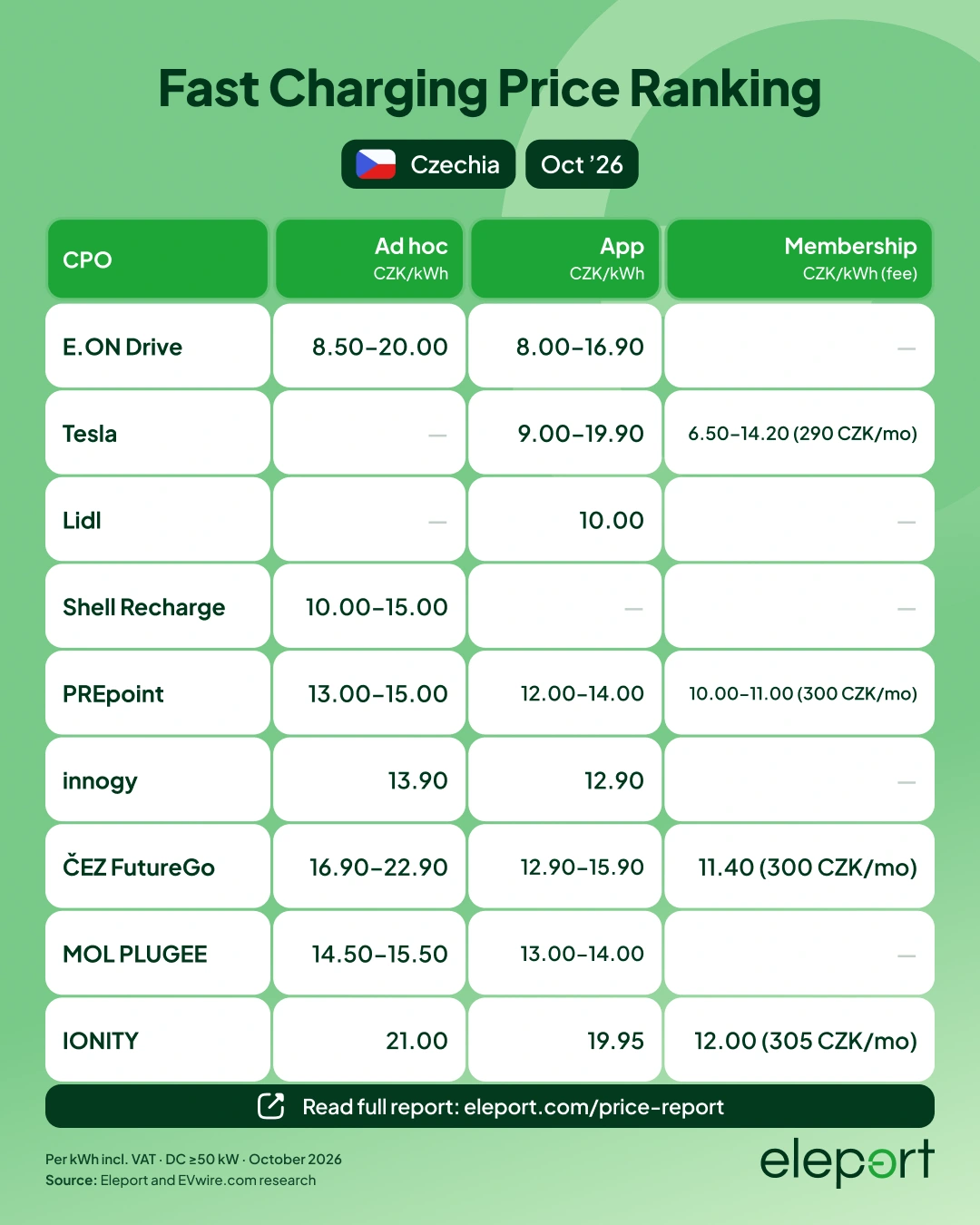
The average (median) fast charging price in Czechia is 13.00 CZK (€0.53) per kWh.
8630 EVs were sold in the first half of 2026, growing +24,9% year-on-year.
BEV market share rose from 5,6% to 6,6%.
Czechia also sits in 10th–12th place, and it is one of the few countries where Tesla isn’t the cheapest to start out with… but it comes as a close second.
That title goes to E.ON Drive, whose night price in its lowest power group starts at 8.00 CZK (€0.33) for registered users. Tesla, with all 12 Czech sites open to every EV, has a supercharger price from 9.00 CZK. Lidl (10.00 CZK in Lidl Plus) and Shell Recharge (10.00–15.00 CZK) follow.
The incumbents keep the middle steady. PREpoint charges 12–14 CZK in its free tier, prices it says have not changed in over two years, and ČEZ FutureGo, the largest network with 1594 DC points, charges 12.90–15.90 CZK after a free registration.
If you pay ČEZ by card without registering, though, the price jumps to 16.90–22.90 CZK, 31% to 44% more.
IONITY is the most expensive in Czechia, starting at 19.95 CZK (€0.82) in its app, one of its highest prices anywhere in Europe.
| CPO | Ad hoc CZK/kWh | App CZK/kWh | Membership CZK/kWh (fee) |
| E.ON Drive | 8.50–20.00 | 8.00–16.90 | — |
| Tesla | — | 9.00–19.90 | 6.50–14.20 (290 CZK/mo) |
| Lidl | — | 10.00 | — |
| Shell Recharge | 10.00–15.00 | — | — |
| PREpoint | 13.00–15.00 | 12.00–14.00 | 10.00–11.00 (300 CZK/mo) |
| innogy | 13.90 | 12.90 | — |
| ČEZ FutureGo | 16.90–22.90 | 12.90–15.90 | 11.40 (300 CZK/mo) |
| MOL PLUGEE | 14.50–15.50 | 13.00–14.00 | — |
| IONITY | 21.00 | 19.95 | 12.00 (305 CZK/mo) |
Fast Charging Price Comparison in Slovakia for 2026
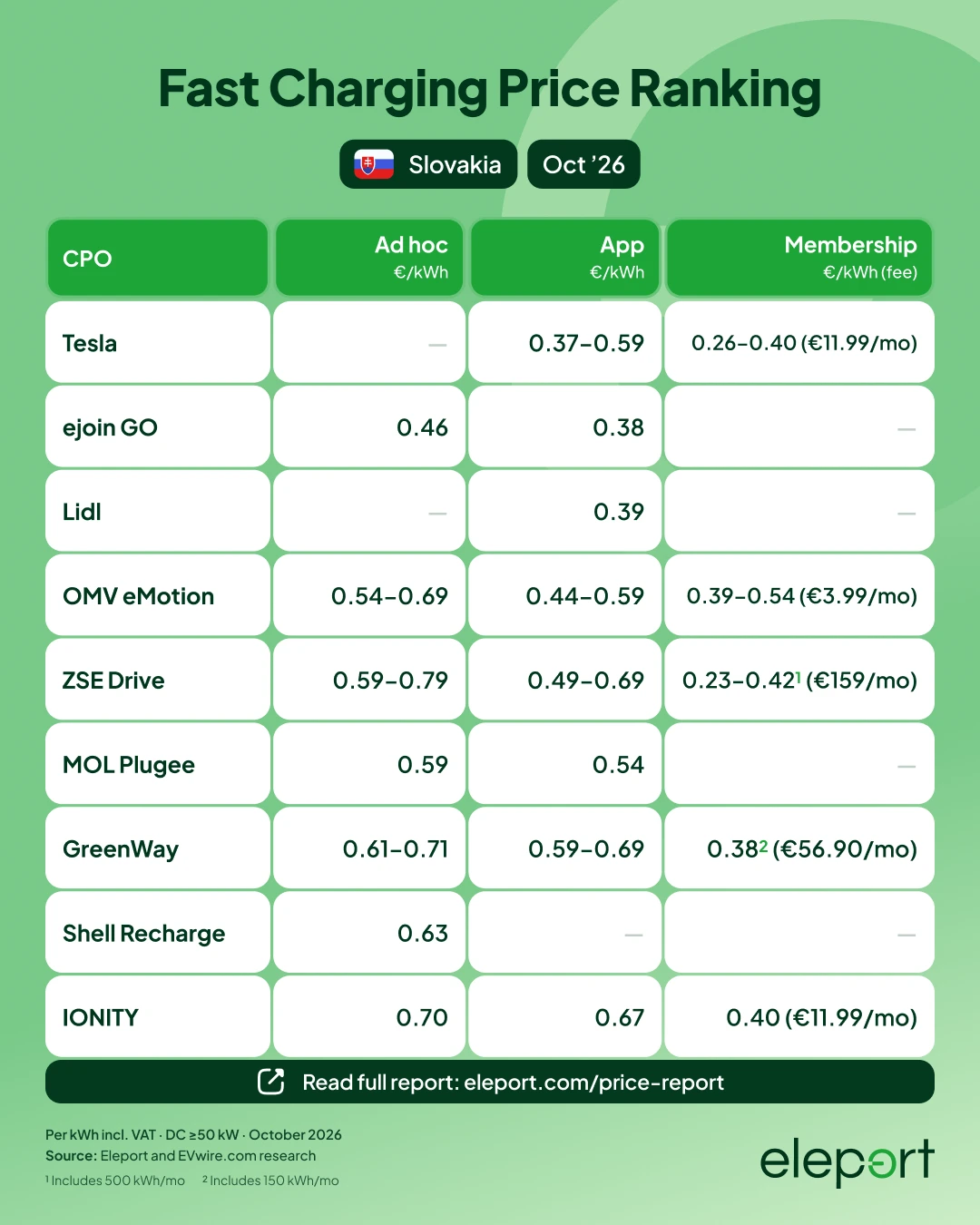
The average (median) fast charging price in Slovakia is €0.54 per kWh.
2678 EVs sold in the first half of 2026, growing +33,4% year-on-year.
BEV market share rose from 4,4% to 6,2%.
At €0.54, Slovakia sits just under the European middle, in 13th place.
Tesla’s six Slovak sites are all open to other EVs, and Tesla charging cost there starts at €0.37, or 0.26€/kWh with membership, for off-peak prices. The peak prices can however go up to 0.59 per kWh. The local player that is on the way of becoming one of the largest in the country, ejoin GO, charges €0.38 in its app (€0.46 by card) regardless of power at its own sites, and Lidl charges €0.39 in Lidl Plus.
The fuel and utility brands come next at around the average price, and then GreenWay (€0.59–0.69 after free registration) and Shell Recharge (€0.63 at all 16 sites, card only) are pricier, together with IONITY topping the list off.
Memberships are a big part of the Slovak market, and for frequent users they can cut the cost to charge electric car models considerably. OMV eMotion, ZSE Drive and GreenWay all sell plans, from €2.99 a month, with GreenWay’s top tier including 150 kWh a month and ZSE Drive’s PRO SAFE 500 kWh.
| CPO | Ad hoc €/kWh | App €/kWh | Membership €/kWh (fee) |
| Tesla | — | 0.37–0.59 | 0.26–0.40 (€11.99/mo) |
| ejoin GO | 0.46 | 0.38 | — |
| Lidl | — | 0.39 | — |
| OMV eMotion | 0.54–0.69 | 0.44–0.59 | 0.39–0.54 (€3.99/mo) |
| ZSE Drive | 0.59–0.79 | 0.49–0.69 | 0.23–0.42¹ (€159/mo) |
| MOL Plugee | 0.59 | 0.54 | — |
| GreenWay | 0.61–0.71 | 0.59–0.69 | 0.38² (€56.90/mo) |
| Shell Recharge | 0.63 | — | — |
| IONITY | 0.70 | 0.67 | 0.40 (€11.99/mo) |
Fast Charging Price Comparison in Slovenia for 2026
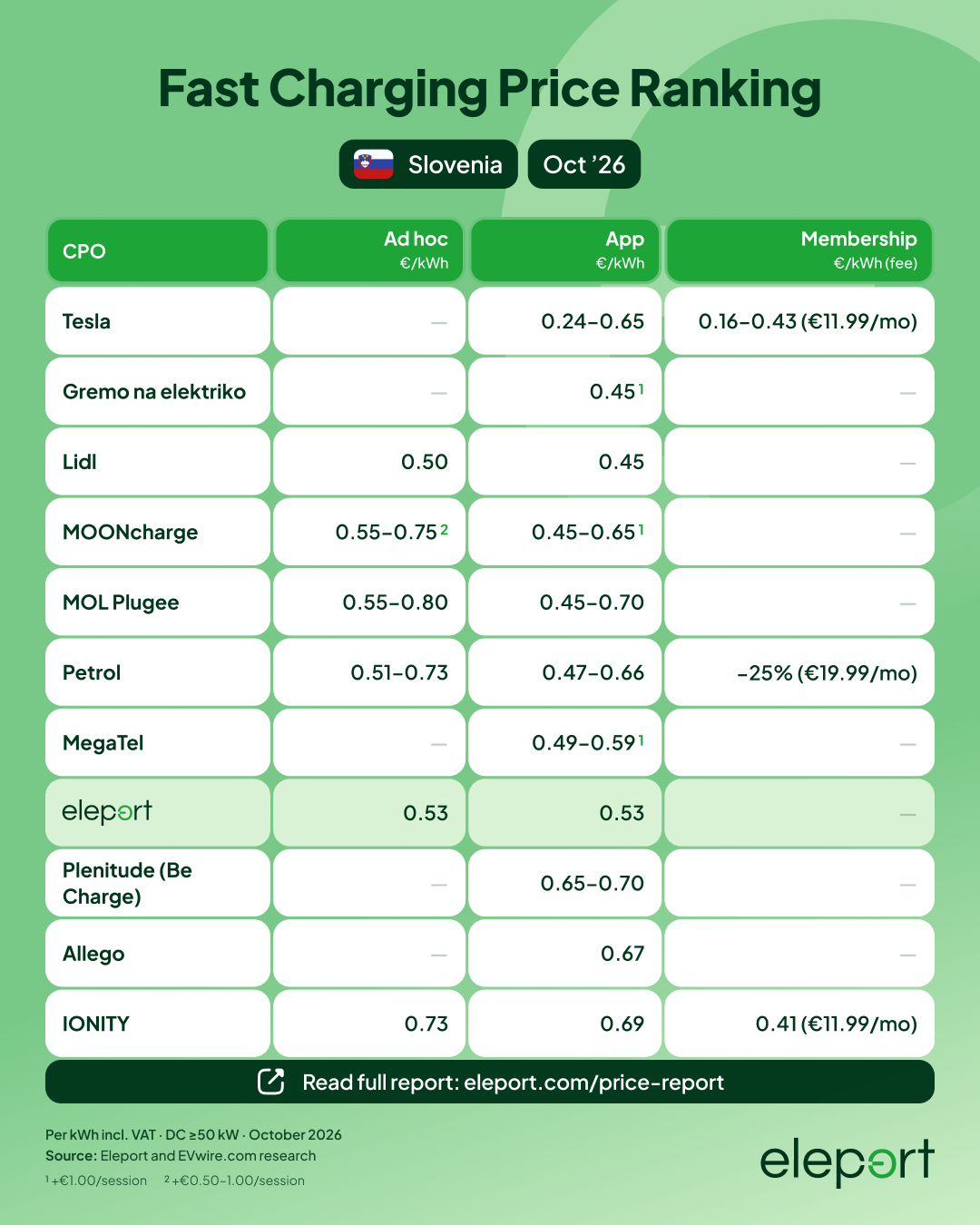
The average (median) fast charging price in Slovenia is €0.55 per kWh.
6062 EVs sold in the first half of 2026, growing +124,5% year-on-year.
BEV market share climbed from 9,0% to 16,5%.
EV sales in Slovenia more than doubled in the first half of the year, and its fast charging median puts it 14th–15th in Europe, level with Croatia, sitting at the €0.55/kWh median for all European countries.
Tesla’s off-peak supercharger price of €0.24 is the cheapest start, at five of its eight sites open to all EVs. With the membership, it can even go as low as 0.16€/kWh. Here, the jump from first place to second is significant: four operators then start at €0.45: Gremo na elektriko, Lidl, MOONcharge and MOL Plugee.
Slovenia’s speciality is the session fee. Gremo na elektriko, MOONcharge and MegaTel all add €1.00 per DC session, so their per-kWh prices look better on paper than on a short top-up, and deciding how much to charge an electric car at each stop changes what you pay.
Eleport charges a flat €0.53 in Slovenia, two cents below the national median, with no session fee and the same price for card and app.
Allego’s regular €0.67 drops to €0.47 at HOFER sites under a promotion “until revoked”, and IONITY app price is the most expensive at €0.69, but drops to lower than everyone except Tesla when using the membership.
Sourcing note – we couldn’t find published prices for EV polnilnice or VOLTRIS through our research yet.
| CPO | Ad hoc €/kWh | App €/kWh | Membership €/kWh (fee) |
| Tesla | — | 0.24–0.65 | 0.16–0.43 (€11.99/mo) |
| Gremo na elektriko | — | 0.45¹ | — |
| Lidl | 0.50 | 0.45 | — |
| MOONcharge | 0.55–0.75² | 0.45–0.65¹ | — |
| MOL Plugee | 0.55–0.80 | 0.45–0.70 | — |
| Petrol | 0.51–0.73 | 0.47–0.66 | −25% (€19.99/mo) |
| MegaTel | — | 0.49–0.59¹ | — |
| Eleport | 0.53 | 0.53 | — |
| Plenitude (Be Charge) | — | 0.65–0.70 | — |
| Allego | — | 0.67 | — |
| IONITY | 0.73 | 0.69 | 0.41 (€11.99/mo) |
Fast Charging Price Comparison in Greece for 2026
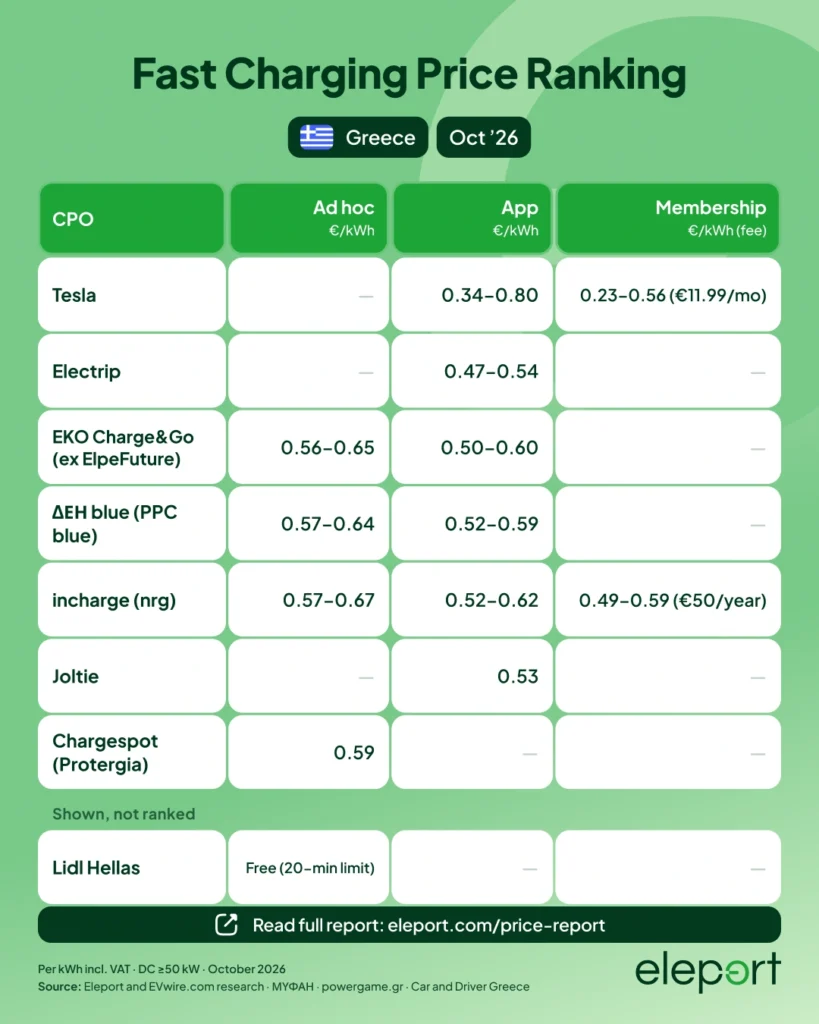
The average (median) fast charging price in Greece is €0.56 per kWh.
5284 EVs sold in the first half of 2026, growing +23,9% year-on-year.
BEV market share rose from 5,5% to 6,3%.
Greece sits a cent above the European middle and shares 16th–17th place with Norway.
The Tesla Supercharger cost starts at €0.34 off-peak at four of its eight Greek sites open to all EVs. The local networks are bunched together: Electrip at €0.47–0.54 in its free app, EKO Charge&Go at €0.50–0.60, PPC blue at €0.52–0.59, incharge (nrg) at €0.52–0.62 and Joltie at €0.53.
PPC blue is cheaper on the islands with a lower 4% VAT rate, while incharge adds €0.10 per kWh at motorway sites. Chargespot (Protergia) has the highest price, €0.59 by card.
Then there’s Lidl, which takes the cost of charging electric car batteries down to zero in specific conditions: its Greek chargers are free for shoppers for up to 20 minutes (previously was free for one hour, then 30 minutes, and now 20), so Lidl Hellas is shown under the table without a rank. As far as we understand, you’d need to restart the charging process after 20 minutes to continue charging (again, for free).
Source notes – some ad hoc prices come from the official ΜΥΦΑΗ register. powergame.gr and Car and Driver Greece helped with Joltie and Lidl.
| CPO | Ad hoc €/kWh | App €/kWh | Membership €/kWh (fee) |
| Tesla | — | 0.34–0.80 | 0.23–0.56 (€11.99/mo) |
| Electrip | — | 0.47–0.54 | — |
| EKO Charge&Go (ex ElpeFuture) | 0.56–0.65 | 0.50–0.60 | — |
| ΔΕΗ blue (PPC blue) | 0.57–0.64 | 0.52–0.59 | — |
| incharge (nrg) | 0.57–0.67 | 0.52–0.62 | 0.49–0.59 (€50/year) |
| Joltie | — | 0.53 | — |
| Chargespot (Protergia) | 0.59 | — | — |
| Shown, not ranked | |||
| Lidl Hellas | Free (20-min limit) | — | — |
Fast Charging Price Comparison in Croatia for 2026
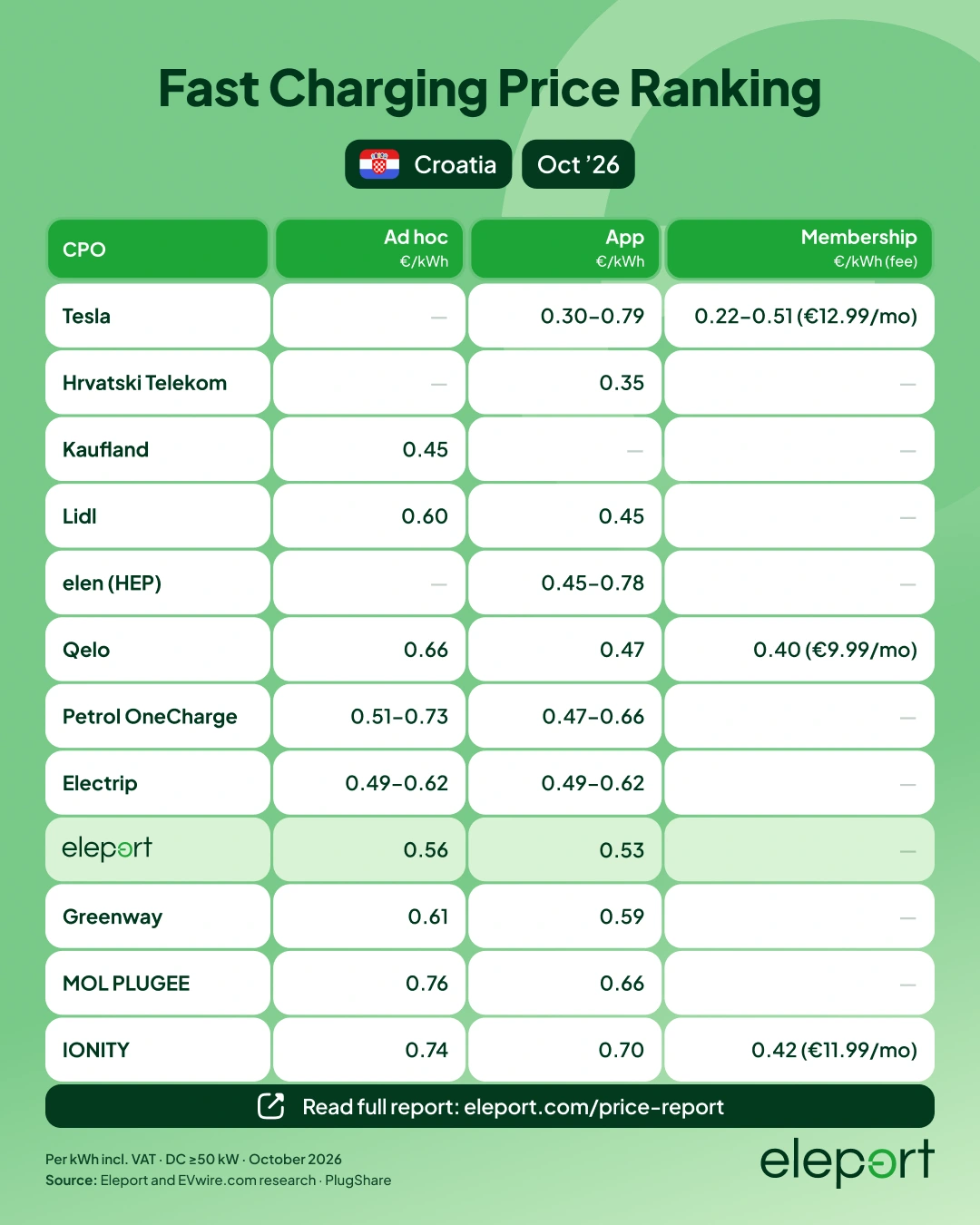
The average (median) fast charging price in Croatia is €0.55 per kWh.
1781 EVs sold in the first half of 2026, growing +349,7% year-on-year.
BEV market share jumped from 0,9% to 4,0%.
Croatia had the biggest EV sales jump in Europe in the first half of 2026, albeit from a very low base, and its fast charging median of €0.55 shares 14th–15th place with Slovenia.
Tesla charging cost starts at €0.30 off-peak at the 13 of its 17 Croatian sites open to all EVs. The supermarket car parks follow: Hrvatski Telekom’s chargers at least in the five Tommy stores charge €0.35 in its app, Lidl at €0.45 in Lidl Plus (€0.60 without the app) and Kaufland at €0.45 too.
HEP’s elen network is app-only, with prices from €0.45 off the motorway up to €0.78 on it, the latter becoming the highest cost to charge electric car batteries of any Croatian network. Qelo, Petrol and Electrip all start in the high €0.40s.
Eleport charges €0.53 with the Eleport app or card at every Croatian site (€0.56 by bank card), which puts it two cents below the national median per kWh. GreenWay, MOL Plugee and IONITY (€0.70 in its app) are on the other side of that median price.
| CPO | Ad hoc €/kWh | App €/kWh | Membership €/kWh (fee) |
| Tesla | — | 0.30–0.79 | 0.22–0.51 (€12.99/mo) |
| Hrvatski Telekom | — | 0.35 | — |
| Kaufland | 0.45 | — | — |
| Lidl | 0.60 | 0.45 | — |
| elen (HEP) | — | 0.45–0.78 | — |
| Qelo | 0.66 | 0.47 | 0.40 (€9.99/mo) |
| Petrol OneCharge | 0.51–0.73 | 0.47–0.66 | — |
| Electrip | 0.49–0.62 | 0.49–0.62 | — |
| Eleport | 0.56 | 0.53 | — |
| Greenway | 0.61 | 0.59 | — |
| MOL PLUGEE | 0.76 | 0.66 | — |
| IONITY | 0.74 | 0.70 | 0.42 (€11.99/mo) |
Fast Charging Price Comparison in Norway for 2026
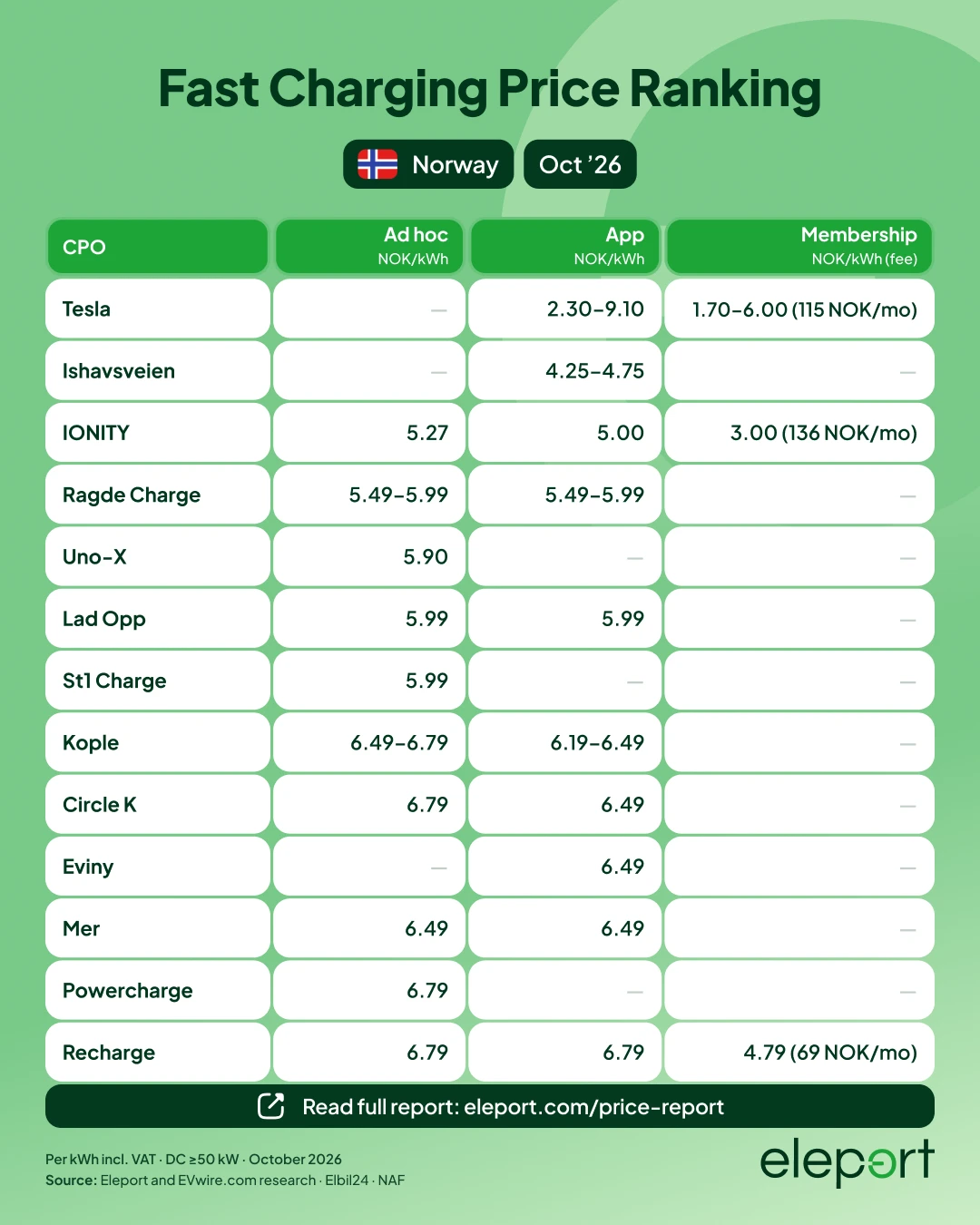
The average (median) fast charging price in Norway is 5.99 NOK (€0.56) per kWh.
71 662 EVs were sold in the first half of 2026, growing +1,3% year-on-year.
BEV market share rose from 93,0% to 97,6%.
The world’s most electric car market is in the middle of the European price table, in 16th–17th place.
Tesla is, interestingly, marking both ends of the Norwegian market. Its off-peak supercharger price of 2.30 NOK (€0.22) is the cheapest in the country, and the peak Tesla Supercharger cost of 9.10 NOK (€0.85) the highest. Ishavsveien comes next-cheapest at 4.25–4.75 NOK in the Kople app.
Norway is one of only four countries where IONITY beats the national median, at 5.00 NOK in its app.
The big networks sit close together: Uno-X at 5.90 NOK, St1 and Lad Opp at 5.99 NOK, Mer at 6.49 NOK at every one of its 244 Norwegian DC sites, Eviny at 6.49 NOK and Circle K at 6.49 NOK in its app. Recharge and Powercharge, at 6.79 NOK, are the most expensive, although Recharges membership at 69 NOK/mo lifts it all the way up to third place if one becomes a member.
There is some consolidation happening here, too. Uno-X took over the Norwegian E.ON Drive & Clever chargers on 1 September 2026, and Mer’s planned merger with Eviny’s fast charging business is still with the competition authority.
Sourcing note – the Elbil24 and NAF price overviews helped us with St1 and Uno-X, and William from RoamingNorway helped us validate some pricing.
| CPO | Ad hoc NOK/kWh | App NOK/kWh | Membership NOK/kWh (fee) |
| Tesla | — | 2.30–9.10 | 1.70–6.00 (115 NOK/mo) |
| Ishavsveien | — | 4.25–4.75 | — |
| IONITY | 5.27 | 5.00 | 3.00 (136 NOK/mo) |
| Ragde Charge | 5.49–5.99 | 5.49–5.99 | — |
| Uno-X | 5.90 | — | — |
| Lad Opp | 5.99 | 5.99 | — |
| St1 Charge | 5.99 | — | — |
| Kople | 6.49–6.79 | 6.19–6.49 | — |
| Circle K | 6.79 | 6.49 | — |
| Eviny | — | 6.49 | — |
| Mer | 6.49 | 6.49 | — |
| Powercharge | 6.79 | — | — |
| Recharge | 6.79 | 6.79 | 4.79 (69 NOK/mo) |
Fast Charging Price Comparison in Poland for 2026
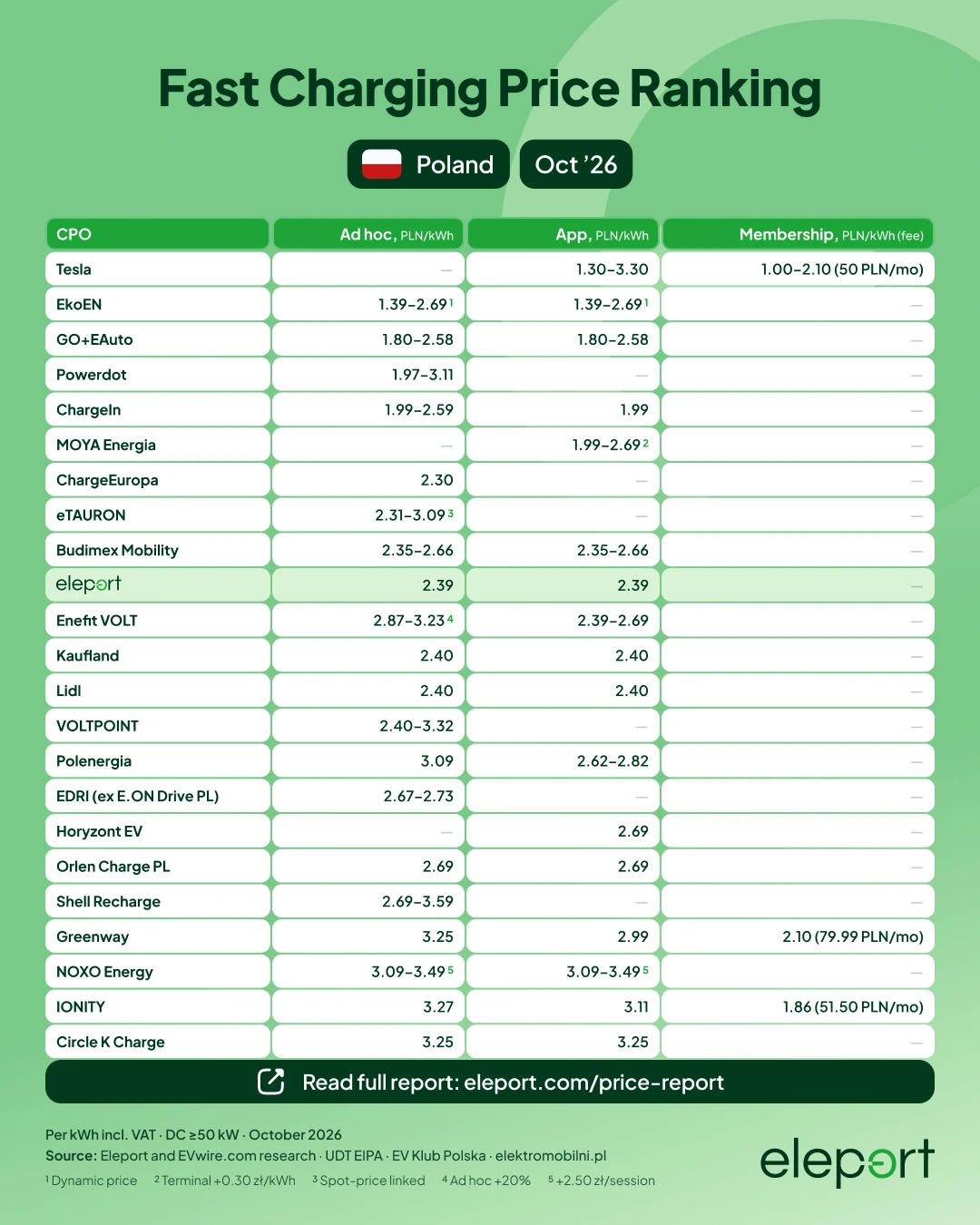
The average (median) fast charging price in Poland is 2.54 PLN (€0.58) per kWh.
16 479 EVs sold in the first half of 2026, growing +15,6% year-on-year.
BEV market share edged up from 5,0% to 5,3%.
Poland is 18th in Europe in terms of fast charging prices on average, and its leaderboard is one of our longest, with 23 ranked operators. How much does it cost to charge an electric car in Poland? From 1.30 PLN (€0.30) off-peak to 3.59 PLN (€0.82) by card at some Shell sites.
Tesla charging cost starts lowest, at 1.30 PLN (€0.30), at the 20 of its 29 sites open to all EVs. EkoEN prices dynamically by time of day, load and occupancy, from 1.39 to 2.69 PLN, and somewhat similarly at slightly higher, eTAURON follows the day-ahead electricity market at 2.31–3.09 PLN. There are 6 operators that fall under the 2 PLN per kWh (0.46€/kWh) range.
A big block sits around 2.40 PLN. Eleport charges 2.39 PLN (€0.55), tenth of 23 and below the national median, with one price whether you pay by card or app. Lidl and Kaufland charge 2.40 PLN, and Enefit 2.39–2.69 PLN in its app (it adds 20% for ad hoc payment).
If charging in Poland, watch out for terminal surcharges, which push up the cost of charging electric car batteries without an app: MOYA Energia adds 0.30 PLN per kWh if you pay at the terminal. NOXO Energy adds a 2.50 zł start fee to its 3.09–3.49 PLN, the latter part of the range already being the highest priced charging in Poland.
GreenWay remains the largest network, with 1416 DC points, at 2.99 PLN in its free tier and 2.10 at the paid membership. E.ON Drive’s Polish chargers now run under the EDRI name.
Some prices come from the official EIPA register (UDT). The EV Klub Polska and elektromobilni.pl rankings also helped us with some of the pricing.
| CPO | Ad hoc PLN/kWh | App PLN/kWh | Membership PLN/kWh (fee) |
| Tesla | — | 1.30–3.30 | 1.00–2.10 (50 PLN/mo) |
| EkoEN | 1.39–2.69¹ | 1.39–2.69¹ | — |
| GO+EAuto | 1.80–2.58 | 1.80–2.58 | — |
| Powerdot | 1.97–3.11 | — | — |
| ChargeIn | 1.99–2.59 | 1.99 | — |
| MOYA Energia | — | 1.99–2.69² | — |
| ChargeEuropa | 2.30 | — | — |
| eTAURON | 2.31–3.09³ | — | — |
| Budimex Mobility | 2.35–2.66 | 2.35–2.66 | — |
| Eleport | 2.39 | 2.39 | — |
| Enefit VOLT | 2.87–3.23⁴ | 2.39–2.69 | — |
| Kaufland | 2.40 | 2.40 | — |
| Lidl | 2.40 | 2.40 | — |
| VOLTPOINT | 2.40–3.32 | — | — |
| Polenergia | 3.09 | 2.62–2.82 | — |
| EDRI (ex E.ON Drive PL) | 2.67–2.73 | — | — |
| Horyzont EV | — | 2.69 | — |
| Orlen Charge PL | 2.69 | 2.69 | — |
| Shell Recharge | 2.69–3.59 | — | — |
| Greenway | 3.25 | 2.99 | 2.10 (79.99 PLN/mo) |
| NOXO Energy | 3.09–3.49⁵ | 3.09–3.49⁵ | — |
| IONITY | 3.27 | 3.11 | 1.86 (51.50 PLN/mo) |
| Circle K Charge | 3.25 | 3.25 | — |
Join our newsletter
No fluff, no spam.
Fast Charging Price Comparison in Germany for 2026
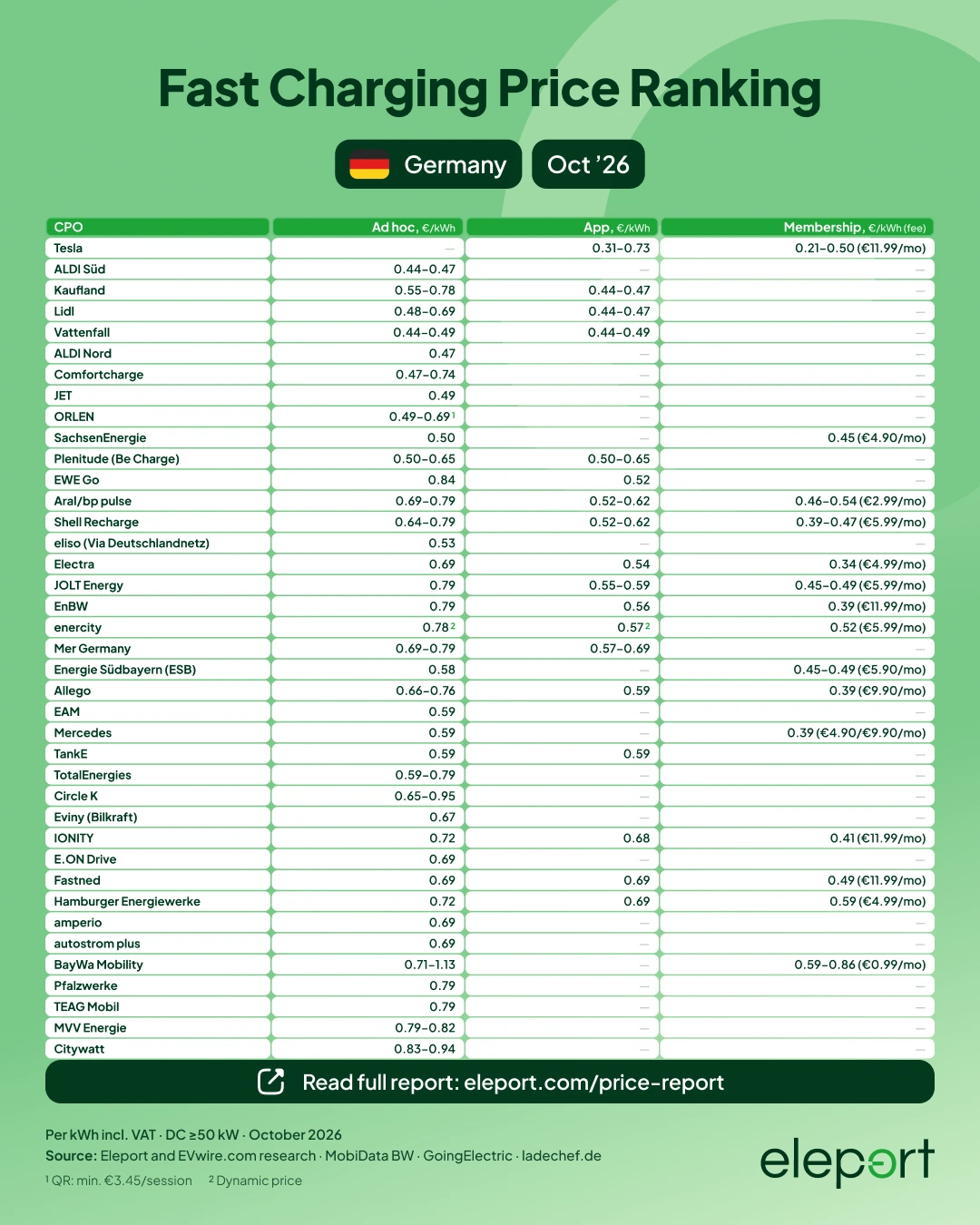
The average (median) fast charging price in Germany is €0.59 per kWh, compared to the European average of 0.55€/kWh.
368 006 EVs sold in the first half of 2026, growing +48,0% year-on-year.
BEV market share climbed significantly from 17,7% to 24,8%.
Europe’s largest (electric) car market has the most operators in this report, 39 ranked, and sits 19th in all of Europe. So how much does it cost to charge an electric car in Germany? Anywhere from €0.31 off-peak to €1.13 by card at the most expensive sites.
Tesla’s supercharger price starts lowest again, at €0.31 off-peak yet can go up to 0.73€ at the top. Then comes the retail floor: Lidl and Kaufland at €0.44–0.47 in their apps, ALDI Süd at €0.44–0.47 by card without any registration, and Vattenfall at €0.44–0.49 for every payment method. ALDI Nord also charges €0.47 per kWh.
Germany is still the clearest example of the card penalty on the cost of charging electric car batteries. EnBW, the largest network in our German data with 9275 DC points, charges €0.56 in its app, but €0.79 by card. EnBW, JOLT, TEAG and Pfalzwerke all charge exactly €0.79 ad hoc, and Shell, Aral pulse, TotalEnergies and Mer top out there.
At the expensive end, BayWa Mobility’s card prices vary by site from €0.71 to €1.13, the highest typical price in Germany, and Citywatt charges €0.83–0.94. ORLEN’s QR payment carries a €3.45 minimum per session.
Fastned and IONITY are situated at the more expensive side, even though they are, with Tesla and EnBW, the most used charging points in Germany on average in Q3.
Sourcing notes – some ad hoc prices come from the operators’ official AFIR data (MobiData BW). GoingElectric and ladechef.de helped map out several of the CPOs.
| CPO | Ad hoc €/kWh | App €/kWh | Membership €/kWh (fee) |
| Tesla | — | 0.31–0.73 | 0.21–0.50 (€11.99/mo) |
| ALDI Süd | 0.44–0.47 | — | — |
| Kaufland | 0.55–0.78 | 0.44–0.47 | — |
| Lidl | 0.48–0.69 | 0.44–0.47 | — |
| Vattenfall | 0.44–0.49 | 0.44–0.49 | — |
| ALDI Nord | 0.47 | — | — |
| Comfortcharge | 0.47–0.74 | — | — |
| JET | 0.49 | — | — |
| ORLEN | 0.49–0.69¹ | — | — |
| SachsenEnergie | 0.50 | — | 0.45 (€4.90/mo) |
| Plenitude (Be Charge) | 0.50–0.65 | 0.50–0.65 | — |
| EWE Go | 0.84 | 0.52 | — |
| Aral/bp pulse | 0.69–0.79 | 0.52–0.62 | 0.46–0.54 (€2.99/mo) |
| Shell Recharge | 0.64–0.79 | 0.52–0.62 | 0.39–0.47 (€5.99/mo) |
| eliso (Via Deutschlandnetz) | 0.53 | — | — |
| Electra | 0.69 | 0.54 | 0.34 (€4.99/mo) |
| JOLT Energy | 0.79 | 0.55–0.59 | 0.45–0.49 (€5.99/mo) |
| EnBW | 0.79 | 0.56 | 0.39 (€11.99/mo) |
| enercity | 0.78² | 0.57² | 0.52 (€5.99/mo) |
| Mer Germany | 0.69–0.79 | 0.57–0.69 | — |
| Energie Südbayern (ESB) | 0.58 | — | 0.45–0.49 (€5.90/mo) |
| Allego | 0.66–0.76 | 0.59 | 0.39 (€9.99/mo) |
| EAM | 0.59 | — | — |
| Mercedes | 0.59 | — | 0.39 (€4.90/mo) |
| TankE | 0.59 | 0.59 | — |
| TotalEnergies | 0.59–0.79 | — | — |
| Circle K | 0.65–0.95 | — | — |
| Eviny (Bilkraft) | 0.67 | — | — |
| IONITY | 0.72 | 0.68 | 0.41 (€11.99/mo) |
| E.ON Drive | 0.69 | — | — |
| Fastned | 0.69 | 0.69 | 0.49 (€11.99/mo) |
| Hamburger Energiewerke | 0.72 | 0.69 | 0.59 (€4.99/mo) |
| amperio | 0.69 | — | — |
| autostrom plus | 0.69 | — | — |
| BayWa Mobility | 0.71–1.13 | — | 0.59–0.86 (€0.99/mo) |
| Pfalzwerke | 0.79 | — | — |
| TEAG Mobil | 0.79 | — | — |
| MVV Energie | 0.79–0.82 | — | — |
| Citywatt | 0.83–0.94 | — | — |
Fast Charging Price Comparison in Austria
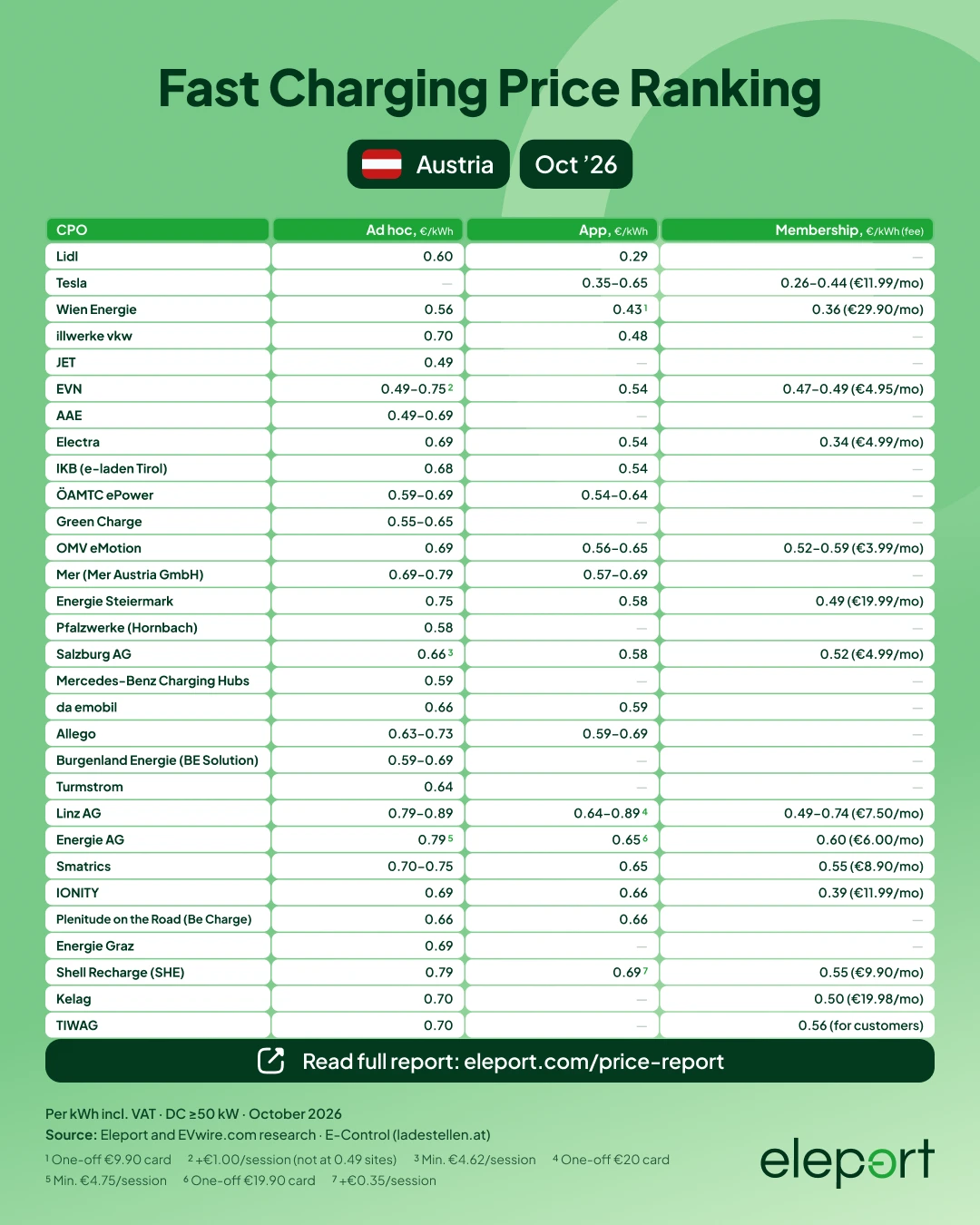
The average (median) fast charging price in Austria is €0.60 per kWh as of October 2026.
40 060 EVs sold in the first half of 2026, growing +27,0% year-on-year.
BEV market share rose from 22,0% to 24,3%.
We have ranked 30 charging operator prices for Austria, and the median fast charging price in the country sits 0.05€/kWh above the European average.
Lidl starts lowest of all in Austria, from €0.29 per kWh in the Lidl Plus app, against €0.60 if you pay by card. That’s the widest app-versus-card gap we found anywhere across Europe. The Tesla Supercharger cost follows at €0.35–0.65 with its free app.
Wien Energie charges €0.43 with its charging card (a one-off €9.90), and illwerke vkw charges €0.48 in its app, though only to customers in its Vorarlberg and Allgäu supply area.
Austria is the home of regional utilities, and many of them add to the cost to charge electric car batteries with card or session fees: Linz AG asks a one-off €20 for a card, Energie AG €19.90, while Salzburg AG and Energie AG set minimum charges of €4.62 and €4.75 per ad hoc session. That makes the EV charging cost of a short top-up higher than the per-kWh price suggests, so deciding how much to charge an electric car in one session matters.
Linz AG (€0.64–0.89 in its app) has the highest typical price on the top of its price range, while Kelag and TIWAG, at €0.70 with no free app tier, have the highest starting price.
Source notes – where an operator’s own page shows no ad hoc price, we brought it in from E-Control’s official register of charging points (ladestellen.at).
| CPO | Ad hoc €/kWh | App €/kWh | Membership €/kWh (fee) |
| Lidl | 0.60 | 0.29 | — |
| Tesla | — | 0.35–0.65 | 0.26–0.44 (€11.99/mo) |
| Wien Energie | 0.56 | 0.43¹ | 0.36 (€29.90/mo) |
| illwerke vkw | 0.70 | 0.48 | — |
| JET | 0.49 | — | — |
| EVN | 0.49–0.75² | 0.54 | 0.47–0.49 (€4.95/mo) |
| AAE | 0.49–0.69 | — | — |
| Electra | 0.69 | 0.54 | 0.34 (€4.99/mo) |
| IKB (e-laden Tirol) | 0.68 | 0.54 | — |
| ÖAMTC ePower | 0.59–0.69 | 0.54–0.64 | — |
| Green Charge | 0.55–0.65 | — | — |
| OMV eMotion | 0.69 | 0.56–0.65 | 0.52–0.59 (€3.99/mo) |
| Mer (Mer Austria GmbH) | 0.69–0.79 | 0.57–0.69 | — |
| Energie Steiermark | 0.75 | 0.58 | 0.49 (€19.99/mo) |
| Pfalzwerke (Hornbach) | 0.58 | — | — |
| Salzburg AG | 0.66³ | 0.58 | 0.52 (€4.99/mo) |
| Mercedes-Benz Charging Hubs | 0.59 | — | — |
| da emobil | 0.66 | 0.59 | — |
| Allego | 0.63–0.73 | 0.59–0.69 | — |
| Burgenland Energie (BE Solution) | 0.59–0.69 | — | — |
| Turmstrom | 0.64 | — | — |
| Linz AG | 0.79–0.89 | 0.64–0.89⁴ | 0.49–0.74 (€7.50/mo) |
| Energie AG | 0.79⁵ | 0.65⁶ | 0.60 (€6.00/mo) |
| Smatrics | 0.70–0.75 | 0.65 | 0.55 (€8.90/mo) |
| IONITY | 0.69 | 0.66 | 0.39 (€11.99/mo) |
| Plenitude on the Road (Be Charge) | 0.66 | 0.66 | — |
| Energie Graz | 0.69 | — | — |
| Shell Recharge (SHE) | 0.79 | 0.69⁷ | 0.55 (€9.90/mo) |
| Kelag | 0.70 | — | 0.50 (€19.98/mo) |
| TIWAG | 0.70 | — | 0.56 (for customers) |
Fast Charging Price Comparison in Luxembourg for 2026
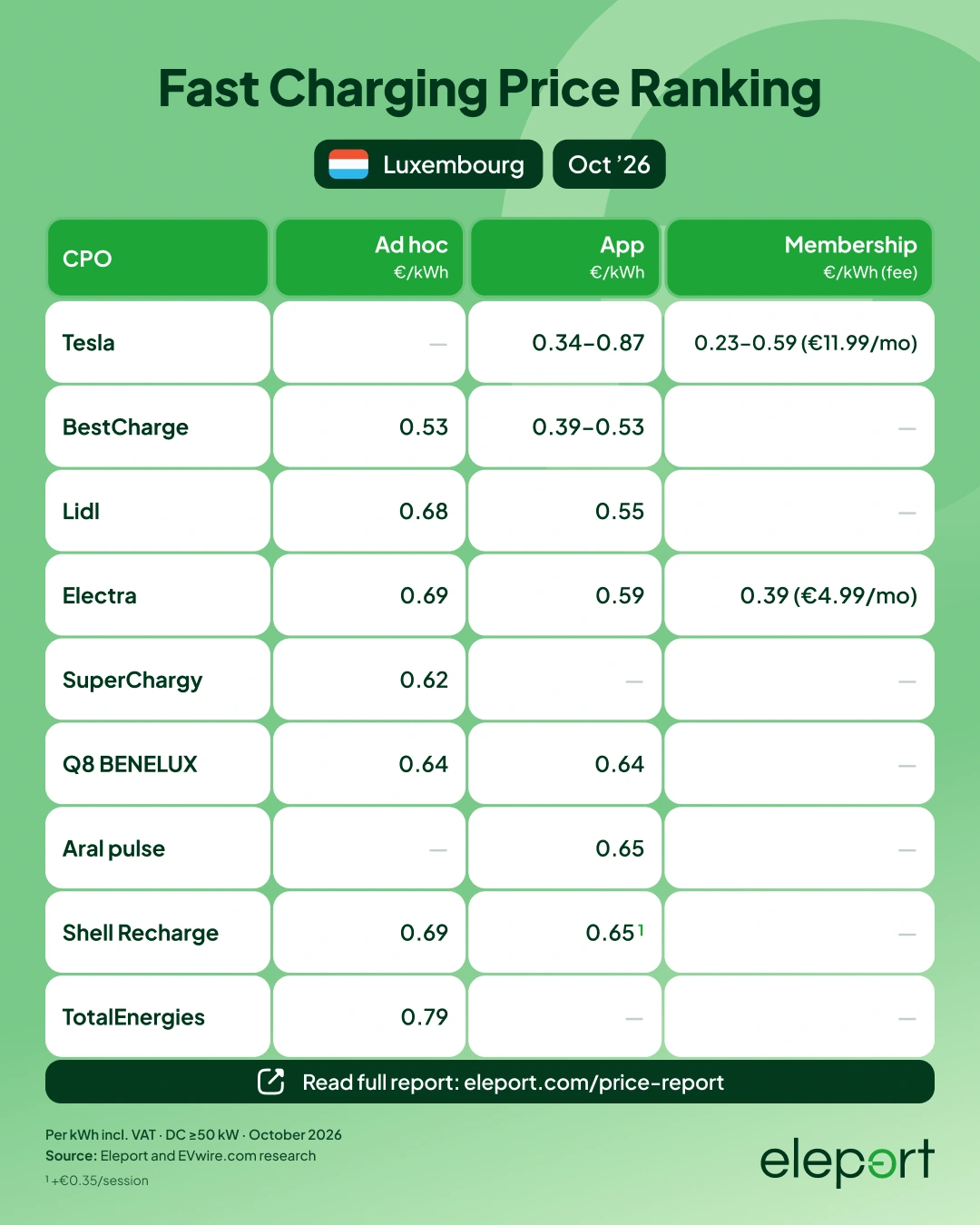
The average (median) fast charging price in Luxembourg is €0.62 per kWh.
7745 EVs sold in the first half of 2026, growing +18,1% year-on-year.
BEV market share rose from 26,0% to 29,2%.
Luxembourg is 21st in Europe in fast charging prices, sitting 0.07€/kWh above the median. One recent price cut stands out: BestCharge went from €0.69 to €0.53 on 1 July 2026, and down to starting 0.39€/kWh in its app prices, rivaling Tesla’s off-peak pricing.
Tesla charging cost at night, €0.34, is the cheapest start, but its daytime €0.87 is also the highest price in Luxembourg. Lidl charges €0.55 in Lidl Plus, a price that includes a €0.15 per kWh state contribution towards the electric car charging cost, or you could charge at Lidl for €0.68/kWh through its website without an account.
Electra (€0.59 in its app), SuperChargy (€0.62), Q8 (€0.64 for every payment method), Aral pulse (€0.65) and Shell Recharge (€0.65 plus €0.35 per session with its card) follow closely.
TotalEnergies, at €0.79, is the most expensive. Circle K and SWIO are on the list, but we couldn’t find a published price for either.
Source note – DriveGreenLiveGreen helped us validate some app prices
| CPO | Ad hoc €/kWh | App €/kWh | Membership €/kWh (fee) |
| Tesla | — | 0.34–0.87 | 0.23–0.59 (€11.99/mo) |
| BestCharge | 0.53 | 0.39–0.53 | — |
| Lidl | 0.68 | 0.55 | — |
| Electra | 0.69 | 0.59 | 0.39 (€4.99/mo) |
| SuperChargy | 0.62 | — | — |
| Q8 BENELUX | 0.64 | 0.64 | — |
| Aral pulse | — | 0.65 | — |
| Shell Recharge | 0.69 | 0.65¹ | — |
| TotalEnergies | 0.79 | — | — |
Fast Charging Price Comparison in Hungary for 2026
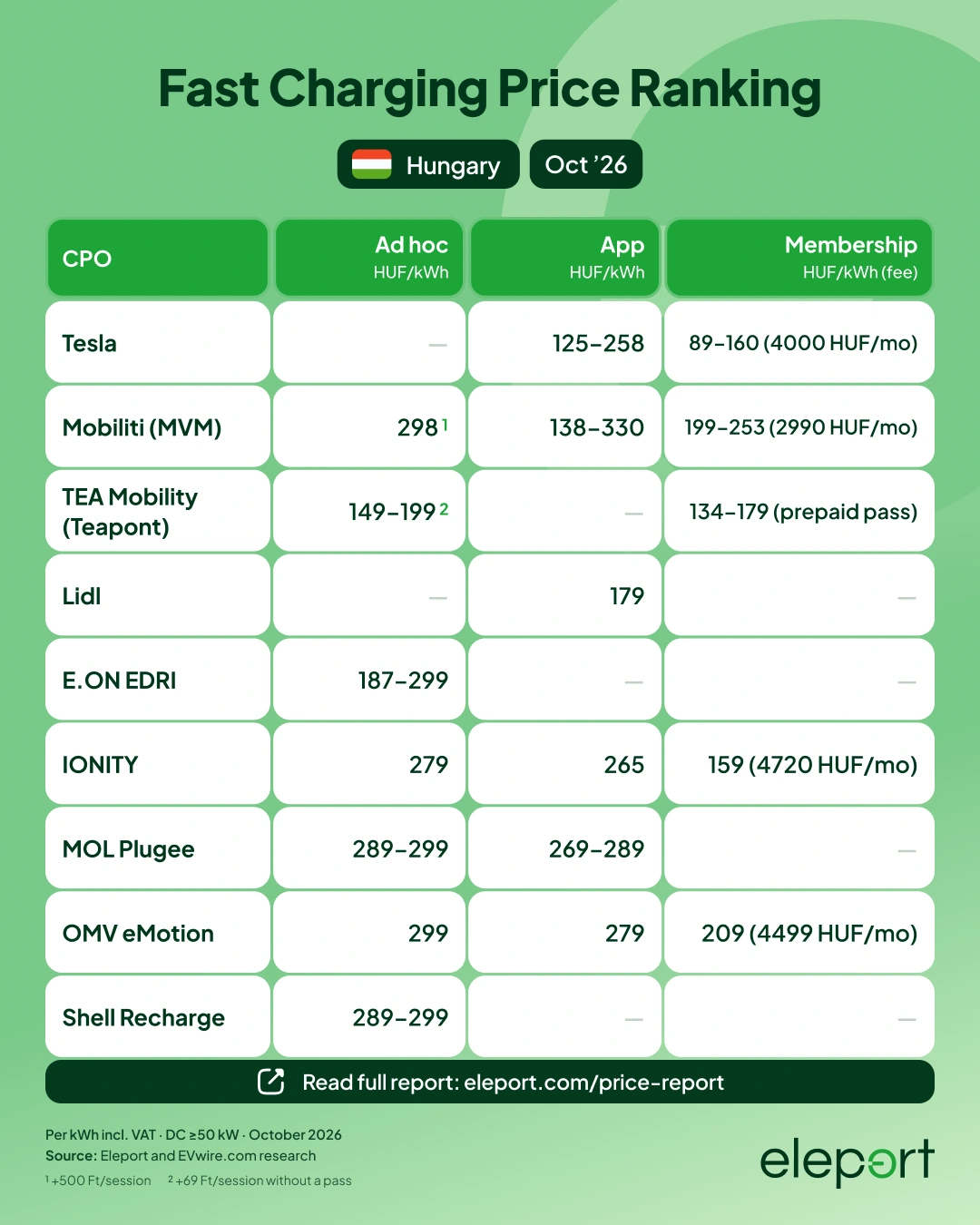
The average (median) fast charging price in Hungary is 243 HUF (€0.67) per kWh.
7497 EVs sold in the first half of 2026, growing +43,7% year-on-year.
BEV market share reached double digits, up from 7,9% to 10,0%.
Hungary fell from 14th to 22nd place compared to our March report, with its median up from €0.53 to €0.67. Much of that comes from the roster rather than the price lists: EP Charger and stormi, the two cheapest names in March, sell charging on sites where the host sets the price, and Parkl works the same way. We don’t rank such platforms in any country.
Tesla’s 16 Hungarian sites are all open to every EV, with a supercharger price from 125 HUF (€0.34) off-peak, setting the price floor. Mobiliti, the national utility MVM’s network, prices per charger from 138 to 330 HUF in its app (most chargers 250 or 269 HUF), while paying by card costs 298 HUF plus 500 Ft per session.
TEA Mobility charges 149–199 HUF plus a 69 Ft start fee if you don’t have a pass, and Lidl charges 179 HUF until 31 October 2026, as its chargers are being handed over to Mobiliti.
The fuel brands are where the electric car charging cost climbs. MOL Plugee charges 269–289 HUF in its app, OMV eMotion 279 HUF and Shell Recharge 289–299 HUF by card, the highest in the country. Hungary having 27% VAT, the highest standard rate in the EU, doesn’t help.
| CPO | Ad hoc HUF/kWh | App HUF/kWh | Membership HUF/kWh (fee) |
| Tesla | — | 125–258 | 89–160 (4000 HUF/mo) |
| Mobiliti (MVM) | 298¹ | 138–330 | 199–253 (2990 HUF/mo) |
| TEA Mobility (Teapont) | 149–199² | — | 134–179 (prepaid pass) |
| Lidl | — | 179 | — |
| E.ON EDRI | 187–299 | — | — |
| IONITY | 279 | 265 | 159 (4720 HUF/mo) |
| MOL Plugee | 289–299 | 269–289 | — |
| OMV eMotion | 299 | 279 | 209 (4499 HUF/mo) |
| Shell Recharge | 289–299 | — | — |
Fast Charging Price Comparison in Portugal for 2026
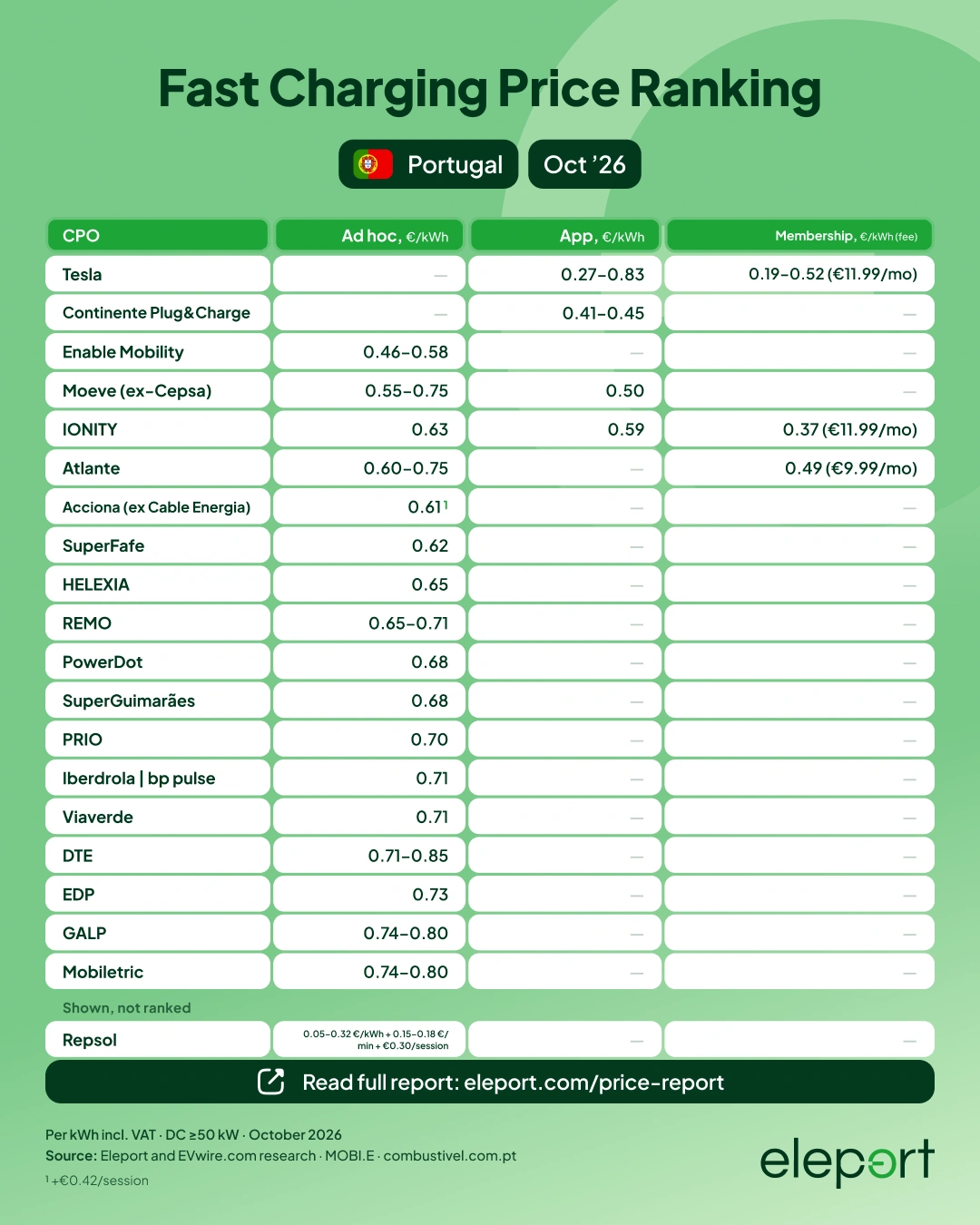
The average (median) fast charging price in Portugal is €0.68 per kWh.
34 706 EVs sold in the first half of 2026, growing +38,7% year-on-year.
BEV market share climbed from 20,2% to 25,3%.
Every fourth new car in Portugal is now fully electric, all while its fast-charging median is 23rd in Europe out of the 29 markets we researched.
The Tesla Supercharger cost of €0.27 off-peak is yet again the cheapest start, and the supermarket chain Continente comes next at €0.41–0.45 in its loyalty card app. Enable Mobility charges €0.46–0.58, and Moeve (ex-Cepsa) €0.50 all-in through its app.
IONITY is fifth of 19 in Portugal at €0.59 in its app, one of only four countries where it is below the national median. With the membership, it drops down to 0.37€/kWh.
For most of the remaining operators, the EV charging cost starts between €0.60 and €0.74. Powerdot (€0.68), EDP (€0.73) and GALP (€0.74–0.80) run the largest networks. DTE has the highest typical price, at €0.71–0.85. Acciona adds €0.42 per ad hoc session. Repsol charges per minute plus per kWh simultaneously at its sites, so it is shown under the table without a rank.
Most ad hoc prices come from the official MOBI.E data, which publishes the price for paying without a contract at each charger.
| CPO | Ad hoc €/kWh | App €/kWh | Membership €/kWh (fee) |
| Tesla | — | 0.27–0.83 | 0.19–0.52 (€11.99/mo) |
| Continente Plug&Charge | — | 0.41–0.45 | — |
| Enable Mobility | 0.46–0.58 | — | — |
| Moeve (ex-Cepsa) | 0.55–0.75 | 0.50 | — |
| IONITY | 0.63 | 0.59 | 0.37 (€11.99/mo) |
| Atlante | 0.60–0.75 | — | 0.49 (€9.99/mo) |
| Acciona (ex Cable Energia) | 0.61¹ | — | — |
| SuperFafe | 0.62 | — | — |
| HELEXIA | 0.65 | — | — |
| REMO | 0.65–0.71 | — | — |
| PowerDot | 0.68 | — | — |
| SuperGuimarães | 0.68 | — | — |
| PRIO | 0.70 | — | — |
| Iberdrola | bp pulse | 0.71 | — | — |
| Viaverde | 0.71 | — | — |
| DTE | 0.71–0.85 | — | — |
| EDP | 0.73 | — | — |
| GALP | 0.74–0.80 | — | — |
| Mobiletric | 0.74–0.80 | — | — |
| Shown, not ranked | |||
| Repsol | 0.05–0.32 €/kWh + 0.15–0.18 €/min + €0.30/session | — | — |
Fast Charging Price Comparison in Belgium for 2026
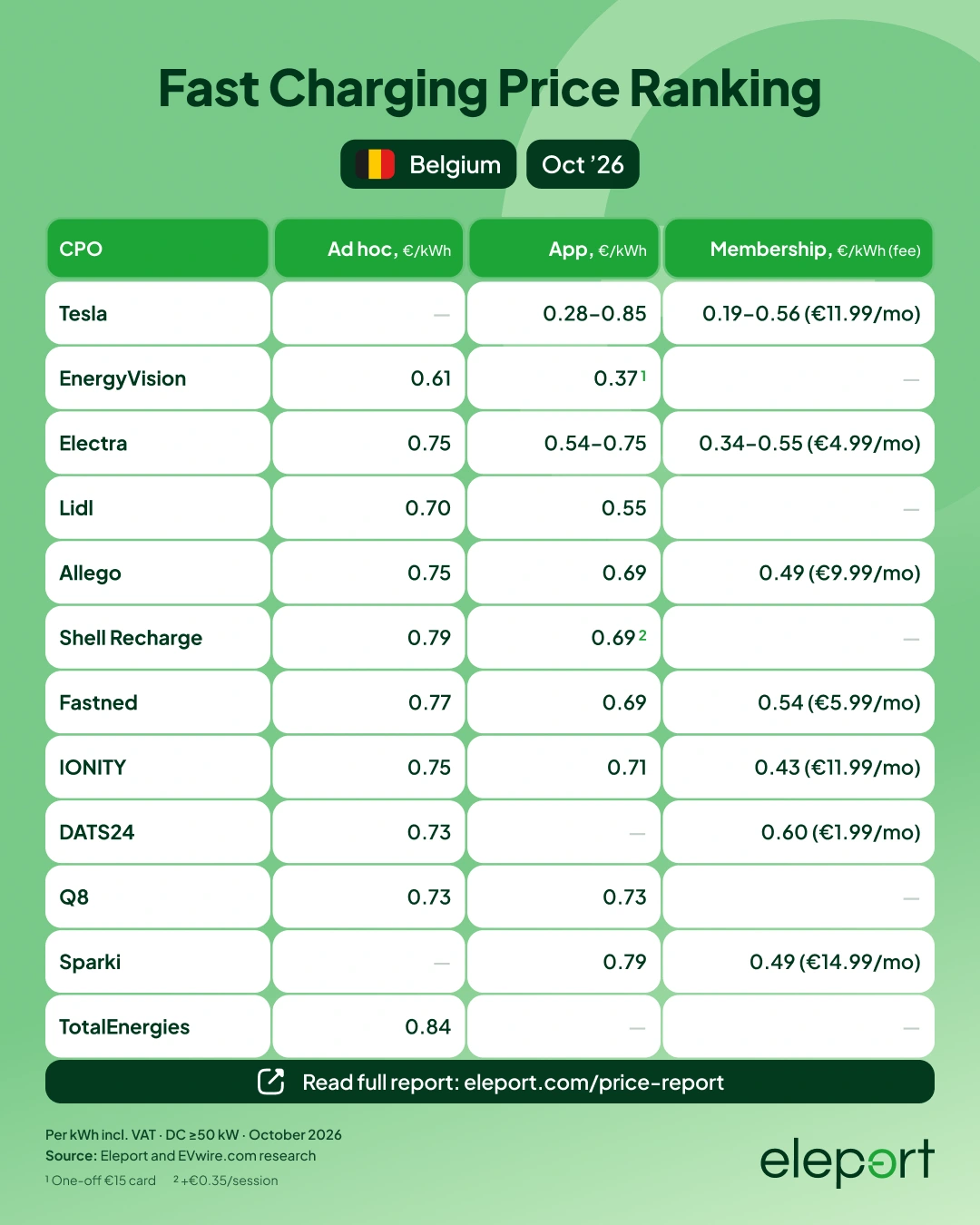
The average (median) fast charging price in Belgium is €0.69 per kWh.
83 282 EVs sold in the first half of 2026, growing +8,2% year-on-year.
BEV market share rose from 32,8% to 36,1%.
Belgium is 24th in Europe with its fast charging prices, €0.14/kWh more than the European average of €0.55/kWh
Tesla charging cost follows the time of day at all 26 Belgian sites open to other EVs, from €0.28 at night up to €0.85 in the daytime, again covering the cheapest to most expensive range of the whole country. And EnergyVision is still the outlier, charging €0.37 with its card (a one-off €15) against €0.61 for ad hoc payment.
Behind them, Electra (€0.54–0.75 in its app, depending on time and demand) and Lidl (€0.55 in Lidl Plus, at chargers of up to 60 kW) are the next cheapest.
Sparki, at €0.79 in its free app tier, and TotalEnergies, at €0.84 by card, close the Belgian EV charging cost table. Powerdot and Circle K are on the list, but we couldn’t find published prices for the Belgian market on their sites.
| CPO | Ad hoc €/kWh | App €/kWh | Membership €/kWh (fee) |
| Tesla | — | 0.28–0.85 | 0.19–0.56 (€11.99/mo) |
| EnergyVision | 0.61 | 0.37¹ | — |
| Electra | 0.75 | 0.54–0.75 | 0.34–0.55 (€4.99/mo) |
| Lidl | 0.70 | 0.55 | — |
| Allego | 0.75 | 0.69 | 0.49 (€9.99/mo) |
| Shell Recharge | 0.79 | 0.69² | — |
| Fastned | 0.77 | 0.69 | 0.54 (€5.99/mo) |
| IONITY | 0.75 | 0.71 | 0.43 (€11.99/mo) |
| DATS24 | 0.73 | — | 0.60 (€1.99/mo) |
| Q8 | 0.73 | 0.73 | — |
| Sparki | — | 0.79 | 0.49 (€14.99/mo) |
| TotalEnergies | 0.84 | — | — |
Fast Charging Price Comparison in the Netherlands for 2026
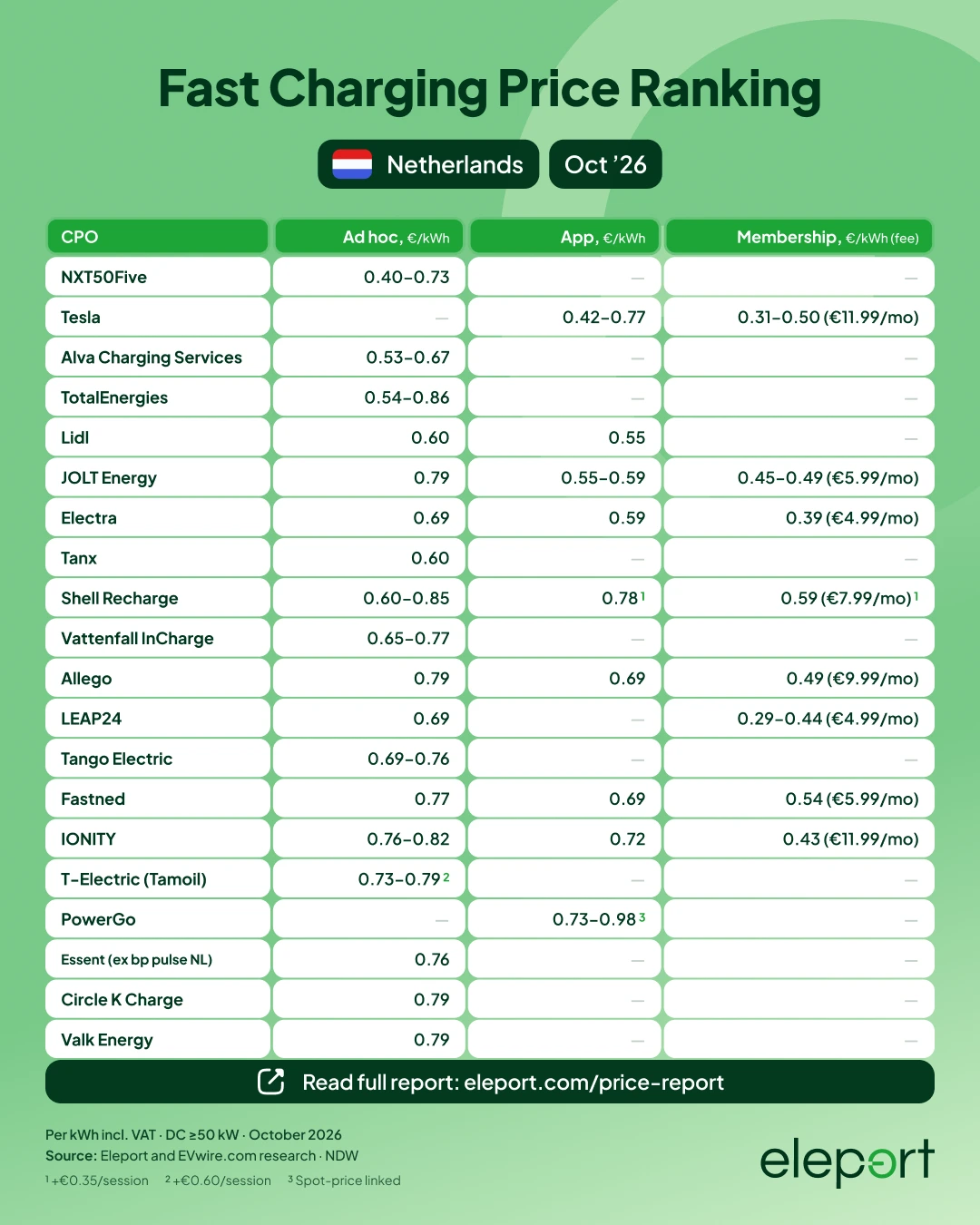
The average (median) fast charging price in the Netherlands is €0.70 per kWh.
63 776 EVs sold in the first half of 2026, declining -0,1% year-on-year.
BEV market share still rose from 35,0% to 36,5%.
The Netherlands shares 25th and 26th place in our report with Switzerland. Despite having one of Europe’s densest public AC networks and high BEV adoption already, its fast charging prices remain some of the highest on the continent.
It’s also one of the few countries where Tesla isn’t the cheapest start. NXT50Five, with 63 DC points, starts from €0.40, and Tesla’s supercharger price follows at €0.42 at night (up to €0.77 in the daytime).
TotalEnergies shows how local the Dutch EV charging cost can be: its prices are set by each municipal concession, from €0.54 in the MRA-E region to €0.86 at Utrecht’s high-power sites. Lidl (€0.55 in Lidl Plus) and JOLT (€0.55–0.59 in its app) are the next cheapest.
LEAP24’s PartnerPas, at €4.99 a month, is an outlier in price as it costs €0.29 at weekends (lowest of any provider) and €0.44 on weekdays. PowerGo’s prices follow the electricity market in 15-minute steps, at €0.73–0.98, the highest typical price in the country, and Essent, which is now taking over the bp pulse and E.ON Drive fast chargers, charges €0.85.
Source note – some ad hoc prices come from the official NDW open data, and electricfelix helped us source some of the pricing
| CPO | Ad hoc €/kWh | App €/kWh | Membership €/kWh (fee) |
| NXT50Five | 0.40–0.73 | — | — |
| Tesla | — | 0.42–0.77 | 0.31–0.50 (€11.99/mo) |
| Alva Charging Services | 0.53–0.67 | — | — |
| TotalEnergies | 0.54–0.86 | — | — |
| Lidl | 0.60 | 0.55 | — |
| JOLT Energy | 0.79 | 0.55–0.59 | 0.45–0.49 (€5.99/mo) |
| Electra | 0.69 | 0.59 | 0.39 (€4.99/mo) |
| Tanx | 0.60 | — | — |
| Shell Recharge | 0.60–0.85 | 0.78¹ | 0.59 (€7.99/mo)¹ |
| Vattenfall InCharge | 0.65–0.77 | — | — |
| Allego | 0.79 | 0.69 | 0.49 (€9.99/mo) |
| LEAP24 | 0.69 | — | 0.29–0.44 (€4.99/mo) |
| Tango Electric | 0.69–0.76 | — | — |
| Fastned | 0.77 | 0.69 | 0.54 (€5.99/mo) |
| IONITY | 0.76–0.82 | 0.72 | 0.43 (€11.99/mo) |
| T-Electric (Tamoil) | 0.73–0.79² | — | — |
| PowerGo | — | 0.73–0.98³ | — |
| Essent (ex bp pulse NL) | 0.76 | — | — |
| Circle K Charge | 0.79 | — | — |
| Valk Energy | 0.79 | — | — |
Fast Charging Price Comparison in Switzerland for 2026
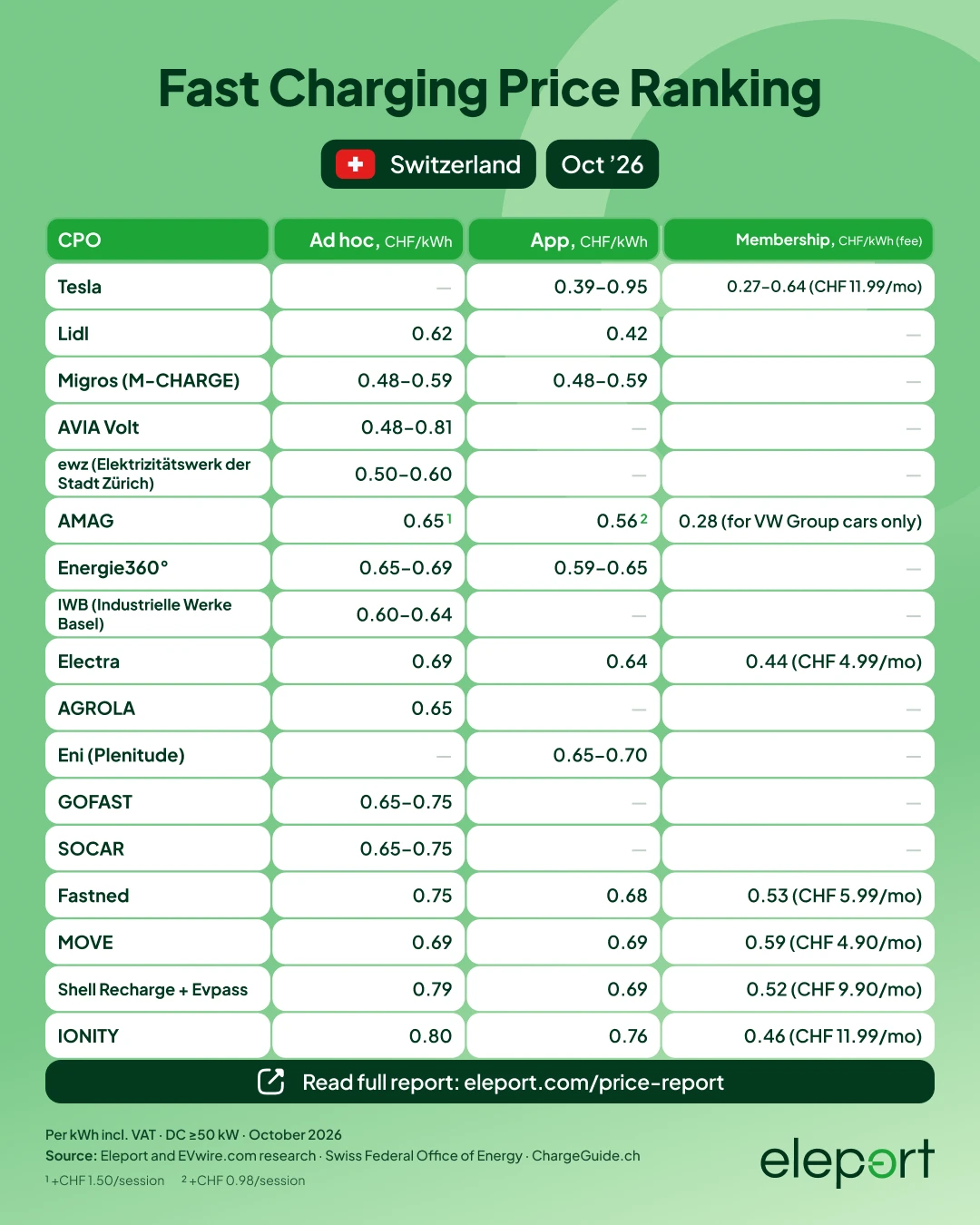
The average (median) fast charging price in Switzerland is 0.65 CHF (€0.70) per kWh.
27 889 EVs sold in the first half of 2026, growing +20,2% year-on-year.
BEV market share rose from 20,5% to 23,9%.
Switzerland shares 25th and 26th place with the Netherlands. It also has the highest starting price in Europe: even the off-peak Tesla Supercharger cost is CHF 0.39 (€0.42).
The grocery chains still undercut most charging companies. Lidl charges CHF 0.42 in Lidl Plus (during store opening hours), and Migros’s M-CHARGE CHF 0.48–0.59. AMAG is interesting – adding a start fee (CHF 0.98 in its app, CHF 1.50 by card) to the open 0.56CHF/kWh tier, while selling VW Group owners a CHF 0.28 rate.
The big news in Switzerland is consolidation. On 1 October 2026, Energie 360° merged Swisscharge, GOFAST, MOVE and its own charging business into JOYA Mobility, with around 1800 DC points. JOYA hasn’t published one price list yet, so Energie 360° (CHF 0.59–0.65 after free registration), GOFAST (CHF 0.65–0.75) and MOVE (CHF 0.69) still appear separately.
IONITY has the highest EV charging cost in Switzerland, at CHF 0.76 in its app.
Source notes – some prices come from the Swiss Federal Office of Energy’s official charging data. ChargeGuide.ch helped us with some of the pricing.
| CPO | Ad hoc CHF/kWh | App CHF/kWh | Membership CHF/kWh (fee) |
| Tesla | — | 0.39–0.95 | 0.27–0.64 (CHF 11.99/mo) |
| Lidl | 0.62 | 0.42 | — |
| Migros (M-CHARGE) | 0.48–0.59 | 0.48–0.59 | — |
| AVIA Volt | 0.48–0.81 | — | — |
| ewz (Elektrizitätswerk der Stadt Zürich) | 0.50–0.60 | — | — |
| AMAG | 0.65¹ | 0.56² | 0.28 (VW Group cars only) |
| Energie360° | 0.65–0.69 | 0.59–0.65 | — |
| IWB (Industrielle Werke Basel) | 0.60–0.64 | — | — |
| Electra | 0.69 | 0.64 | 0.44 (CHF 4.99/mo) |
| AGROLA | 0.65 | — | — |
| Eni (Plenitude) | — | 0.65–0.70 | — |
| GOFAST | 0.65–0.75 | — | — |
| SOCAR | 0.65–0.75 | — | — |
| Fastned | 0.75 | 0.68 | 0.53 (CHF 5.99/mo) |
| MOVE | 0.69 | 0.69 | 0.59 (CHF 4.90/mo) |
| Shell Recharge + Evpass | 0.79 | 0.69 | 0.52 (CHF 9.90/mo) |
| IONITY | 0.80 | 0.76 | 0.46 (CHF 11.99/mo) |
Fast Charging Price Comparison in Ireland for 2026
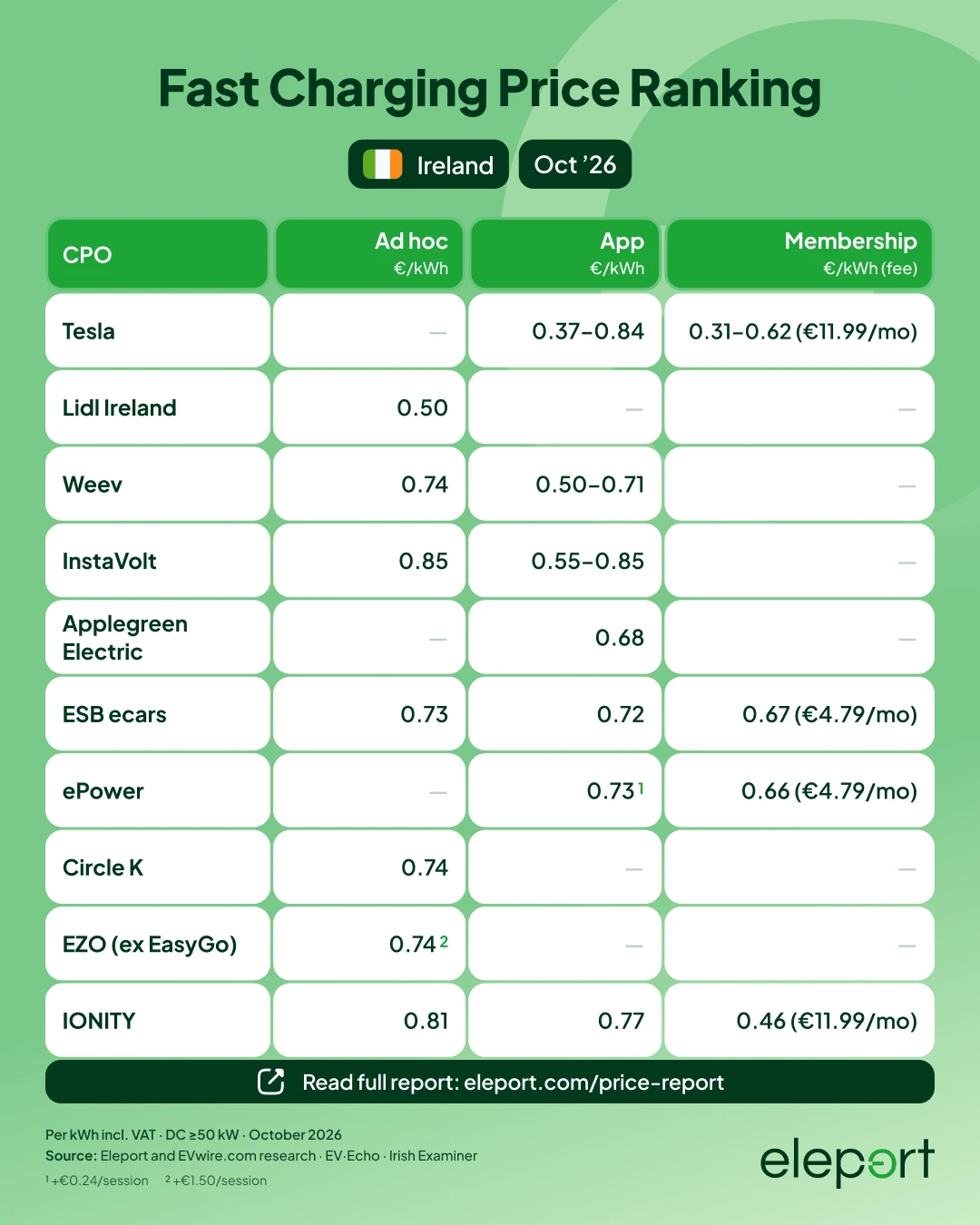
The average (median) fast charging price in Ireland is €0.71 per kWh.
20 159 EVs sold in the first half of 2026, growing +47,9% year-on-year.
BEV market share jumped from 16,7% to 23,7%.
Ireland is 27th in Europe, despite a reduced 9% VAT rate on electricity.
Tesla charging cost starts at €0.37 off-peak, starting the country out. Lidl Ireland, whose chargers are run by EZO, charges a flat €0.50 by contactless card, and Weev’s app night rate (22:00–07:00) is the same €0.50, against €0.74 by contactless.
Night rates are the easiest way to cut your EV charging cost in Ireland. InstaVolt charges €0.55 in its app between 20:00 and 07:00 and asks €0.85/kWh the rest of the time, the highest rate in the whole country.
The rest of the market is bunched between €0.68 and €0.74. EZO, formerly EasyGo, charges €0.74 plus a €1.50 access fee per session, which adds to the cost of charging electric car batteries on short stops. IONITY is the most expensive at €0.77 in its app.
Sourcing note – I found EV·Echo and the Irish Examiner very helpful for sourcing some of these.
| CPO | Ad hoc €/kWh | App €/kWh | Membership €/kWh (fee) |
| Tesla | — | 0.37–0.84 | 0.31–0.62 (€11.99/mo) |
| Lidl Ireland | 0.50 | — | — |
| Weev | 0.74 | 0.50–0.71 | — |
| InstaVolt | 0.85 | 0.55–0.85 | — |
| Applegreen Electric | — | 0.68 | — |
| ESB ecars | 0.73 | 0.72 | 0.67 (€4.79/mo) |
| ePower | — | 0.73¹ | 0.66 (€4.79/mo) |
| Circle K | 0.74 | — | — |
| EZO (ex EasyGo) | 0.74² | — | — |
| IONITY | 0.81 | 0.77 | 0.46 (€11.99/mo) |
Fast Charging Price Comparison in Italy
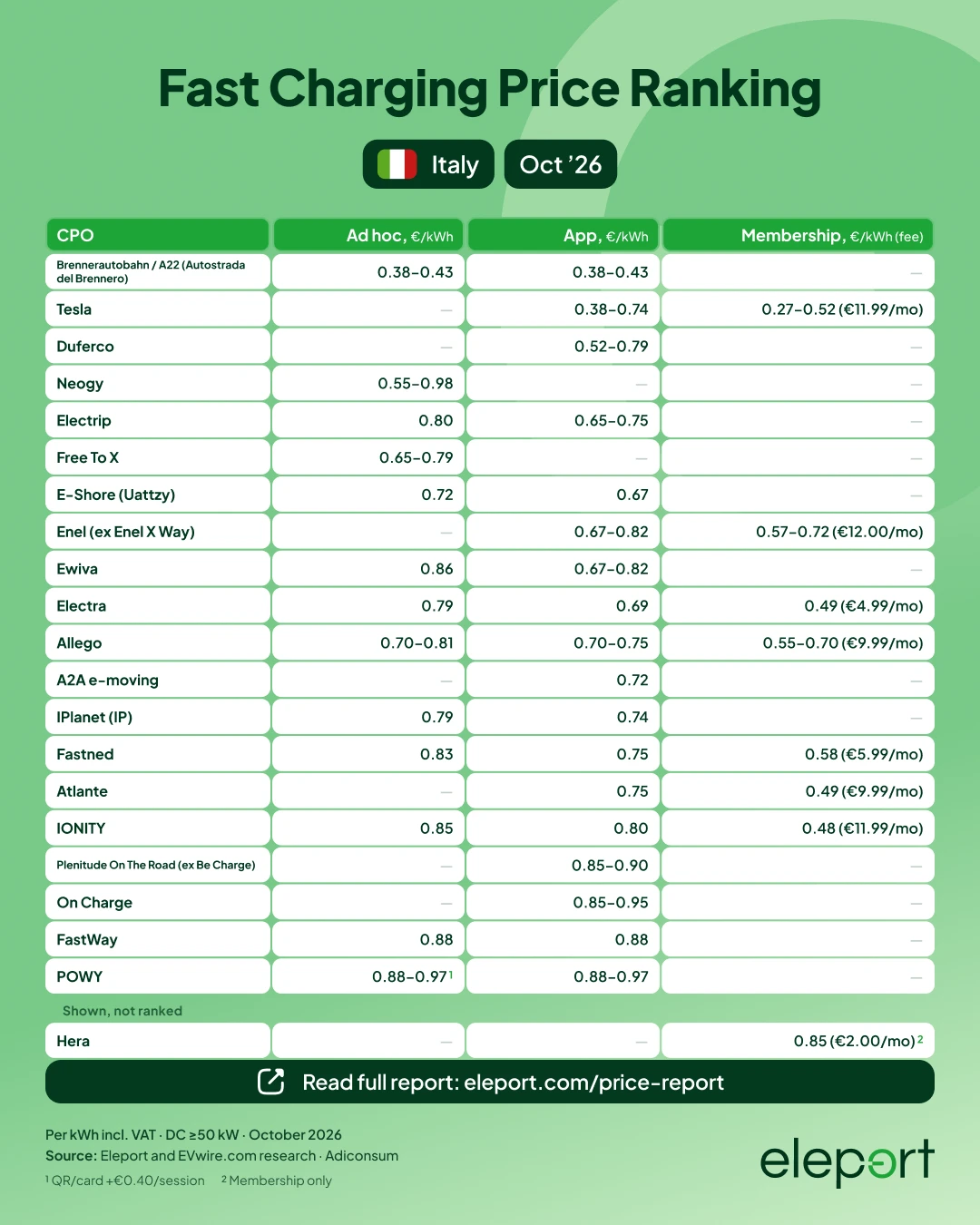
The average (median) fast charging price in Italy is €0.74 per kWh.
79 434 EVs were sold in the first half of 2026, growing +77,7% year-on-year.
BEV market share rose from 5,2% to 8,5%.
Italy is second from the bottom again in terms of fast charging prices in Europe. How much does it cost to charge an electric car in Italy? From €0.38 on the Brenner motorway all the way to €0.98 at the most expensive sites.
The cheapest start is shared. Brennerautobahn’s A22 motorway network charges €0.38–0.43 in its rEVcharge app, and Tesla’s Supercharger price starts at the same €0.38 off-peak. After that there’s a jump: Duferco starts at €0.52, and Neogy charges €0.55 in Alto Adige but €0.79–0.98 in the rest of Italy.
The largest network, Enel, with 5698 DC points, charges €0.67–0.82 per kWh in its app by time of day, and Ewiva uses the same Enel On Your Way app and prices, or €0.86 in ad-hoc.
At the top, Plenitude On The Road (€0.85–0.90), On Charge (€0.85–0.95), FastWay (€0.88) and POWY (€0.88–0.97) all charge more than €0.85. POWY has the highest typical price in Italy.
Hera sells charging only with a membership, so it is shown under the table without a rank.
Sourcing note – the Adiconsum price observatory helped us with finding a few of these.
| CPO | Ad hoc €/kWh | App €/kWh | Membership €/kWh (fee) |
| Brennerautobahn / A22 (Autostrada del Brennero) | 0.38–0.43 | 0.38–0.43 | — |
| Tesla | — | 0.38–0.74 | 0.27–0.52 (€11.99/mo) |
| Duferco | — | 0.52–0.79 | — |
| Neogy | 0.55–0.98 | — | — |
| Electrip | 0.80 | 0.65–0.75 | — |
| Free To X | 0.65–0.79 | — | — |
| E-Shore (Uattzy) | 0.72 | 0.67 | — |
| Enel (ex Enel X Way) | — | 0.67–0.82 | 0.57–0.72 (€12.00/mo) |
| Ewiva | 0.86 | 0.67–0.82 | — |
| Electra | 0.79 | 0.69 | 0.49 (€4.99/mo) |
| Allego | 0.70–0.81 | 0.70–0.75 | 0.55–0.70 (€9.99/mo) |
| A2A e-moving | — | 0.72 | — |
| IPlanet (IP) | 0.79 | 0.74 | — |
| Fastned | 0.83 | 0.75 | 0.58 (€5.99/mo) |
| Atlante | — | 0.75 | 0.49 (€9.99/mo) |
| IONITY | 0.85 | 0.80 | 0.48 (€11.99/mo) |
| Plenitude On The Road (ex Be Charge) | — | 0.85–0.90 | — |
| On Charge | — | 0.85–0.95 | — |
| FastWay | 0.88 | 0.88 | — |
| POWY | 0.88–0.97¹ | 0.88–0.97 | — |
Fast Charging Price Comparison in the United Kingdom
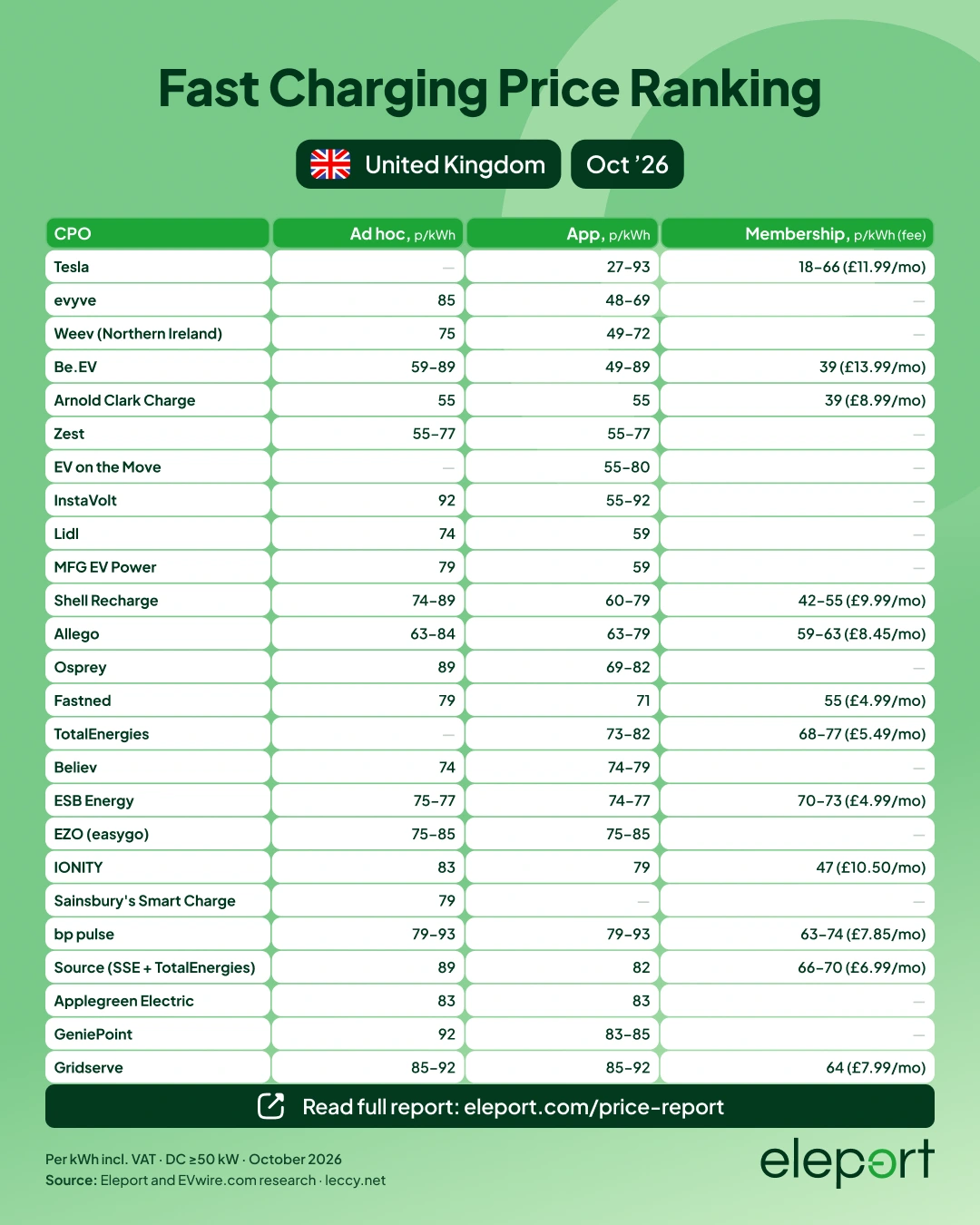
The average (median) fast charging price in the United Kingdom is 73.50p (€0.87) per kWh.
284 579 EVs were sold in the first half of 2026, growing +26,6% year-on-year.
BEV market share rose from 21,6% to 25,0%.
And we’ve now come to the end of our list the 29th place out of 29 in Europe. UK sits, on average, €0.32 per every kWh higher than the European median of 0.55€/kWh.
Every fourth new car sold in the UK is fully electric, and the UK still has the highest public EV charging cost in Europe. How much does it cost to charge an electric car on a UK rapid charger? From 27p (0.32€) to 93p (1.11€) per kWh, depending on who you use and when.
As a sidenote, home charging in the UK actually got cheaper this autumn when the VAT on household electricity in Great Britain was cut from 5% to 0% on 1 October, while public charging still carries 20% VAT.
Off-peak charging is where UK drivers can save.
Tesla’s supercharger price starts at 27p (€0.32) and even at 18p (0.21€) per kWh for the membership, though the Tesla Supercharger cost at peak reaches 93p (1.11€), also markingn the peak for the country. What’s notable is that the second place after Tesla’s 27p off-peak pricing, evyve, comes in with starting at 48p for the weekend rate, so the gap is quite large.
There are others playing with timing, too, like Weev 49p at night in Northern Ireland, Be.EV 49p off-peak (19:00–07:00) and InstaVolt 55p between 20:00 and 07:00 in its app. Be.EV has also taken over Mer’s UK public charging network.
Pay by contactless at peak and you’re in a whole different market. InstaVolt’s contactless price is 92p, bp pulse charges 89p at most sites, and Gridserve (85–92p) and bp pulse (79–93p) are the only two operators whose typical price is above €1 per kWh.
Lidl (59p in Lidl Plus, 74p by card) and MFG EV Power, the largest network in our UK data with 3028 DC charging points (59p in its app, 79p contactless), sit in the cheaper half.
With average fast-charging prices more than twice as high as in Finland, it is quite telling that they are able to get to a quarter of BEV market share in the country.
Sourcing note – leccy.net helped us find Applegreen’s pricing.
| CPO | Ad hoc p/kWh | App p/kWh | Membership p/kWh (fee) |
| Tesla | — | 27–93 | 18–66 (£11.99/mo) |
| evyve | 85 | 48–69 | — |
| Weev (Northern Ireland) | 75 | 49–72 | — |
| Be.EV | 59–89 | 49–89 | 39 (£13.99/mo) |
| Arnold Clark Charge | 55 | 55 | 39 (£8.99/mo) |
| Zest | 55–77 | 55–77 | — |
| EV on the Move | — | 55–80 | — |
| InstaVolt | 92 | 55–92 | — |
| Lidl | 74 | 59 | — |
| MFG EV Power | 79 | 59 | — |
| Shell Recharge | 74–89 | 60–79 | 42–55 (£9.99/mo) |
| Allego | 63–84 | 63–79 | 59–63 (€9.99/mo) |
| Osprey | 89 | 69–82 | — |
| Fastned | 79 | 71 | 55 (£4.99/mo) |
| TotalEnergies | — | 73–82 | 68–77 (£5.49/mo) |
| Believ | 74 | 74–79 | — |
| ESB Energy | 75–77 | 74–77 | 70–73 (£4.99/mo) |
| EZO (easygo) | 75–85 | 75–85 | — |
| IONITY | 83 | 79 | 47 (£10.50/mo) |
| Sainsbury’s Smart Charge | 79 | — | — |
| bp pulse | 79–93 | 79–93 | 63–74 (£7.85/mo) |
| Source (SSE + TotalEnergies) | 89 | 82 | 66–70 (£6.99/mo) |
| Applegreen Electric | 83 | 83 | — |
| GeniePoint | 92 | 83–85 | — |
| Gridserve | 85–92 | 85–92 | 64 (£7.99/mo) |
Roundup: fast charging in Europe in October 2026 goes from €0.35 average in Finland to €0.87 in the UK
| Rank | Country | Median €/kWh |
| 1 | Finland | 0.35 |
| 2 | Estonia | 0.37 |
| 3 | Bulgaria | 0.39 |
| 4 | Lithuania | 0.40 |
| 5 | Latvia | 0.41 |
| 6 | Iceland | 0.48 |
| 7–8 | Romania | 0.49 |
| 7–8 | Sweden | 0.49 |
| 9 | Denmark | 0.51 |
| 10–12 | France | 0.53 |
| 10–12 | Spain | 0.53 |
| 10–12 | Czechia | 0.53 |
| 13 | Slovakia | 0.54 |
| 14–15 | Slovenia | 0.55 |
| 14–15 | Croatia | 0.55 |
| 16–17 | Greece | 0.56 |
| 16–17 | Norway | 0.56 |
| 18 | Poland | 0.58 |
| 19 | Germany | 0.59 |
| 20 | Austria | 0.60 |
| 21 | Luxembourg | 0.62 |
| 22 | Hungary | 0.67 |
| 23 | Portugal | 0.68 |
| 24 | Belgium | 0.69 |
| 25–26 | Netherlands | 0.70 |
| 25–26 | Switzerland | 0.70 |
| 27 | Ireland | 0.71 |
| 28 | Italy | 0.74 |
| 29 | United Kingdom | 0.87 |
| Europe (median of the 29 country medians) | 0.55 |
The cheapest fast charging in Europe is in Finland, the Baltics and Bulgaria, and Italy and the UK sit at the bottom, with the European middle at €0.55 per kWh.
EV charging cost still depends a lot on where you are. Underneath those medians the market keeps moving: networks merged or changed hands in Switzerland, Norway, the Netherlands and the UK, and in Denmark, the Netherlands and Poland some prices follow the electricity market hour by hour.
The advice is simple. The cheapest fast charge is usually the one where you didn’t just tap your bank card. A free app, an off-peak window, a flat across-uses pricing, or a supermarket car park tends to be the cheaper way to charge – notably, in a few countries a session fee can undo a good per-kWh price.
For EV drivers who cross borders, it pays to check the local leaderboard before the trip.
We’ll be back in about six months with the next edition.

Kārlis Mendziņš