
Most arguments about the running costs of an electric car assume a driveway, a wall box and a cheap nightly tariff. We wanted to test the version that does not, where every kilowatt-hour comes from a public DC fast charger at the full walk-up price.
The no-driveway version of EV ownership that most calculators and studies skip – charging only at DC fast chargers or an ultra-fast charging hub.
What we found was surprising: even when only fast charging, the costs of running an EV per 100 km is lower than driving it on petrol or diesel, in most European countries. That is without taking any other factors like maintenance or purchase prices into account, just the refueling cost.
Our fresh October 2026 fast charging price report gave us one half of the comparison: a median EV charging price for fast charging in each of the 29 European countries it covers, taken from the operators’ own price pages, pay-without-an-app pages and official national registers. It is the only such study we know of, recording over 500 charging network prices.
For the other half of this comparison, we went to the pump, with the freshest petrol and diesel prices from official and primary sources for the same 29 countries.
Then we pitched EV vs petrol and diesel on a 100 km trip cost, using the fast-charging prices and a set average consumption based on ICCT data.
With fuel prices where they are this autumn, fast charging your EV comes out cheaper than both petrol and diesel in 20 of the 29 European countries we calculated, up from 14 in July. Against petrol alone, fast charging wins in 22. And that’s if you’re looking at the country’s median fast charging price, not even the lowest options.
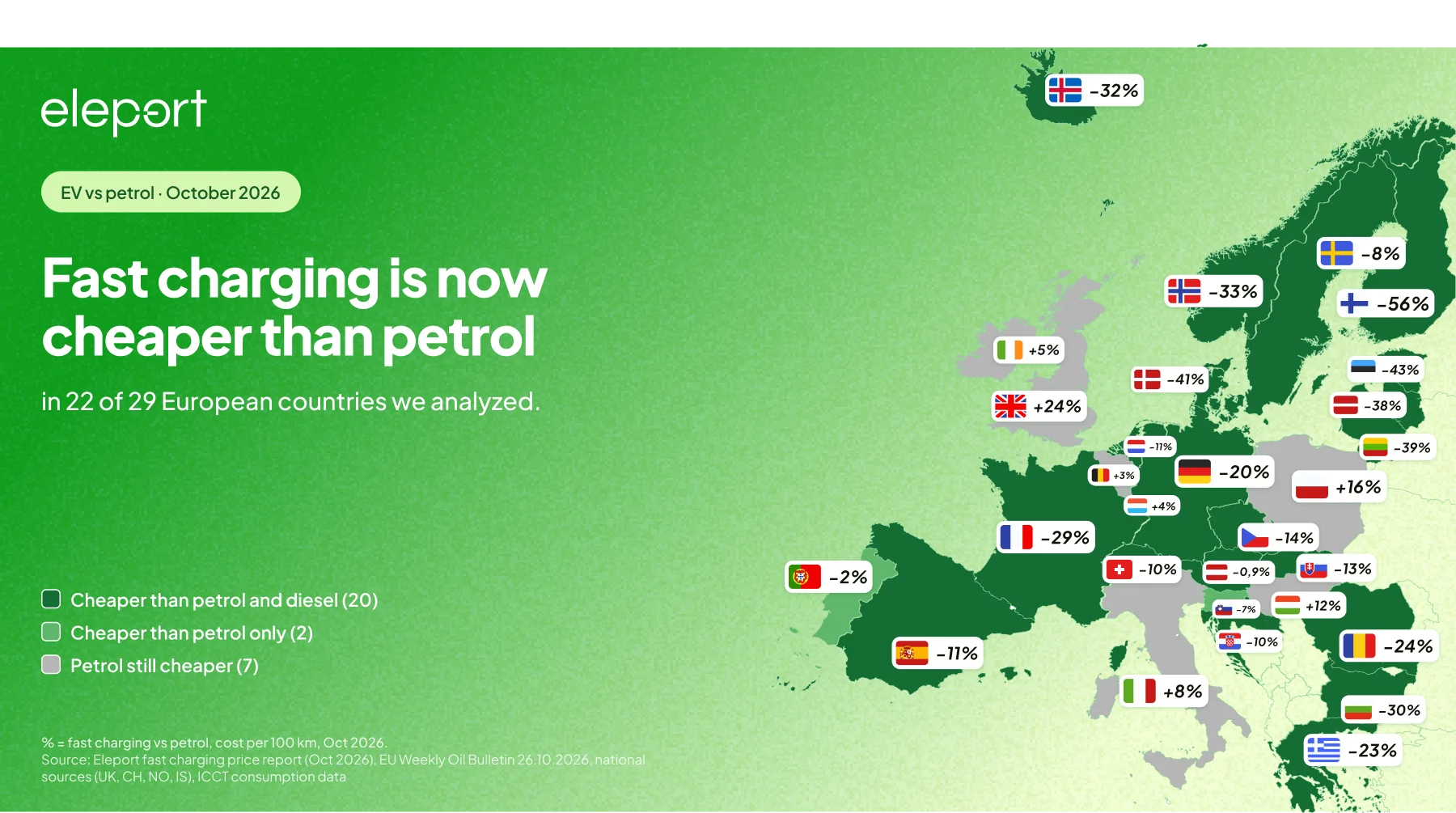
The answer to “is electric car cheaper than petrol?”, and by how far, depends a lot on where you live, so below you will find every country in turn, from Finland, where fast charging costs well under half of what petrol does, to the United Kingdom, where it still costs almost a quarter more.
The key findings at a glance
- Driving 100 km charged on DC fast charging cost a median 11,11€ across the 29 countries in October 2026, against 13,33€ on petrol and 12,37€ on diesel. So on average, the electric car cost vs petrol is already lower even when running purely on fast chargers in Europe.
- Comparing the median cost of charging electric car vs petrol and diesel, fast charging is about 17% cheaper than petrol and 10% cheaper than diesel, even at public prices with no subscription discounts.
- Fast charging beats petrol in 22 of 29 countries and diesel in 20. Petrol still wins against median fast charging costs in the United Kingdom, Poland, Hungary, Italy, Ireland, Luxembourg and Belgium.
- In our July comparison, calculated on the same basis, fast charging and diesel were practically level, 1% apart, on average. Since then, the EU average price of diesel has risen from 2,009€ to 2,146€ a litre, while the European fast charging median moved only from 0,54€ to 0,55€ per kWh.
- Diesel now costs more per litre than petrol in 27 of the 29 countries.
- At the lowest published fast-charging price we found in each country, electric beats petrol in all 29 countries, by about 40% or more.
EV vs petrol: fast charging is cheaper in 22 of 29 countries on average
Let’s start the EV vs petrol comparison with the middle of the map.
Is it cheaper to fast charge an electric car than to fill up with petrol in Europe? In most of Europe, the answer is now yes.
At October 2026 prices, fast charging a medium-segment electric car costs a median 11,11€ per 100 km across the 29 countries in our report, against 13,33€ for petrol and 12,37€ for diesel.
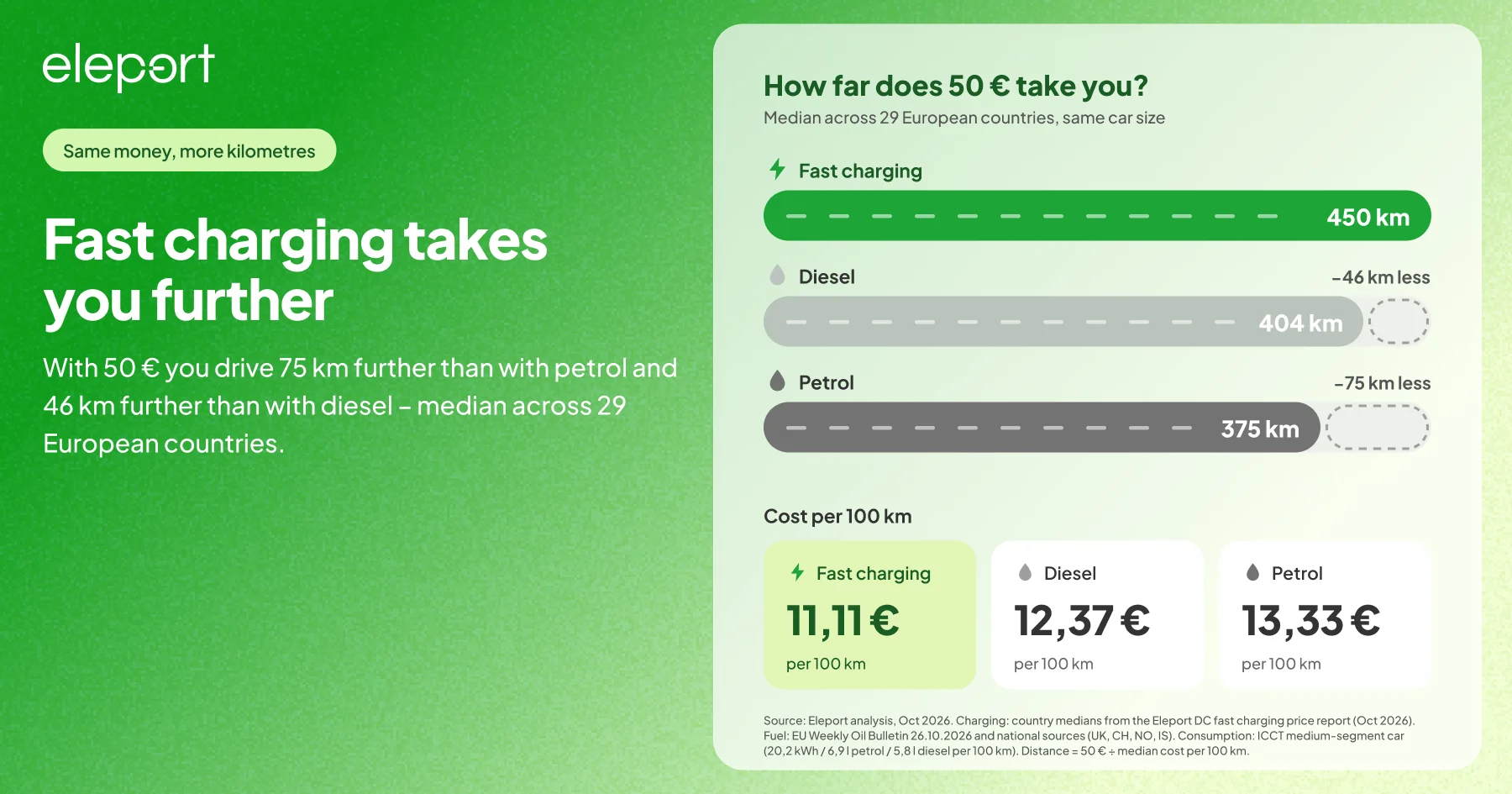
That makes the EV fast charge about 17% cheaper than petrol and 10% cheaper than diesel, and cheaper than petrol on the average across Europe.
In other words, on a 500 km road trip, the EV vs petrol bill would be about 56€ at the median fast charging price, against roughly 67€ for petrol and 62€ for diesel.
Keep in mind what that 11,11€ stands for. It is 100 km charged at the median price of public DC fast charging (ultra fast charging included), as a category the most expensive way to put energy into an electric car, with no subscription and no home charging anywhere in the mix.
So in reality, the savings are usually much larger for EV drivers, either with cheaper fast charging not just median (with petrol or diesel it is hard to find such a significant difference in price), or even better when home charging.
For the EU countries, the fuel side of the calculation we pulled in from the official source. Across the 27 member states, the European Commission’s Weekly Oil Bulletin put the weighted average at 1,954€ for a litre of petrol and 2,146€ for diesel on 26 October 2026, taxes included. At real-world consumption, that is about 13,48€ per 100 km on petrol and 12,45€ on diesel, close to the medians of our 29 countries. For the other four countries, we relied on national sources.
Against diesel, fast charging went from a tie in the summer to a clear lead today
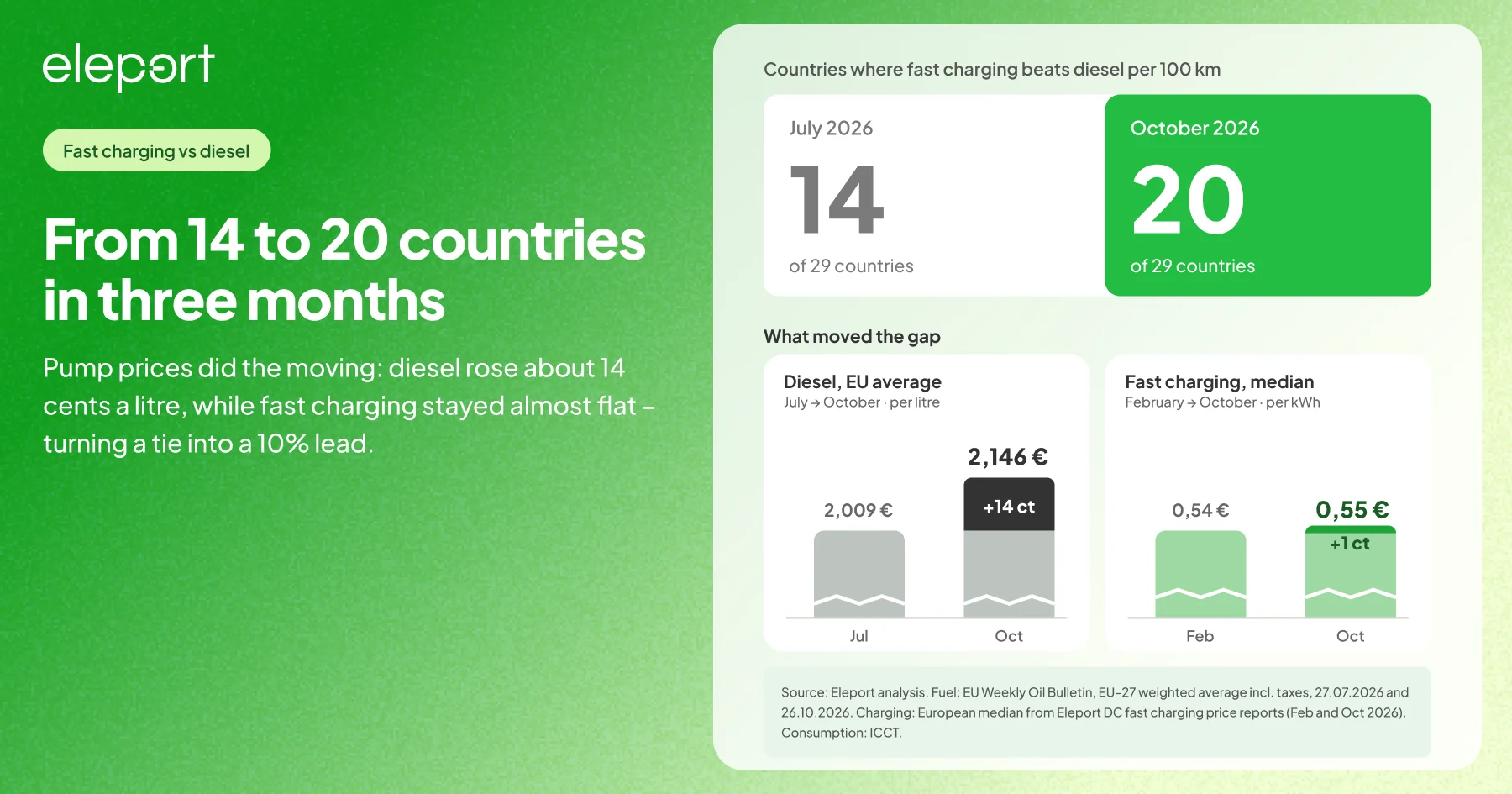
Three months earlier, the picture was a lot tighter. With the fuel prices of 27 July and the charging prices of our previous report, fast charging was 12% cheaper than petrol and just 1% cheaper than diesel, a tie for any practical purpose.
The EV charging price hardly changed, with the European fast charging median going from 0,54€ per kWh in February, as published in our March report, to 0,55€ in October. The pump prices did the moving. The EU average price of petrol edged up from 1,940€ to 1,954€ a litre, while diesel jumped from 2,009€ to 2,146€.
The reason for higher diesel prices Europe-wide sits in the global diesel market. The International Energy Agency’s October Oil Market Report describes diesel benchmarks at nearly double the price of crude oil, with supply disrupted from both Russia and the Middle East, and expects constrained supplies of diesel and other middle distillates to persist well into 2027.
So is fast charging cheaper than diesel now? In 20 of the 29 countries, yes. Across the 29, fast charging cost a median 11,11€ per 100 km against 12,37€ for diesel, about 10% less. Diesel still wins in nine: the United Kingdom, Italy, Ireland, Hungary, Poland, Portugal, Luxembourg, Belgium and Slovenia, the last of them by under 1%.
In July, that count was still 14. Sweden, Czechia, Slovakia, Croatia, Austria and the Netherlands all moved from diesel winning the €/100km cost, to now EV fast charging taking it over on average for each of these countries.
The full table: EV fast charging cost vs petrol and diesel in every country for October 2026
Here is the whole October comparison in one place, sorted by the EV vs petrol gap, from the countries where the plug saves the most to those where the pump wins. Charging column shows the median fast charging price from our October 2026 DC fast charging price report.
Fuel columns are the price at the pump with all taxes, from the EU Weekly Oil Bulletin of 26 October 2026 for the 25 EU countries, and from national sources for the four marked †. All costs are in euros per 100 km.
| Country | Fast charging €/kWh | Fast charging €/100 km | Petrol €/100 km | Charging vs petrol | Diesel €/100 km | Charging vs diesel |
|---|---|---|---|---|---|---|
| Finland | 0,35 | 7,07 | 16,19 | −56% | 14,78 | −52% |
| Estonia | 0,37 | 7,47 | 13,02 | −43% | 12,19 | −39% |
| Denmark | 0,51 | 10,30 | 17,42 | −41% | 14,51 | −29% |
| Lithuania | 0,40 | 8,08 | 13,30 | −39% | 12,89 | −37% |
| Latvia | 0,41 | 8,28 | 13,33 | −38% | 12,08 | −31% |
| Norway † | 0,56 | 11,31 | 16,96 | −33% | 14,98 | −25% |
| Iceland † | 0,48 | 9,70 | 14,21 | −32% | 14,13 | −31% |
| Bulgaria | 0,39 | 7,88 | 11,21 | −30% | 10,96 | −28% |
| France | 0,53 | 10,71 | 15,05 | −29% | 13,64 | −22% |
| Romania | 0,49 | 9,90 | 13,02 | −24% | 11,81 | −16% |
| Greece | 0,56 | 11,31 | 14,79 | −23% | 12,34 | −8% |
| Germany | 0,59 | 11,92 | 14,95 | −20% | 13,33 | −11% |
| Czechia | 0,53 | 10,71 | 12,41 | −14% | 11,31 | −5% |
| Slovakia | 0,54 | 10,91 | 12,56 | −13% | 11,43 | −5% |
| Spain | 0,53 | 10,71 | 12,08 | −11% | 10,95 | −2% |
| Netherlands | 0,70 | 14,14 | 15,96 | −11% | 14,32 | −1% |
| Switzerland † | 0,70 | 14,14 | 15,79 | −10% | 15,08 | −6% |
| Croatia | 0,55 | 11,11 | 12,36 | −10% | 11,63 | −4% |
| Sweden | 0,49 | 9,90 | 10,77 | −8% | 11,82 | −16% |
| Slovenia | 0,55 | 11,11 | 11,95 | −7% | 11,07 | +0,3% |
| Portugal | 0,68 | 13,74 | 14,08 | −2% | 12,70 | +8% |
| Austria | 0,60 | 12,12 | 12,23 | −0,9% | 12,37 | −2% |
| Belgium | 0,69 | 13,94 | 13,48 | +3% | 13,78 | +1% |
| Luxembourg | 0,62 | 12,52 | 12,05 | +4% | 11,91 | +5% |
| Ireland | 0,71 | 14,34 | 13,60 | +5% | 12,39 | +16% |
| Italy | 0,74 | 14,95 | 13,84 | +8% | 13,03 | +15% |
| Hungary | 0,67 | 13,53 | 12,10 | +12% | 11,19 | +21% |
| Poland | 0,58 | 11,72 | 10,12 | +16% | 10,33 | +13% |
| United Kingdom † | 0,87 | 17,57 | 14,20 | +24% | 13,66 | +29% |
| Median of 29 countries | 0,55 | 11,11 | 13,33 | −17% | 12,37 | −10% |
A minus sign means fast charging costs that much less than the fuel per 100 km, a plus sign means it costs more. Percentages are rounded to whole numbers except where the gap is under 1%. In the median row, they compare the three median costs.
EV vs petrol country by country: where fast charging wins, and by how much
Every country below gets the same three numbers for the electric car vs petrol car cost per km, counted per 100 km: on a fast charger, on petrol and on diesel in October.
Where it changes the picture, we also show what the same 100 km costs at the lowest published price in our report for that country, with no subscription. That is usually the bottom of an operator’s range, an off-peak hour or a lower-power charger rather than ultra fast charging, so treat it as what a driver who plans around it can get.
EV vs petrol: countries where fast charging is more than 25% cheaper
Keep in mind that we are taking the median fast charging prices per country here, which means that more knowledgeable drivers can win significantly more with electric car fast charging, compared to petrol or diesel (both of which can’t have such a range in pricing from the median pricing, really).
Finland: fast charging on average costs 7,07€ per 100 km, against petrol at 16,19€ and diesel at 14,78€ in October 2026. This means fast charging in Finland is 56% cheaper to run on than petrol and 52% cheaper than diesel.
Finland has the cheapest fast charging in our report and the third most expensive petrol of the 29 countries, so the EV vs petrol gap is the widest on the map. At the off-peak Tesla Supercharger price per kWh of 0,21€, the lowest published price there, 100 km would cost 4,24€.
While there isn’t a strong correlation between the average price of fast charging and the EV market share of sales in European countries, Finland did just pass a major 50% milestone in BEV market share in Q1-Q3 2026, so the market is really taking off.
Estonia: fast charging on average costs 7,47€ per 100 km, petrol 13,02€, diesel 12,19€ in October 2026. This means fast charging in Estonia is 43% cheaper to run on than petrol and 39% cheaper than diesel.
The Estonian fast charging median fell from 0,41€ to 0,37€ per kWh between our two reports, widening the EV vs petrol gap. At the lowest published price we found for Estonia, at 0,22€/kWh, 100 km costs 4,44€.
Denmark: fast charging on average costs 10,30€ per 100 km, petrol 17,42€, diesel 14,51€ in October 2026. This means fast charging in Denmark is 41% cheaper to run on than petrol and 29% cheaper than diesel.
Denmark’s 0,51€/kWh median ranks ninth of 29, and partly the large EV vs petrol gap comes from the pump: with a petrol price per litre of 2,525€, Denmark has the most expensive petrol of all 29 countries.
Lithuania: fast charging on average costs 8,08€ per 100 km, against petrol at 13,30€, diesel 12,89€ in October 2026. This means fast charging in Lithuania is 39% cheaper to run on than petrol and 37% cheaper than diesel.
Latvia: fast charging on average costs 8,28€ per 100 km, petrol 13,33€, diesel 12,08€ in October 2026. This means fast charging in Latvia is 38% cheaper to run on than petrol and 31% cheaper than diesel.
Norway: fast charging on average costs 11,31€ per 100 km, petrol 16,96€, diesel 14,98€ in October 2026. This means fast charging in Norway is 33% cheaper to run on than petrol and 25% cheaper than diesel.
Norway’s fuel figures are September averages, the latest official ones, and most of the jump in its EV vs petrol gap since July is petrol tax. The road usage tax on fuel had been set to zero from 1 April to 1 September 2026, and once it returned, the national average went from 19,42 kroner a litre of petrol in August to 26,18 in September, according to Statistics Norway.
Iceland: fast charging on average costs 9,70€ per 100 km, petrol 14,21€, diesel 14,13€ in October 2026. This means fast charging in Iceland is 32% cheaper to run on than petrol and 31% cheaper than diesel.
Iceland works a little differently from the rest of the countries. Since 1 January 2026 its petrol and diesel duties have been replaced by a per-kilometre fee for all cars, the same kind of fee electric cars have paid since 2024, so that part of the cost no longer sits in the pump price, which matters for any EV vs petrol comparison. Petrol there climbed from about 221 krónur a litre in late July to 281 in late October.
Bulgaria: fast charging on average costs 7,88€ per 100 km, petrol 11,21€, diesel 10,96€ in October 2026. This means fast charging in Bulgaria is 30% cheaper to run on than petrol and 28% cheaper than diesel.
Bulgarian fuel is among the cheapest in the EU, and even here, fast charging still wins the EV vs petrol comparison comfortably. At Fines Charging’s 0,19€/kWh, the cheapest published freely accessible price anywhere in our pricing report, 100 km costs just 3,84€.
France: fast charging on average costs 10,71€ per 100 km against petrol at 15,05€, diesel 13,64€ in October 2026. This means fast charging in France is 29% cheaper to run on than petrol and 22% cheaper than diesel.
EV vs petrol: countries where fast charging is still clearly cheaper, by 10 to 25%
Romania: fast charging on average costs 9,90€ per 100 km against petrol at 13,02€ and diesel at 11,81€ in October 2026. This means fast charging in Romania is 24% cheaper to run on than petrol and 16% cheaper than diesel.
Greece: fast charging on average costs 11,31€ per 100 km, petrol 14,79€, diesel 12,34€ in October 2026. This means fast charging in Greece is 23% cheaper to run on than petrol and 8% cheaper than diesel.
Greece is one of only two countries in the comparison where a litre of diesel still costs less than a litre of petrol, the other being Denmark.
Germany: fast charging on average costs 11,92€ per 100 km, petrol 14,95€, diesel 13,33€ in October 2026. This means fast charging in Germany is 20% cheaper to run on than petrol and 11% cheaper than diesel.
German pump prices in October already include a temporary energy tax cut of 14,04 cents a litre on petrol and diesel, which the Bundestag approved for 1 October to 31 December 2026. So in Germany the EV vs petrol comparison is measured against tax-reduced fuel, which might change with the new year.
Czechia: fast charging on average costs 10,71€ per 100 km, petrol 12,41€, diesel 11,31€ in October 2026. This means fast charging in Czechia is 14% cheaper to run on than petrol and 5% cheaper than diesel.
Slovakia: fast charging on average costs 10,91€ per 100 km, petrol 12,56€, diesel 11,43€ in October 2026. This means fast charging in Slovakia is 13% cheaper to run on than petrol and 5% cheaper than diesel.
Spain: fast charging on average costs 10,71€ per 100 km, petrol 12,08€, diesel 10,95€ in October 2026. This means fast charging in Spain is 11% cheaper to run on than petrol and 2% cheaper than diesel.
Spain moved the other way on fast charging prices, as its median EV charging price rose from 0,47€ to 0,53€ per kWh between our reports in March against October, and its October fuel prices include a 20 cents per litre cut in fuel tax, with smaller cuts planned for November and December depending on inflation.
Netherlands: fast charging on average costs 14,14€ per 100 km, petrol 15,96€, diesel 14,32€ in October 2026. This means fast charging in the Netherlands is 11% cheaper to run on than petrol and 1% cheaper than diesel.
Dutch fast charging is among the priciest in Europe, but Dutch fuel is pricier still, at 2,313€ for a litre of petrol, so EV vs petrol still goes to the plug. Fast charging is, however, basically on par with diesel here.
Switzerland: fast charging on average costs 14,14€ per 100 km, petrol 15,79€, diesel 15,08€ in October 2026. This means fast charging in Switzerland is 10% cheaper to run on than petrol and 6% cheaper than diesel.
The Touring Club Schweiz put the national average at 2,13 francs for petrol and 2,42 for diesel on 23 October, which makes Swiss diesel the most expensive of all 29 countries once converted to euros.
Croatia: fast charging on average costs 11,11€ per 100 km, petrol 12,36€, diesel 11,63€ in October 2026. This means fast charging in Croatia is 10% cheaper to run on than petrol and 4% cheaper than diesel.
Close calls on EV vs petrol: countries where fast charging is still cheaper, by less than 10%
In these four countries, and the four in the next section, the median fast charger and the petrol pump are near enough level that the network you pick, and whether it is ultra fast charging or a slower DC charger, matters more than the national average.
Sweden: fast charging on average costs 9,90€ per 100 km, petrol 10,77€, diesel 11,82€ in October 2026. This means fast charging in Sweden is 8% cheaper to run on than petrol and 16% cheaper than diesel.
Sweden is the only country where the EV vs petrol result switched to fast charging being cheaper since we calculated this in July. Its fast charging median dropped from 0,53€ to 0,49€ per kWh between our two reports, while fuel got more expensive, so the plug moved ahead. Petrol is still relatively cheap here, at 1,560€ a litre, the second lowest of the petrol prices in Europe we compared. Tesla’s off-peak 0,20€/kWh, the lowest published Swedish price, would bring 100 km cost down to 4,04€, significantly beating the fossil fuels.
Slovenia: fast charging on average costs 11,11€ per 100 km, petrol 11,95€, diesel 11,07€ in October 2026. This means fast charging in Slovenia is 7% cheaper to run on than petrol, but 0,3% more expensive than diesel.
Slovenia and Portugal are where fast charging still beats petrol but not diesel. In Slovenia the diesel gap is only 0,3%, practically a tie.
Portugal: fast charging on average costs 13,74€ per 100 km, petrol 14,08€, diesel 12,70€ in October 2026. This means fast charging in Portugal is 2% cheaper to run on than petrol, but 8% more expensive than diesel.
Austria: fast charging on average costs 12,12€ per 100 km, petrol 12,23€, diesel 12,37€ in October 2026. This means fast charging in Austria is 0,9% cheaper to run on than petrol and 2% cheaper than diesel.
In Austria, EV vs petrol is nearly level at the median, and a litre of diesel costs 36 cents more than petrol, so even with its lower consumption the diesel driver pays more per 100 km. At Lidl’s 0,29€/kWh, the lowest published Austrian price, 100 km on fast charging would cost just 5,86€, less than half of petrol or diesel.
Close calls on EV vs petrol: countries where fast charging is more expensive, but by less than 10%
Belgium: fast charging on average costs 13,94€ per 100 km, petrol 13,48€, diesel 13,78€ in October 2026. This means fast charging in Belgium is 3% more expensive to run on than petrol and 1% more expensive than diesel.
Belgian fast charging, at a 0,69€/kWh median, is among the more expensive in Europe, and that is enough to tip it, even though the EV vs petrol and diesel gap has more than halved since July. At the lowest published Belgian price, 0,28€/kWh, 100 km costs 5,66€, well under half of petrol.
Luxembourg: fast charging on average costs 12,52€ per 100 km, petrol 12,05€, diesel 11,91€ in October 2026. This means fast charging in Luxembourg is 4% more expensive to run on than petrol and 5% more expensive than diesel.
Petrol here costs 1,746€ a litre, the fifth cheapest of the 29 countries, and that keeps the fossil fuel prices currently just ahead in the EV vs petrol comparison.
Ireland: fast charging on average costs 14,34€ per 100 km, petrol 13,60€, diesel 12,39€ in October 2026. This means fast charging in Ireland is 5% more expensive to run on than petrol and 16% more expensive than diesel.
Italy: fast charging on average costs 14,95€ per 100 km, petrol 13,84€, diesel 13,03€ in October 2026. This means fast charging in Italy is 8% more expensive to run on than petrol and 15% more expensive than diesel.
Italy has the second most expensive fast charging in our report, at a 0,74€/kWh median. But at the lowest published price, 0,38€/kWh on the A22 Brennero motorway network, 100 km would cost 7,68€, just over half the petrol cost.
EV vs petrol: where petrol and diesel are still clearly cheaper than median fast charging
Hungary: fast charging on average costs 13,53€ per 100 km, petrol 12,10€, diesel 11,19€ in October 2026. This means fast charging in Hungary is 12% more expensive to run on than petrol and 21% more expensive than diesel.
Hungary’s median EV charging price rose from 0,53€ to 0,67€ per kWh between our two reports of March and October, the biggest increase in the comparison, and Hungarian fuel is cheaper than the European middle, so both sides work against the plug in the EV vs petrol comparison here.
Poland: fast charging on average costs 11,72€ per 100 km, petrol 10,12€, diesel 10,33€ in October 2026. This means fast charging in Poland is 16% more expensive to run on than petrol and 13% more expensive than diesel.
Poland’s fast charging, at 0,58€/kWh, sits close to the European median and did not change between our reports. Polish petrol did, falling from 1,719€ a litre in late July on our last comparison to 1,467€ in late October, now the cheapest petrol in Europe among our 29 countries, and that is what put running on fossil fuels in front of fast charging prices for now. Of course, mixing in home charging will get the EV driver in front again for running costs quickly.
United Kingdom: fast charging on average costs 17,57€ per 100 km, petrol 14,20€, diesel 13,66€ in October 2026. This means fast charging in the United Kingdom is 24% more expensive to run on than petrol and 29% more expensive than diesel.
The UK has the most expensive fast charging in our report, a 73,50p median per kWh. Petrol averaged 174,07p a litre and diesel 199,22p in the week of 26 October, according to the UK government’s weekly road fuel prices. The spread between operators, from ultra fast charging hubs to off-peak sites, is huge, though. For example, at Tesla’s off-peak 0,32€/kWh, the lowest published UK price, 100 km costs 6,46€, which is 54% less than the price of running it on petrol.
Recap: In which countries is fast charging still more expensive than petrol?
In seven of the 29 we covered: the United Kingdom, Poland, Hungary, Italy, Ireland, Luxembourg and Belgium. The gap runs from 3% in Belgium to 24% in the United Kingdom.
The reasons differ. In the UK, Italy, Ireland and Belgium, it is mostly expensive DC fast charging, with medians from 0,69€/kWh up. In Poland and Luxembourg, it is cheap petrol. Hungary has a bit of both.
One way to see the EV vs petrol tipping point is the break-even price, what a kilowatt-hour would have to cost for fast charging to match petrol per 100 km. Across the 29 countries at once, the median break-even is 0,66€/kWh, well above the European fast charging median of 0,55€. Per country, that break-even currently runs from 0,50€ in Poland, where petrol is cheapest, to 0,86€ in Denmark. The seven countries above are exactly the ones where the median fast charger sits over its own break-even.
Fuel taxes set most of the EV vs petrol gap between countries
Petrol prices in Europe, across the 25 EU countries of our comparison, ranged from 1,467€ a litre in Poland to 2,525€ in Denmark, in the same week. Before taxes, the same Oil Bulletin has Polish petrol at 1,01€ and Danish at 1,30€, so only about 29 cents of that 1,06€ gap comes before tax. The rest is excise duty and VAT.
That also means governments can move petrol prices in Europe with a single decision, and this year several did. Germany and Spain both have temporary fuel tax cuts in force in October, of 14,04 and 20 cents a litre. Norway’s road usage tax came back on 1 September after five months at zero, and the average price of petrol rose by about a third in one month, most of it the returning tax. Iceland moved its petrol and diesel duties off the litre and now charges every car per kilometre.
None of that touches the EV charging price, which each operator sets on its own schedule. Those temporary cuts make October’s fuel prices look perhaps kinder than they otherwise would, and once they end, the tax part of the pump price goes back up.
The cheapest networks and home charging tilt the picture further in EVs’ favour
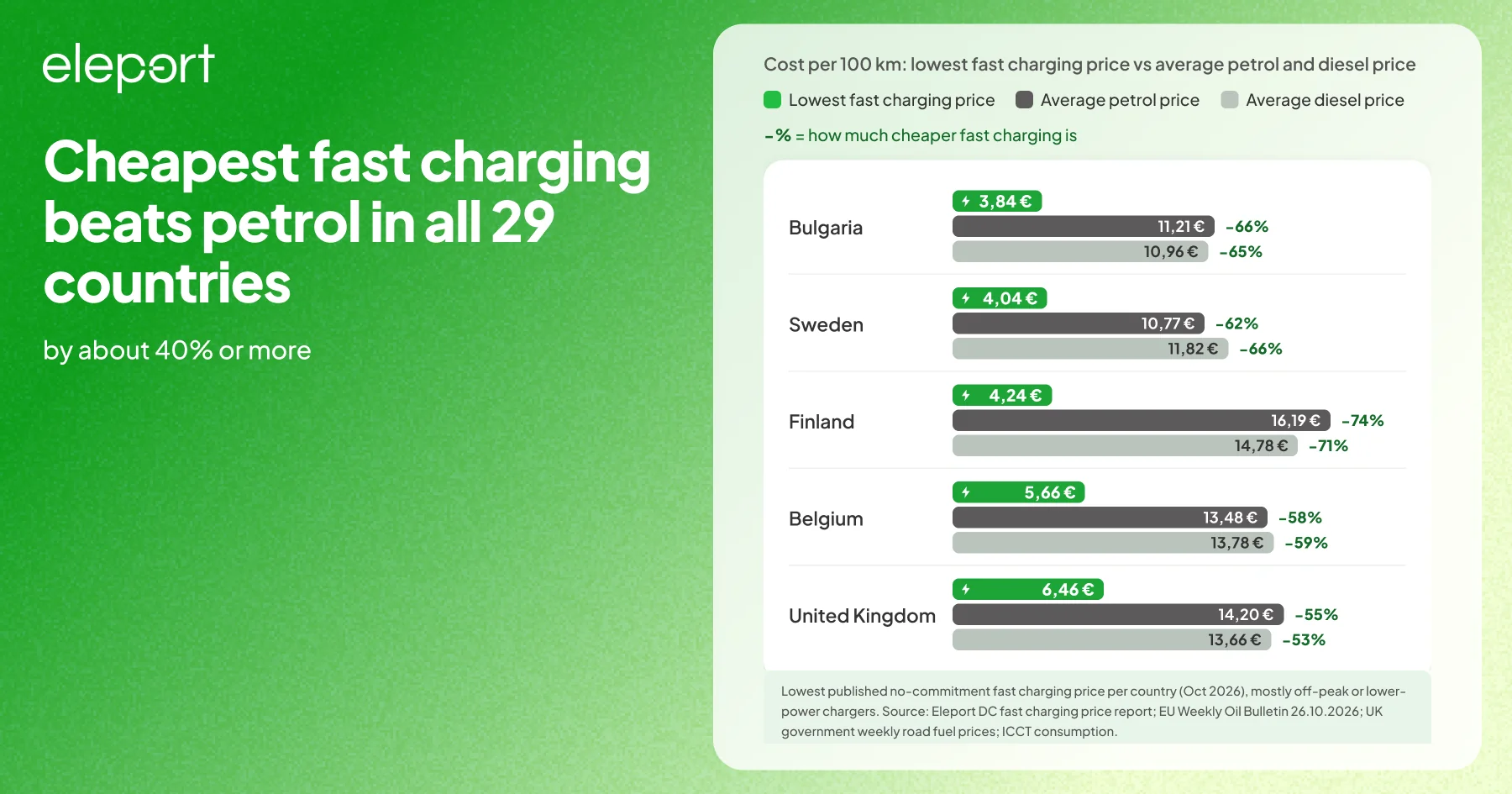
All of the above uses median electric car fast charging prices, so about half of the operators in each country charge less than the figure we used, as our network-by-network breakdown of how much does it cost to charge an electric car shows.
At the lowest published no-commitment price in each country, fast charging comes out cheaper than petrol in all 29, by about 40% or more. That includes the UK, Italy, and Poland. As a note, we’re not even taking the charging membership prices into these calculations, which would lower the charging costs further. Those floors are mostly off-peak hours or chargers with a lower charging speed, and the cheapest operator is not always the one on your route, but the option is there in every market we checked.
And then there is home charging, mostly slower AC charging, which this comparison leaves out completely. The EU average household electricity price was 28,32€ per 100 kWh in the first half of 2026, Eurostat’s latest figure, which puts 100 km at about 5,72€, which is 49% below the median fast charging cost, 57% below the median petrol cost for Europe and 54% below the median diesel cost of Europe. For drivers who can plug in at home, that is much closer to the everyday cost, which of course also varies greatly per country too.
Electric car fast charging has been talked about as only being for road trips and necessary top-ups, but now in most of Europe even that costs less than filling up, whether you charge with Eleport or on another network.
Methodology
Charging prices come from our October 2026 fast charging price report: the median of each operator’s best no-commitment price (ad hoc or free EV charging app) for DC fast charging at 50 kW and above, ultra fast charging included, VAT included, read in October 2026. Non-euro prices were converted at the European Central Bank reference rates of 15 October 2026.
Fuel prices are pump prices with all taxes included, the latest available from official sources when we put this together:
- 25 EU countries: the European Commission’s Weekly Oil Bulletin, Euro-super 95 and automotive diesel, prices of 26 October 2026.
- United Kingdom: the government’s weekly road fuel prices, week of 26 October 2026.
- Switzerland: the Touring Club Schweiz national averages of 23 October 2026.
- Norway: Statistics Norway’s monthly average for September 2026, the latest official figure.
- Iceland: our own average of the posted prices at 245 stations of the main Icelandic fuel chains, collected from the retailers’ websites by the open Gasvaktin project, as of 23 to 26 October 2026. Iceland has no official weekly average.
The four non-EU fuel prices were converted with the same exchange rates as the charging prices.
To turn both into a cost per 100 km we used real-world consumption figures from the International Council on Clean Transportation (ICCT). They are for a medium-segment car, the sales-weighted average of those registered in the EU in 2023 with SUVs left out, and come to 20,2 kWh of electricity, 6,9 litres of petrol or 5,8 litres of diesel per 100 km.
Those three figures stay the same for every country and both dates, so only the local price of energy moves. We also ran the October comparison with other published real-world consumption figures, including the EU’s own on-board monitoring data, and with none of them did fast charging come out ahead in fewer countries. The European figures are medians of the 29 country values, in line with the price report itself, and the European percentages compare those median costs.