Those of us already driving an EV know the answer to this question. The ones thinking of getting an EV might be wondering about it, and the naysayers are just going to state EVs don’t work in the winter, without relying on actual user ownership or test results.
We have both, so here’s our analysis on whether electric cars in winter still get you to work, to the summer cottage, or across the country once the frost settles in.
A battery does give up range in the cold, as anyone who has watched the range estimate on a January morning will tell you. So, do electric cars work in cold weather? The easiest example here would be Norway, where winters run long and cold. We all know by now that Norway has “done it” on the EV transition, with almost every new car sold there today being fully electric.
What really changes for electric cars in winter, in most cases, is how far you get on a charge. That depends on your EV technology, the temperature, your speed, how long your trips are and, more than most people expect, the heater.
We’ve pulled together fleet data from tens of thousands of cars and the two big winter tests of 2026, one at 0°C and one down to −32°C, to show what EV winter range looks like across the Nordics and the Baltics.
Much of the winter range penalty is actually energy spent warming things up, so most of the fixes are doable when learning how to best operate your EV in sub-zero temperatures.
Do EVs Work in Winter? Norway Already Shows the Answer
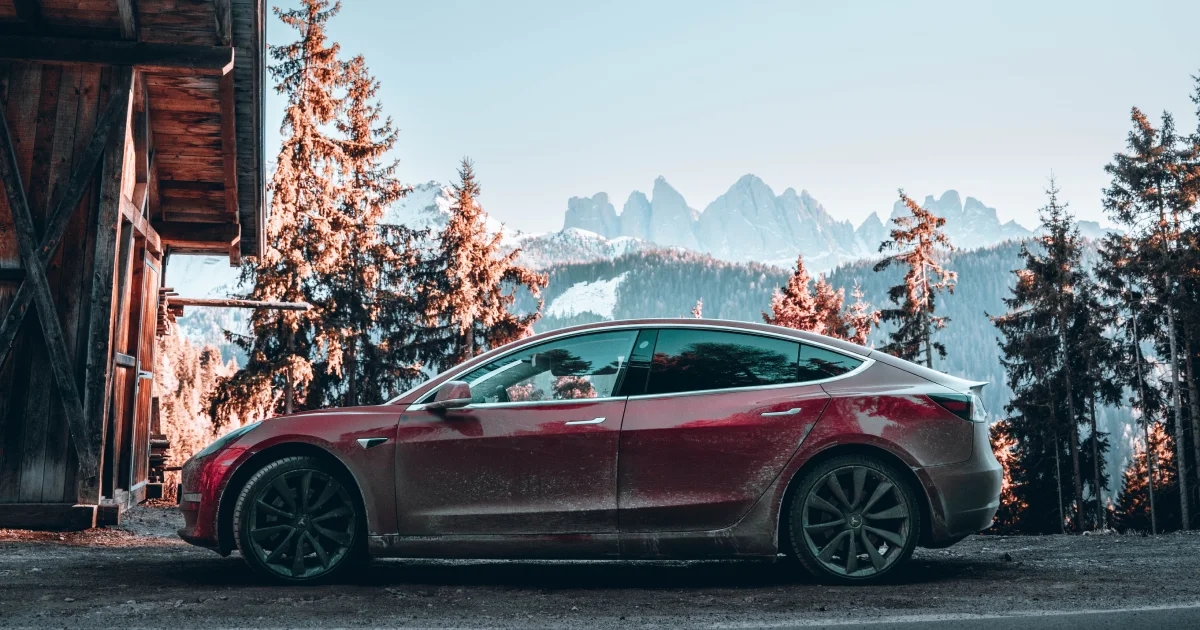
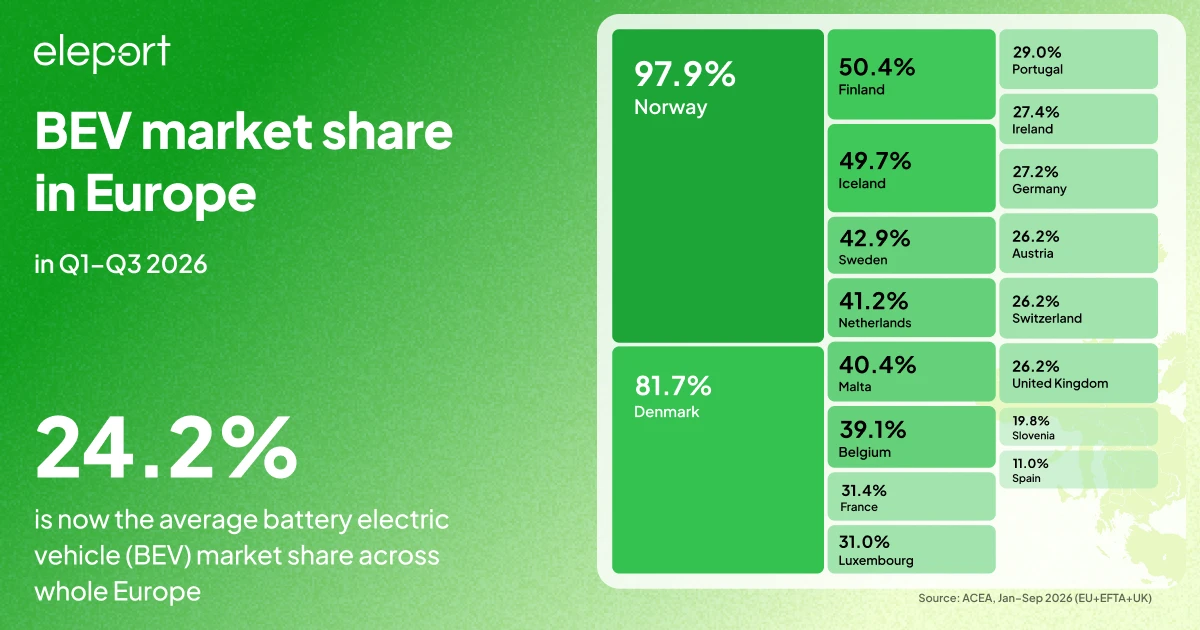
Norway is the obvious place to start. In 2025, 95,9% of all new passenger cars registered there were fully electric, according to the annual report of Elbilforeningen, the Norwegian EV Association. This year the EV market share in Norway has climbed even higher, to 97,9% in the first nine months and 98% through October.
Electric cars in Norway aren’t only an Oslo story, either. In Finnmark, the country’s northernmost county, 12 of 18 municipalities registered nothing but electric new cars in 2025. Nationally, 107 of Norway’s 357 municipalities reached 100%.
Norway’s neighbours are moving the same way. Our Q3 2026 EV sales report shows Denmark at 81,7% EV market share for the first nine months of the year, Sweden at 42,9% and Finland at 50,4%.
Tax breaks can explain some of Norway’s numbers, sure, but drivers in Finnmark keep choosing electric through Arctic winters, so the more useful question is how far electric cars in winter will take you.
EV Winter Range, Degree by Degree
Let’s start with the shape of the curve, because the range of electric cars in cold weather drops gradually with the temperature.
Telematics company Geotab analysed 5,2 million trips by 4200 electric cars and found the efficiency sweet spot at about 21,5°C. Between 10°C and 31°C, the cars typically drove at or above their rated range.
Below 10°C, however, the losses for electric cars in cold weather start building. Recurrent, which tracks battery data from owners’ cars, published its winter study in November 2025, covering more than 30 000 vehicles and 34 models in the US. Recurrent’s data shows EVs keep about 78% of their best warm-weather range at 0°C and about 70% at −7°C, a loss of roughly 22 to 30%.
How much range does an EV lose in winter? Somewhere around a quarter, give or take, on a typical Baltic winter day of around −3°C, and motorway speeds push the loss higher. But the EV model we are talking about here matters a lot. In Recurrent’s data, the best winter performer kept 88% of its range at 0°C, while the worst kept 69%.
Further down the thermometer, Geotab’s older fleet data, measured against rated range instead of each car’s best, showed cars averaging 54% of that figure at −15°C. Then again, the older fleet of EVs has a clearly reduced winter efficiency compared to today’s EV technology and battery thermal management, so I wouldn’t take a 46% drop as a rule at −15°C.
Here is what a Baltic winter looks like in the climate records. The Estonian Weather Service gives Tallinn a January average of −2,9°C and a February average of −3,6°C for 1991 to 2020, and the Lithuanian Hydrometeorological Service puts Vilnius at −3,7°C in January.
Latvia’s January averages −3,2°C across the country, according to a University of Latvia study of the same period.
Those averages hide the cold snaps, and they are where the bigger losses in electric car winter range come from: the lowest January reading at Tallinn-Harku over the same 30 years was −29,4°C. We’ve looked at the question of do electric cars lose charge in cold weather before, with road test data from Canada.
Why Electric Cars in Cold Weather Lose Range: Mostly, It’s the Heater
A combustion engine turns much of its fuel into waste heat, and in winter that waste warms the cabin almost for free. An electric motor wastes very little, so the warmth has to come out of the battery powering the heater.
The US Department of Energy’s fuel economy guidance puts figures on what happens to electric cars in cold weather. At −7°C an EV’s range can drop by 41% in mixed driving, and about two-thirds of the extra energy goes into heating the cabin. With the heater off, the range loss at the same temperature is about 12%.
Geotab notes that heating the cabin air can draw 3 to 5 kW, a big load for a car that is otherwise sparing with energy. Many EVs actually show the heater electricity draw in the car’s infotainment system, which is worth watching on any EV winter drive.
Short trips suffer most for electric cars in winter, for the same reason. Recurrent’s point is that warming up a cold car takes more energy than keeping a warm one warm. It follows that a short hop on a frozen morning costs proportionally more than a long drive.
The battery plays its part as well. Part of the energy in a cold pack simply isn’t available. Tesla’s Model S owner’s manual flags this with a blue snowflake on the instrument panel and shows the locked-away energy in blue on the battery meter. Until the pack warms, regenerative braking, acceleration and charging speed may all be limited.
Then come the losses every car, regardless of fuel type, feels in winter. The DOE lists denser cold air, which adds drag at motorway speeds, and lower tyre pressure, which adds rolling resistance whether you’re on summer or winter tyres.
Petrol cars aren’t spared either. The same DOE page says a conventional petrol car’s fuel economy in city driving is roughly 15% worse at −7°C than at 25°C, and up to 24% worse on short trips of five or six kilometres. A full tank and a fuel station on every corner just make that loss easier to miss, which is why it almost feels like it isn’t there.
Motorway Driving and Deep Frost: What the 2026 Winter Tests Found
Fleet averages blend everything together, so here are two EV cold weather tests from January 2026 to pick out the hard cases and find the model-by-model winners.
ADAC, Germany’s automobile club, sent 14 family EVs on a simulated Munich to Berlin run in a climate chamber set to 0°C. The cars averaged 111 km/h with the cabin at 20 to 23°C, after a night parked in the cold and with no battery preconditioning from the grid.
None of them covered the 582 km the test required without a stop. The Audi A6 Avant e-tron went furthest at 441 km and the Tesla Model Y managed 406 km, while the BYD Sealion 7 didn’t reach 300 km.
The Norwegian test went far colder. On 28 January, NAF and Motor took this year’s line-up north from Oslo for their El Prix winter test, starting at around −7°C in Oslo and passing −13°C by Lillehammer on the way to the coldest stretch near Folldal.
Do electric cars work at −30°C? Yes, though with a lot less range. The longest-range cars in NAF’s El Prix test kept driving through −32°C, and across all 24 new EVs the average came in 38% below WLTP range. The best two, the Hyundai Inster and the MG IM6, lost 29%.
The same test a year earlier, run between −6°C and +8°C, came in at 18% below WLTP on average, as NAF noted in its results. The line-up of cars was different, so the two years aren’t a like-for-like comparison.
The Lucid Air went furthest with 519 km, still 46% short of its 960 km WLTP figure, partly because it spent the longest time in the coldest air. The Inster, by contrast, stopped where it was −16°C, as its battery is smaller. NAF’s test chief Kjersti Stuestøl said that for a number of popular family cars, you should expect half the range when the real cold hits. NAF is an FIA member club, and Greenfleet’s write-up of the FIA winter test notes that most cars stayed reliable and comfortable despite the range drop.
Heat Pumps and Efficiency: What an EV Heat Pump Does in the Cold
An EV heat pump moves warmth in from the outside air instead of generating all of it through a resistive element, so it needs less electricity to heat the same cabin.
Recurrent found an EV heat pump adds roughly 10% range at 0°C compared with cars without one. The advantage fades as the temperature drops, and by around −18°C a heat pump performs much like an ordinary resistive heater.
ADAC came to its own EV cold weather conclusion after the Munich to Berlin run. Every competitive car in the field had a heat pump, and the club noted it is now standard on many models.
Efficiency counts just as much for electric cars in winter. In the same test, the Tesla Model Y used 22,2 kWh per 100 km and the BYD Sealion 7 needed 35,3 kWh. ADAC worked out that the BYD’s electricity for the same trip cost 60% more. For a ranked shortlist from last year’s El Prix, see our pick of the best EVs for winter driving.
Another worry about electric cars in cold weather that we see spread around is the battery itself.
Does cold weather damage an EV battery? No, not by itself. Winter range loss is temporary, and Recurrent says it does no long-term harm to the battery, so the range comes back as temperatures rise. What cold can do is make the car limit charging power and regenerative braking until the pack warms up.
However, leaving your EV parked in very cold weather without much battery charge for a long period of time might lead to some issues. Some EVs, like the Nissan Leaf, switch on a protective battery heater all on their own when the battery pack temperature has dropped really low.
How to Keep More of Your EV’s Range in Winter
Most of the fixes come down to timing. These are the ones that help electric cars in winter the most:
- Warm the car while it’s still plugged in. The DOE recommends preheating the cabin while charging, and Tesla’s Model S manual suggests scheduling preconditioning so the cabin and battery are warm by your departure time.
- Leave it plugged in at home when you can. Tesla says this keeps the battery warm with the charging system instead of the battery’s own energy.
- Use the heated seats and turn the cabin temperature down a notch. Using the seat warmers in place of the cabin heater is a way to save energy and extend range.
- Use battery preconditioning before a fast charge. On many modern EVs, setting the DC fast charger as your navigation destination heats the pack on the way. You can find Eleport fast chargers on the map in the Eleport App, and our guide to EV preconditioning explains how to trigger it.
- Plan any long EV winter trip with a bigger buffer. After its −32°C test, NAF advised drivers to expect to charge before they have driven half the car’s stated range when the real cold sets in.
So, Do EVs Work in a Nordic or Baltic Winter?
Yes, and the strongest evidence comes from the coldest corners of Europe, where EV drivers already show it every winter.
What winter changes for electric cars in cold weather is the distance. On a typical Baltic January day of around −3°C, plan for something like a quarter less range than on a warm day, more on the motorway and probably more on short trips that start with a cold car often.
In everyday driving around −7°C, about two-thirds of the extra energy goes on heating, which is why preheating on the cable, a heat pump and battery preconditioning before the charger win so much of it back.
For a daily commute, electric car winter range rarely decides anything. For a long EV winter drive to the other end of the country, it decides where you stop, and with a bit of planning that’s about all it decides.