
Eight weeks.
That is how long it took Tesla Full Self-Driving (Supervised) to go from its first European clearance in the Netherlands to five national approvals.
And the FSD Europe rollout is still picking up speed.
On 10 April 2026, the Dutch vehicle authority, the RDW, granted type approval for FSD Supervised, the first sign-off of its kind anywhere in the European Union. To explain briefly, the FSD Supervised is the latest Tesla driver assistance system, but it still requires the driver to pay attention to the road completely. Interventions happen, even though in some cases drivers can go months without needing to touch the steering wheel.
Since the launch in the Netherlands, the Tesla FSD Europe news has barely paused. Lithuania, Estonia, Denmark, and Belgium have each switched the system on, all of them leaning on that single Dutch decision and fast-tracking their own program thanks to it.
The bloc-wide vote that would make FSD legal across all 27 member states based on the Dutch approval, though, has not happened yet, and some trackers now expect it to slip into 2027.
The Tesla FSD Europe story now runs on two tracks.
National recognitions have cleared five countries since April.
The formal EU-wide decision, the one that would cover every member state at once, still has no vote due on the calendar.
In this article, we will map where the European approvals stand, explain how the actual mechanism works, weigh what the safety data does (and does not) show, and lay out what is keeping the rest of the continent on the sidelines.
Tesla FSD Europe Approval Status in June 2026: The Timeline
Anyone following the Tesla FSD Europe latest news 2026 has watched the map redraw itself almost weekly. The sequence is tight, and every step traces back to the same Dutch type approval.
The RDW itself was testing the system for 18+ months and over 250 000+ km, on the Lelystad test track, plus on the public roads. That was all done before the RDW results that were made public on the 10th of April, 2026.
Here’s the timeline for Tesla FSD Europe 2026:
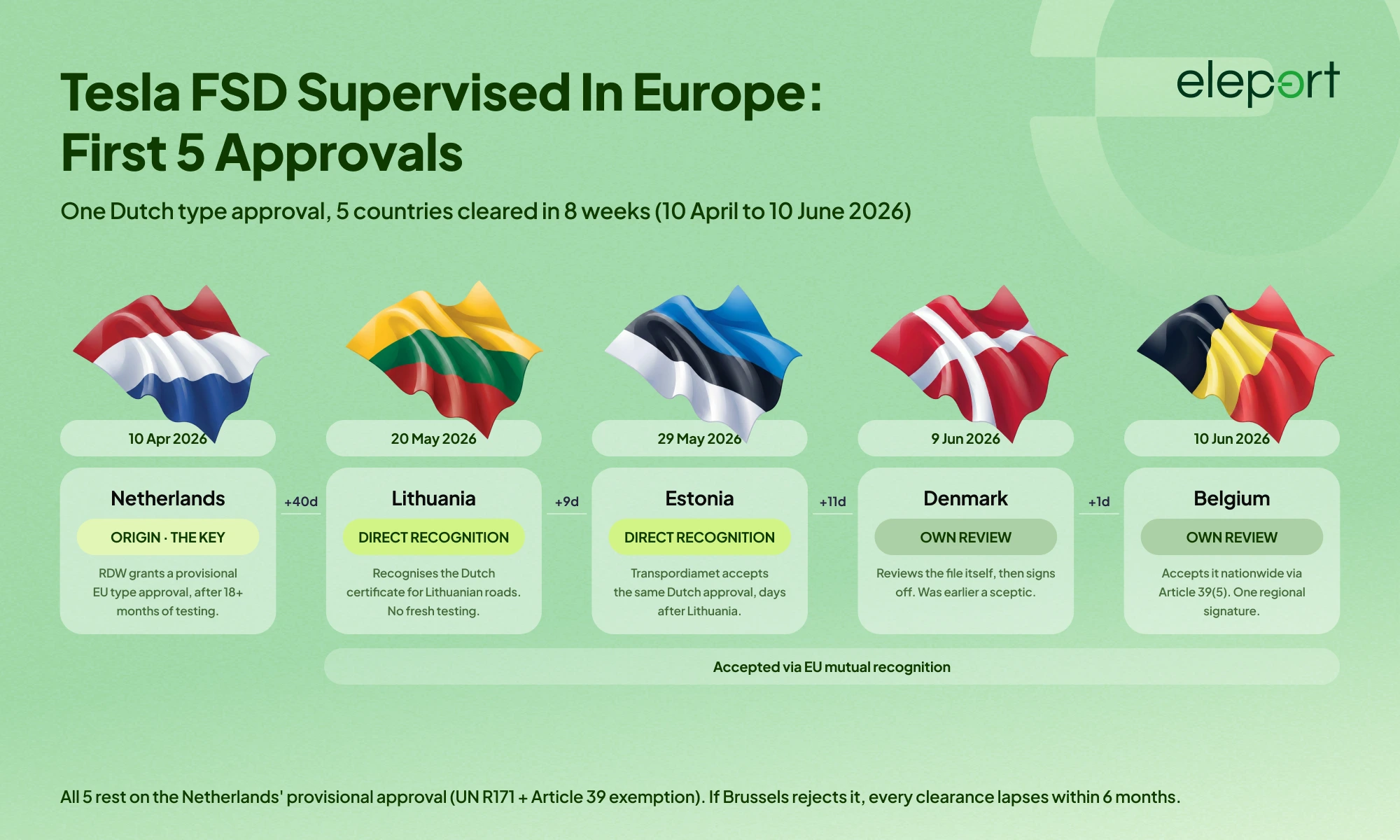
- 10 April 2026, Netherlands. The RDW issues a provisional EU type approval after more than 18 months of testing on its track and on public roads. First in Europe.
- 20 May 2026, Lithuania. The national transport authority recognises the Dutch approval for local roads, with no fresh testing of its own. Second.
- 29 May 2026, Estonia. The Transpordiamet accepts the same Dutch type approval, nine days after Lithuania and weeks after Tesla’s official market launch in the country. Third.
- 9 June 2026, Denmark. The Færdselsstyrelsen signs off after reviewing the technical file itself, having earlier counted among the system’s skeptics. Fourth.
- 10 June 2026, Belgium. The Flemish mobility minister accepts the provisional approval for the whole country, one day after Denmark. Fifth.
What makes the Tesla FSD Europe 2026 picture unusual is how little each new country had to do that wanted to fast-track their approval. The Netherlands carried the heavy load, namely the year and a half of testing that produced the original RDW approval. After that, Lithuania and Estonia simply recognised the Dutch certificate. Denmark and Belgium read the file first, then accepted it – Belgium through another 5000 km of testing of their own on Flanders’ roads.
How One Dutch Approval Unlocked Five FSD Europe Countries
The legal plumbing matters here, because it explains the speed.
The RDW cleared FSD Supervised under UN Regulation 171, the standard that governs what regulators call Driver Control Assistance Systems, or DCAS. It paired that with an exemption under Article 39 of Regulation (EU) 2018/858, the provision built for vehicle technology that does not yet fit the harmonised EU rulebook. The result is a type approval with provisional validity, issued by one member state.
The Tesla FSD Europe approval route hinges on exactly that.
Under EU mutual recognition, once one country grants a provisional type approval, others may accept it on their own territory without repeating the testing.
Belgium’s mobility minister spelled it out in her signed decision, accepting the provisional EU type approval under Article 39, point 5, of the same regulation, on the condition that the driver stays responsible at all times. Because vehicle homologation in Belgium runs through the regions, a signature in Flanders carried it to the FSD Europe map as for the entire country.
So the national fast lane is real, and it is quick. What it is not is permanent, which might come as a surprise to most. Every clearance granted this way is tied to the Dutch certificate, and that certificate is provisional until Brussels rules on it. Five countries have chosen the shortcut. The rest are waiting for the main road to open, and if it doesn’t and is rejected…
What FSD Supervised Is, and What It Is Not
Worth being precise here, because the name Full Self-Driving (FSD), even if there’s an added “Supervised” to it, does a lot of unearned work.
FSD Supervised in Europe is officially an SAE Level 2 system. The car can start from a parked position, change lanes, take roundabouts, follow navigation through junctions and stop at a destination, but the driver supervises throughout and, importantly, stays legally responsible for the vehicle. Cabin sensors check that your eyes are on the road and your hands can retake the wheel within moments. Ignore the prompts and the system escalates its warnings, then locks you out.
In legal terms, that puts it alongside hands-off highway features Europe already cleared, including BMW’s motorway system with automated lane changes and Ford’s BlueCruise, the latter approved through the same Article 39 mechanism.
Even though RDW said, in their own press release, that “the system is safer than other driver assistance systems.”
The RDW made a second point that Tesla FSD Europe owners often miss: the European build is not the American one. EU cars run different software versions tuned for local signage and traffic rules, so the US release and the EU release are not directly comparable.
Access to the system for Tesla owners is a subscription. In the markets where it is live, Tesla FSD Europe, of course with the term Supervised next to it still, runs at 99€ a month, with a reduced 49€ rate for owners who previously bought Enhanced Autopilot. The one-time purchase option is not available anymore in most countries for Tesla FSD Europe. The approval so far covers only cars fitted with Tesla’s Hardware 4 computer, which leaves owners of older vehicles without a direct path to the feature for now – even though Tesla is saying they’ll release a FSD V14 “Lite” version this summer.
The Safety Numbers Behind the FSD Approvals
Every regulator that signed off pointed to the same conclusion the RDW reached after its 18 months of testing: used as intended, the system is “safer than other driver assistance systems,” because it monitors the driver continuously. The Danish authority reached the same view from the same file.
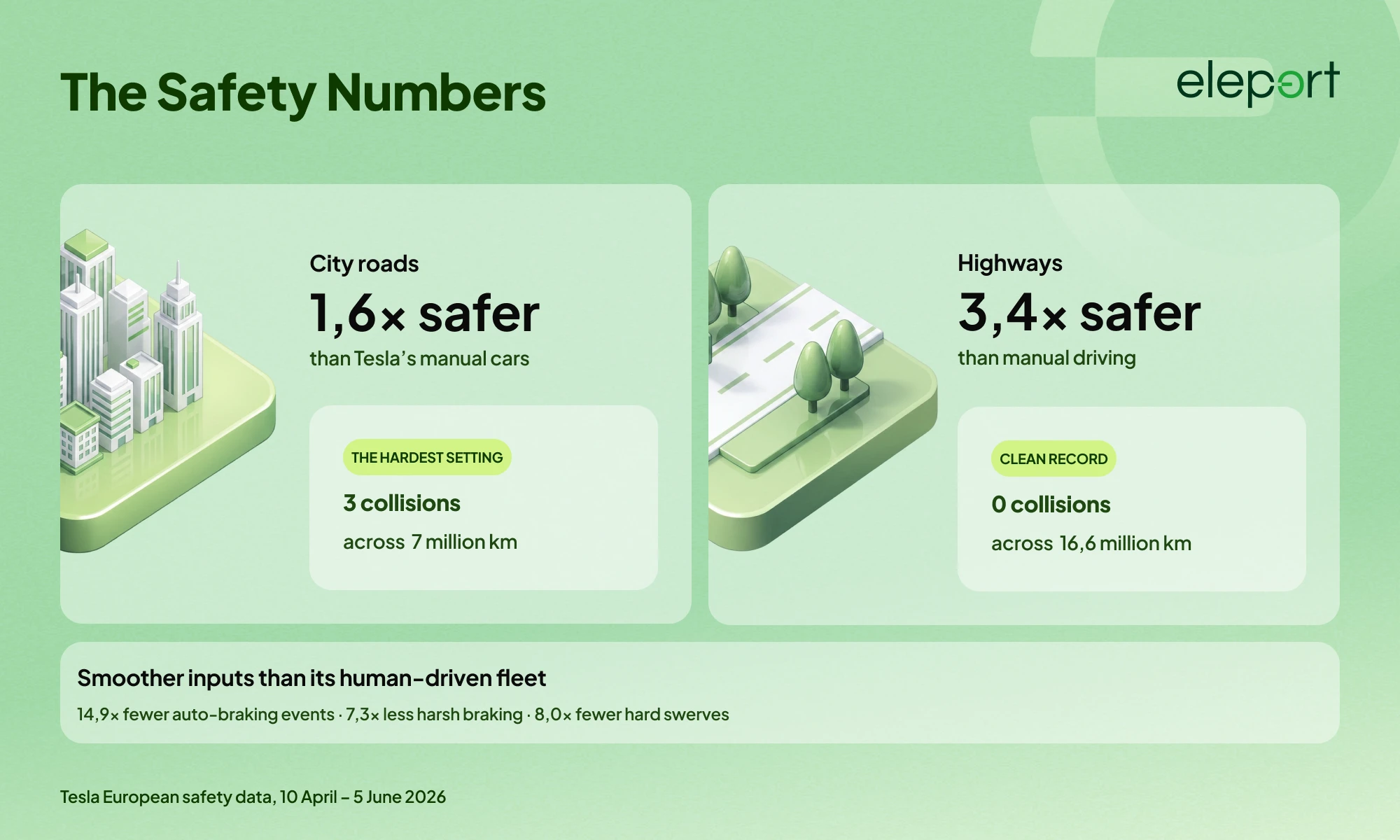
Tesla has since published its first European safety statistics, drawn from Dutch driving between 10 April and 5 June 2026.
- On non-highway roads, so urban roads – the hardest setting, the fleet logged three collisions across 7,0 million km (4,35 million miles), which Tesla says is 1,6x safer than its manually driven cars on the same roads.
- On highways, it recorded zero collisions over 16,6 million km (10,31 million miles), or 3,4x safer than manual driving.
- The company also reported smoother inputs:
- 14,9x fewer automatic emergency braking events,
- 8,8x less harsh acceleration,
- 7,3x less harsh braking and
- 8,0x fewer hard swerves than its human-driven fleet.
Treat those figures with care.
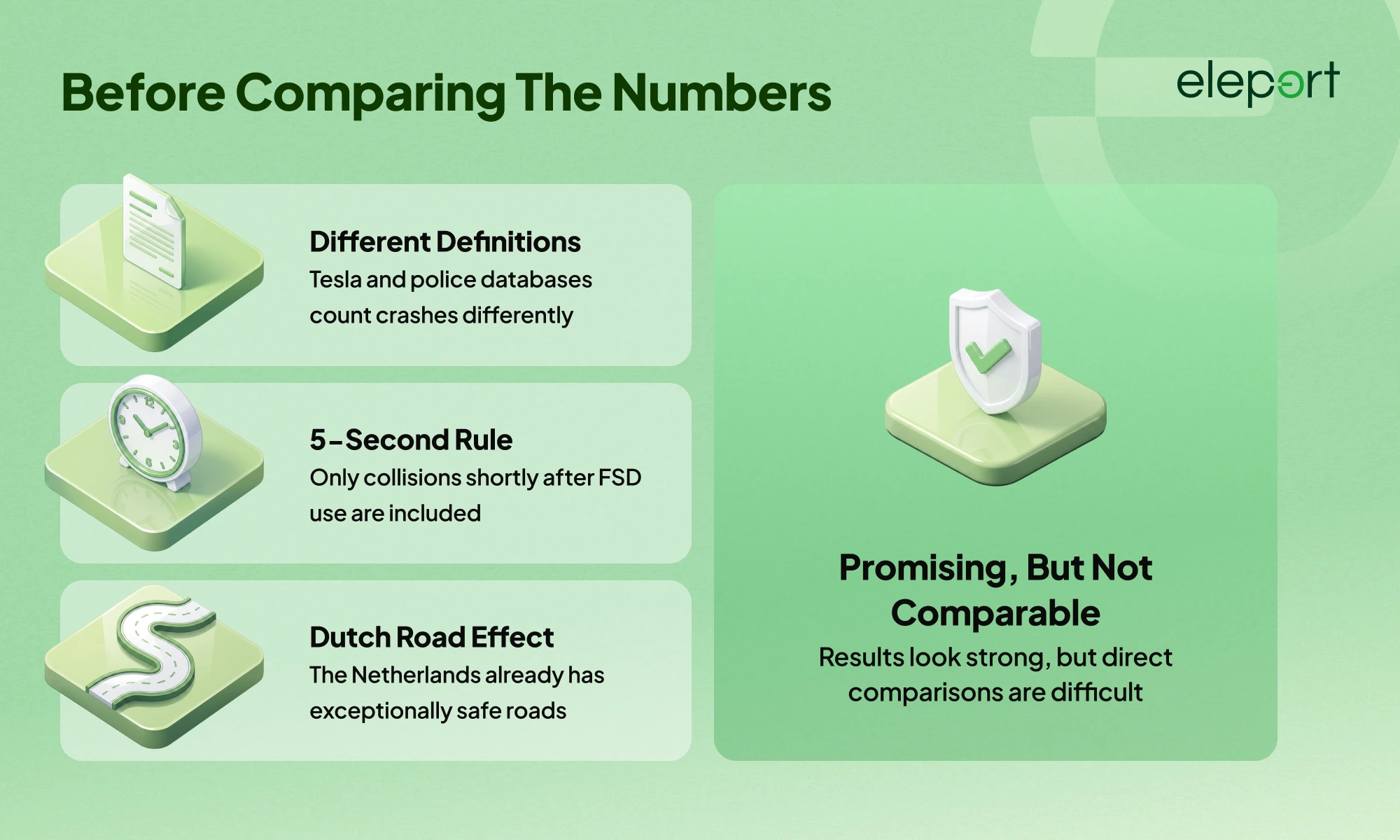
They are Tesla’s own, the urban cases come with little detail, and Tesla counts a collision only when FSD was active within five seconds of impact, which is a different basis from police-registered crash data. However, one should also note that Dutch roads are one of the safest in the world, which means the safety multipliers are especially weighted here and would likely translate to even bigger wins elsewhere (Tesla claims ~7x win in the US).
The non-highway 1,6x safety stats are the more grounded read on where the system stands than the highway banner. The sharpest Tesla FSD Europe news of the cycle came from a mid-June Reuters report, which argued that Tesla had shown regulators flattering US marketing figures. The RDW’s reply was blunt: it does not decide on marketing claims or outside statistics, only on its own tests on tracks and public roads.
Why Is the Rest of Europe Still Waiting for FSD?
The Tesla FSD Europe status 2026 splits along a clear line.
The countries that moved are mostly small, willing to recognise the Dutch certificate and switch the system on within days.
The big markets are not playing that game, and that gap now shapes the Tesla FSD Europe experience for most owners. Germany, France, Italy, Spain and the Czech Republic have signalled they would rather wait for a coordinated EU decision, than grant a national clearance that Brussels could later overturn.
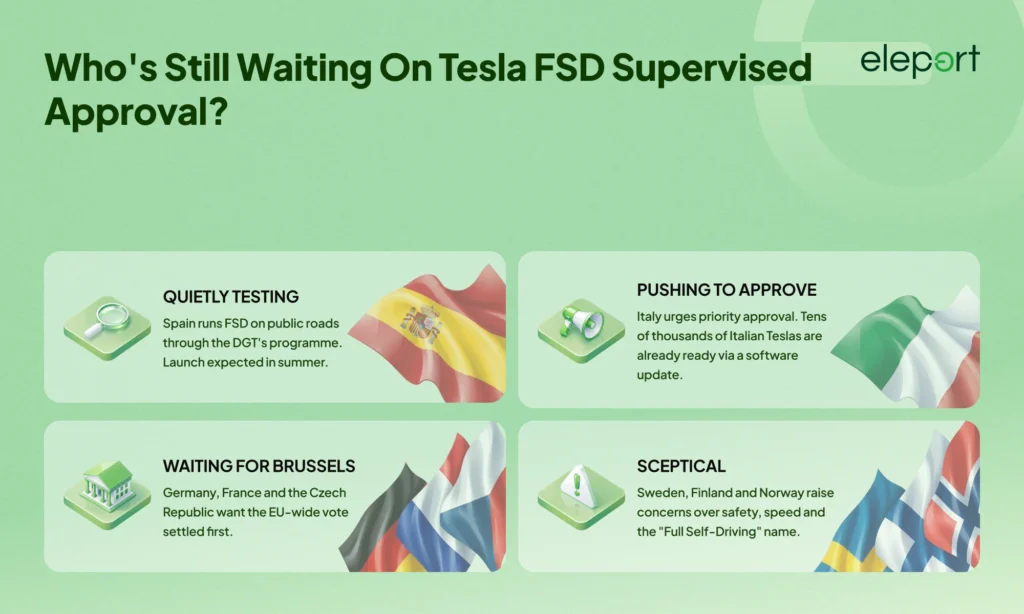
Waiting does not mean idle. Spain has Tesla running FSD Supervised on public roads under the DGT’s ES-AV automated-vehicle testing programme, a fleet that grew from 19 cars to around 30 and has covered some 80 000 km since November 2025 with no reported incidents.
The country can wave the system through on mutual recognition once the test programme closes, and a commercial launch is expected before summer.
Italy sits on the cautious list officially, yet the pressure there runs the other way. In April the senator Carlo Calenda filed a parliamentary question urging the transport minister to prioritise approval, noting the tens of thousands of Italian Teslas already carrying the hardware.
There is also genuine skepticism, concentrated in the north.
Sweden, Finland, Norway and, until its sudden reversal, Denmark all raised concerns at the European level. Their objections were specific: FSD’s habit of nudging over posted speed limits, its behaviour on icy roads, and whether a name like “Full Self-Driving” oversells a system that still needs a human in charge.
A Swedish investigator put it on record this spring that he was surprised Tesla let the software speed at all. Denmark’s later about-face, after it read the technical file in full and decided to launch the system nationally, is exactly why each Tesla FSD Europe approval lands as news every time a country goes for adoption.
The politics is sadly also still a part of the puzzle and it all feeds into the upcoming EU vote. A bloc-wide yes needs a qualified majority, and the largest member states carry enough population weight to shape, or stall, the outcome. As long as Germany, France and Italy prefer to wait, the continent-wide answer waits with them.
The EU-Wide Vote: Timeline and the Six-Month Clock
So when does the EU-wide decision on Tesla FSD in Europe land? It will likely not happen on the 30th of June, the date many owners and news outlets have circled. The RDW notified the European Commission on 13 April and presented its Article 39 file to the Technical Committee on Motor Vehicles, the TCMV, on 5 May.
The committee’s 30 June meeting carries the topic for further discussion, but no vote is scheduled. The committee meets only every few months, so the next realistic window is autumn, with October or December. This means that a full European Union FSD (Supervised) recognition could slip into early 2027.
The bar is high by design. Approval needs a double majority, so at least 15 of the 27 member states representing 65% of the EU population.
Here is the part that Tesla owners should consider, even though they might have the system available today:
The Dutch certificate is provisional, and the Danish authority was candid about what that means: if the Commission ultimately rejects the system, the Dutch approval lapses after six months, and every national clearance built on it falls too.
FSD Supervised would then no longer be permitted for sale anywhere in the EU. That clause is why there is no single Tesla FSD Europe release date 2026 to point to.
It keeps the whole Tesla FSD Europe timeline provisional until Brussels rules. The Tesla FSD Europe approval 2026 cadence has been fast at the national level precisely because the binding decision, the one that removes the six-month risk, is the slow one still ahead.
Beyond the European Union: The Non-Members and the Competitive Picture
The EU is not the whole map here, not actually.
The United Kingdom left the bloc and cannot recognise the Dutch certificate automatically, so its Vehicle Certification Agency has to run its own assessment, with a supervised launch flagged for sometime in 2026.
Norway, where Tesla was the best-selling carmaker (of any kind, and yes they almost exclusively sell EVs now over there) in early 2026, runs its own EEA process and has signalled it expects something like the review it once ran for Ford’s BlueCruise, without committing to a date.
Switzerland sits outside the framework too.
Within the EU, Greece is reported to be moving quickly, and Tesla is in talks with Ireland, too.
The timing is striking for another reason. Just as Tesla’s Level 2 system spreads, two of its rivals have retreated from the level above.
Mercedes-Benz paused its Drive Pilot Level 3 feature from upcoming S-Class and EQS facelifts, and BMW dropped its Personal Pilot Level 3 system, with both pivoting toward Level 2+ approaches that compete more directly with Tesla.
For now, that leaves FSD Supervised as the most capable driver-assistance system widely available on European roads, a position won as much by others stepping back as by Tesla stepping forward.
Globally, Tesla says roughly 1,3 million vehicles already have FSD access and is chasing approval in more than 30 countries. An unsupervised version of this same software is what drives Tesla’s robotaxis, so the approval fight is also the opening move in a broader robotaxi rollout already taking shape across the continent for 2026. Europe is the prize, and the FSD Europe push is the part of that map still being drawn.
What’s next for FSD in Europe?
The next chapter of Tesla FSD Europe will be written in Brussels, not in another national capital. Whatever the committee decides, it will define Tesla FSD Europe 2026 more than any single national approval has. The fast lane has done what it can, namely five countries live inside two months, and it could add a few more before the autumn. But the national approvals are borrowed, each one resting on a Dutch certificate that the Commission can still confirm or void. A “yes” turns the current five scattered clearances into one continent-wide green light and removes the six-month cloud hanging over every owner who subscribed. A no unwinds it all.
Until that vote, there is no clear answer. Owners in five countries are already driving with the system today, while the drivers in Europe’s largest markets wait on a committee that has, so far, only agreed to keep talking.