If you are, like us, interested in EV industry advancements and EV battery tech, you’ll quickly find we live in really exciting times.
We’ve seen all kinds of technologies pushed off the press circuit for years now, sometimes materializing, but sometimes seemingly left as “future technology” forever.
However, in 2026, we have reached quite a few new milestones in both EV battery technology and EV charging technologies worth celebrating. We’re finally seeing them on the road. New technologies, charging at Eleport charging stations, or anywhere else. Or at the very least, we’re seeing them just about enter our EVs on the roads, not still behind the curve.
Let’s take a look at the electric vehicle battery technology that matters in 2026, the manufacturing shift quietly making cells cheaper, and what all of it changes for the way you charge.
What counts as new EV battery technologies in 2026
Search for the latest battery technology on the internet, and you will drown in claims.
Every week brings another headline about the newest battery tech or some new battery tech that will supposedly end range anxiety forever. Most of it is a roadmap. Very little actually enters the EVs that we see around us.
The list of what you would find when searching for new battery technologies breakthroughs 2026 are… mostly noise. The list that actually matters only runs three names long:
solid-state,
sodium-ion and
silicon anodes.
Those are the new battery technologies 2026 delivered, each crossing a real line this year, whether into a buyable vehicle, a mass-production date with a name on it, or a public charging rollout. Everything else, lithium-sulphur, lithium-metal beyond the first niche cars, lithium-air, sits further back.
The other thing to keep straight is what a breakthrough even means. It is not always a new chemistry. Sometimes the new battery technology that moves the needle is a cheaper way to build a cell you already know, and that one shows up directly on a price tag.
That, more than any single new EV battery tech, is what changed in 2026.
Solid-State: now out of the labs and on our roads.
A Mercedes-Benz EQS drove 1205 km from Stuttgart to Malmö without stopping, in August 2025, using new battery technology: lithium-metal solid-state cells from US maker Factorial. Those cells were developed with Mercedes-AMG’s Formula 1 powertrain unit in Brixworth.
Mercedes-Benz says the pack holds about 25% more usable energy at a weight and size close to the standard EQS battery, and it wants the technology in series production by the end of the decade. The route ran on ordinary highways through three countries, not a closed test track, which is the part that matters.
Why use solid-state batteries? Solid-state swaps the flammable liquid electrolyte for a solid one. The payoff is more energy in the same space, better safety, and the headroom for long range. The catch has always been building the things at volume.
Plenty of other makers are pushing, some already further ahead compared to Mercedes.
China’s Ganfeng has started small-scale production of a solid-state cell it rates at 500 Wh/kg, while GAC-backed Greater Bay Technology rolled out all-solid-state A-sample cells and is targeting gigawatt-hour production this year.
The first production vehicle on a solid-state pack is however, oddly, a motorcycle.
The Verge TS Pro, from an Estonian/Finnish firm, runs cells from Finnish startup Donut Lab. The claims (400 Wh/kg, five-minute charging, 100 000-cycle life) drew open scorn from battery scientists, with one rival chief executive saying flatly that such a battery does not exist.
A March pack-level test from a respectable lab, however, did sustain 100 kW for five minutes in a real bike, so something is happening there. Just remember it is a low-volume motorcycle, not a car you can warranty for a decade. No carmaker has matched it in a passenger EV yet.
Sodium-Ion batteries go mainstream
The cleanest story in new EV battery technology this year that actually hits the road is sodium-ion batteries.
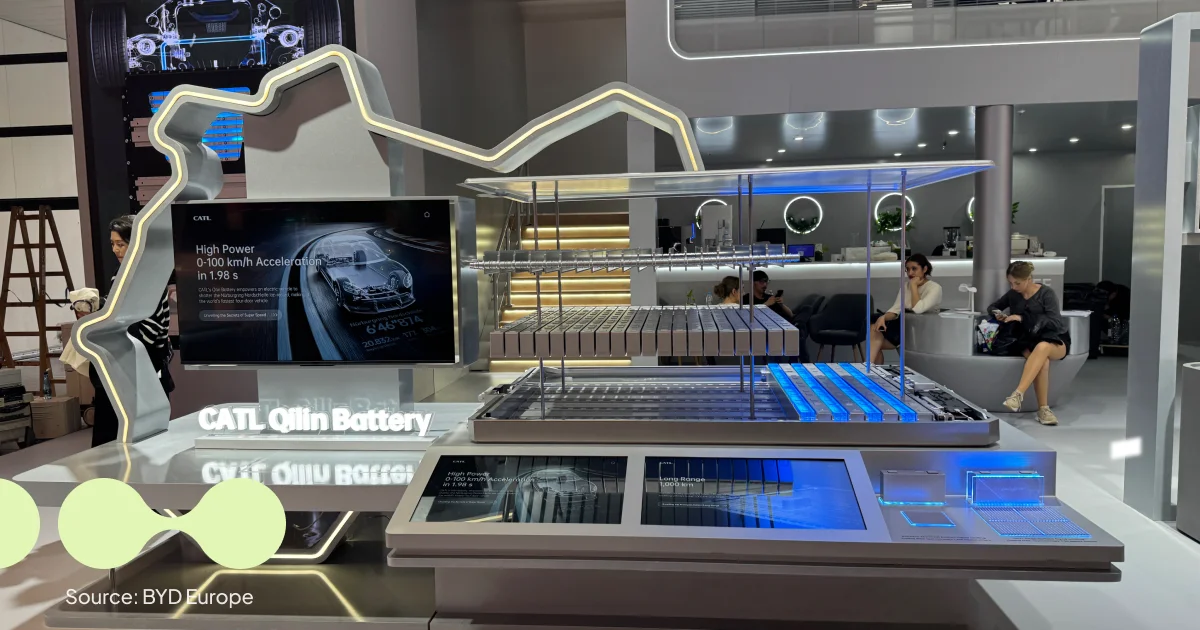
In February, CATL (the world’s largest battery maker) and Changan unveiled the Changan Nevo A06, the world’s first mass-production passenger EV running a sodium-ion pack, with mass production of the cells due by the end of 2026.
CATL’s Naxtra cell sits at about 175 Wh/kg today, close to lithium iron phosphate (LFP), and the company is targeting LFP-level density within three years to reach around 600 km of range.
Sodium’s energy density still trails lithium, so the pull is elsewhere. It runs on abundant sodium rather than lithium, cobalt and nickel, which keeps costs of this new EV battery technology even further down.
Importantly, sodium ion also performs better in the cold. The Nevo A06’s pack keeps working from −40°C to +70°C, a huge operating range for the new EV battery technology.
CATL says the discharge power at −30°C is nearly three times that of an equivalent LFP cell, the battery holds about 90% of its capacity at −40°C, and it can still take a charge when frozen solid. For a Tallinn February or a Helsinki taxi shift, that is a bigger deal than a few extra kilometres on paper.
Is CATL the only one with this new EV battery technology, sodium ion? No, BYD’s third-generation sodium cells, meanwhile, claim to be usable for more than 10 000 charge cycles.
Sodium will not replace lithium at the premium end any time soon, but for cheap, cold-climate, city-range cars, it is arriving fast as one of the new battery technologies in common use.
Silicon Anodes And The Energy-Density Race
If solid-state is the long game, silicon anodes are the upgrade happening right now, inside cars you can order.
The new Mercedes-AMG GT 4-Door Coupé, built on the AMG.EA platform, uses a silicon-containing anode paired with an NCMA cathode to reach 298 Wh/kg at cell level. That is the high end of today’s lithium-ion. That chemistry lets it charge at 600 kW and go from 10% to 80% in about 11 minutes, the fastest charging from any Western carmaker. Production starts at Sindelfingen in summer 2026.
Silicon stores far more lithium than the graphite anodes in most cells, which is why it boosts both range and charging speed. The problem is that silicon swells by roughly 300% as it charges and shrinks as it drains, which cracks a pure-silicon anode apart. Today’s answer is a silicon-graphite blend, with the share of silicon creeping up over time.
There is a European supply-chain angle here, too.
The Netherlands’ LeydenJar and Germany’s NorcSi are both scaling silicon-anode production in 2026, while US players Sila and Group14 ramp up volume. Graphite is overwhelmingly processed in China, so a shift toward silicon is partly an industrial hedge, not only a performance one. The appeal of this new EV battery technology is that it needs no new car platform to reach you. It drops into existing designs as the cells mature.
Cheaper batteries, not just better ones
Here is the breakthrough that rarely makes the splashy headlines and matters most to your wallet. Battery prices are falling, by a lot.
How do we know battery prices are falling? According to BloombergNEF’s 2025 battery price survey, which polls hundreds of companies from the real industry rather than guessing, the average lithium-ion pack fell 8% to a record-low $108 per kWh in 2025, now 93% cheaper than in 2010.
Packs for battery-electric cars came in at $99 per kWh, the second year under $100.
The catch for European drivers is geography. Average pack prices in China were $84 per kWh, while Europe ran about 56% higher. That’s a big reason an EV here still costs more than the petrol equivalent. BloombergNEF expects another small drop in 2026, and points to silicon, lithium-metal and solid-state as the next wave of cost cuts.
The new battery technologies in this article are not just about range. This wave of new EV battery technology is about price, too.
Manufacturing is part of that story. Tesla confirmed on its January 2026 earnings call that it is now making 4680 cells with both anode and cathode using a fully dry electrode process in Texas, and putting those packs in some Model Y cars.
The dry process skips the wet, solvent-heavy coating step, which reduces factory space and cuts costs. How much it cuts is contested: Elon Musk pushed back in May on talk that it would halve battery cost, saying it would significantly reduce cathode production cost rather than the whole pack. The promising new battery technologies rarely give you the landslide win that is first speculated.
The dry cathode had resisted mass production since 2020 when it was hailed as one of the new battery technologies, so finally cracking it is real progress, even if it is not the cheap-car miracle once promised. Cheaper LFP and sodium pull in the same direction. The result is a new battery technology for electric cars that you’ll actually notice – in the cheaper sticker price.
Charging catches up: megawatt and five-minute top-ups
Bigger, faster batteries are pointless if charging cannot keep pace.
That gap is closing fast, and most of the year’s loudest EV charging news has come from it.
BYD has absolutely set the pace in the industry for now.
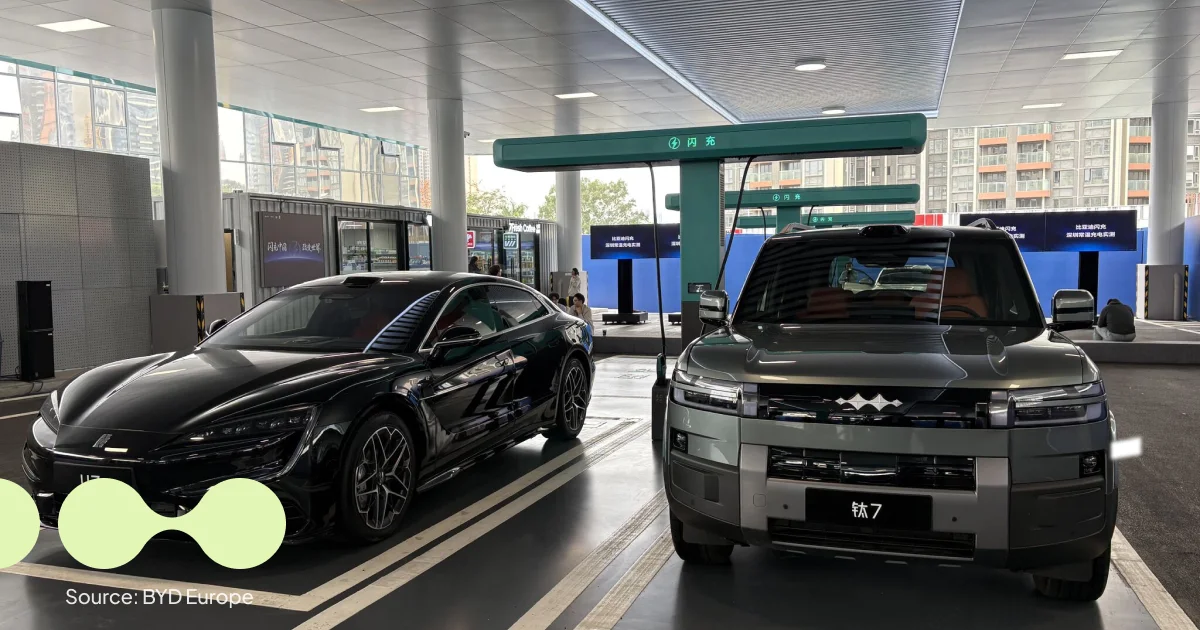
Its Super e-Platform and BYD Flash Charging technology run at 1000V and can hit megawatt-class power, adding around 400 km of range in five minutes on the home-market cars.
In April, BYD brought it to Europe with the launch of the Denza Z9 GT in Paris, a 115 000€ shooting brake that recharges from 10% to 80% in about six and a half minutes.
BYD says it plans 3000 flash-charging stations across Europe within a year, open to any car with a CCS2 plug, starting in Germany, France, Italy, Spain, the UK and the Netherlands. For the full picture, Eleport’s guide to BYD Flash Charging in Europe breaks down how and where
Among the EV charging innovations 2026 has delivered, this is the one you’ll be sure to notice.
The Mercedes-AMG GT’s 600 kW sits just behind this, and it is the fastest a Western brand currently offers. To put that in context, most European fast chargers still top out between 150 kW and 400 kW, with new 600 kW units only starting to appear. One quick clarification, since the term is often confused: the Megawatt Charging System (MCS) you read about is a separate standard for trucks and buses. Passenger cars stay on CCS2 in Europe, even for megawatt charging levels.
Wireless charging is also inching forward. The Porsche Cayenne Electric is the first production EV with factory-fitted inductive charging, at up to 11 kW from a floor plate. Think of it as a home-convenience feature rather than a fast-charging one. No other production car has confirmed it will follow yet, so treat wireless EV charging as a real but slow-moving niche for now.
What It Means For European Drivers
Strip away the chemistry and the practical question for you is whether an EV fits where you live. Across more of Europe, the infrastructure now says – it does.
According to the IEA’s Global EV Outlook 2026, the Netherlands ended 2025 with 210 000 public charging points, ahead of Germany at 196 000 and France at 185 000. The most striking growth, though, was on the eastern and northern edge of the continent.
Five EU countries grew their public charging networks by more than 50% in a single year: Denmark, Estonia, Latvia, Lithuania, and Romania, partly helped by the EXPAND-E programme and its more than 70 million euros across 23 member states. If you follow EV charging infrastructure news, you’ve also seen Eleport expand significantly throughout the Central and Eastern Europe.
The chargers are also getting faster.
A 2026 charging report from gridX found ultra-fast points (150 kW and up) now make up 11,8% of Europe’s public network, up from 9,4% a year earlier, with DC capacity growing 38,5%. AFIR, the EU rule that mandates high-power charging every 60 km along major highways, is pushing that build-out. So the latest EV battery technology and the chargers to feed it are arriving together at the same time, which… has not always been true.
Line up the new battery technologies 2026, and the pattern is clear.
Solid-state has gone from a lab curiosity to a Mercedes crossing three countries on a single charge. Sodium-ion, the new electric car battery technology that looks like it’s built for a proper European winter, is about to put cheap cold-weather cars on sale. Silicon anodes are already in showrooms, quietly buying back range and minutes at the plug.
Underneath it all, battery prices, and thus EV prices, keep falling. If you have been holding out for the next EV battery update before you switch, this is the year the waiting stopped paying off. Plenty is still a year or two away, but significant battery and charging innovations have already arrived.