The question that started with the modern era of EVs is still relevant today, even if several parts of the equation have changed over time.
Usually, everyone who answers this big cost comparison question has an opinion or a number, depending on who you ask, yet almost nobody has a source for the claims.
Some of it comes from a neighbour’s electricity bill, the rest from a headline about a battery replacement that cost the price of a small flat and got passed around the office for a week. So we went looking for the direct verifiable math for 2026 instead.
Let’s start with the bad news, because it is the first thing anyone sees.
Are electric cars more expensive to buy than the petrol equivalent?
Across Europe, on average, still yes. However, the purchase price gap has visibly decreased.
What happens afterwards is where it gets interesting. Energy, servicing, insurance, tax and resale value pull in different directions once the car is yours, and the electric car vs petrol car comparison only means anything added up across years, not weeks.
That is the real question underneath every version of this argument. Are electric cars cheaper to run once the purchase price is behind you, and is it cheaper to run an electric car by enough to notice?
Below, we’ve gathered all 2026 numbers you would need to land on a final result, some of the insights helped by our recent exclusive EV charging cost versus fuel prices analysis.
So Are Electric Cars More Expensive To Buy In 2026?
Yes, mostly, and pretending otherwise helps nobody. However, that’s just for the new EVs.
The useful part here is the direction of the gap.
JATO Dynamics found battery electric vehicles (BEVs) were 53% more expensive than combustion cars in 2018, and “just” 22% more expensive in 2024.
Electric prices fell 15% over that stretch while combustion prices rose 7%.
However, make sure to check whether there are any purchase incentives available in your country, often designed to take the EVs more towards purchase parity with ICE cars.
Importantly, the used market has already flipped.
BEUC, the European consumer organisation, concluded in September 2025 that battery electric cars are already the cheapest option for used-car buyers, with new medium cars following from 2026.
There’s some small print, though: that study covers leasing and energy only, leaving out maintenance, insurance and tax, which is the ground the rest of this article walks over.
Electric Cars Are Cheaper To Run Based On Energy Alone
This is the section that settles the core of the whole electric car vs petrol car argument, so we will show the core calculations on it.
Are electric cars cheaper than gas? For the basis, here are the average consumptions:

A European electric car uses about 21 kWh per 100 km on the road, the average across 342 electric models sold in Europe in a 2024 study in the journal Sustainability.
A petrol car burns roughly 7,4 litres over the same distance and a diesel about 6,8, both derived from the EU’s on-board fuel consumption monitoring, which runs about a fifth heavier than the official test cycle.
Now the prices.
Household electricity across the EU averaged 28,96€ per 100 kWh in second half of 2025, the most recent half-year Eurostat has published, with Hungary at 10,82€ and Ireland at 40,42€ at the extremes.
Fue prices comes from the European Commission’s Weekly Oil Bulletin.
For the week ending 10th of August 2026, so the very recent find for this article, the EU average sat at 1,91€ per litre for Euro-super 95 and 2,01€ for diesel.
So here it is, the cost of running electric car vs petrol, stripped down to energy and nothing else:
- Home charging: 6,08€ per 100 km
- Diesel: 13,69€ per 100 km
- Petrol: 14,14€ per 100 km
The cost to charge an electric car at home comes to 43% of what the same distance costs in petrol. In imperial terms, roughly 10 cents per mile against about 23 cents per mile.
At an average driver’s run, about 15 000 km a year, that is 912€ of electricity cost against 2121€ of petrol. A gap of 1209€ if only home charging, every year, just on the energy cost.
Of course, since this is an average, you’ll find larger or lesser wins based on each country, and you can calculate the differences per country from the links above.
Most EV owners don’t charge only at home, though.
Public charging narrows the gap, without closing it. Our own EV charging prices start at 0,29€/kWh on AC in Estonia and Lithuania, which works out at 6,09€ per 100 km, effectively identical to the EU average for home charging.
Fast charging on the standard tariffs runs from 0,32€/kWh in Estonia to 0,56€/kWh in Croatia, so 6,72€ to 11,76€ per 100 km depending on the market and the charger. Still under both of the fossil fuels.
EVs Can Even Be Cheaper To Run If Only Fast Charging
What happens to the EV savings if you cannot charge at home?
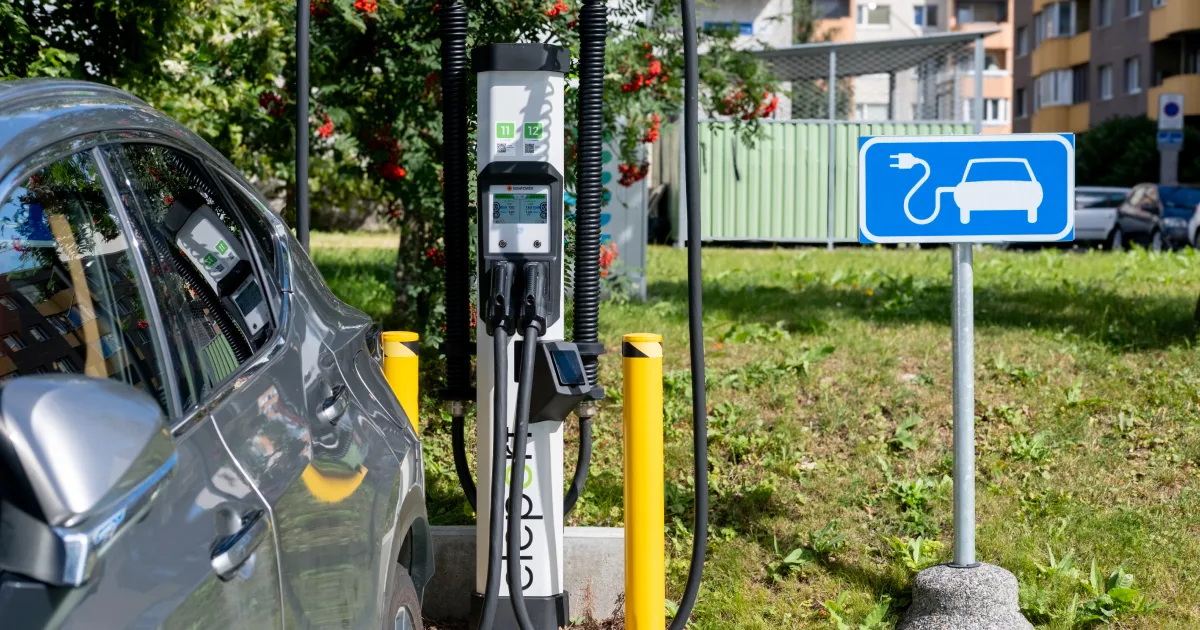
Turns out you keep most of them, but not all. Our extensive analysis just recently found that in late July 2026, the European median fast charge was about 16% below petrol and 13% below diesel. Fast charging ended up being cheaper than petrol, on average, in 23 of our 29 analyzed European countries, and cheaper than diesel in 25 of the countries analyzed.
So essentially, the only thing that can beat fast charging an EV on cost… is home charging an EV.
Maintenance of Electric Cars vs Petrol Cars?
Yes. You’ve already heard it has fewer moving parts, no oil changes (at least not your usual), no cambelt, no exhaust, no clutch. If you’re wondering, are electric cars cheaper to run in other aspects than energy costs, then this is one of the keys.
Regenerative braking does so much of the slowing down that even brake pads and discs last far longer than they do on a combustion car.
The theory is obvious. So are electric cars cheaper to maintain once someone counts real invoices, and… by how much?
The Car Expert and Clear Vehicle Data went through more than 600 vehicles, and found electric cars about 30% cheaper to service over five years, £3857 against £5514 for petrol, diesel and hybrid. Converted in August 2026 exchange rates, that’s roughly 4514€ for EVs against 6453€ in ICE cars.
The tougher test is the 48 like-for-like pairs, where the same model exists in both forms. There, the gap narrows to about 24%.
So the service cost difference lands between 1550€ and 1939€ over five years. It is British data, scheduled servicing only so we can’t really say it will uniformly apply throughout Europe, but it gives us a likely range of the savings nevertheless.
There is one caveat on electric car maintenance costs vs gas equivalents. Electric cars are often heavier than their ICE counterparts, due to the battery. Heavy cars eat tyres, and although the average SUV is already quite heavy no matter the drivetrain, this will still slightly tighten the gap between the costs.
Insurance of Electric Cars vs Petrol Cars
Here the answer flips, and the answer to the ‘are electric cars cheaper to insure’ bit is that… they are likely to be more costly for now.
Germany makes the point most sharply. Verivox ran model calculations in January 2026 and found roughly half of comprehensive tariffs charging more for an electric car than for its combustion twin, the worst cases 44% higher on identical terms.
On a BMW X3, about 49% of tariffs came out more expensive for the electric version. Enyaq against Kodiaq, around 40%.
The strange part is that the claims do not back it up. The German insurers’ own association, the GDV, finds electric cars cause neither more frequent nor more expensive damage, so these premiums are not tracking experience so much as caution.
British figures published in July 2026 put the average electric car insurance premium at £654 (€764) a year against £551 to £607 (€644 to €709) for petrol and diesel, as seen from Brumble’s analysis of Association of British Insurers and Department for Transport data. The trade coverage puts the gap at roughly 10% to 27% once vehicle mix and methodology are allowed for.
It’s about the repair economics, mostly. Specialist labour is scarcer, battery packs are hard to assess after an impact, and a damaged pack can write off a car that an engine in the nose would have survived.
The trend here is also towards the gap narrowing. That gap sat near 30% in 2023, and on smaller models like the Nissan Leaf, MG4 and Dacia Spring the premiums have already reportedly converged with petrol.
So when someone asks are electric cars cheaper to insure, two of Europe’s largest markets both today say: not really.
The penalty is shrinking fast, though, and depends heavily on which car you pick. Insurance markets differ enormously by country, so treat those percentages as a direction rather than a final stat.
Depreciation and Taxes of EVs Can Influence the Outcome
Depreciation is usually the biggest line in the whole calculation. Germany has the clearest numbers:
DAT, the country’s standard valuation authority, put three-year-old cars in June 2026 at 50,9% of list price if electric, against 59,6% for petrol and 58,8% for diesel.
So the electric car shed 49,1%, while the petrol car shed 40,4%. Nearly nine points, and DAT reports that gap widening.
Matched pairs read worse. Carvago’s March 2026 run of ten models found a VW ID.3 down 51,2% against a Golf at 41,3%, and a Škoda Enyaq down 51,7% against a Kodiaq at 33,0%.
There is one strong caveat, however, and it matters. Both sets measure against undiscounted list price, and electric cars carried far heavier new-car discounts, so a slice of that gap is arithmetic and not the market pricing it. Incentives matter in a similar way.
Let’s put it on our example car anyway. A 22% premium takes a 30 000€ petrol car to 36 600€ electric, and at those retention rates the electric one loses about 5851€ more across three years.
Stats from the UK show less of a gap between the drivetrains. Cox Automotive’s UK analysis in November 2025 put three-year electric depreciation at 38% to 42% against 35% to 40% for petrol. A gap of a few points, where the used electric market had been in freefall two years earlier.
Depreciation sits outside the running-cost sum further down, because it is a capital cost and not a running one. Worth remembering which way it leans.
Tax, however, is where the electric vs petrol car comparison stops being a European question and turns into a national one. Company car benefit rates, registration taxes, circulation charges, low-emission zone fees, VAT on charging, all of it differs by country.
We are not going to average that here, but you can find all the incentives of each kind from our recent analysis on EV incentives for each European country in 2026.
What Is The Real EV Total Cost Of Ownership Over Five Years?

Time to add up, because the electric vs petrol car maths will only make sense fully if you look at it all at once. Let’s take an average use: five years, 15 000 km a year, European averages, charging at home. Here’s what our calculations so far would tell you
- Energy costs: 4561€ electric against 10 604€ petrol, a saving of 6043€
- Scheduled servicing: a saving of 1550€ to 1939€, depending on how like-for-like you make the comparison
- Insurance: roughly 275€ to 600€ worse for the electric car, based on the British figures
- Net running-cost advantage: somewhere between 7000€ and 7700€ over five years
Now put that against the purchase premium.
JATO’s 22% was measured in 2024 and has been closing since, but let’s take it at face value and 22% on a 30 000€ petrol car is about 6600€, recovered within five years.
Depreciation claws roughly 5851€ of that back over three years based on the German average, which is why the answer sits closer to a draw than the running costs alone suggest.
That is the EV total cost of ownership story in one paragraph, and part of why fleet buyers went electric first.
Higher mileages, earlier crossover, plus company car tax breaks in several countries. Today, however, 22.2% of all European cars sold are fully electric in 2026, which shows the adoption has grown far beyond fleets.
Are electric cars cheaper than gas cars overall? On European averages over five years, yes, provided you can charge at home and keep the car long enough to work through the purchase premium. If you however buy the EV at the top of the market pricing, just drive 6000 km a year and rely on fast charging alone, the results gets much less comfortable. Even the car itself is more comfortable.
Mileage is what mostly decides it. The electric car running cost advantage accrues per kilometre, so the more you drive, the faster the premium disappears, and a rising oil price speeds the same clock up. The International Energy Agency found in its Global EV Outlook 2026 that annual fuel cost savings for EU electric drivers grew 35% on 2025.
Which settles the version of the question that matters most. Are electric cars cheaper in the long run? At high mileage, with a home charger and a car kept past year five, comfortably.
Hit The Right Conditions And EVs Become a Big Win
The electric car vs petrol car answer is not a slogan in either direction, and anyone offering you a one-word version is selling something for one side or another.
The verdict is that up front you pay more, though far less so than you would have in 2018.
Then you claw it back at roughly 8€ per 100 km on energy and 310€ to 390€ a year on servicing, while handing back up to about 120€ a year on insurance and a few points on depreciation. That is the cost of running an electric car in a nutshell.
Are electric cars cheaper to run than petrol cars? Yes, and by a wide margin on energy, which is the cost you see every week. Home charging costs about 43% of the equivalent petrol usage for the same kilometres driven, and our 29-country survey found the median public fast charge undercutting both fuels across Europe in late July.
If your conditions, vehicle choice and usage patterns hit the right spot, the EV vs ICE cost of ownership question stops being close and makes for a significant win.